Global Egg Allergy Market
Market Size in USD Billion
CAGR :
% 
 USD
2.83 Billion
USD
4.94 Billion
2025
2033
USD
2.83 Billion
USD
4.94 Billion
2025
2033
 Forecast Period Forecast Period |
2026 –2033 |
 Market Size (Base Year) Market Size (Base Year) |
USD 2.83 Billion |
 Market Size (Forecast Year) Market Size (Forecast Year) |
USD 4.94 Billion |
 CAGR CAGR |
% |
| Major Markets Players |
|
Egg Allergy Market Size
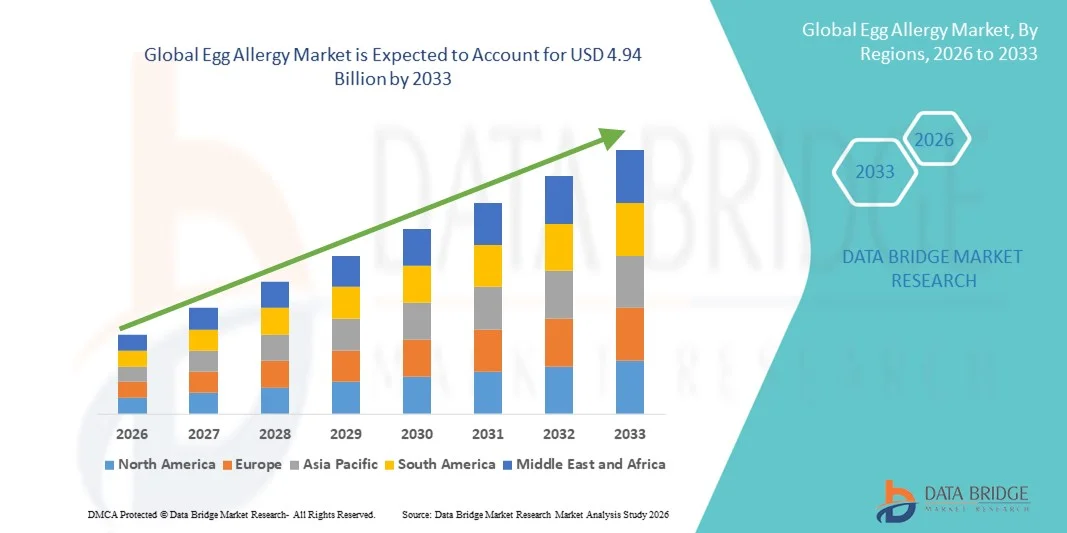
- The global Egg Allergy market size was valued at USD 2.83 billion in 2025 and is expected to reach USD 4.94 billion by 2033, at a CAGR of 7.22% during the forecast period
- The market growth is largely fueled by the increasing prevalence of egg allergies worldwide, combined with rising awareness about food safety and allergen management, leading to higher demand for diagnostic, preventive, and treatment solutions
- Furthermore, growing consumer focus on allergy-friendly diets, along with advancements in immunotherapy and alternative food products, is positioning egg allergy solutions as essential for both healthcare providers and consumers. These converging factors are accelerating the adoption of egg allergy diagnostics and treatments, thereby significantly boosting the industry's growth
Egg Allergy Market Analysis
- Egg allergy diagnostics and treatment solutions, including immunotherapy, oral food challenges, and allergen-free products, are increasingly vital components of modern healthcare and consumer wellness systems in both clinical and home settings due to their enhanced safety, effectiveness, and integration with personalized healthcare approaches
- The escalating demand for egg allergy solutions is primarily fueled by the rising prevalence of egg allergies, growing consumer awareness about food safety, and a preference for convenient, evidence-based management options
- North America dominated the egg allergy market with the largest revenue share of 38.5% in 2025, characterized by advanced healthcare infrastructure, high awareness of food allergies, and a strong presence of leading diagnostics and therapy providers, with the U.S. witnessing substantial growth in egg allergy testing and treatment adoption, particularly among children and allergy-prone populations
- Asia-Pacific is expected to be the fastest-growing region in the egg allergy market during the forecast period due to increasing urbanization, rising disposable incomes, and growing awareness about food allergies, especially in countries like China and India
- The Oral Immunotherapy (OIT) segment dominated the largest market revenue share of 47.8% in 2025, owing to its ability to gradually desensitize patients to egg allergens
Report Scope and Egg Allergy Market Segmentation
|
Attributes |
Egg Allergy Key Market Insights |
|
Segments Covered |
|
|
Countries Covered |
North America
Europe
Asia-Pacific
Middle East and Africa
South America
|
|
Key Market Players |
|
|
Market Opportunities |
|
|
Value Added Data Infosets |
In addition to the insights on market scenarios such as market value, growth rate, segmentation, geographical coverage, and major players, the market reports curated by the Data Bridge Market Research also include in-depth expert analysis, patient epidemiology, pipeline analysis, pricing analysis, and regulatory framework. |
Egg Allergy Market Trends
Enhanced Convenience Through Awareness and Product Innovation
- A significant and accelerating trend in the global Egg Allergy market is the growing focus on awareness, early diagnosis, and product innovation. This is enabling consumers to manage egg allergies more effectively and integrate allergen-safe options into daily life
- For instance, Enjoy Life Foods has expanded its egg-free bakery and snack product lines, allowing children and adults with egg allergies to enjoy safe alternatives without compromising taste or nutrition. Similarly, major retailers are increasingly stocking hypoallergenic products, making them more accessible for households managing egg allergies
- Advances in diagnostic tools, such as component-resolved diagnostics (CRD), allow healthcare providers to identify specific allergenic proteins in patients, facilitating personalized dietary and treatment plans
- The integration of allergen-free products into schools, childcare centers, and foodservice establishments is promoting safer environments for individuals with egg allergies, streamlining daily meal planning and management
- This trend toward more accessible, safe, and innovative products is reshaping consumer expectations, encouraging companies to develop a wider range of egg-free foods, supplements, and therapeutic options
- The demand for convenient and safe egg allergy solutions is growing across both residential and institutional sectors, as consumers increasingly prioritize health, safety, and variety in dietary options
Egg Allergy Market Dynamics
Driver
Growing Need Due to Rising Awareness and Health Consciousness
- The increasing prevalence of egg allergies, particularly among children, coupled with rising health consciousness, is a key driver for the heightened demand for egg-free products and allergy management solutions
- For instance, in 2025, Enjoy Life Foods launched a new line of egg-free cookies, muffins, and cakes, targeting children with egg allergies. This product line strengthened the Food & Beverages segment, while its nutritional supplement offerings for egg-sensitive individuals supported growth in the Nutritional Supplements segment
- As consumers become more informed about egg allergies and their impact, there is a growing preference for hypoallergenic foods, supplements, and therapeutic solutions, making allergen-free products a critical part of daily diets
- Furthermore, the rising focus on preventive healthcare and allergen labeling regulations is increasing awareness among parents, schools, and healthcare providers, stimulating adoption of egg-free options
- The convenience of ready-to-use egg-free products, allergen-safe meal kits, and easy-to-read food labels are key factors driving market growth in both household and institutional setting
Restraint/Challenge
Limited Awareness, High Costs, and Regulatory Barriers
- Despite growing awareness, many populations remain under-informed about proper egg allergy management, leading to misdiagnosis, accidental exposure, and delayed adoption of allergen-safe solutions
- For instance, a 2024 survey by Allergy UK reported that over 30% of parents with egg-allergic children were unaware of available hypoallergenic snack options, highlighting the need for better educational initiatives
- The relatively high cost of hypoallergenic foods, specialized supplements, and therapeutic products compared to conventional alternatives can restrict adoption, especially in developing regions or among price-sensitive consumers
- Regulatory compliance and strict allergen labeling requirements can create challenges for manufacturers, affecting the availability and affordability of products across different markets
- Limited product variety in certain regions, especially in rural or underdeveloped areas, can hinder widespread adoption of egg-free solutions
- Consumer skepticism regarding the taste and effectiveness of egg-free alternatives may also slow growth, as some individuals prefer conventional products or are unaware of safe alternatives
- Addressing these challenges through consumer education, development of more affordable options, expansion of product variety, and government-led awareness campaigns will be essential to sustain long-term market growth
Egg Allergy Market Scope
The market is segmented on the basis of diagnosis, treatment, and end-users.
- By Diagnosis
On the basis of diagnosis, the Egg Allergy market is segmented into Blood Test, Skin-Prick Test, Atopy Patch Test, Oral Food Challenge, and Others. The Blood Test segment dominated the largest market revenue share of 41.5% in 2025, driven by its high accuracy, reliability, and ease of administration. Healthcare providers prefer blood tests to measure specific IgE levels, which allows precise diagnosis and better patient management. Blood tests are widely available across hospitals and diagnostic centers, making them convenient for both pediatric and adult patients. The procedure is minimally invasive and quick, which enhances patient compliance. The growing awareness of egg allergy among parents and caregivers boosts demand for blood tests. Integration with advanced laboratory equipment also improves efficiency. Blood tests are compatible with various allergy panels, allowing simultaneous testing for multiple allergens. The segment benefits from standardized protocols and insurance coverage in many regions. Hospitals and clinics often rely on blood tests as a first-line diagnostic tool. Ongoing research to improve sensitivity and reduce false positives further strengthens market adoption. Overall, blood tests remain the preferred choice due to their credibility and ease of integration into routine clinical practice.
The Oral Food Challenge segment is expected to witness the fastest CAGR of 20.3% from 2026 to 2033, driven by its status as the gold standard for confirming egg allergies. Oral food challenges are increasingly adopted in specialized allergy clinics and research centers. Growing awareness among caregivers about diagnostic accuracy encourages more patients to undergo the procedure. The segment benefits from advances in clinical protocols that minimize risk during testing. Rising prevalence of egg allergy in children supports growth. Enhanced training for allergists and dietitians increases procedural safety. Integration with mobile apps for monitoring reactions enhances patient confidence. Clinical guidelines are promoting oral food challenges for personalized allergy management. Research funding and academic studies are accelerating adoption. The segment provides opportunities for hospitals to offer premium allergy services. Urbanization and improved healthcare infrastructure are expanding access. Increasing insurance reimbursement in some countries makes it more accessible. Overall, oral food challenge adoption is growing due to its unmatched diagnostic reliability.
- By Treatment
On the basis of treatment, the Egg Allergy market is segmented into Oral Immunotherapy, Medication, and Others. The Oral Immunotherapy (OIT) segment dominated the largest market revenue share of 47.8% in 2025, owing to its ability to gradually desensitize patients to egg allergens. Hospitals and specialized clinics are increasingly implementing OIT protocols for better patient outcomes. Oral immunotherapy improves quality of life by reducing severe allergic reactions. Adoption is supported by clinical evidence demonstrating efficacy and safety. OIT can be personalized according to patient tolerance levels. The treatment is convenient for home-based follow-ups with digital monitoring. Growing awareness among caregivers about long-term benefits drives demand. Integration with mobile health apps for progress tracking enhances engagement. Research initiatives are optimizing dosage and duration protocols. The segment benefits from support by pediatricians and allergists. Government programs in some regions support OIT adoption. Insurance coverage is expanding in several markets. Overall, OIT remains the most preferred treatment due to clinical effectiveness and patient convenience.
The Medication segment is expected to witness the fastest CAGR of 19.1% from 2026 to 2033, fueled by the development of novel antihistamines and biologics. Increasing accessibility of pharmacological interventions supports faster adoption. Patients and healthcare providers are seeking adjunct therapies to manage allergic reactions. Medication provides immediate relief during accidental exposure. Growth is supported by ongoing clinical trials and FDA approvals. Rising consumer awareness and self-management trends boost demand. The segment benefits from online pharmacy penetration and telemedicine consultations. Hospitals and clinics are integrating medications with immunotherapy protocols. Rising prevalence of egg allergy in urban populations drives prescription rates. Market players are focusing on combination therapies for enhanced efficacy. Digital tools for dosage monitoring improve adherence. Expanding insurance coverage in some regions enhances affordability. Overall, medication adoption is growing rapidly due to convenience and supplementary treatment value.
- By End-Users
On the basis of end-users, the Egg Allergy market is segmented into Hospitals and Clinics, Diagnostic Centers, Research and Academic Institutes, and Others. The Hospitals and Clinics segment dominated the largest market revenue share of 44.2% in 2025, supported by widespread availability of specialists, advanced diagnostic facilities, and structured treatment protocols. Hospitals provide integrated care combining diagnosis, treatment, and follow-up. Patient trust and accessibility boost preference for hospital-based services. Adoption is driven by routine pediatric and adult care inclusion. Hospitals invest in training staff for allergy management. Multi-disciplinary teams improve treatment outcomes. Availability of specialized OIT programs attracts patients. Insurance coverage and government support enhance utilization. Technological integration with EHR systems streamlines patient management. Urban concentration of hospitals increases market share. Standardized protocols and clinical guidelines reinforce adoption. Continuous research and clinical trials support hospital credibility. Overall, hospitals and clinics remain the dominant end-user segment due to comprehensive service offerings.
The Research and Academic Institutes segment is expected to witness the fastest CAGR of 18.7% from 2026 to 2033, driven by rising investments in allergy research and clinical trials. Focus on immunotherapy and novel diagnostic tool development is increasing. Academic institutions are collaborating with hospitals to conduct studies. Growth is supported by government and private research funding. Advanced laboratories facilitate development of new diagnostic methods. Educational programs increase awareness of egg allergy mechanisms. Research findings are translating into improved clinical practices. Emerging markets are investing in allergy research infrastructure. Academic publications boost global recognition of institutes. Technology integration accelerates study efficiency. Collaboration with pharmaceutical companies enhances treatment innovation. Increasing student and researcher interest fuels growth. Overall, research and academic institutes are growing rapidly due to their role in innovation and knowledge dissemination.
Egg Allergy Market Regional Analysis
- North America dominated the egg allergy market with the largest revenue share of 38.5% in 2025, driven by advanced healthcare infrastructure, high awareness of food allergies, and a strong presence of leading diagnostics and therapy providers
- The market witnessed substantial growth in egg allergy testing and treatment adoption, particularly among children and allergy-prone populations
- Increased research initiatives, government support, and school-based allergy awareness programs are further boosting market growth
U.S. Egg Allergy Market Insight
The U.S. egg allergy market captured the largest revenue share within North America, supported by widespread screening programs and the adoption of innovative allergy treatments. Rising awareness among parents, pediatricians, and schools regarding the risks of egg allergies, along with improved access to diagnostic tests and immunotherapy solutions, is accelerating demand. Moreover, the growing prevalence of early-onset allergies in children is encouraging proactive diagnosis and management.
Europe Egg Allergy Market Insight
The Europe egg allergy market is expected to grow steadily, driven by increased awareness of food allergies, stringent labeling regulations, and improved healthcare access. Countries like Germany, France, and the U.K. are witnessing rising adoption of diagnostic testing and treatment options for both children and adults. Public health campaigns and advancements in oral immunotherapy and allergy-friendly food alternatives are further supporting growth.
U.K. Egg Allergy Market Insight
The U.K. egg allergy market is anticipated to expand at a notable CAGR, fueled by heightened awareness of food allergens, government health initiatives, and the growing demand for allergy diagnostics and therapies. School programs, allergy-safe food labeling, and an increasing number of allergy specialists are driving adoption. Moreover, the U.K.’s well-established healthcare system ensures easier access to allergy testing and management solutions.
Germany Egg Allergy Market Insight
The Germany egg allergy market is projected to grow significantly, supported by increasing awareness about food allergies and a strong emphasis on preventive healthcare. Germany’s healthcare infrastructure, combined with research in immunotherapy and diagnostic advancements, encourages the adoption of egg allergy treatments. Additionally, consumer preference for allergen-free products is contributing to market expansion.
Asia-Pacific Egg Allergy Market Insight
The Asia-Pacific egg allergy market is expected to be the fastest-growing region during the forecast period, driven by urbanization, rising disposable incomes, and growing awareness of food allergies in countries such as China, India, and Japan. Expanding healthcare access, increasing pediatric allergy prevalence, and government initiatives to improve allergy diagnosis and treatment are key growth drivers.
Japan Egg Allergy Market Insight
The Japan egg allergy market is gaining momentum due to high healthcare standards, rapid urbanization, and increasing awareness of pediatric food allergies. Rising demand for diagnostic testing, allergen-free food products, and immunotherapy treatments are supporting growth. The aging population also highlights the need for comprehensive allergy management across all age groups.
China Egg Allergy Market Insight
The China egg allergy market accounted for the largest revenue share in the Asia-Pacific region in 2025. Factors contributing to growth include an expanding middle class, rising awareness of food allergies, increasing healthcare accessibility, and a strong focus on pediatric allergy management. Government initiatives promoting allergy education and research, alongside a growing range of allergy-friendly products, are fueling market expansion.
Egg Allergy Market Share
The Egg Allergy industry is primarily led by well-established companies, including:
- Nestlé Health Science (Switzerland)
- DBV Technologies (France)
- ALK-Abelló (Denmark)
- Thermo Fisher Scientific (U.S.)
- Danone Nutricia Research (France)
- Stallergenes Greer (France)
- Mead Johnson Nutrition (U.S.)
- Arla Foods Ingredients (Denmark)
- Abbott Nutrition (U.S.)
- FARE (Food Allergy Research & Education) (U.S.)
- Nutricia (Netherlands)
- Novartis (Switzerland)
- Sanofi (France)
- Ajinomoto (Japan)
- FrieslandCampina (Netherlands)
- Kerry Group (Ireland)
- Kerry Ingredients (Ireland)
- Mead Johnson & Company (U.S.)
Latest Developments in Global Egg Allergy Market
- In October 2021, Egg Allergy – Pipeline Insight, 2021 was published by ResearchAndMarkets.com, outlining global R&D efforts for egg allergy therapeutics including AR201 by Aimmune Therapeutics, Viaskin Egg by DBV Technologies, and other emerging drug candidates at various clinical and preclinical stages — indicating an expanding research landscape dedicated to treating egg allergy beyond avoidance strategies
- In April 2024, Egg Allergy Drug Pipeline Research 2024 was released, providing comprehensive insight into the egg allergy therapy landscape and reaffirming active development programs — including oral immunotherapy AR201 and the Viaskin Egg epicutaneous immunotherapy candidate, as well as detailing therapeutic assessment, development activities, and clinical progress across key companies focused on egg allergy treatments
- In January 2026, GSK announced a USD 2.2 billion acquisition of RAPT Therapeutics, gaining rights to ozureprubart, a potential long‑acting food allergy immunotherapy in Phase II clinical trials for allergens including egg. The deal highlights the industry’s strategic consolidation to accelerate development of broader‑spectrum food allergy therapeutics that could benefit egg‑allergic patients in the coming decade
SKU-
Get online access to the report on the World's First Market Intelligence Cloud

- Interactive Data Analysis Dashboard
- Company Analysis Dashboard for high growth potential opportunities
- Research Analyst Access for customization & queries
- Competitor Analysis with Interactive dashboard
- Latest News, Updates & Trend analysis
- Harness the Power of Benchmark Analysis for Comprehensive Competitor Tracking
Research Methodology
Data collection and base year analysis are done using data collection modules with large sample sizes. The stage includes obtaining market information or related data through various sources and strategies. It includes examining and planning all the data acquired from the past in advance. It likewise envelops the examination of information inconsistencies seen across different information sources. The market data is analysed and estimated using market statistical and coherent models. Also, market share analysis and key trend analysis are the major success factors in the market report. To know more, please request an analyst call or drop down your inquiry.
The key research methodology used by DBMR research team is data triangulation which involves data mining, analysis of the impact of data variables on the market and primary (industry expert) validation. Data models include Vendor Positioning Grid, Market Time Line Analysis, Market Overview and Guide, Company Positioning Grid, Patent Analysis, Pricing Analysis, Company Market Share Analysis, Standards of Measurement, Global versus Regional and Vendor Share Analysis. To know more about the research methodology, drop in an inquiry to speak to our industry experts.
Customization Available
Data Bridge Market Research is a leader in advanced formative research. We take pride in servicing our existing and new customers with data and analysis that match and suits their goal. The report can be customized to include price trend analysis of target brands understanding the market for additional countries (ask for the list of countries), clinical trial results data, literature review, refurbished market and product base analysis. Market analysis of target competitors can be analyzed from technology-based analysis to market portfolio strategies. We can add as many competitors that you require data about in the format and data style you are looking for. Our team of analysts can also provide you data in crude raw excel files pivot tables (Fact book) or can assist you in creating presentations from the data sets available in the report.