




Global Egg Processing Market
Market Size in USD Billion
CAGR :
% 
 USD
34.63 Billion
USD
47.39 Billion
2025
2033
USD
34.63 Billion
USD
47.39 Billion
2025
2033
 Forecast Period Forecast Period |
2026 - 2033 |
 Market Size (Base Year) Market Size (Base Year) |
USD 34.63 Billion |
 Market Size (Forecast Year) Market Size (Forecast Year) |
USD 47.39 Billion |
 CAGR CAGR |
% |
| Major Markets Players |
|
Egg Processing Market Overview
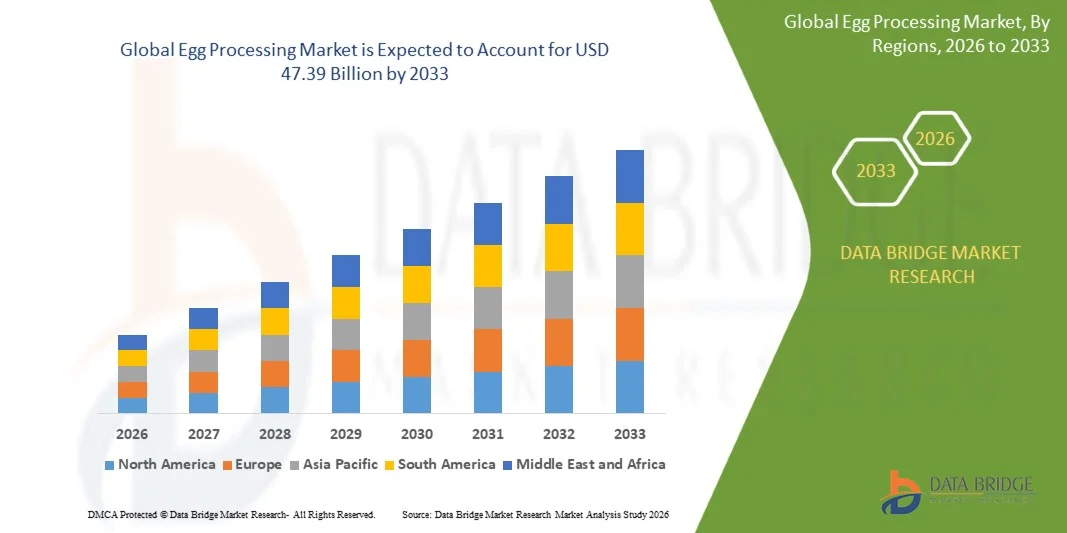
The Egg Processing Market was valued at USD 34.63 billion in 2025 and is projected to reach USD 47.39 billion by 2033, growing at a CAGR of 4.00% from 2026 to 2033. The market is witnessing steady growth driven by increasing demand for convenient and ready-to-use protein sources, rising consumption of processed food products across foodservice and retail sectors, and growing adoption of egg-based ingredients in bakery, confectionery, and packaged food applications.
The expansion of industrial food processing and the shift toward hygienic, long-shelf-life egg products such as liquid eggs, frozen eggs, and dried egg powders are further supporting market growth. In addition, rising awareness regarding food safety standards and the efficiency benefits of processed eggs over shell eggs in large-scale food manufacturing is encouraging wider adoption across commercial food production systems.
Key Market Trends & Insights
- North America dominated the egg processing market with the largest revenue share of 39.6% in 2025, supported by a well-established poultry industry, strong presence of large-scale food manufacturers, and high adoption of processed egg products in bakery, confectionery, and institutional foodservice applications.
- Asia-Pacific is expected to be the fastest-growing region, recording a CAGR of 5.2% from 2026 to 2033. Growth is driven by rapid urbanization, rising disposable incomes, expansion of the processed food industry, and increasing demand for bakery and convenience food products in countries such as China, India, and Japan.
- The Liquid Egg Products segment held the largest market revenue share of approximately 46.2% in 2025 driven by strong demand from industrial bakeries, foodservice chains, and processed food manufacturers due to its convenience, uniform consistency, and reduced handling risk compared to shell eggs. Liquid eggs are widely used in large-scale food production systems across North America and Europe, particularly in bakery and ready-meal manufacturing where food safety compliance and operational efficiency are critical.
- The Dried Egg Products segment is projected to register the fastest growth at a CAGR of 7.9% from 2026 to 2033, driven by increasing demand for long shelf-life ingredients, military rations, and food applications in regions with limited cold chain infrastructure. Spray-dried egg powders are increasingly adopted in confectionery and bakery formulations due to ease of storage, reduced transportation cost, and stability under varying environmental conditions.
- The Bakery segment held the largest market revenue share of approximately 38.7% in 2025 driven by extensive usage of eggs as emulsifiers, binders, and texture enhancers in cakes, pastries, bread, and biscuits. Rising consumption of packaged bakery products and expansion of industrial baking operations across Asia-Pacific and Europe are further supporting segment dominance.
- The Ready-To-Eat Meals segment is projected to register the fastest growth at a CAGR of 8.6% from 2026 to 2033, driven by increasing urbanization, changing dietary habits, and rising demand for convenience food products. Egg-based ingredients are widely used in meal kits, instant noodles, and processed convenience foods due to their high protein content and functional properties.
- The Food and Beverage Manufacturers segment held the largest market revenue share of approximately 41.5% in 2025 driven by high-volume utilization of processed egg ingredients in bakery, confectionery, and packaged food production. Large-scale food manufacturers rely on liquid and powdered egg products for standardized quality, improved shelf life, and reduced contamination risk.
- The Food Service Industry segment is projected to register the fastest growth at a CAGR of 8.3% from 2026 to 2033, driven by expansion of quick-service restaurants, hotels, airlines, and institutional catering services globally. Increasing adoption of pre-processed egg products in commercial kitchens is improving operational efficiency and food safety compliance.
Market Size & Forecast
- Global Market Value (2025): USD 34.63 Billion
- Expected Market Value (2033): USD 47.39 Billion
- Forecast CAGR (2026–2033): 4.00%
- Leading Region in 2025: North America
- Fastest Growing Region: Asia-Pacific
Report Scope and Egg Processing Market Segmentation
|
Attributes |
Egg Processing Key Market Insights |
|
Segments Covered |
· By Product Type: Dried Egg Products, Liquid Egg Products, and Frozen Egg Products · By Application: Bakery, Confectionary, Dairy Products, Ready- To- Eat Meals, Soups and Sauces, and Other · By End Users: Farmers, Raw Material Suppliers, Manufacturers and Suppliers of Egg Products, Traders, Distributors, and Retailers, Food and Beverage Manufacturers, and Food Service Industry |
|
Countries Covered |
North America · U.S. · Canada · Mexico Europe · Germany · France · U.K. · Netherlands · Switzerland · Belgium · Russia · Italy · Spain · Turkey · Rest of Europe Asia-Pacific · China · Japan · India · South Korea · Singapore · Malaysia · Australia · Thailand · Indonesia · Philippines · Rest of Asia-Pacific Middle East and Africa · Saudi Arabia · U.A.E. · South Africa · Egypt · Israel · Rest of Middle East and Africa South America · Brazil · Argentina · Rest of South America |
|
Key Market Players |
• ACTINI GROUP (France) |
|
Market Opportunities |
· Expansion Of Functional Food Applications · Rising Demand From Bakery And Confectionery Industry |
|
Value Added Data Infosets |
In addition to the insights on market scenarios such as market value, growth rate, segmentation, geographical coverage, and major players, the market reports curated by the Data Bridge Market Research also include in-depth expert analysis, pricing analysis, brand share analysis, consumer survey, demography analysis, supply chain analysis, value chain analysis, raw material/consumables overview, vendor selection criteria, PESTLE Analysis, Porter Analysis, and regulatory framework. |
Egg Processing Market Trends
Trend: Growth In Liquid Egg Processing, Spray-Dried Egg Products And Advanced Food Safety Technologies
Rising demand for convenient, shelf-stable, and protein-rich food ingredients is accelerating the adoption of processed egg products across foodservice, bakery, confectionery, and ready-to-eat meal industries. Traditional shell egg handling faces limitations such as perishability, contamination risk, and storage inefficiency, encouraging large-scale food processors to shift toward pasteurized liquid eggs, frozen egg products, and spray-dried egg powders with longer shelf life and consistent quality.
In the food manufacturing sector, egg processing is increasingly integrated into large-scale bakery and processed food production systems. For instance, pasteurized liquid eggs are widely used in industrial bakeries and hotel chains across North America and Europe to ensure food safety compliance and reduce Salmonella-related risks, with regulatory agencies such as the U.S. Food and Drug Administration mandating pasteurization standards for specific egg products used in foodservice applications. Spray-dried egg powder is also gaining traction in packaged food production due to its low moisture content and ease of transport, particularly in regions with limited cold chain infrastructure.
The expansion of global egg production is further supporting processing demand. According to FAO-based estimates, global egg production exceeds 85 million tonnes annually, driven by high consumption in Asia-Pacific, particularly China and India, which together account for a significant share of global output. This large raw material base is enabling continuous investment in industrial-scale egg breaking, separation, and processing facilities. In addition, rising demand for high-protein diets in sports nutrition and health-focused food products is increasing utilization of egg protein isolates in supplements and functional foods.
Egg Processing Market Dynamics
Key Market Driver: Rising Demand For Processed Protein Ingredients And Food Safety Compliance
Growing global consumption of protein-rich diets, combined with increasing concerns regarding foodborne illnesses, is significantly driving the adoption of processed egg products. Egg processing enables removal of microbiological risks through pasteurization while providing standardized yolk, albumen, and whole egg formulations for industrial use.
Food manufacturers across bakery, confectionery, and ready-meal sectors are increasingly relying on liquid egg products to improve production efficiency and reduce labor-intensive shell egg handling. For instance, large-scale bakery chains and QSR (quick service restaurant) operators in Europe and the U.S. are shifting toward bulk liquid egg supply to ensure consistent quality and reduce contamination risks in high-volume food preparation environments.
In addition, expanding global foodservice networks and institutional catering services such as airlines, hospitals, and hotels are increasing demand for frozen and refrigerated egg products due to their longer shelf life and ease of storage. Industry data from Europe indicates that pasteurized egg product adoption in industrial food applications has been steadily increasing, particularly in Germany, France, and the Netherlands, where food safety regulations are stringent.
Key Restraint/Challenge: Cold Chain Dependency And Price Volatility Of Raw Eggs
Despite strong demand growth, the egg processing industry faces significant challenges related to cold chain logistics, raw material price volatility, and disease outbreaks in poultry populations. Processed egg products such as liquid and frozen eggs require continuous refrigeration throughout storage and transportation, increasing operational costs and limiting penetration in developing regions with weak cold chain infrastructure.
In addition, fluctuations in shell egg prices due to avian influenza outbreaks and feed cost variations directly impact production economics. For instance, the U.S. experienced sharp egg price volatility during 2022–2023 due to highly pathogenic avian influenza, which reduced laying hen populations and significantly increased input costs for processors. Similar disruptions have been observed in parts of Europe, affecting supply consistency for industrial egg processors.
Furthermore, the capital-intensive nature of egg breaking, pasteurization, and drying equipment limits entry for small and mid-sized players, restricting market scalability in cost-sensitive regions where return on investment remains a critical factor.
Key Market Opportunity: Expansion Of Functional Foods, Nutraceuticals And Industrial Bakery Applications
Increasing demand for functional food ingredients and high-protein nutrition is creating strong opportunities for egg-derived components such as egg white protein, yolk-based emulsifiers, and dried egg powders. These ingredients are widely used in sports nutrition, protein supplements, and meal replacement products due to their high biological value and amino acid profile.
Food manufacturers are increasingly incorporating egg proteins into clean-label formulations, replacing synthetic emulsifiers and stabilizers in bakery and confectionery products. For instance, global bakery manufacturers are adopting egg-based ingredients to improve texture, moisture retention, and shelf stability in packaged cakes, pastries, and desserts.
In addition, advancements in spray-drying and membrane filtration technologies are improving the efficiency and quality of egg powder production, enabling broader applications in military rations, space food systems, and disaster relief nutrition kits. In Asia-Pacific, rising demand for processed convenience foods in countries such as China, Japan, and India is accelerating investments in automated egg breaking and processing facilities, strengthening the long-term growth outlook of the market.
Egg Processing Market Scope
The market is segmented on the basis of product type, application, and end users.
- By Product Type
On the basis of product type, the egg processing market is segmented into Dried Egg Products, Liquid Egg Products, and Frozen Egg Products. The Liquid Egg Products segment held the largest market revenue share of approximately 46.2% in 2025 driven by strong demand from industrial bakeries, foodservice chains, and processed food manufacturers due to its convenience, uniform consistency, and reduced handling risk compared to shell eggs. Liquid eggs are widely used in large-scale food production systems across North America and Europe, particularly in bakery and ready-meal manufacturing where food safety compliance and operational efficiency are critical.
The Dried Egg Products segment is projected to register the fastest growth at a CAGR of 7.9% from 2026 to 2033, driven by increasing demand for long shelf-life ingredients, military rations, and food applications in regions with limited cold chain infrastructure. Spray-dried egg powders are increasingly adopted in confectionery and bakery formulations due to ease of storage, reduced transportation cost, and stability under varying environmental conditions.
- By Application
On the basis of application, the egg processing market is segmented into Bakery, Confectionary, Dairy Products, Ready-To-Eat Meals, Soups and Sauces, and Other applications. The Bakery segment held the largest market revenue share of approximately 38.7% in 2025 driven by extensive usage of eggs as emulsifiers, binders, and texture enhancers in cakes, pastries, bread, and biscuits. Rising consumption of packaged bakery products and expansion of industrial baking operations across Asia-Pacific and Europe are further supporting segment dominance.
The Ready-To-Eat Meals segment is projected to register the fastest growth at a CAGR of 8.6% from 2026 to 2033, driven by increasing urbanization, changing dietary habits, and rising demand for convenience food products. Egg-based ingredients are widely used in meal kits, instant noodles, and processed convenience foods due to their high protein content and functional properties.
- By End Users
On the basis of end users, the egg processing market is segmented into Farmers, Raw Material Suppliers, Manufacturers and Suppliers of Egg Products, Traders, Distributors, and Retailers, Food and Beverage Manufacturers, and Food Service Industry. The Food and Beverage Manufacturers segment held the largest market revenue share of approximately 41.5% in 2025 driven by high-volume utilization of processed egg ingredients in bakery, confectionery, and packaged food production. Large-scale food manufacturers rely on liquid and powdered egg products for standardized quality, improved shelf life, and reduced contamination risk.
The Food Service Industry segment is projected to register the fastest growth at a CAGR of 8.3% from 2026 to 2033, driven by expansion of quick-service restaurants, hotels, airlines, and institutional catering services globally. Increasing adoption of pre-processed egg products in commercial kitchens is improving operational efficiency and food safety compliance.
Egg Processing Market Regional Analysis
North America Egg Processing Market Insight
North America dominated the egg processing market with the largest revenue share of 39.6% in 2025, supported by strong demand from industrial food manufacturing, bakery chains, and foodservice providers. The region benefits from a highly organized poultry industry, advanced processing infrastructure, and strict food safety regulations that encourage the use of pasteurized and standardized egg products. Increasing consumption of packaged bakery goods, ready-to-eat meals, and protein-rich food products is further driving demand for liquid, frozen, and dried egg ingredients.
U.S. Egg Processing Market Insight
The U.S. egg processing market captured the largest revenue share in 2025 within North America, driven by large-scale industrial food production and high penetration of processed food consumption. The country has a well-established egg processing industry supported by major producers and food ingredient suppliers, with widespread use of liquid eggs in bakery, confectionery, and institutional catering applications. The growing preference for high-protein diets and convenience foods is further strengthening demand, while regulatory standards from agencies such as the USDA and FDA ensure consistent adoption of pasteurized egg products in food manufacturing.
Europe Egg Processing Market Insight
The Europe egg processing market is expected to witness the fastest growth rate from 2026 to 2033, primarily driven by stringent food safety regulations, rising demand for processed convenience foods, and increasing adoption of clean-label ingredients. The region’s strong bakery and confectionery industry is a key driver for liquid and dried egg products. In addition, growing awareness of protein-rich diets and sustainable food production practices is supporting the shift from shell eggs to processed alternatives. Expanding foodservice networks across urban centers is further accelerating market growth across residential and commercial applications.
U.K. Egg Processing Market Insight
The U.K. egg processing market is expected to witness the fastest growth rate from 2026 to 2033, driven by rising demand for ready-to-eat meals, bakery products, and processed convenience foods. Increasing focus on food safety and hygiene standards is encouraging food manufacturers and foodservice providers to adopt pasteurized liquid egg products. In addition, the growth of quick-service restaurants and institutional catering services is further supporting market expansion, along with strong retail penetration of packaged egg-based products.
Germany Egg Processing Market Insight
The Germany egg processing market is expected to witness the fastest growth rate from 2026 to 2033, supported by strong demand from industrial bakery producers, confectionery manufacturers, and packaged food companies. Germany’s advanced food processing industry and strict quality regulations are driving adoption of standardized egg ingredients. Increasing preference for high-protein and functional food products is also contributing to growth, while sustainability-focused food manufacturing practices are encouraging efficient utilization of egg-derived ingredients across multiple applications.
Asia-Pacific Egg Processing Market Insight
The Asia-Pacific egg processing market is expected to witness the fastest growth rate from 2026 to 2033, driven by rapid urbanization, rising disposable incomes, and increasing consumption of processed and convenience foods in countries such as China, India, and Japan. The region is experiencing strong expansion of bakery, fast food, and packaged food industries, which is significantly increasing demand for liquid and dried egg products. In addition, growing investments in food processing infrastructure and cold chain logistics are improving accessibility and adoption of processed egg ingredients across emerging economies.
Japan Egg Processing Market Insight
The Japan egg processing market is expected to witness the fastest growth rate from 2026 to 2033, supported by high demand for convenience foods, strong bakery culture, and advanced food processing technologies. The country’s aging population and preference for easy-to-use food ingredients are further driving adoption of liquid and frozen egg products. Integration of egg ingredients in premium bakery, confectionery, and ready-meal applications is also increasing, supported by strict food safety standards and high-quality manufacturing practices.
China Egg Processing Market Insight
The China egg processing market accounted for the largest market revenue share in Asia-Pacific in 2025, attributed to massive egg production capacity, rapid urbanization, and strong growth in processed food consumption. China has a well-developed poultry farming base and expanding industrial food processing sector, which supports large-scale adoption of liquid, frozen, and dried egg products. Increasing demand for bakery products, instant foods, and protein-rich diets is further accelerating market expansion, along with strong domestic manufacturing capabilities and government support for food industrialization.
Egg Processing Market Share
The Egg Processing industry is primarily led by well-established companies, including:
• ACTINI GROUP (France)
• Groupe Avril (France)
• Cal-Maine Foods, Inc. (U.S.)
• MOBA MOBILE AUTOMATION AG (Netherlands)
• EPS S.P.A. (Italy)
• IGRECA (France)
• Interovo Egg Group BV (Netherlands)
• PELBO SPA (Italy)
• BouwhuisEnthoven (Netherlands)
• SANOVO TECHNOLOGY GROUP (Denmark)
• Paul Mueller (U.S.)
• Lowrie Foods (U.S.)
• SKM Egg (U.K.)
• Newburg Egg Corporation (U.S.)
• Rembrandt Foods (U.S.)
• IsoNova (U.S.)
• Ballas Egg (U.S.)
Latest Developments in Egg Processing Market
- In January 2024, Kewpie Egg Corporation expanded its operations by establishing its first subsidiary in Australia, aiming to strengthen distribution of condiments such as mayonnaise and dressings. The expansion is expected to enhance supply chain efficiency and improve regional market penetration. This move is likely to support growing demand for egg-based processed food products and strengthen the company’s global footprint in the egg processing value chain.
- In January 2024, Cal-Maine, Inc. initiated an acquisition strategy involving a broiler processing plant, hatchery, and feed mill, with plans to repurpose these facilities for egg production and processing operations. The company will initially convert the broiler processing plant into an egg grading facility to improve processing capacity. This development is expected to expand production efficiency and reinforce Cal-Maine’s leadership position in the egg processing industry.
- In November 2023, Rose Acre Farms announced a strategic collaboration with Tideland Electric Membership Corp. to develop an advanced microgrid system at its Hyde County facility. The project integrates solar energy generation and battery storage to ensure uninterrupted power supply for processing operations. This initiative is expected to enhance operational reliability, reduce energy dependency, and strengthen the company’s sustainability profile in the egg processing market.
SKU-
Get online access to the report on the World's First Market Intelligence Cloud

- Interactive Data Analysis Dashboard
- Company Analysis Dashboard for high growth potential opportunities
- Research Analyst Access for customization & queries
- Competitor Analysis with Interactive dashboard
- Latest News, Updates & Trend analysis
- Harness the Power of Benchmark Analysis for Comprehensive Competitor Tracking
Global Egg Processing Market, Supply Chain Analysis and Ecosystem Framework
To support market growth and help clients navigate the impact of geopolitical shifts, DBMR has integrated in-depth supply chain analysis into its Global Egg Processing Market research reports. This addition empowers clients to respond effectively to global changes affecting their industries. The supply chain analysis section includes detailed insights such as Global Egg Processing Market consumption and production by country, price trend analysis, the impact of tariffs and geopolitical developments, and import and export trends by country and HSN code. It also highlights major suppliers with data on production capacity and company profiles, as well as key importers and exporters. In addition to research, DBMR offers specialized supply chain consulting services backed by over a decade of experience, providing solutions like supplier discovery, supplier risk assessment, price trend analysis, impact evaluation of inflation and trade route changes, and comprehensive market trend analysis.
Research Methodology
Data collection and base year analysis are done using data collection modules with large sample sizes. The stage includes obtaining market information or related data through various sources and strategies. It includes examining and planning all the data acquired from the past in advance. It likewise envelops the examination of information inconsistencies seen across different information sources. The market data is analysed and estimated using market statistical and coherent models. Also, market share analysis and key trend analysis are the major success factors in the market report. To know more, please request an analyst call or drop down your inquiry.
The key research methodology used by DBMR research team is data triangulation which involves data mining, analysis of the impact of data variables on the market and primary (industry expert) validation. Data models include Vendor Positioning Grid, Market Time Line Analysis, Market Overview and Guide, Company Positioning Grid, Patent Analysis, Pricing Analysis, Company Market Share Analysis, Standards of Measurement, Global versus Regional and Vendor Share Analysis. To know more about the research methodology, drop in an inquiry to speak to our industry experts.
Customization Available
Data Bridge Market Research is a leader in advanced formative research. We take pride in servicing our existing and new customers with data and analysis that match and suits their goal. The report can be customized to include price trend analysis of target brands understanding the market for additional countries (ask for the list of countries), clinical trial results data, literature review, refurbished market and product base analysis. Market analysis of target competitors can be analyzed from technology-based analysis to market portfolio strategies. We can add as many competitors that you require data about in the format and data style you are looking for. Our team of analysts can also provide you data in crude raw excel files pivot tables (Fact book) or can assist you in creating presentations from the data sets available in the report.












