


Global Electric Cargo Bikes Market
Market Size in USD Billion
CAGR :
% 
 USD
2.48 Billion
USD
5.51 Billion
2025
2033
USD
2.48 Billion
USD
5.51 Billion
2025
2033
 Forecast Period Forecast Period |
2026 –2033 |
 Market Size (Base Year) Market Size (Base Year) |
USD 2.48 Billion |
 Market Size (Forecast Year) Market Size (Forecast Year) |
USD 5.51 Billion |
 CAGR CAGR |
% |
| Major Markets Players |
|
Electric Cargo Bike Market Size
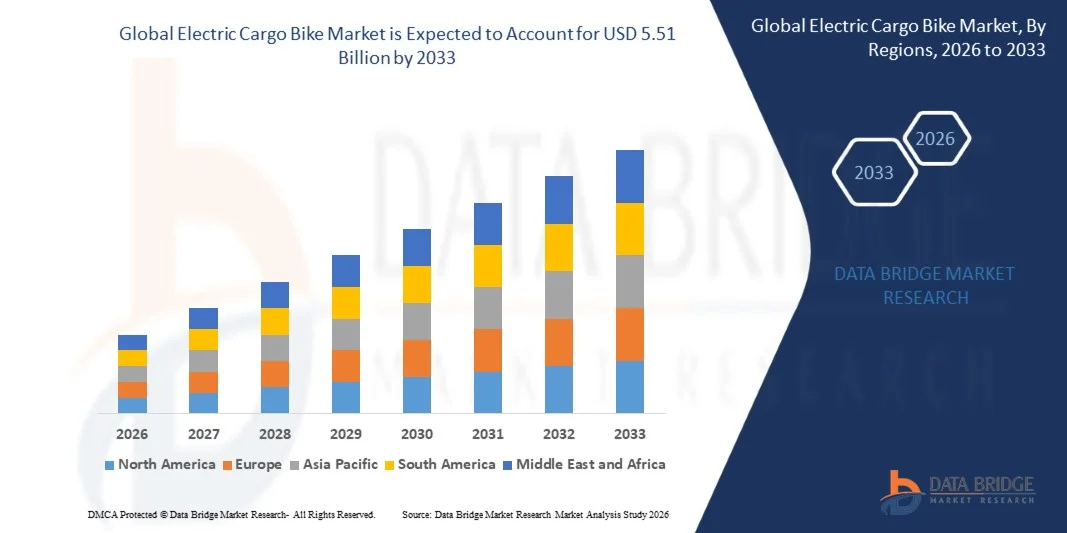
- The global electric cargo bike market size was valued at USD 2.48 billion in 2025 and is expected to reach USD 5.51 billion by 2033, at a CAGR of 10.5% during the forecast period
- The market growth is largely fueled by the increasing demand for eco-friendly and efficient last-mile delivery solutions, combined with advancements in battery technology, lightweight frames, and high-capacity electric cargo bike designs, which enhance operational efficiency in urban logistics
- Furthermore, government initiatives promoting low-emission transport, rising environmental awareness among consumers, and urban congestion challenges are establishing electric cargo bikes as a preferred alternative to conventional delivery vehicles. These converging factors are accelerating adoption across commercial and residential sectors, thereby significantly boosting the industry's growth
Electric Cargo Bike Market Analysis
- Electric cargo bikes, offering battery-powered assistance for transporting goods or passengers, are increasingly vital in urban mobility and last-mile delivery services due to their sustainability, maneuverability in congested areas, and cost efficiency compared with traditional vans or trucks
- The escalating demand for electric cargo bikes is primarily fueled by growing e-commerce logistics, rising environmental consciousness, and the need for faster, low-emission transportation solutions in both commercial and residential applications
- Europe dominated the electric cargo bike market with a share of 46.5% in 2025, due to increasing adoption of eco-friendly transportation, supportive government policies, and a growing trend toward urban logistics solutions
- Asia-Pacific is expected to be the fastest growing region in the electric cargo bike market during the forecast period due to rapid urbanization, increasing disposable incomes, and rising environmental awareness in countries such as China, Japan, and India
- Lithium ion segment dominated the market with a market share of 52.5% in 2025, due to its high energy density, long lifecycle, and lighter weight compared with traditional battery types. Lithium-ion batteries enable longer travel distances per charge, making them ideal for commercial and urban delivery applications. Their efficiency and faster charging capabilities also reduce downtime for fleet operators, improving overall operational productivity
Report Scope and Electric Cargo Bike Market Segmentation
|
Attributes |
Electric Cargo Bike Key Market Insights |
|
Segments Covered |
|
|
Countries Covered |
North America
Europe
Asia-Pacific
Middle East and Africa
South America
|
|
Key Market Players |
|
|
Market Opportunities |
|
|
Value Added Data Infosets |
In addition to the market insights such as market value, growth rate, market segments, geographical coverage, market players, and market scenario, the market report curated by the Data Bridge Market Research team includes in-depth expert analysis, import/export analysis, pricing analysis, production consumption analysis, and pestle analysis. |
Electric Cargo Bike Market Trends
“Growing Adoption of Last-Mile Delivery Solutions”
- A significant trend in the electric cargo bike market is the rising adoption of these vehicles for last-mile delivery services, driven by increasing e-commerce volumes, urban congestion, and the push for low-emission transport. Businesses are leveraging electric cargo bikes to improve delivery speed, reduce operational costs, and access areas unsuitable for larger vehicles
- For instance, UPS has implemented electric cargo bikes in European cities such as London and Hamburg to enhance last-mile parcel delivery, reduce traffic impact, and cut carbon emissions. These deployments demonstrate the efficiency and environmental benefits that electric cargo bikes offer for urban logistics operations
- Retail and grocery chains are increasingly integrating electric cargo bikes into their distribution networks to provide timely deliveries in dense urban areas. These bikes enable safer navigation through narrow streets and faster fulfillment of short-distance deliveries, positioning them as practical alternatives to conventional delivery vans
- Municipal and government programs promoting shared cargo bikes for commercial use are gaining momentum. Fleet-based adoption encourages urban mobility solutions that align with sustainability goals, fostering broader acceptance of electric cargo bikes in city logistics
- Consumer awareness of eco-friendly transportation is contributing to the trend as businesses emphasize green credentials. The ability to lower carbon footprints while maintaining operational efficiency makes electric cargo bikes an attractive option for companies seeking sustainability targets
- The market is witnessing the development of specialized models designed for diverse payload capacities, modular attachments, and weather-resistant performance. This evolution supports increased deployment across industries including retail, logistics, and food delivery
Electric Cargo Bike Market Dynamics
Driver
“Government Initiatives Promoting Low-Emission Transport”
- Government support for low-emission transportation and sustainable urban mobility is driving the growth of the electric cargo bike market. Incentives such as subsidies, tax benefits, and grants encourage businesses and individuals to adopt zero-emission vehicles and reduce urban pollution
- For instance, the European Union’s Clean Vehicles Directive provides funding and policy support to promote electric and low-emission cargo bikes for municipal and commercial use. Programs under this directive stimulate market adoption while encouraging manufacturers to innovate in battery efficiency and vehicle design
- Cities across Europe and North America are implementing urban mobility policies that favor electric cargo bikes over traditional vans for short-distance deliveries. These regulations support congestion reduction, air quality improvement, and the use of environmentally friendly logistics solutions
- Public-private partnerships are emerging to facilitate electric cargo bike sharing and fleet operations in urban centers. By collaborating with manufacturers, municipalities accelerate deployment and provide infrastructure such as charging stations and dedicated bike lanes
- The rising focus on sustainable last-mile logistics by corporations is complemented by government programs. Incentives reduce financial barriers for companies integrating electric cargo bikes, reinforcing adoption trends and market expansion
Restraint/Challenge
“High Initial Investment and Battery Costs”
- High upfront costs and expensive battery technology remain major challenges for the electric cargo bike market. The purchase price of advanced cargo bikes, combined with battery replacements, creates financial barriers for smaller operators and new entrants
- For instance, companies such as Riese & Müller produce high-performance cargo e-bikes with lithium-ion batteries, which involve significant investment. While offering durability and extended range, the cost limits widespread adoption among budget-conscious businesses and individual users
- Maintenance and replacement of batteries add ongoing operational expenses, affecting total cost of ownership and deterring potential adopters. Battery degradation over time also impacts reliability and long-term efficiency of electric cargo fleets
- Limited availability of standardized charging infrastructure in certain regions creates additional hurdles for deployment and operational planning. Businesses may face increased logistical complexity and higher investment requirements for fleet management
- Market growth is also influenced by competition from conventional delivery vehicles that offer lower initial costs. This pricing gap poses a challenge for electric cargo bike manufacturers and fleet operators seeking to scale operations while remaining cost-competitive
Electric Cargo Bike Market Scope
The market is segmented on the basis of product type, battery type, and end use.
• By Product Type
On the basis of product type, the electric cargo bike market is segmented into two-wheeled, three-wheeled, and four-wheeled. The two-wheeled segment dominated the market with the largest revenue share in 2025, driven by its lightweight design, maneuverability, and ease of navigation in congested urban areas. Businesses and individual users favor two-wheeled cargo bikes for last-mile delivery due to their ability to access narrow streets and reduce transit times. The segment also benefits from lower maintenance costs and compatibility with various cargo attachments, enhancing operational efficiency. In addition, two-wheeled models are increasingly integrated with smart tracking systems and GPS-enabled fleet management solutions, further boosting adoption.
The three-wheeled segment is anticipated to witness the fastest growth rate from 2026 to 2033, fueled by increasing adoption among commercial delivery providers seeking stability and higher payload capacity. For instance, companies such as Rad Power Bikes have introduced three-wheeled electric cargo bikes with modular cargo options, offering flexible solutions for last-mile logistics. The enhanced stability makes them suitable for carrying heavier loads safely, while their ergonomic design improves rider comfort during extended delivery routes. Rising demand from small businesses and e-commerce providers is expected to drive sustained growth in this segment.
• By Battery Type
On the basis of battery type, the electric cargo bike market is segmented into lead-based, nickel-based, and lithium-ion. The lithium-ion segment dominated the market with the largest revenue share of 52.5% in 2025, owing to its high energy density, long lifecycle, and lighter weight compared with traditional battery types. Lithium-ion batteries enable longer travel distances per charge, making them ideal for commercial and urban delivery applications. Their efficiency and faster charging capabilities also reduce downtime for fleet operators, improving overall operational productivity. Many manufacturers are offering lithium-ion-equipped models with smart battery management systems, enhancing safety and performance.
The lithium-ion segment is expected to continue witnessing the fastest growth from 2026 to 2033 due to rising demand for sustainable and high-performance cargo bikes. For instance, Bosch and Shimano are actively supplying lithium-ion battery systems optimized for electric cargo bike applications, boosting adoption across urban logistics networks. The trend is further supported by declining costs of lithium-ion technology and government incentives for electric mobility solutions, making them a preferred choice for new fleet deployments.
• By End Use
On the basis of end use, the electric cargo bike market is segmented into courier & parcel service providers, large retail suppliers, personal transportation, service delivery, waste management, and municipal services. The courier & parcel service provider segment dominated the market with the largest revenue share in 2025, driven by the rapid growth of e-commerce and the need for efficient last-mile delivery solutions. Electric cargo bikes help companies reduce delivery times, lower operational costs, and decrease carbon emissions in urban areas. Many service providers are integrating these bikes into their fleets for flexible, eco-friendly, and reliable delivery operations. The segment is also benefiting from partnerships with local governments promoting sustainable urban transport and green logistics initiatives.
The large retail supplier segment is expected to witness the fastest growth from 2026 to 2033, fueled by the expansion of omni-channel retail and the increasing need for in-city distribution solutions. For instance, DHL and UPS have started adopting electric cargo bikes to deliver goods directly to urban stores and customers, enhancing operational efficiency. These bikes allow retailers to optimize last-mile routes, handle bulky orders, and maintain timely delivery schedules while minimizing traffic congestion and emissions. Rising consumer demand for faster, greener delivery services continues to drive growth in this segment.
Electric Cargo Bike Market Regional Analysis
- Europe dominated the electric cargo bike market with the largest revenue share of 46.5% in 2025, driven by increasing adoption of eco-friendly transportation, supportive government policies, and a growing trend toward urban logistics solutions
- Consumers in the region highly value the efficiency, sustainability, and flexibility offered by electric cargo bikes for last-mile deliveries, municipal services, and personal transport
- This widespread adoption is further supported by urban congestion challenges, rising fuel costs, and strong awareness of environmental impacts, establishing electric cargo bikes as a preferred solution for both commercial and residential users
Germany Electric Cargo Bike Market Insight
The Germany electric cargo bike market captured the largest revenue share in Europe in 2025, fueled by the country’s well-established cycling infrastructure and proactive urban mobility initiatives. For instance, companies such as Riese & Müller are driving demand by offering advanced, high-capacity cargo bikes tailored for both logistics and private use. The German population increasingly favors low-emission transport alternatives, and municipal governments are incentivizing electric cargo bike adoption for delivery services. Integration with smart mobility platforms and the availability of reliable charging infrastructure further propel market growth. Moreover, Germany’s emphasis on sustainability and eco-conscious consumer behavior continues to support the market expansion.
U.K. Electric Cargo Bike Market Insight
The U.K. electric cargo bike market is projected to grow at a substantial CAGR during the forecast period, driven by government incentives promoting zero-emission transport and rising urban last-mile delivery needs. For instance, companies such as Yuba Electric are expanding operations in major cities to cater to e-commerce and courier services. Increasing environmental awareness among consumers and businesses is fostering the adoption of electric cargo bikes. The rise of urban congestion and restrictions on conventional delivery vans further enhances demand. Strong e-commerce growth and investments in cycling infrastructure are expected to sustain market expansion in the U.K.
France Electric Cargo Bike Market Insight
The France electric cargo bike market is expected to expand at a considerable CAGR throughout the forecast period, fueled by government subsidies for low-emission vehicles and increasing adoption of sustainable logistics solutions. For instance, La Poste is utilizing electric cargo bikes for mail and parcel deliveries in urban centers. French consumers and businesses are seeking alternatives to conventional vehicles to reduce emissions and operating costs. Urbanization trends and rising interest in micro-mobility solutions support the integration of electric cargo bikes in both commercial and personal transportation sectors. The focus on eco-friendly solutions across residential and business applications is driving consistent growth in the market.
North America Electric Cargo Bike Market Insight
The North America electric cargo bike market is poised for moderate growth, driven by the rise in urban delivery services and increasing investments in sustainable transport. For instance, Rad Power Bikes in the U.S. is expanding its cargo bike portfolio to serve businesses and private users seeking eco-friendly solutions. Consumers value the convenience and cost savings associated with electric cargo bikes, especially for last-mile logistics. Increasing government focus on reducing emissions in urban areas supports market adoption. The growth of e-commerce and demand for reliable delivery solutions further fuels the North American market.
U.S. Electric Cargo Bike Market Insight
The U.S. electric cargo bike market captured a notable revenue share in 2025, propelled by expanding e-commerce, rising fuel prices, and growing environmental consciousness. For instance, companies such as Urban Arrow are providing tailored cargo bikes for delivery services and municipal operations. Rising urban congestion and consumer demand for sustainable mobility solutions are driving adoption. The availability of advanced battery technology and high-performance models further encourages usage. In addition, corporate fleets and small businesses are increasingly replacing conventional vehicles with electric cargo bikes to reduce operational costs and carbon footprint.
Asia-Pacific Electric Cargo Bike Market Insight
The Asia-Pacific electric cargo bike market is projected to grow at the fastest CAGR during the forecast period of 2026 to 2033, driven by rapid urbanization, increasing disposable incomes, and rising environmental awareness in countries such as China, Japan, and India. For instance, Chinese companies such as Yadea are innovating with high-capacity cargo models to meet logistics demand. The adoption of micro-mobility solutions for urban deliveries and personal transport is expanding. Government initiatives promoting clean energy and low-emission vehicles are supporting market growth. Affordability of electric cargo bikes and the emergence of domestic manufacturers in APAC further accelerate adoption.
China Electric Cargo Bike Market Insight
The China electric cargo bike market accounted for the largest market revenue share in Asia-Pacific in 2025, attributed to rapid urbanization, e-commerce growth, and strong government support for low-emission transport. For instance, manufacturers such as Aima Electric are producing versatile cargo bikes for both commercial and residential use. Urban delivery services are increasingly replacing traditional vehicles with electric cargo bikes to reduce congestion and emissions. Rising consumer awareness regarding eco-friendly mobility is driving the adoption of electric cargo bikes. The combination of government incentives, affordability, and innovation is propelling market expansion in China.
Japan Electric Cargo Bike Market Insight
The Japan electric cargo bike market is gaining traction due to rising urbanization, increasing demand for sustainable logistics, and the country’s technology-driven transport culture. For instance, companies such as Bridgestone are offering innovative cargo bike models for urban deliveries and commercial usage. Japanese consumers favor compact, efficient, and low-emission vehicles for personal and business transport. Integration with smart mobility networks and easy access to charging infrastructure further supports market growth. Aging population trends also encourage adoption of simpler, ergonomic electric cargo bike designs suitable for varied user groups.
Electric Cargo Bike Market Share
The electric cargo bike industry is primarily led by well-established companies, including:
- Accell Group (Netherlands)
- Derby Cycle (Germany)
- JIANGSU XINRI E-VEHICLE CO., LTD. (China)
- AIMA Technology Co., Ltd. (China)
- Karbon Kinetics Ltd (U.K.)
- Solex Cycle North America Inc. (U.S.)
- ITALJET SPA (Italy)
- A2B (U.K.)
- Amego Electric Vehicles Inc. (Canada)
- Pedego Electric Bikes (U.S.)
- Riese & Müller GmbH (Germany)
- M1-Sporttechnik (Germany)
- F.I.V. E. Bianchi S.p.A. (Italy)
- WUXI YADEA EXPORT-IMPORT CO., LTD. (China)
- Giant Bicycles (Taiwan)
- Trek Bicycle Corporation (U.S.)
- myStromer AG (Switzerland)
- Specialized Bicycle Components, Inc. (U.S.)
Latest Developments in Global Electric Cargo Bike Market
- In October 2025, FedEx Express UK introduced newly designed e-cargo bikes in London to enhance last-mile delivery operations. This initiative strengthens the company’s commitment to sustainability while improving urban logistics efficiency. The deployment of these electric cargo bikes is expected to accelerate the adoption of low-emission delivery solutions in the U.K. market, encouraging competitors and local businesses to explore eco-friendly urban transport alternatives. FedEx’s wider rollout as part of its sustainability roadmap could also set a benchmark for corporate adoption of electric cargo bikes in European metropolitan areas
- In September 2025, eMotorad launched the G1 cargo e-cycle targeting last-mile delivery services. This compact, eco-friendly electric cargo bicycle addresses the growing demand for efficient, low-emission urban logistics. The introduction is likely to attract small businesses and delivery operators seeking sustainable and cost-effective alternatives to traditional vans, thereby boosting adoption of electric cargo bikes in the European and broader urban logistics market. The product’s design emphasizes maneuverability and operational efficiency, reinforcing the trend toward green delivery solutions
- In March 2025, Tern unveiled its updated GSD cargo bike for both Europe and North America, featuring a reinforced aluminum frame and a 210 kg gross vehicle rating. This development strengthens Tern’s position in the high-capacity cargo segment, enabling businesses and consumers to transport heavier loads with greater safety and reliability. The upgrade is expected to enhance the market appeal of electric cargo bikes for commercial deliveries and family transport solutions, reinforcing growth in regions prioritizing urban mobility and sustainable transport
- In October 2024, India’s Zadd Bikes launched the Utility Hauler designed specifically for domestic last-mile delivery operators. This model provides an affordable and practical electric cargo bike solution for small-scale logistics providers, addressing India’s growing urban delivery demands. The launch is anticipated to support the adoption of electric cargo bikes in local commercial fleets, driving market growth in emerging economies and setting the stage for further innovation in compact, efficient delivery vehicles
- In July 2024, Vello released the Sub Titanium long-tail cargo model, weighing approximately 24 kg, targeting customers prioritizing lightweight and efficient cargo bikes. This product caters to niche segments in Europe and North America focused on performance, portability, and ease of use. Its introduction is likely to influence premium urban mobility markets, encouraging the integration of lightweight materials and ergonomic design in next-generation electric cargo bikes
SKU-
Get online access to the report on the World's First Market Intelligence Cloud

- Interactive Data Analysis Dashboard
- Company Analysis Dashboard for high growth potential opportunities
- Research Analyst Access for customization & queries
- Competitor Analysis with Interactive dashboard
- Latest News, Updates & Trend analysis
- Harness the Power of Benchmark Analysis for Comprehensive Competitor Tracking
Research Methodology
Data collection and base year analysis are done using data collection modules with large sample sizes. The stage includes obtaining market information or related data through various sources and strategies. It includes examining and planning all the data acquired from the past in advance. It likewise envelops the examination of information inconsistencies seen across different information sources. The market data is analysed and estimated using market statistical and coherent models. Also, market share analysis and key trend analysis are the major success factors in the market report. To know more, please request an analyst call or drop down your inquiry.
The key research methodology used by DBMR research team is data triangulation which involves data mining, analysis of the impact of data variables on the market and primary (industry expert) validation. Data models include Vendor Positioning Grid, Market Time Line Analysis, Market Overview and Guide, Company Positioning Grid, Patent Analysis, Pricing Analysis, Company Market Share Analysis, Standards of Measurement, Global versus Regional and Vendor Share Analysis. To know more about the research methodology, drop in an inquiry to speak to our industry experts.
Customization Available
Data Bridge Market Research is a leader in advanced formative research. We take pride in servicing our existing and new customers with data and analysis that match and suits their goal. The report can be customized to include price trend analysis of target brands understanding the market for additional countries (ask for the list of countries), clinical trial results data, literature review, refurbished market and product base analysis. Market analysis of target competitors can be analyzed from technology-based analysis to market portfolio strategies. We can add as many competitors that you require data about in the format and data style you are looking for. Our team of analysts can also provide you data in crude raw excel files pivot tables (Fact book) or can assist you in creating presentations from the data sets available in the report.












