


Electric Engine Market Size
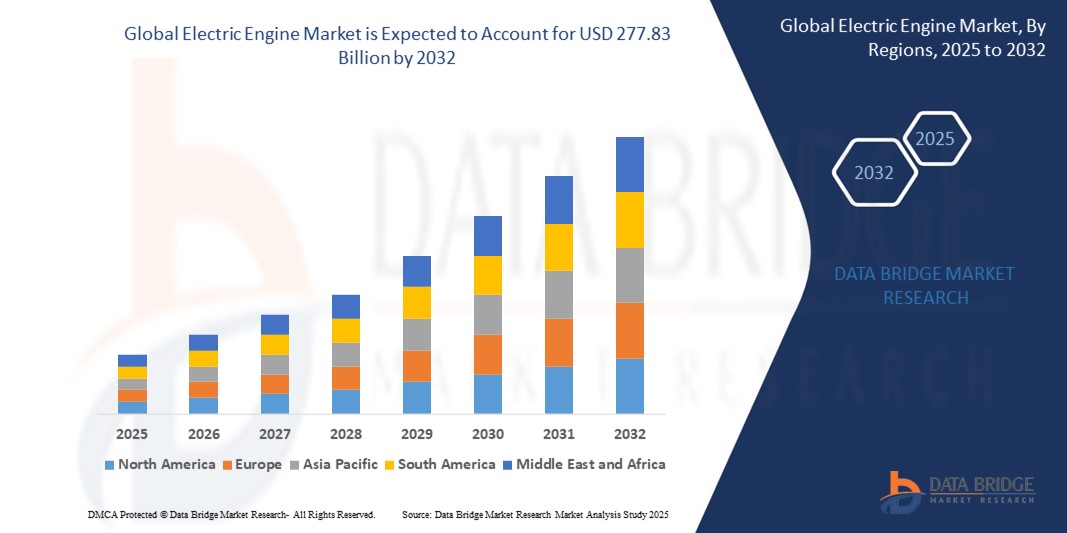
- The Global Electric Engine Market size was valued at USD 136.40 Billion in 2024 and is expected to reach USD 277.83 Billion by 2032, at a CAGR of 9.30% during the forecast period
- Growth in industrial automation, including robotics and smart manufacturing, is increasing the need for reliable and efficient electric motors to power machinery, conveyor systems, and automated processes.
- Stricter global regulations and standards on energy efficiency are pushing industries to adopt high-efficiency electric engines, which reduce energy consumption and operational costs.
Electric Engine Market Analysis
- Technological advancements are steering the market towards smart and energy-efficient electric motors. The integration of Internet of Things (IoT) and Artificial Intelligence (AI) enables real-time monitoring and predictive maintenance, enhancing operational efficiency. Additionally, innovations in motor materials and designs are leading to compact, high-efficiency motors suitable for applications ranging from industrial machinery to consumer electronics.
- The market faces challenges due to supply chain disruptions, particularly concerning rare-earth magnets essential for high-performance motors. China's dominance in rare-earth mineral production has led to export restrictions, prompting automakers to seek alternative materials and suppliers. Startups like Conifer are developing motors that eliminate the need for rare-earth magnets, aiming to reduce dependency on geopolitically sensitive supply chains.
- The push towards industrial automation is significantly boosting the demand for electric motors in manufacturing and logistics. Electric motors are integral to automation systems, driving machinery such as conveyor belts and robotics. Simultaneously, the integration of electric motors in renewable energy applications, including wind turbines and solar tracking systems, is expanding, aligning with global sustainability goals.
- North America dominates the Electric Engine Market with the largest revenue share of 42.02% in 2024, due to integration of electric engines in renewable energy systems, such as wind turbines and solar tracking systems, is expanding as the world increases its investment in sustainable power generation.
- Asia-Pacific is expected to be the fastest growing region in the Electric Engine Market due to demand for HVAC (Heating, Ventilation, and Air Conditioning) systems in residential, commercial, and industrial sectors is boosting the electric engine market, as these systems rely heavily on electric motors.
- Hybrid and Plug-In Hybrid Vehicle segment dominates the Electric Engine Market with a market share of 22.2% in 2024, driven by Ongoing innovations in electric motor design, such as miniaturization, sensor integration, and the use of sustainable materials, are enhancing performance, efficiency, and application versatility.
Report Scope and Electric Engine Market Segmentation
|
Attributes |
Electric Engine Market Insights |
|
Segments Covered |
|
|
Countries Covered |
North America
Europe
Asia-Pacific
Middle East and Africa
South America
|
|
Key Market Players |
|
|
Market Opportunities |
|
|
Value Added Data Infosets |
In addition to the insights on market scenarios such as market value, growth rate, segmentation, geographical coverage, and major players, the market reports curated by the Data Bridge Market Research also include in-depth expert analysis, pricing analysis, brand share analysis, consumer survey, demography analysis, supply chain analysis, value chain analysis, raw material/consumables overview, vendor selection criteria, PESTLE Analysis, Porter Analysis, and regulatory framework. |
Electric Engine Market Trends
“Growing Emphasis on Cybersecurity and Identity Management”
- The global electric engine market is experiencing robust growth as industries and transportation sectors accelerate their shift toward electrification. This trend is driven by increasing regulatory pressure to reduce carbon emissions, rising fuel costs, and growing consumer demand for sustainable solutions. Electric engines are being rapidly adopted in automotive, aerospace, marine, and industrial applications, replacing traditional combustion engines and enabling cleaner, more efficient operations.
- A significant trend in the electric engine market is the integration of smart technologies and the Internet of Things (IoT). Electric engines are increasingly equipped with advanced sensors, connectivity features, and AI-driven analytics, allowing for real-time monitoring, predictive maintenance, and remote diagnostics. This enhances operational efficiency, reduces downtime, and provides end-users with greater control and convenience over their electric-powered systems.
- Manufacturers are prioritizing the development of high-efficiency electric engines that minimize energy consumption and environmental impact. This includes advancements in battery technologies, lightweight materials, and power electronics, all aimed at extending range, reducing charging times, and lowering the total cost of ownership for electric vehicles and industrial equipment.
- North America currently dominates the market, supported by regulatory frameworks, substantial investments in clean technology, and established infrastructure for electric mobility.
- Asia Pacific is emerging as the fastest-growing region fueled by rapid urbanization, government incentives for electric vehicles, and significant investments in manufacturing capacity, especially in China, Japan, and India.
Electric Engine Market Dynamics
Driver
“Surging Demand for Energy-Efficient and Eco-Friendly Propulsion Solutions”
- The global shift toward sustainability and stringent emission regulations is accelerating the adoption of electric engines across automotive, aerospace, marine, and industrial sectors.
- For instance, in early 2025, Tesla introduced its next-generation electric engine platform for heavy-duty trucks, boasting improvement in energy efficiency reduction in lifecycle emissions compared to previous models.
- Electric engines offer significant advantages, including lower operational costs, reduced greenhouse gas emissions, and quieter operation, making them increasingly attractive for both commercial and consumer applications.
- This trend is further bolstered by government incentives, growing investments in renewable energy integration, and advancements in battery technology, which collectively drive the expansion of electric engine deployment in vehicles, industrial equipment, and grid applications.
Restraint/Challenge
“High Initial Costs and Raw Material Supply Chain Constraints”
- The production of electric engines requires advanced materials such as rare earth magnets, copper, and high-grade steel, which are subject to price volatility and supply chain disruptions.
- For instance, in 2025, Siemens Energy announced a temporary slowdown in electric motor production due to a global shortage of neodymium, a critical component for high-performance electric engines.
- High upfront costs for research, development, and manufacturing, coupled with the need for specialized infrastructure, can deter adoption—especially among small and medium-sized enterprises (SMEs) and in price-sensitive markets.
- Additionally, the recycling and disposal of batteries and electronic components pose environmental and regulatory challenges, potentially impacting the long-term sustainability and scalability of electric engine solutions.
Electric Engine Market Scope
The market is segmented on the basis of vehicle type vehicle drive type, vehicle class, component, powertrain type, and sales channels.
- By Vehicle Type
On the basis of Vehicle Type, the Electric Engine Market is segmented into Hybrid and Plug-In Hybrid Vehicle, Battery Electric Vehicle, 48V Mild Hybrid Vehicle, Full Cell Electric Vehicle, Passenger and Commercial Vehicles. The Hybrid and Plug-In Hybrid Vehicle segment dominates the largest market revenue share of 22.2% in 2024, driven by Supportive government policies—including subsidies, tax incentives, and stricter emissions regulations—are accelerating the adoption of electric vehicles and, by extension, electric engines.
The Battery Electric Vehicle segment is anticipated to witness the fastest growth rate of 16.7% from 2025 to 2032, fueled by Global efforts to reduce carbon emissions and transition to low-carbon economies are driving the replacement of internal combustion engines with electric motors across industries.
- By Vehicle Drive Type
On the basis of Vehicle Drive Type, the Electric Engine Market is segmented into Front Wheel Drive, Rear Wheel Drive, All Wheel Drive. The Front Wheel Drive segment held the largest market revenue share in 2024 driven by proliferation of consumer electronics and home automation devices, all of which require compact and efficient electric motors, is contributing to market growth.
The Rear-Wheel-Drive segment is expected to witness the fastest CAGR from 2025 to 2032, driven by Urbanization and Infrastructure Growth.
- By Vehicle Class
On the basis of Vehicle Class, the Electric Engine Market is segmented into Mid-Priced, Luxury. The Mid-Priced segment held the largest market revenue share in 2024 driven by Decarbonization Initiatives.
The Luxury segment is expected to witness the fastest CAGR from 2025 to 2032, driven by proliferation of consumer electronics and home automation devices, all of which require compact and efficient electric motors, is contributing to market growth.
- By Component
On the basis of Component, the Electric Engine Market is segmented into Battery, Power Electronic Controller, Motor/Generator, Converter, Transmission, On-Board Charger, Electric Vehicle Drive Module, EV Power Distribution Model, EV Thermal Systems. The Battery segment held the largest market revenue share in 2024 driven by urbanization, especially in Asia-Pacific, is driving demand for infrastructure equipped with electric motors for elevators, water treatment, and public utilities.
The Converter segment is expected to witness the fastest CAGR from 2025 to 2032, driven by Advances in battery technology have lowered costs and improved charging speeds, making electric vehicles and other battery-powered applications more viable and attractive.
- By Powertrain Type
On the basis of Powertrain Type, the Electric Engine Market is segmented into BEV Powertrain, MHEV Powertrain, Series Hybrid Powertrain, Parallel Hybrid Powertrain, Series-Parallel Hybrid Powertrain. The BEV Powertrain segment held the largest market revenue share in 2024 driven by urbanization, especially in Asia-Pacific, is driving demand for infrastructure equipped with electric motors for elevators, water treatment, and public utilities.
The MHEV Powertrain segment is expected to witness the fastest CAGR from 2025 to 2032, driven by government policies—including subsidies, tax incentives, and stricter emissions regulations—are accelerating the adoption of electric vehicles and, by extension, electric engines.
- By Sales Channels
On the basis of Sales Channels, the Electric Engine Market is segmented into OEM, Aftermarket. The OEM segment held the largest market revenue share in 2024 driven by efforts to reduce carbon emissions and transition to low-carbon economies are driving the replacement of internal combustion engines with electric motors across industries.
The Aftermarket segment is expected to witness the fastest CAGR from 2025 to 2032, driven by Expansion of Consumer Electronics.
Electric Engine Market Regional Analysis
- North America dominates the Electric Engine Market with the largest revenue share of 42.02% in 2024, driven by proliferation of consumer electronics and home automation devices, all of which require compact and efficient electric motors, is contributing to market growth.
- Rapid urbanization, especially in Asia-Pacific, is driving demand for infrastructure equipped with electric motors for elevators, water treatment, and public utilities.
- Advances in battery technology have lowered costs and improved charging speeds, making electric vehicles and other battery-powered applications more viable and attractive.
U.S. Electric Engine Market Insight
The U.S. Electric Engine Market captured the largest revenue share of 52% in 2024 within North America, fueled by Investments in Manufacturing Capacity.
Europe Electric Engine Market Insight
Growth in industrial automation, including robotics and smart manufacturing, is increasing the need for reliable and efficient electric motors to power machinery, conveyor systems, and automated processes driving market in Europe.
U.K. Electric Engine Market Insight
The U.K. Electric Engine Market is anticipated to grow at a noteworthy CAGR during the forecast period, driven by Stricter global regulations and standards on energy efficiency are pushing industries to adopt high-efficiency electric engines, which reduce energy consumption and operational costs.
Germany Electric Engine Market Insight
The Germany Electric Engine Market is expected to expand at a considerable CAGR during the forecast period, fueled by the integration of electric engines in renewable energy systems, such as wind turbines and solar tracking systems, is expanding as the world increases its investment in sustainable power generation.
Asia-Pacific Electric Engine Market Insight
The Asia-Pacific Electric Engine Market is poised to grow at the fastest CAGR of 14% during the forecast period of 2025 to 2032, driven by Rising demand for HVAC (Heating, Ventilation, and Air Conditioning) systems in residential, commercial, and industrial sectors is boosting the electric engine market, as these systems rely heavily on electric motors.
Japan Electric Engine Market Insight
The Japan Electric Engine Market is gaining momentum due to innovations in electric motor design, such as miniaturization, sensor integration, and the use of sustainable materials, are enhancing performance, efficiency, and application versatility.
China Electric Engine Market Insight
The China Electric Engine Market accounted for the largest market revenue share in Asia-Pacific in 2024, driven by government policies—including subsidies, tax incentives, and stricter emissions regulations—are accelerating the adoption of electric vehicles and, by extension, electric engines.
Electric Engine Market Share
The Electric Engine Market is primarily led by well-established companies, including:
- Hitachi Astemo, Ltd. (U.S)
- Magna International Inc (Canada)
- Robert Bosch GmbH (Germany),
- Continental AG (Germany)
- Cummins Inc (U.S)
- BorgWarner Inc. (U.S)
- ZF Friedrichshafen AG (Germany)
- DENSO CORPORATION (Japan)
- DANA TM4 INC., (Canada)
- VALEO (France)
- Mitsubishi Electric Corporation (Japan)
- AKKA (Belgium)
- Ricardo (U.K),
- FEV Europe GmbH (Germany)
- ATESTEO GmbH & Co. KG(Germany)
- HORIBA, Ltd. (Japan)
- Applus+ (Spain)
- Intertek Group plc (U.K.)
- IAV (Germany),
Latest Developments in Global Electric Engine Market
- In March 2023, A. Hitachi Astemo announced the merger of its subsidiary, Hitachi Astemo Electric Motor Systems, to strengthen its electric powertrain strategy. Additionally, by October 2024, the company reported a 31% reduction in CO₂ emissions at its factories and offices compared to FY2010 levels, aligning with its goal to achieve carbon neutrality by FY2030.
- In February 2024, Bosch reached a preliminary agreement with the U.S. government for up to $225 million in subsidies to produce silicon carbide power semiconductors in California, crucial for electric vehicles. However, in November 2024, Bosch announced plans to cut up to 5,500 jobs in its automotive division due to challenges in the transition to electric vehicles.
- In September 2023, Continental expanded its aftermarket product range, introducing components tailored for electric vehicles, including brake systems compatible with Euro 7 standards and sensors for driver assistance systems.
- In July 2023, BorgWarner continues its "Charging Forward" initiative, focusing on electrification and sustainable mobility solutions, including investments in EV technologies and charging infrastructure.
- In January 2024, Mitsubishi Electric announced a ¥10 billion investment to construct a new facility for assembling and inspecting power semiconductor modules in Fukuoka Prefecture, Japan, aiming to enhance production capabilities for electric vehicle components.

- Interactive Data Analysis Dashboard
- Company Analysis Dashboard for high growth potential opportunities
- Research Analyst Access for customization & queries
- Competitor Analysis with Interactive dashboard
- Latest News, Updates & Trend analysis
- Harness the Power of Benchmark Analysis for Comprehensive Competitor Tracking
Data collection and base year analysis are done using data collection modules with large sample sizes. The stage includes obtaining market information or related data through various sources and strategies. It includes examining and planning all the data acquired from the past in advance. It likewise envelops the examination of information inconsistencies seen across different information sources. The market data is analysed and estimated using market statistical and coherent models. Also, market share analysis and key trend analysis are the major success factors in the market report. To know more, please request an analyst call or drop down your inquiry.
The key research methodology used by DBMR research team is data triangulation which involves data mining, analysis of the impact of data variables on the market and primary (industry expert) validation. Data models include Vendor Positioning Grid, Market Time Line Analysis, Market Overview and Guide, Company Positioning Grid, Patent Analysis, Pricing Analysis, Company Market Share Analysis, Standards of Measurement, Global versus Regional and Vendor Share Analysis. To know more about the research methodology, drop in an inquiry to speak to our industry experts.
Data Bridge Market Research is a leader in advanced formative research. We take pride in servicing our existing and new customers with data and analysis that match and suits their goal. The report can be customized to include price trend analysis of target brands understanding the market for additional countries (ask for the list of countries), clinical trial results data, literature review, refurbished market and product base analysis. Market analysis of target competitors can be analyzed from technology-based analysis to market portfolio strategies. We can add as many competitors that you require data about in the format and data style you are looking for. Our team of analysts can also provide you data in crude raw excel files pivot tables (Fact book) or can assist you in creating presentations from the data sets available in the report.













