


Global Electronic Passports Market
Market Size in USD Billion
CAGR :
% 
 USD
29.42 Billion
USD
156.14 Billion
2025
2033
USD
29.42 Billion
USD
156.14 Billion
2025
2033
 Forecast Period Forecast Period |
2026 –2033 |
 Market Size (Base Year) Market Size (Base Year) |
USD 29.42 Billion |
 Market Size (Forecast Year) Market Size (Forecast Year) |
USD 156.14 Billion |
 CAGR CAGR |
% |
| Major Markets Players |
|
Electronic Passports Market Size
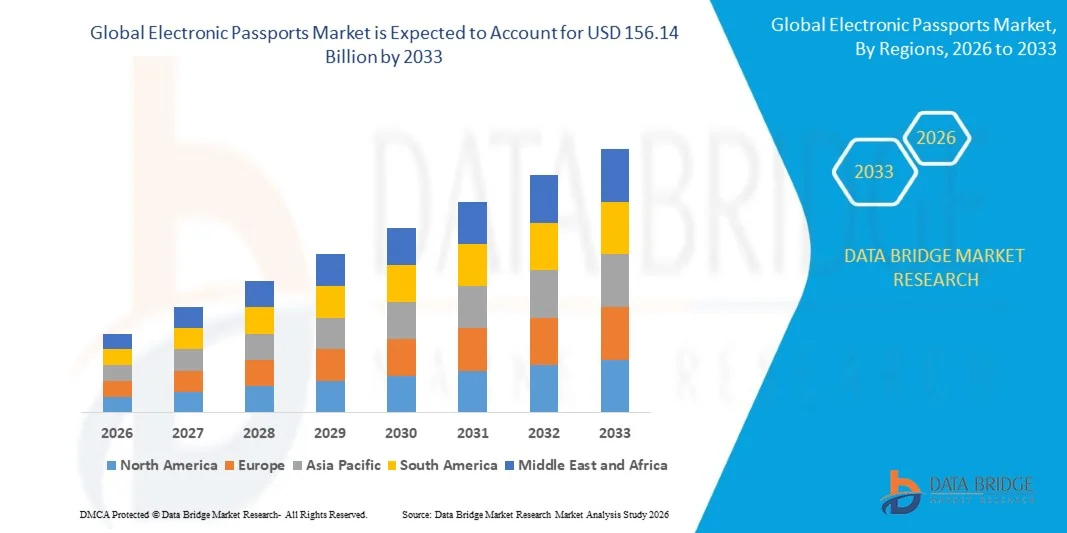
- The global electronic passports market size was valued at USD 29.42 billion in 2025 and is expected to reach USD 156.14 billion by 2033, at a CAGR of 23.20% during the forecast period
- The market growth is largely fuelled by the increasing adoption of biometric identification technologies and rising demand for secure and tamper-proof travel documents
- In addition, growing international travel and stricter border security regulations are encouraging governments to implement electronic passports for improved identity verification
Electronic Passports Market Analysis
- The market is witnessing rapid growth driven by increasing concerns over identity fraud, terrorism, and illegal immigration, leading to widespread adoption of e-passports globally
- In addition, continuous innovation in biometric authentication and data encryption technologies is enhancing passport security and operational efficiency, supporting long-term market growth
- North America dominated the electronic passports market with the largest revenue share in 2025, driven by strong government initiatives for secure identification systems and widespread adoption of biometric-enabled travel documents
- Asia-Pacific region is expected to witness the highest growth rate in the global electronic passports market, driven by rapid urbanization, increasing cross-border travel, and strong government focus on implementing biometric-enabled e-passport systems. The region is also benefiting from large-scale digital transformation initiatives and growing investments in smart border control infrastructure
- The RFID segment held the largest market revenue share in 2025 driven by its widespread adoption for secure data storage and contactless information transmission. RFID-enabled e-passports allow quick verification at border control points, improving efficiency and reducing processing time. In addition, its ability to securely store encrypted personal data makes it a preferred technology for governments worldwide
Report Scope and Electronic Passports Market Segmentation
|
Attributes |
Electronic Passports Key Market Insights |
|
Segments Covered |
|
|
Countries Covered |
North America
Europe
Asia-Pacific
Middle East and Africa
South America
|
|
Key Market Players |
• Gemalto NV (Netherlands) |
|
Market Opportunities |
• Increasing Adoption Of Biometric And Digital Identity Technologies |
|
Value Added Data Infosets |
In addition to the insights on market scenarios such as market value, growth rate, segmentation, geographical coverage, and major players, the market reports curated by the Data Bridge Market Research also include in-depth expert analysis, geographically represented company-wise production and capacity, network layouts of distributors and partners, detailed and updated price trend analysis and deficit analysis of supply chain and demand. |
Electronic Passports Market Trends
“Rising Adoption of Biometric and Secure Travel Technologies”
• The growing focus on secure and tamper-proof identification is significantly shaping the electronic passports market, as governments increasingly prefer advanced solutions that enhance border security and identity verification. Electronic passports are gaining traction due to their ability to store biometric and personal data securely, improving authentication accuracy and reducing fraud. This trend strengthens their adoption across international travel and immigration systems, encouraging authorities to upgrade traditional passport infrastructure
• Increasing concerns regarding identity theft, illegal immigration, and cross-border security threats have accelerated the demand for electronic passports globally. Governments and regulatory bodies are actively implementing e-passports with embedded RFID chips and biometric features such as facial recognition and fingerprint scanning. This shift is prompting collaborations between technology providers and government agencies to enhance security frameworks and improve traveler experience
• Digital transformation and smart border initiatives are influencing adoption, with authorities emphasizing automation, real-time verification, and seamless passenger processing. These advancements are helping countries improve operational efficiency at airports and border checkpoints while strengthening national security. In addition, governments are investing in infrastructure upgrades and cybersecurity measures to support the large-scale implementation of electronic passports
• For instance, in 2024, several countries across Europe and Asia expanded their e-passport programs by integrating advanced biometric authentication and automated border control systems. These initiatives were introduced to enhance travel security and streamline immigration processes, with deployment across international airports and border crossings. The systems were also positioned as part of broader smart governance strategies, improving traveler convenience and reducing processing time
• While adoption of electronic passports is increasing, sustained market growth depends on continuous technological advancements, cost-effective implementation, and robust data security measures. Governments are also focusing on interoperability standards, system integration, and infrastructure scalability to ensure efficient global adoption
Electronic Passports Market Dynamics
Driver
“Increasing Focus on Border Security and Identity Verification”
• Rising global concerns related to security, terrorism, and identity fraud are major drivers for the electronic passports market. Governments are increasingly adopting biometric-enabled passports to strengthen identity verification processes and ensure secure cross-border travel. This trend is also encouraging the development of advanced authentication technologies and secure data storage systems
• Expanding international travel and tourism are influencing market growth, as authorities seek efficient solutions to manage increasing passenger volumes. Electronic passports enable faster processing and reduce manual verification efforts, improving overall travel efficiency. The integration of automated border control systems further supports this transition
• Government initiatives and regulatory mandates are actively promoting the adoption of electronic passports. Many countries are upgrading legacy systems and introducing mandatory biometric passport programs to enhance national security. These initiatives are supported by partnerships between governments and technology providers to develop advanced solutions
• For instance, in 2023, countries such as the U.S. and Germany expanded their electronic passport infrastructure by implementing enhanced biometric features and digital verification systems. These developments followed rising demand for secure travel documents and improved border management capabilities. Authorities also emphasized data protection and system reliability to strengthen public trust
• Although increasing security requirements support market growth, widespread adoption depends on cost management, infrastructure readiness, and global standardization. Investments in cybersecurity, system integration, and international collaboration will be critical for long-term market expansion
Restraint/Challenge
“High Implementation Cost and Data Security Concerns”
• The high cost associated with the implementation of electronic passport systems remains a key challenge, particularly for developing countries. Infrastructure development, biometric integration, and system maintenance require significant investment, which can limit adoption. In addition, ongoing operational costs and technology upgrades further increase financial burden
• Data security and privacy concerns remain critical issues, as electronic passports store sensitive personal and biometric information. Risks related to data breaches, unauthorized access, and cyber threats can impact user confidence and regulatory compliance. Governments must implement strong encryption and cybersecurity measures to mitigate these risks
• Technical and interoperability challenges also impact market growth, as different countries follow varying standards and systems. Ensuring compatibility across global border control systems can be complex and time-consuming. In addition, integration with existing infrastructure may require significant upgrades and coordination
• For instance, in 2024, some developing regions faced delays in e-passport implementation due to budget constraints and concerns regarding data protection frameworks. Authorities also encountered challenges in aligning with international standards and ensuring system interoperability, which slowed adoption rates
• Overcoming these challenges will require investment in cost-effective technologies, enhanced cybersecurity frameworks, and international collaboration. Governments and industry players must focus on standardization, awareness, and infrastructure development to unlock the full potential of the global electronic passports market
Electronic Passports Market Scope
The market is segmented on the basis of technology, security, type, component, application, and end-user.
• By Technology
On the basis of technology, the electronic passports market is segmented into radio frequency identification (RFID) and biometrics. The RFID segment held the largest market revenue share in 2025 driven by its widespread adoption for secure data storage and contactless information transmission. RFID-enabled e-passports allow quick verification at border control points, improving efficiency and reducing processing time. In addition, its ability to securely store encrypted personal data makes it a preferred technology for governments worldwide.
The biometrics segment is expected to witness the fastest growth rate from 2026 to 2033, driven by increasing demand for enhanced identity verification and security. Biometric technologies such as facial recognition and fingerprint scanning improve authentication accuracy and reduce fraud risks. These solutions are increasingly integrated into e-passports to strengthen border control systems and support automated verification processes.
• By Security
On the basis of security, the electronic passports market is segmented into basic access control (BAC), password authenticated connection establishment (PACE), supplemental access control (SAC), and extended access control (EAC). The basic access control segment held the largest market revenue share in 2025 driven by its early adoption and widespread implementation across legacy e-passport systems. BAC provides a foundational level of security by controlling access to passport data and preventing unauthorized reading.
The PACE segment is expected to witness the fastest growth rate from 2026 to 2033, driven by its enhanced encryption capabilities and improved protection against data breaches. PACE offers stronger authentication mechanisms compared to traditional methods, making it increasingly preferred in next-generation e-passports. Governments are actively upgrading systems to adopt more secure protocols such as PACE.
• By Type
On the basis of type, the electronic passports market is segmented into ordinary e-passport, service, and diplomatic e-passport. The ordinary e-passport segment held the largest market revenue share in 2025 driven by its extensive use among general population for international travel. The increasing number of travelers and mandatory adoption of e-passports in many countries support segment growth.
The diplomatic e-passport segment is expected to witness the fastest growth rate from 2026 to 2033, driven by the need for enhanced security and identification for government officials and diplomats. These passports include advanced security features and are increasingly being adopted by countries to ensure secure international mobility for officials.
• By Component
On the basis of component, the electronic passports market is segmented into software, hardware, and services. The hardware segment held the largest market revenue share in 2025 driven by the demand for embedded chips, biometric sensors, and secure passport booklets. Hardware components form the core of e-passport systems, ensuring data storage and physical security.
The software segment is expected to witness the fastest growth rate from 2026 to 2033, driven by increasing need for data management, encryption, and authentication systems. Software solutions enable secure processing and verification of passport data, supporting efficient border control operations and system integration.
• By Application
On the basis of application, the electronic passports market is segmented into business travel and leisure travel. The leisure travel segment held the largest market revenue share in 2025 driven by the growing number of international tourists and rising disposable incomes. E-passports facilitate faster and more secure travel experiences, encouraging adoption among leisure travelers.
The business travel segment is expected to witness the fastest growth rate from 2026 to 2033, driven by increasing globalization and cross-border business activities. Professionals require secure and efficient travel documentation, supporting the demand for advanced e-passports with enhanced security features.
• By End-User
On the basis of end-user, the electronic passports market is segmented into adult and child. The adult segment held the largest market revenue share in 2025 driven by higher international travel frequency among working professionals and general population. Governments prioritize issuing e-passports to adults for security and identification purposes.
The child segment is expected to witness the fastest growth rate from 2026 to 2033, driven by increasing family travel and regulatory requirements for individual identification of minors. The adoption of e-passports for children ensures secure travel and compliance with international travel regulations.
Electronic Passports Market Regional Analysis
• North America dominated the electronic passports market with the largest revenue share in 2025, driven by strong government initiatives for secure identification systems and widespread adoption of biometric-enabled travel documents
• Authorities in the region highly prioritize advanced security features, data encryption, and efficient border control systems to manage increasing international travel and security concerns
• This widespread adoption is further supported by robust technological infrastructure, high government spending, and early implementation of digital identity programs, establishing electronic passports as a critical component of national security and travel management systems
U.S. Electronic Passports Market Insight
The U.S. electronic passports market captured the largest revenue share in 2025 within North America, fueled by the early adoption of biometric passport systems and continuous advancements in border security technologies. Government agencies are increasingly focusing on enhancing identity verification through secure and tamper-proof travel documents. The integration of advanced biometric features such as facial recognition and fingerprint authentication is further strengthening the system. In addition, strong investment in digital infrastructure and cybersecurity solutions is significantly contributing to market growth.
Europe Electronic Passports Market Insight
The Europe electronic passports market is expected to witness the fastest growth rate from 2026 to 2033, primarily driven by stringent regulatory frameworks and the increasing need for secure cross-border travel within the region. The adoption of standardized e-passport systems across European countries is supporting seamless travel and efficient immigration processes. In addition, investments in smart border control technologies and automated verification systems are fostering market expansion. The region is also focusing on enhancing interoperability and data security measures.
U.K. Electronic Passports Market Insight
The U.K. electronic passports market is expected to witness significant growth from 2026 to 2033, driven by increasing government focus on digital identity and border security. The rising number of international travelers and the need for efficient immigration processes are supporting adoption. In addition, the implementation of advanced biometric technologies and automated border control systems is improving operational efficiency. The country’s strong technological infrastructure further supports market development.
Germany Electronic Passports Market Insight
The Germany electronic passports market is expected to witness strong growth from 2026 to 2033, fueled by the country’s emphasis on data security, technological innovation, and efficient public administration systems. The adoption of advanced biometric authentication and secure identification technologies is increasing across government initiatives. In addition, Germany’s focus on privacy and compliance with strict data protection regulations is driving demand for highly secure e-passport systems. The integration of digital solutions in border control is also supporting market growth.
Asia-Pacific Electronic Passports Market Insight
The Asia-Pacific electronic passports market is expected to witness the fastest growth rate from 2026 to 2033, driven by rapid urbanization, increasing international travel, and government initiatives promoting digital identity systems in countries such as China, India, and Japan. The region is investing heavily in modernizing border control infrastructure and enhancing security measures. In addition, the growing adoption of biometric technologies and expansion of airport infrastructure are supporting market growth.
Japan Electronic Passports Market Insight
The Japan electronic passports market is expected to witness significant growth from 2026 to 2033 due to the country’s advanced technological capabilities and strong focus on security and efficiency. The integration of biometric authentication and automated border control systems is improving travel convenience. In addition, increasing international tourism and government investments in smart infrastructure are supporting market expansion. The demand for secure and reliable identification systems continues to drive adoption.
China Electronic Passports Market Insight
The China electronic passports market accounted for the largest market revenue share in Asia Pacific in 2025, attributed to the country’s large population, increasing international travel, and strong government initiatives for digital transformation. The widespread adoption of biometric passports and advanced border control technologies is driving market growth. In addition, continuous investments in infrastructure and the presence of domestic technology providers are enhancing system capabilities. The push toward smart governance and secure identification systems further supports market expansion.
Electronic Passports Market Share
The Electronic Passports industry is primarily led by well-established companies, including:
• Gemalto NV (Netherlands)
• Mühlbauer Group (Germany)
• Entrust Datacard Corporation (U.S.)
• HID Global Corporation (U.S.)
• Infineon Technologies AG (Germany)
• Safran (France)
• Eastcompeace Technology Co., Ltd (China)
• CardLogix Corporation (U.S.)
• 4G Identity Solutions (U.S.)
• Atlantic Zeiser GmbH (Germany)
• PrimeKey (Sweden)
• MULTOS (U.K.)
• M2SYS Technology (U.S.)
Latest Developments in Global Electronic Passports Market
- In September, IDEMIA (France), contract award, secured a major contract with a Southeast Asian government to supply electronic passports, strengthening its presence in a high-growth region and expanding its public sector partnerships. This development enhances secure travel documentation and supports the adoption of advanced e-passport systems. In addition, it reinforces IDEMIA’s position in global identity solutions and border security markets. The move is expected to improve international travel security and accelerate digital identity adoption across emerging economies. It also strengthens long-term government collaboration and revenue stability in the electronic passports market
- In August, Thales Group (France), strategic partnership, entered into a collaboration with a leading technology firm to develop next-generation biometric solutions for electronic passports, enhancing secure identification capabilities. This initiative focuses on improving biometric accuracy, user experience, and data protection in travel documents. In addition, it supports innovation in facial recognition and identity verification technologies. The partnership strengthens Thales’s position as a key technology provider in the e-passport ecosystem. It is expected to drive advancement in secure border control and improve global interoperability standards
- In July, HID Global (U.S.), product launch, introduced a new range of electronic passport readers designed to streamline verification processes at border control points, improving speed and operational efficiency. These advanced readers enhance authentication accuracy and reduce passenger processing time at airports. In addition, they integrate modern security features to strengthen identity verification systems. The launch supports increasing demand for automated and secure border management solutions. It is expected to improve efficiency in immigration systems and reinforce HID Global’s competitive position in the market
SKU-
Get online access to the report on the World's First Market Intelligence Cloud

- Interactive Data Analysis Dashboard
- Company Analysis Dashboard for high growth potential opportunities
- Research Analyst Access for customization & queries
- Competitor Analysis with Interactive dashboard
- Latest News, Updates & Trend analysis
- Harness the Power of Benchmark Analysis for Comprehensive Competitor Tracking
Global Electronic Passports Market, Supply Chain Analysis and Ecosystem Framework
To support market growth and help clients navigate the impact of geopolitical shifts, DBMR has integrated in-depth supply chain analysis into its Global Electronic Passports Market research reports. This addition empowers clients to respond effectively to global changes affecting their industries. The supply chain analysis section includes detailed insights such as Global Electronic Passports Market consumption and production by country, price trend analysis, the impact of tariffs and geopolitical developments, and import and export trends by country and HSN code. It also highlights major suppliers with data on production capacity and company profiles, as well as key importers and exporters. In addition to research, DBMR offers specialized supply chain consulting services backed by over a decade of experience, providing solutions like supplier discovery, supplier risk assessment, price trend analysis, impact evaluation of inflation and trade route changes, and comprehensive market trend analysis.
Research Methodology
Data collection and base year analysis are done using data collection modules with large sample sizes. The stage includes obtaining market information or related data through various sources and strategies. It includes examining and planning all the data acquired from the past in advance. It likewise envelops the examination of information inconsistencies seen across different information sources. The market data is analysed and estimated using market statistical and coherent models. Also, market share analysis and key trend analysis are the major success factors in the market report. To know more, please request an analyst call or drop down your inquiry.
The key research methodology used by DBMR research team is data triangulation which involves data mining, analysis of the impact of data variables on the market and primary (industry expert) validation. Data models include Vendor Positioning Grid, Market Time Line Analysis, Market Overview and Guide, Company Positioning Grid, Patent Analysis, Pricing Analysis, Company Market Share Analysis, Standards of Measurement, Global versus Regional and Vendor Share Analysis. To know more about the research methodology, drop in an inquiry to speak to our industry experts.
Customization Available
Data Bridge Market Research is a leader in advanced formative research. We take pride in servicing our existing and new customers with data and analysis that match and suits their goal. The report can be customized to include price trend analysis of target brands understanding the market for additional countries (ask for the list of countries), clinical trial results data, literature review, refurbished market and product base analysis. Market analysis of target competitors can be analyzed from technology-based analysis to market portfolio strategies. We can add as many competitors that you require data about in the format and data style you are looking for. Our team of analysts can also provide you data in crude raw excel files pivot tables (Fact book) or can assist you in creating presentations from the data sets available in the report.












