




Global Electronic Stethoscopes Market
Market Size in USD Million
CAGR :
% 
 USD
124.38 Million
USD
192.33 Million
2025
2033
USD
124.38 Million
USD
192.33 Million
2025
2033
 Forecast Period Forecast Period |
2026 –2033 |
 Market Size (Base Year) Market Size (Base Year) |
USD 124.38 Million |
 Market Size (Forecast Year) Market Size (Forecast Year) |
USD 192.33 Million |
 CAGR CAGR |
% |
| Major Markets Players |
|
Electronic Stethoscopes Market Overview
The global electronic stethoscopes market was valued at USD 124.38 million in 2025 and is projected to reach USD 192.33 million by 2033, growing at a CAGR of 5.6% from 2026 to 2033. The is market is witnessing steady growth driven by increasing adoption of digital auscultation devices, rising prevalence of cardiovascular and respiratory diseases, and continuous advancements in digital signal processing and noise reduction technologies.
The growing burden of chronic diseases globally, combined with the need for early and accurate diagnosis in primary care and emergency settings, is encouraging healthcare providers to shift from traditional acoustic stethoscopes to advanced electronic and smart stethoscopes. Integration of Bluetooth connectivity, AI-based sound analysis, and telemedicine compatibility is further enhancing clinical efficiency and enabling remote patient monitoring, particularly in telehealth and homecare environments.
Key Market Trends & Insights
- North America dominated the global electronic stethoscopes market with the largest revenue share of 38.42% in 2025, supported by advanced healthcare infrastructure, high adoption of digital diagnostic devices, and strong presence of key medical device manufacturers and telehealth providers.
- The Digitizing Stethoscopes segment led the market with a 58.36% share in 2025, driven by their advanced ability to convert acoustic sound into digital signals for enhanced visualization, recording, and analysis.
- Asia-Pacific is expected to be the fastest-growing region, fueled by expanding healthcare access, rising investment in hospital infrastructure, increasing burden of chronic diseases, and rapid adoption of telemedicine solutions in countries such as India and China.
- Amplifying Stethoscopes are the fastest-growing product type, projected to register a CAGR of 6.4%, reflecting the surge in demand for cost-effective digital enhancement over traditional acoustic devices.
- The Integrated Chest-Piece System segment dominated the technology category with a 44.72% revenue share in 2025, led by its ability to combine traditional auscultation mechanics with embedded digital processing capabilities.
- Bluetooth Connectivity accounted for 49.80% of the market, preferred by widespread compatibility with mobile devices, ease of use, and ability to support real-time data transmission
- The Wireless Transmission System segment is the fastest-growing technology category, with a CAGR of 7.3%, driven by increasing demand for real-time remote patient monitoring and telehealth integration.
Market Size & Forecast
- Global Market Value (2025): USD 124.38 Million
- Expected Market Value (2033): USD 192.33 Million
- Forecast CAGR (2026–2033): 5.6%
- Leading Region in 2025: North America
- Fastest Growing Region: Asia Pacific
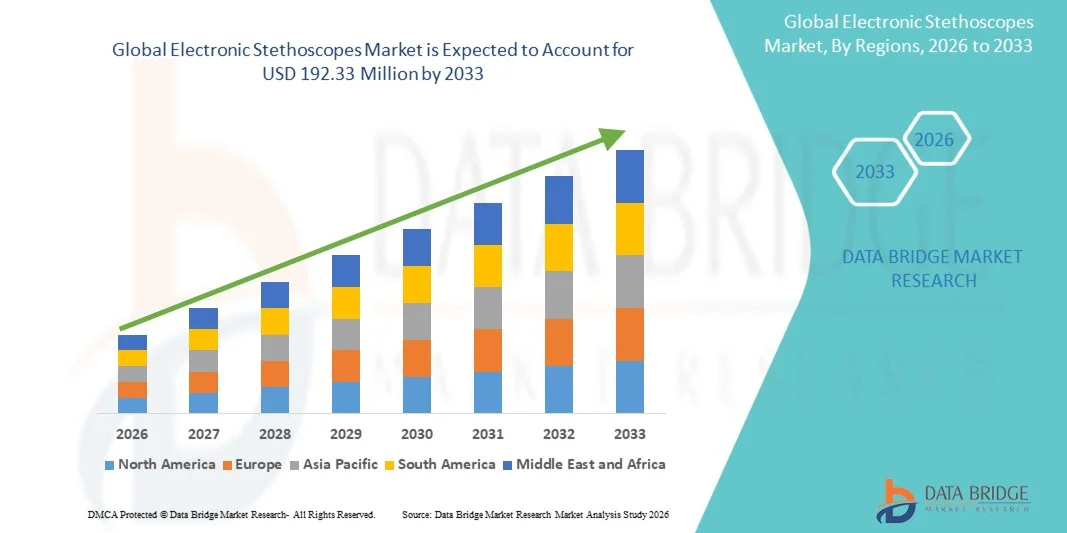
Report Scope and Global Electronic Stethoscopes Market Segmentation
|
Attributes |
Electronic Stethoscopes Key Market Insights |
|
Segments Covered |
|
|
Countries Covered |
North America · U.S. · Canada · Mexico Europe · Germany · France · U.K. · Netherlands · Switzerland · Belgium · Russia · Italy · Spain · Turkey · Rest of Europe Asia-Pacific · China · Japan · India · South Korea · Singapore · Malaysia · Australia · Thailand · Indonesia · Philippines · Rest of Asia-Pacific Middle East and Africa · Saudi Arabia · U.A.E. · South Africa · Egypt · Israel · Rest of Middle East and Africa South America · Brazil · Argentina · Rest of South America |
|
Key Market Players |
· 3M (U.S.) · Eko Health, Inc. (U.S.) · Thinklabs Medical LLC (U.S.) · Cardionics, Inc. (U.S.) · American Diagnostic Corporation (U.S.) · Welch Allyn, Inc. (U.S.) · Hill-Rom Holdings, Inc. (U.S.) · GE Healthcare (U.S.) · CliniCloud Inc. (Australia) · AMD Global Telemedicine, Inc. (U.S.) · Medline Industries, LP (U.S.) · Drägerwerk AG & Co. KGaA (Germany) · Littmann (U.S.) · Omron Healthcare Co., Ltd. (Japan) · Koninklijke Philips N.V. (Netherlands) · Riester GmbH (Germany) · Meditech Equipment Co., Ltd. (India) · Timesco Healthcare Ltd. (U.K.) · Sonavi Labs, Inc. (U.S.) |
|
Market Opportunities |
· Expansion of AI-powered cardiac auscultation tools that can detect early-stage heart diseases · Growing integration of electronic stethoscopes with telemedicine platforms · Increasing adoption in veterinary and emergency medical services |
|
Value Added Data Infosets |
In addition to the insights on market scenarios such as market value, growth rate, segmentation, geographical coverage, and major players, the market reports curated by the Data Bridge Market Research also include in-depth expert analysis, patient epidemiology, pipeline analysis, pricing analysis, and regulatory framework. |
Global Electronic Stethoscopes Market Trends
Trend: Growth in Digital Auscultation & Telehealth Adoption
Healthcare providers are increasingly adopting electronic stethoscopes to enhance diagnostic accuracy through amplified sound, noise reduction, and digital signal processing. The integration of Bluetooth connectivity and mobile applications enables real-time sharing of heart and lung sounds with specialists, supporting remote consultations and telemedicine workflows. Medical training institutions and hospitals are also leveraging these devices for standardized teaching and improved clinical documentation, while AI-assisted sound interpretation is enhancing early detection of cardiac and respiratory abnormalities. For instance, 3M Littmann’s CORE Digital Stethoscope with Eko integration is widely used for digital auscultation and remote cardiac sound sharing in clinical settings.
Global Electronic Stethoscopes Market Dynamics
Key Market Driver: Rising Burden of Cardiopulmonary Diseases and Demand for Early Diagnosis
The increasing prevalence of cardiovascular diseases, chronic obstructive pulmonary disease (COPD), and respiratory infections is driving demand for more accurate and early diagnostic tools. Electronic stethoscopes enable better detection of subtle heart murmurs and lung abnormalities compared to traditional devices, improving clinical decision-making in primary care and emergency departments. Growing focus on preventive healthcare and early screening programs further supports adoption across hospitals and outpatient clinics. For instance, Digital stethoscopes integrated with EHR systems are increasingly used in U.S. hospitals such as Mayo Clinic and Cleveland Clinic for enhanced cardiac screening workflows.
Key Restraint/Challenge: High Device Cost and Limited Adoption in Low-Resource Settings
A key restraint in the electronic stethoscopes market is the relatively high cost compared to conventional acoustic stethoscopes, limiting adoption in price-sensitive regions and smaller healthcare facilities. Additional challenges include dependency on battery power, software compatibility issues, and the need for clinician training to interpret digital sound outputs effectively. These factors can slow penetration in rural healthcare systems and developing economies where budget constraints remain significant.
For Instance, In several public healthcare systems in South Asia and Africa, traditional acoustic stethoscopes still dominate due to procurement cost limitations and lack of digital infrastructure support.
Key Market Opportunity: Integration of AI-Based Diagnostic and Remote Monitoring Platforms
The integration of artificial intelligence and cloud-based analytics presents a significant opportunity for the market, enabling automated detection of abnormal heart and lung sounds with higher accuracy. Electronic stethoscopes combined with telehealth platforms can support continuous remote patient monitoring, especially for chronic disease management and elderly care. Expansion of connected healthcare ecosystems is expected to open new applications in homecare, ambulatory services, and rural telemedicine. For instance, Eko Health’s AI-enabled cardiac detection platform, used alongside electronic stethoscopes, supports early identification of heart murmurs and atrial fibrillation in remote and primary care settings.
Global Electronic Stethoscopes Market Scope
The Electronic Stethoscopes market is segmented on the basis of product type, technology, connectivity, and end user.
- By Product Type
On the basis of product type, the global electronic stethoscopes market is segmented into amplifying stethoscopes and digitizing stethoscopes. The Digitizing Stethoscopes segment dominated the market with a 58.36% share in 2025, owing to their advanced ability to convert acoustic sound into digital signals for enhanced visualization, recording, and analysis. These devices enable clinicians to store, replay, and share auscultation data, improving diagnostic accuracy and documentation efficiency. Their integration with mobile applications and hospital information systems further strengthens their clinical utility. Increasing adoption in cardiology and pulmonary care is supporting their dominance. They are widely preferred in hospitals due to better noise filtering and precision diagnostics. Growing use in telemedicine and remote consultations is further reinforcing segment leadership.
The Amplifying Stethoscopes segment is projected to register the fastest growth at a CAGR of 6.4% from 2026 to 2033, driven by rising demand for cost-effective digital enhancement over traditional acoustic devices. These stethoscopes improve sound amplification without complex system integration, making them suitable for clinics and outpatient settings. Their affordability compared to fully digitized systems is increasing adoption in emerging markets. Continuous improvements in acoustic clarity and noise reduction are expanding their usability. Growing awareness of early diagnosis in primary care is further supporting demand. They also serve as an entry-level upgrade path for healthcare facilities transitioning from acoustic devices.
- By Technology
On the basis of technology, the market is segmented into integrated chest-piece systems, wireless transmission systems, integrated receiver head-piece systems, and others. The Integrated Chest-Piece System segment dominated the market with a 44.72% share in 2025, driven by its ability to combine traditional auscultation mechanics with embedded digital processing capabilities. These systems offer high sound fidelity and real-time amplification while maintaining a familiar clinical design for physicians. Their robustness and reliability make them widely accepted in hospitals and emergency care environments. They also require minimal additional infrastructure compared to fully wireless systems. Continuous improvements in micro-sensor integration are enhancing performance. Strong adoption in cardiology departments is further reinforcing segment dominance.
The Wireless Transmission System segment is expected to grow the fastest at a CAGR of 7.3% from 2026 to 2033, driven by increasing demand for real-time remote patient monitoring and telehealth integration. These systems enable seamless transmission of auscultation data to smartphones, tablets, and cloud platforms. Their ability to support remote diagnosis is particularly valuable in rural and underserved regions. Advancements in Bluetooth and low-energy wireless technologies are improving connectivity and reducing latency. Growing adoption of telemedicine platforms is significantly accelerating demand. Integration with AI-based diagnostic tools is further enhancing clinical value.
- By Connectivity
On the basis of connectivity, the market is segmented into wired, Bluetooth, and Wi-Fi-enabled devices. The Bluetooth Connectivity segment dominated the market with a 49.18% share in 2025, due to its widespread compatibility with mobile devices, ease of use, and ability to support real-time data transmission. Bluetooth-enabled stethoscopes are widely used in hospitals for quick sharing of auscultation data with specialists. Their low power consumption and stable connectivity make them highly practical for clinical environments. Increasing integration with mobile health applications is further supporting adoption. They also enable seamless teleconsultation workflows in outpatient care. Growing preference for portable digital healthcare solutions is strengthening segment leadership.
The Wi-Fi Connectivity segment is projected to register the fastest growth at a CAGR of 7.1% from 2026 to 2033, driven by increasing demand for cloud-based patient monitoring and hospital-wide digital integration. Wi-Fi-enabled devices allow continuous data streaming and storage in electronic health record systems. They support multi-user access and advanced analytics across healthcare networks. Growing adoption of smart hospitals and IoT-based medical infrastructure is boosting demand. These systems are particularly useful in intensive care and remote monitoring applications. Expansion of hospital digital ecosystems is further accelerating segment growth.
- By End User
On the basis of end user, the market is segmented into hospitals, clinics, medical institutions, ambulatory surgical centres, homecare camps, and catheterization laboratories. The Hospitals segment dominated the market with a 52.64% share in 2025, driven by high patient inflow, strong procurement capacity, and increasing adoption of advanced diagnostic technologies. Hospitals extensively use electronic stethoscopes in cardiology, emergency care, and intensive care units for accurate auscultation. Integration with hospital information systems and EHR platforms further enhances clinical workflow efficiency. Growing focus on early disease detection is strengthening adoption. Hospitals also benefit from better reimbursement support for advanced diagnostic tools. Continuous upgrades in hospital digital infrastructure are reinforcing segment dominance.
The Homecare Camps segment is expected to witness the fastest growth at a CAGR of 6.9% from 2026 to 2033, driven by rising demand for remote patient monitoring and community-based healthcare services. Electronic stethoscopes in homecare settings enable early diagnosis and continuous monitoring of chronic diseases. Increasing aging population and preference for at-home healthcare solutions are major growth drivers. Telemedicine expansion is making remote auscultation more practical and accessible. Government initiatives promoting rural healthcare access are further supporting adoption. Advancements in portable and user-friendly devices are accelerating segment penetration.
Global Electronic Stethoscopes Market Regional Analysis
North America dominated the global electronic stethoscopes market with the largest revenue share of 38.42% in 2025, supported by advanced healthcare infrastructure, high adoption of digital diagnostic devices, and strong presence of key medical device manufacturers and telehealth providers. The region also benefits from widespread integration of AI-enabled diagnostic tools, strong reimbursement frameworks, and rapid expansion of telemedicine services across hospitals and outpatient care settings. Increasing focus on early disease detection, remote patient monitoring, and digital transformation of healthcare systems continues to strengthen North America’s leadership position in the global market.
U.S. Electronic Stethoscopes Market Insight
The U.S. electronic stethoscopes market is witnessing strong growth due to high adoption of digital healthcare technologies, increasing prevalence of cardiovascular and respiratory diseases, and widespread integration of telemedicine platforms. The country’s advanced hospital infrastructure, strong presence of leading medical device companies, and rapid deployment of AI-enabled diagnostic tools are driving demand across hospitals, clinics, and homecare settings. In addition, growing emphasis on remote patient monitoring and early disease detection is accelerating adoption of connected stethoscope solutions across primary and specialized care environments. In addition, strong presence of leading medtech companies and continuous product innovation is supporting market expansion. Growing focus on preventive healthcare and early disease detection continues to strengthen adoption across all care settings.
Europe Electronic Stethoscopes Market Insight
The Europe electronic stethoscopes market remains a significant contributor to global revenue, driven by strong public healthcare systems, increasing focus on early disease diagnosis, and widespread adoption of digital health technologies. The region benefits from advanced hospital infrastructure, rising integration of telemedicine services, and growing use of AI-assisted diagnostic tools across cardiology and pulmonary care. Increasing emphasis on patient monitoring efficiency and healthcare digitization across major economies such as Germany, France, and the U.K. is further supporting market expansion. In addition, strong regulatory support for medical device innovation and rising demand for connected diagnostic solutions continue to strengthen adoption across hospitals and clinics.
U.K. Electronic Stethoscopes Market Insight
The U.K. electronic stethoscopes market is experiencing steady growth, supported by increasing adoption of telemedicine services, rising focus on early diagnosis, and modernization of public healthcare infrastructure under the NHS. Growing use of digital stethoscopes in remote consultations and primary care settings is improving diagnostic accessibility and efficiency. Furthermore, integration of AI-assisted auscultation tools and expanding digital health initiatives are strengthening market penetration across hospitals and clinics. In addition, increasing focus on reducing hospital workload through remote diagnostics is strengthening market penetration.
Germany Electronic Stethoscopes Market Insight
The Germany electronic stethoscopes market is expanding steadily due to strong healthcare infrastructure, high emphasis on precision diagnostics, and increasing adoption of advanced medical technologies. Hospitals and clinics are increasingly using electronic stethoscopes for cardiopulmonary assessment and chronic disease management. Continuous digitalization of healthcare systems, along with growing integration of AI-powered diagnostic support tools, is further driving market growth in Germany. Strong regulatory frameworks ensuring quality and safety of medical devices further enhance adoption confidence.
Asia-Pacific Electronic Stethoscopes Market Insight
The Asia-Pacific electronic stethoscopes market is expected to witness rapid growth, driven by expanding healthcare infrastructure, rising burden of chronic diseases, and increasing adoption of telemedicine solutions in emerging economies. Growing awareness of early diagnosis and improving access to modern diagnostic devices are supporting regional expansion. In addition, increasing investments in hospital modernization and growing penetration of digital health technologies are accelerating demand across both urban and rural healthcare settings. Government initiatives focused on improving healthcare access and early disease detection are also supporting market expansion. In addition, rising private healthcare investments and growing medical tourism are accelerating adoption across the region.
Japan Electronic Stethoscopes Market Insight
The Japan electronic stethoscopes market is witnessing consistent growth due to its advanced healthcare system, aging population, and strong focus on technological innovation in medical diagnostics. Healthcare providers are increasingly adopting digital stethoscopes for accurate cardiac and pulmonary assessment, especially in elderly care. Moreover, integration of AI-based diagnostic support systems and expansion of telehealth services are further contributing to market growth. Expansion of telehealth services is also enabling remote patient monitoring and consultation. Continuous technological advancements in medical devices further support market growth in Japan.
China Electronic Stethoscopes Market Insight
The China electronic stethoscopes market is growing rapidly, driven by expanding healthcare infrastructure, rising prevalence of chronic diseases, and increasing government focus on digital health transformation. Growing adoption of smart medical devices in hospitals and primary care centers is significantly boosting demand. In addition, rapid expansion of telemedicine platforms, increasing investment in healthcare digitization, and rising awareness of early disease detection are positioning China as one of the fastest-growing markets globally. Rising awareness of preventive healthcare and early screening is also contributing to market growth. In addition, strong domestic manufacturing capabilities and supportive policy reforms are accelerating market adoption.
Global Electronic Stethoscopes Market Share
The Electronic Stethoscopes industry is primarily led by well-established companies, including:
- 3M (U.S.)
- Eko Health, Inc. (U.S.)
- Thinklabs Medical LLC (U.S.)
- Cardionics, Inc. (U.S.)
- American Diagnostic Corporation (U.S.)
- Welch Allyn, Inc. (U.S.)
- Hill-Rom Holdings, Inc. (U.S.)
- GE Healthcare (U.S.)
- CliniCloud Inc. (Australia)
- AMD Global Telemedicine, Inc. (U.S.)
- Medline Industries, LP (U.S.)
- Drägerwerk AG & Co. KGaA (Germany)
- Littmann (U.S.)
- Omron Healthcare Co., Ltd. (Japan)
- Koninklijke Philips N.V. (Netherlands)
- Riester GmbH (Germany)
- Meditech Equipment Co., Ltd. (India)
- Timesco Healthcare Ltd. (U.K.)
- Sonavi Labs, Inc. (U.S.)
Latest Developments in Global Electronic Stethoscopes Market
- In November 2025, clinical research findings published by TCTMD reported that AI-powered electronic stethoscopes improved the detection of heart failure in resource-limited healthcare settings by enabling earlier identification of reduced cardiac function without reliance on advanced imaging tools. The study emphasized the value of digital auscultation combined with artificial intelligence in improving diagnostic access in underserved regions. This development highlights the growing importance of electronic stethoscopes in addressing global healthcare disparities and expanding access to cardiac screening technologies
- In September 2025, Eko Health announced advancements to its CORE 500™ Digital Stethoscope platform, enhancing its AI-assisted diagnostic capabilities and improving integration with ECG and digital health systems. The upgraded device enables real-time visualization, recording, and sharing of heart and lung sounds, supporting both in-clinic and telehealth applications. This development reflects the accelerating shift toward connected diagnostic ecosystems in healthcare and highlights growing demand for smart stethoscopes that combine auscultation with advanced analytics and remote patient monitoring capabilities
- In August 2025, a clinical study conducted in collaboration with Imperial College London and NHS partners demonstrated that an AI-enabled electronic stethoscope developed by Eko Health could detect heart failure and valvular disease in approximately 15 seconds during routine examinations. The study highlighted significantly improved diagnostic accuracy compared to traditional auscultation methods, particularly in primary care environments. This breakthrough underscores the increasing role of AI-assisted electronic stethoscopes in rapid, point-of-care cardiovascular screening and early disease detection
- In April 2024, the U.S. Food and Drug Administration (FDA) cleared an AI-powered algorithm developed by Eko Health for use with its digital stethoscope platform to detect low ejection fraction, an early indicator of heart failure. The solution enables clinicians to identify potential cardiac dysfunction during routine auscultation in primary care settings within seconds, improving early diagnosis and intervention rates. This regulatory clearance marked a major advancement in integrating artificial intelligence with electronic stethoscopes, strengthening their role in predictive and preventive cardiology and expanding their clinical utility beyond traditional sound amplification
- In February 2022, research published in The Lancet Digital Health validated the clinical effectiveness of AI-enabled electronic stethoscopes for detecting reduced ejection fraction during routine primary care visits. The study demonstrated improved screening performance compared to conventional examination methods, supporting the use of digital auscultation combined with machine learning algorithms. This milestone contributed to accelerating clinical acceptance of electronic stethoscopes as advanced diagnostic tools in preventive cardiology and large-scale population screening programs
SKU-
Get online access to the report on the World's First Market Intelligence Cloud

- Interactive Data Analysis Dashboard
- Company Analysis Dashboard for high growth potential opportunities
- Research Analyst Access for customization & queries
- Competitor Analysis with Interactive dashboard
- Latest News, Updates & Trend analysis
- Harness the Power of Benchmark Analysis for Comprehensive Competitor Tracking
Research Methodology
Data collection and base year analysis are done using data collection modules with large sample sizes. The stage includes obtaining market information or related data through various sources and strategies. It includes examining and planning all the data acquired from the past in advance. It likewise envelops the examination of information inconsistencies seen across different information sources. The market data is analysed and estimated using market statistical and coherent models. Also, market share analysis and key trend analysis are the major success factors in the market report. To know more, please request an analyst call or drop down your inquiry.
The key research methodology used by DBMR research team is data triangulation which involves data mining, analysis of the impact of data variables on the market and primary (industry expert) validation. Data models include Vendor Positioning Grid, Market Time Line Analysis, Market Overview and Guide, Company Positioning Grid, Patent Analysis, Pricing Analysis, Company Market Share Analysis, Standards of Measurement, Global versus Regional and Vendor Share Analysis. To know more about the research methodology, drop in an inquiry to speak to our industry experts.
Customization Available
Data Bridge Market Research is a leader in advanced formative research. We take pride in servicing our existing and new customers with data and analysis that match and suits their goal. The report can be customized to include price trend analysis of target brands understanding the market for additional countries (ask for the list of countries), clinical trial results data, literature review, refurbished market and product base analysis. Market analysis of target competitors can be analyzed from technology-based analysis to market portfolio strategies. We can add as many competitors that you require data about in the format and data style you are looking for. Our team of analysts can also provide you data in crude raw excel files pivot tables (Fact book) or can assist you in creating presentations from the data sets available in the report.












