




Global Enteric Disease Testing Treatment Market
Market Size in USD Billion
CAGR :
% 
 USD
4.58 Billion
USD
6.41 Billion
2025
2033
USD
4.58 Billion
USD
6.41 Billion
2025
2033
 Forecast Period Forecast Period |
2026 - 2033 |
 Market Size (Base Year) Market Size (Base Year) |
USD 4.58 Billion |
 Market Size (Forecast Year) Market Size (Forecast Year) |
USD 6.41 Billion |
 CAGR CAGR |
% |
| Major Markets Players |
|
Enteric Disease Testing-Treatment Market Size
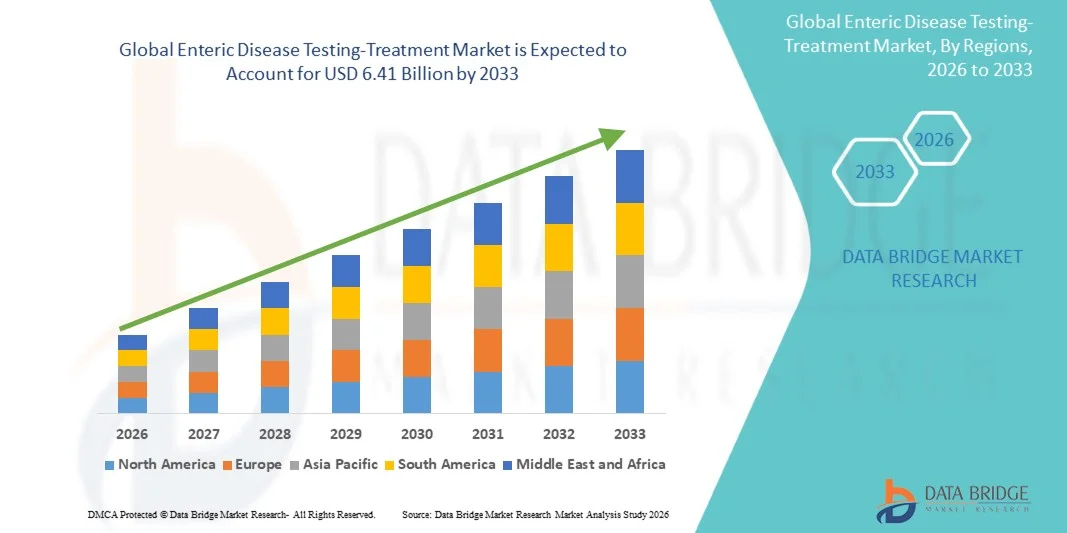
- The global enteric disease testing-treatment market size was valued at USD 4.58 billion in 2025 and is expected to reach USD 6.41 billion by 2033, at a CAGR of 4.30% during the forecast period
- The market growth is largely fueled by the rising prevalence of enteric diseases caused by bacterial, viral, and parasitic infections, along with increasing awareness regarding early diagnosis and timely treatment. Advancements in molecular diagnostics, rapid testing kits, and improved laboratory infrastructure are driving greater adoption of enteric disease testing and treatment solutions across hospitals, diagnostic centers, and public health institutions
- Furthermore, growing government initiatives to control waterborne and foodborne illnesses, rising healthcare expenditure in developing economies, and expanding access to point-of-care diagnostic technologies are establishing enteric disease testing and treatment solutions as essential components of infectious disease management. These converging factors are accelerating the uptake of Enteric Disease Testing-Treatment solutions, thereby significantly boosting the industry's growth
Enteric Disease Testing-Treatment Market Analysis
- Enteric disease testing and treatment solutions, including molecular diagnostic assays, rapid antigen tests, and antimicrobial therapies, play a critical role in identifying and managing gastrointestinal infections caused by bacteria, viruses, and parasites. These solutions are essential for reducing disease burden, preventing outbreaks, and improving patient outcomes across both hospital and community healthcare settings
- The escalating demand for enteric disease testing and treatment is primarily fueled by the rising incidence of foodborne and waterborne illnesses, increasing awareness regarding infectious disease control, and advancements in rapid diagnostic technologies. Growing public health surveillance programs and expanding laboratory capabilities are further supporting market growth
- North America dominated the enteric disease testing-treatment market with the largest revenue share of 41.7% in 2025, driven by advanced healthcare infrastructure, strong disease surveillance systems, high diagnostic testing rates, and the presence of leading biotechnology and pharmaceutical companies. The U.S. experienced substantial growth due to increasing adoption of multiplex PCR panels and rapid testing platforms in hospitals and diagnostic laboratories
- Asia-Pacific is expected to be the fastest-growing region in the enteric disease testing-treatment market during the forecast period, projected to expand at a CAGR of 13.1%, driven by improving healthcare infrastructure, rising incidence of enteric infections, increasing government initiatives for sanitation and disease control, and growing access to affordable diagnostic and treatment solutions in countries such as China, India, and Southeast Asia
- The Bacterial Enteric Diseases segment dominated the largest market revenue share of 44.7% in 2025, driven by the high global prevalence of infections such as salmonellosis, shigellosis, and E. coli–related illnesses
Report Scope and Enteric Disease Testing-Treatment Market Segmentation
|
Attributes |
Enteric Disease Testing-Treatment Key Market Insights |
|
Segments Covered |
|
|
Countries Covered |
North America
Europe
Asia-Pacific
Middle East and Africa
South America
|
|
Key Market Players |
• Abbott (U.S.) |
|
Market Opportunities |
|
|
Value Added Data Infosets |
In addition to the insights on market scenarios such as market value, growth rate, segmentation, geographical coverage, and major players, the market reports curated by the Data Bridge Market Research also include in-depth expert analysis, patient epidemiology, pipeline analysis, pricing analysis, and regulatory framework. |
Enteric Disease Testing-Treatment Market Trends
“Advancements in Rapid Molecular Diagnostics and Integrated Treatment Approaches”
- A significant and accelerating trend in the global enteric disease testing-treatment market is the increasing adoption of advanced molecular diagnostic technologies that enable rapid, accurate, and multiplex detection of gastrointestinal pathogens. Innovations in polymerase chain reaction (PCR) panels, next-generation sequencing, and point-of-care diagnostic platforms are transforming the way enteric infections are identified and managed across healthcare settings
- For instance, multiplex gastrointestinal panels capable of simultaneously detecting bacterial, viral, and parasitic pathogens are being widely implemented in hospitals and diagnostic laboratories to reduce turnaround time and improve clinical decision-making. These comprehensive testing solutions support early diagnosis, allowing healthcare providers to initiate targeted treatment promptly and reduce the misuse of broad-spectrum antibiotics
- The integration of laboratory automation, digital reporting systems, and data analytics tools is further enhancing diagnostic efficiency and surveillance of enteric diseases. Healthcare facilities are increasingly utilizing data-driven platforms to monitor outbreak patterns, track antimicrobial resistance, and optimize patient management strategies
- This growing emphasis on precision diagnostics and evidence-based treatment is reshaping the clinical approach to enteric disease management, improving patient outcomes while minimizing hospitalization duration and healthcare costs. As a result, manufacturers are focusing on developing cost-effective, high-sensitivity testing kits and combination treatment solutions to address the evolving needs of both developed and emerging markets
Enteric Disease Testing-Treatment Market Dynamics
Driver
“Rising Incidence of Gastrointestinal Infections and Growing Focus on Early Diagnosis”
- The increasing global burden of gastrointestinal infections caused by bacteria, viruses, and parasites is a major driver propelling the growth of the Enteric Disease Testing-Treatment market. Factors such as inadequate sanitation in certain regions, contaminated food and water sources, and increasing international travel are contributing to higher infection rates worldwide
- Governments and healthcare organizations are strengthening disease surveillance systems and promoting early diagnostic testing to control outbreaks and reduce mortality rates, particularly among pediatric and geriatric populations who are more vulnerable to severe dehydration and complications
- The growing awareness among patients and healthcare professionals regarding the importance of timely diagnosis and appropriate antimicrobial therapy is further stimulating demand for advanced testing kits and targeted treatment regimens
- For instance, Rapid diagnostic tools not only improve treatment accuracy but also help reduce unnecessary antibiotic prescriptions, supporting global antimicrobial stewardship initiatives
- In addition, increasing healthcare expenditure, improvements in laboratory infrastructure, and expansion of diagnostic services in emerging economies are contributing significantly to market expansion. The shift toward preventive healthcare and improved access to medical facilities are further accelerating the adoption of enteric disease testing and treatment solutions
Restraint/Challenge
“High Diagnostic Costs and Limited Access in Low-Resource Settings”
- Despite technological advancements, the relatively high cost of advanced molecular diagnostic tests remains a key challenge, particularly in low- and middle-income countries where healthcare budgets are constrained. Sophisticated testing platforms often require specialized laboratory infrastructure and trained personnel, limiting their accessibility in rural and resource-limited areas
- For instance, advanced multiplex PCR-based gastrointestinal panels typically require dedicated analyzers and proprietary consumables, which can significantly increase per-test costs compared to conventional stool culture methods, making them less feasible for small or underfunded healthcare facilities
- Delayed diagnosis due to lack of awareness, inadequate laboratory capacity, and limited reimbursement coverage in certain regions can hinder timely treatment and slow market penetration. In many developing economies, conventional stool culture methods are still widely used due to cost considerations, despite their longer turnaround times and lower sensitivity compared to modern molecular techniques
- Furthermore, concerns related to regulatory approvals, quality control standards, and the need for continuous monitoring of antimicrobial resistance patterns add complexity to product development and commercialization. Addressing these challenges through the development of affordable point-of-care diagnostic solutions, expanded public health initiatives, and improved funding for infectious disease control programs will be essential for ensuring sustainable market growth
Enteric Disease Testing-Treatment Market Scope
The market is segmented on the basis of disease type, therapeutics, and testing technology.
• By Disease Type
On the basis of disease type, the Enteric Disease Testing-Treatment market is segmented into Bacterial Enteric Diseases, Viral Enteric Diseases, and Parasitic Enteric Diseases. The Bacterial Enteric Diseases segment dominated the largest market revenue share of 44.7% in 2025, driven by the high global prevalence of infections such as salmonellosis, shigellosis, and E. coli–related illnesses. Increasing cases of foodborne outbreaks and contaminated water supplies significantly contribute to demand for rapid testing and effective antibiotic treatment. Hospitals and diagnostic laboratories prioritize bacterial testing due to the severity and transmission rate of these infections. Government surveillance programs and food safety regulations further strengthen segment dominance. Rising awareness regarding antimicrobial resistance has increased diagnostic screening. Growing healthcare infrastructure in emerging economies also supports treatment adoption. Availability of targeted antibiotics and combination therapies reinforces revenue generation. Continuous monitoring initiatives by public health agencies further sustain growth.
The Viral Enteric Diseases segment is expected to witness the fastest CAGR of 10.8% from 2026 to 2033, fueled by increasing outbreaks of rotavirus and enteroviruses globally. Pediatric populations are particularly vulnerable, driving demand for early diagnostic testing. Expanding vaccination awareness programs and improved detection methods contribute to segment growth. Technological advancements in rapid viral diagnostic kits enhance adoption rates. Hospitals are increasingly utilizing molecular testing for precise viral identification. Growing investment in preventive healthcare further supports expansion. Rising global travel and urbanization also contribute to infection spread, accelerating demand. Continuous research in antiviral therapies and supportive treatment options boosts long-term growth potential.
• By Therapeutics
On the basis of therapeutics, the Enteric Disease Testing-Treatment market is segmented into Campylobacter, Cryptosporidium, E-Coli, Enteroviruses, RhinoViruses, RotaVirus, Salmonellosis, and Shigellosis. The E-Coli segment accounted for the largest market revenue share of 21.6% in 2025, driven by frequent foodborne outbreaks and severe gastrointestinal complications associated with pathogenic strains. Healthcare providers prioritize rapid identification and treatment of E. coli infections due to potential complications such as dehydration and hemolytic uremic syndrome. Increasing regulatory focus on food safety testing further strengthens demand. Availability of well-established antibiotic treatment regimens supports revenue generation. Diagnostic advancements enable faster pathogen identification, reducing hospital stays. Public health awareness campaigns promote early testing and treatment. The segment benefits from continuous monitoring programs in both developed and developing nations. Rising laboratory testing volumes further enhance dominance.
The Rotavirus segment is anticipated to witness the fastest CAGR of 11.5% from 2026 to 2033, driven by high incidence rates in children under five years of age. Although vaccination programs have reduced severe cases in developed regions, emerging economies continue to experience high infection rates. Increasing focus on pediatric healthcare infrastructure boosts testing and treatment adoption. Rapid antigen detection tests are widely used for early diagnosis. Growth is supported by government initiatives targeting diarrheal disease reduction. Expansion of hospital and clinic networks in rural areas further accelerates adoption. Continued research into improved antiviral and supportive therapies also contributes to segment growth.
• By Testing Technology
On the basis of testing technology, the Enteric Disease Testing-Treatment market is segmented into Molecular Diagnostics, Monoclonal Antibodies, Immunoassays, Differential Light Scanning, Information Technology, AI, Liposomes, Flow Cytometry, Chromatography, Diagnostic Imaging, Gel Microdroplets, and Others. The Molecular Diagnostics segment dominated the largest market revenue share of 36.9% in 2025, driven by high accuracy, rapid turnaround time, and ability to detect multiple pathogens simultaneously. PCR-based assays are widely used in hospitals and diagnostic laboratories for precise pathogen identification. Increasing demand for multiplex testing panels enhances segment growth. Technological advancements have reduced testing time and improved sensitivity. Government funding for infectious disease monitoring further supports dominance. Integration with automated laboratory systems boosts efficiency. Rising awareness regarding early detection and outbreak prevention strengthens demand. Expanding adoption in emerging economies also contributes significantly to revenue.
The AI and Information Technology-based Diagnostics segment is expected to witness the fastest CAGR of 13.4% from 2026 to 2033, driven by growing adoption of digital health platforms and predictive analytics in infectious disease management. AI-powered systems enhance data interpretation and outbreak tracking capabilities. Hospitals increasingly integrate AI tools with molecular diagnostic platforms to improve efficiency. Real-time surveillance systems assist public health authorities in rapid response planning. Investment in healthcare digitalization further fuels growth. Integration with electronic health records improves patient management. Growing demand for automated and remote diagnostic solutions supports expansion. Continuous innovation in machine learning algorithms strengthens long-term growth prospects.
Enteric Disease Testing-Treatment Market Regional Analysis
- North America dominated the enteric disease testing-treatment market with the largest revenue share of 41.7% in 2025, driven by advanced healthcare infrastructure, robust disease surveillance systems, high diagnostic testing rates, and the strong presence of leading biotechnology and pharmaceutical companies. The region benefits from well-established laboratory networks and rapid adoption of innovative molecular diagnostic technologies, enabling timely identification and management of gastrointestinal infections
- Healthcare providers in the region emphasize early and accurate detection of bacterial, viral, and parasitic pathogens to reduce complications and prevent outbreaks. The widespread use of multiplex PCR panels and rapid gastrointestinal testing platforms in hospitals and reference laboratories has significantly improved diagnostic turnaround time and treatment precision
- This strong market position is further supported by favorable reimbursement frameworks, increasing awareness regarding foodborne and waterborne diseases, and continuous investment in public health monitoring programs, establishing North America as a leading region in enteric disease diagnostics and therapeutics
U.S. Enteric Disease Testing-Treatment Market Insight
The U.S. enteric disease testing-treatment market captured the largest revenue share % in 2025 within North America, fueled by high healthcare expenditure and rapid technological adoption across clinical laboratories. The country has witnessed substantial growth in the utilization of multiplex PCR-based gastrointestinal panels and automated diagnostic systems in hospitals and outpatient settings. Increasing incidence of foodborne illnesses and strong regulatory emphasis on infectious disease reporting have further strengthened market demand. In addition, growing collaboration between diagnostic manufacturers and healthcare institutions is enhancing access to advanced testing and targeted antimicrobial therapies across the country.
Europe Enteric Disease Testing-Treatment Market Insight
The Europe enteric disease testing-treatment market is projected to expand at a substantial CAGR throughout the forecast period, supported by strict food safety regulations, well-structured public healthcare systems, and increasing awareness regarding infectious disease control. European countries are focusing on strengthening laboratory capabilities and promoting early detection programs to mitigate the burden of gastrointestinal infections. Rising adoption of advanced molecular diagnostics, along with improved antimicrobial stewardship practices, is fostering steady market growth across the region.
U.K. Enteric Disease Testing-Treatment Market Insight
The U.K. enteric disease testing-treatment market anticipated to grow at a noteworthy CAGR during the forecast period, driven by enhanced surveillance programs and increasing National Health Service (NHS) initiatives aimed at controlling infectious diseases. The growing need to reduce hospital admissions associated with severe diarrheal infections and foodborne outbreaks is encouraging the adoption of rapid diagnostic testing solutions. Furthermore, improved laboratory modernization and public awareness campaigns are expected to contribute to sustained market expansion.
Germany Enteric Disease Testing-Treatment Market Insight
The Germany enteric disease testing-treatment market is expected to expand at a considerable CAGR during the forecast period, supported by the country’s strong healthcare infrastructure and emphasis on high-quality diagnostic standards. Germany’s focus on precision medicine and advanced laboratory automation is accelerating the adoption of molecular testing platforms for gastrointestinal pathogens. In addition, increased awareness regarding antimicrobial resistance and structured infection control programs are contributing to market development in both hospital and private laboratory settings.
Asia-Pacific Enteric Disease Testing-Treatment Market Insight
The Asia-Pacific enteric disease testing-treatment market is poised to grow at the fastest CAGR of 13.1% during the forecast period, driven by improving healthcare infrastructure, rising incidence of enteric infections, and increasing government initiatives for sanitation and disease control in countries such as China, India, and Southeast Asia. Expanding access to diagnostic laboratories and affordable treatment solutions is strengthening early disease detection across both urban and semi-urban populations. Growing public health investments and international collaborations aimed at reducing the burden of waterborne and foodborne diseases are further supporting regional growth.
Japan Enteric Disease Testing-Treatment Market Insight
The Japan enteric disease testing-treatment market is gaining steady momentum due to advanced healthcare facilities, high diagnostic standards, and strong focus on infectious disease surveillance. The country’s aging population and increasing emphasis on preventive healthcare are encouraging early testing and effective management of gastrointestinal infections. Adoption of automated laboratory systems and high-sensitivity molecular diagnostic platforms is further contributing to market growth.
China Enteric Disease Testing-Treatment Market Insight
The China enteric disease testing-treatment market accounted for the largest revenue share in Asia Pacific in 2025, attributed to rapid healthcare modernization, rising awareness regarding infectious diseases, and expanding government-led sanitation initiatives. The increasing incidence of food safety concerns and water contamination issues has heightened demand for reliable diagnostic and treatment solutions. Growing domestic manufacturing capabilities and improved accessibility to cost-effective molecular testing kits are key factors propelling sustained market growth in China.
Enteric Disease Testing-Treatment Market Share
The Enteric Disease Testing-Treatment industry is primarily led by well-established companies, including:
• Abbott (U.S.)
• Thermo Fisher Scientific Inc. (U.S.)
• Danaher Corporation (U.S.)
• bioMérieux S.A. (France)
• Becton, Dickinson and Company (U.S.)
• Qiagen N.V. (Germany)
• F. Hoffmann-La Roche Ltd. (Switzerland)
• Merck & Co., Inc. (U.S.)
• GlaxoSmithKline plc (U.K.)
• Pfizer Inc. (U.S.)
• Sanofi S.A. (France)
• AstraZeneca plc (U.K.)
• Novartis AG (Switzerland)
• Takeda Pharmaceutical Company Limited (Japan)
• Bio-Rad Laboratories, Inc. (U.S.)
• Hologic, Inc. (U.S.)
• Cepheid (U.S.)
• PerkinElmer, Inc. (U.S.)
• Siemens Healthineers AG (Germany)
• DiaSorin S.p.A. (Italy)
Latest Developments in Global Enteric Disease Testing-Treatment Market
- In March 2023, Biomerica, Inc. announced the launch of its InFoods IBS test as a laboratory-developed test (LDT), completing validation testing and processing its first patient samples. The test identifies specific trigger foods that contribute to irritable bowel syndrome symptoms, enabling more personalized dietary treatment approaches for gastrointestinal conditions
- In April 2023, the World Health Organization (WHO) coordinated a global deployment of more than 1.2 million rapid cholera diagnostic tests to 14 high-risk countries as part of a joint programme with Gavi, UNICEF, and FIND, improving the ability of health systems to detect and respond to cholera outbreaks early
- In May 2023, Biomerica, Inc. announced that its inFoods® IBS test was validated for use with a simple finger-stick whole blood collection method, making it easier and more convenient for healthcare providers to collect samples and expand clinical accessibility
- In October 2024, Biomerica, Inc. announced direct-to-consumer availability of its inFoods IBS test, allowing U.S. patients to order the test online and submit simple at-home finger-prick samples, expanding access to personalized GI symptom management outside traditional clinical settings
- In February 2025, Biomerica, Inc. announced the publication of pivotal clinical trial results in Gastroenterology showing that its inFoods IBS test supported personalized dietary therapy that significantly reduced symptoms like abdominal pain and bloating in IBS patients, highlighting clinical validation of a non-drug enteric treatment approach
SKU-
Get online access to the report on the World's First Market Intelligence Cloud

- Interactive Data Analysis Dashboard
- Company Analysis Dashboard for high growth potential opportunities
- Research Analyst Access for customization & queries
- Competitor Analysis with Interactive dashboard
- Latest News, Updates & Trend analysis
- Harness the Power of Benchmark Analysis for Comprehensive Competitor Tracking
Research Methodology
Data collection and base year analysis are done using data collection modules with large sample sizes. The stage includes obtaining market information or related data through various sources and strategies. It includes examining and planning all the data acquired from the past in advance. It likewise envelops the examination of information inconsistencies seen across different information sources. The market data is analysed and estimated using market statistical and coherent models. Also, market share analysis and key trend analysis are the major success factors in the market report. To know more, please request an analyst call or drop down your inquiry.
The key research methodology used by DBMR research team is data triangulation which involves data mining, analysis of the impact of data variables on the market and primary (industry expert) validation. Data models include Vendor Positioning Grid, Market Time Line Analysis, Market Overview and Guide, Company Positioning Grid, Patent Analysis, Pricing Analysis, Company Market Share Analysis, Standards of Measurement, Global versus Regional and Vendor Share Analysis. To know more about the research methodology, drop in an inquiry to speak to our industry experts.
Customization Available
Data Bridge Market Research is a leader in advanced formative research. We take pride in servicing our existing and new customers with data and analysis that match and suits their goal. The report can be customized to include price trend analysis of target brands understanding the market for additional countries (ask for the list of countries), clinical trial results data, literature review, refurbished market and product base analysis. Market analysis of target competitors can be analyzed from technology-based analysis to market portfolio strategies. We can add as many competitors that you require data about in the format and data style you are looking for. Our team of analysts can also provide you data in crude raw excel files pivot tables (Fact book) or can assist you in creating presentations from the data sets available in the report.












