


What is the Global Enterprise Robotic Process Automation Market Size and Growth Rate?
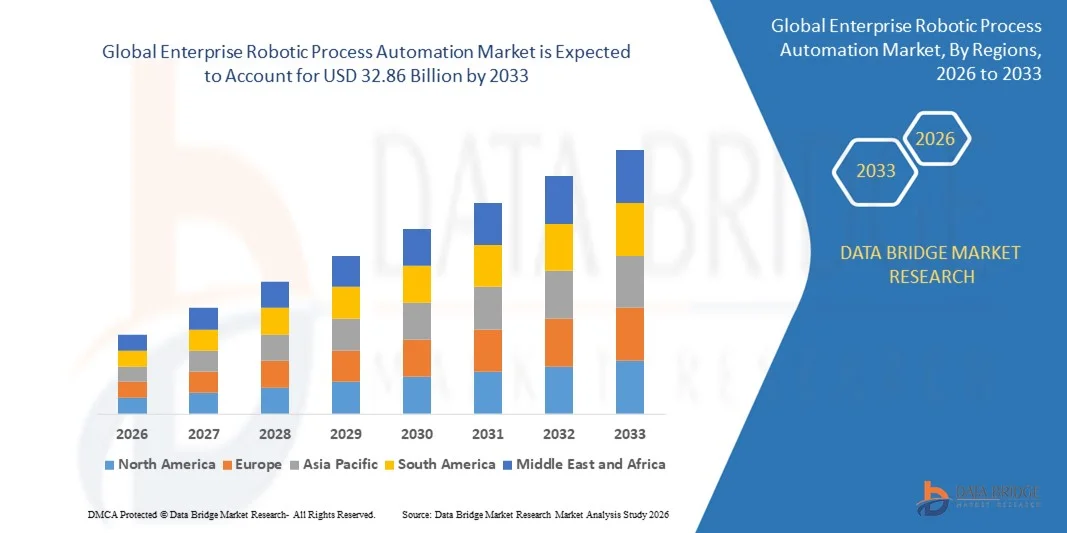
- The global enterprise robotic process automation market size was valued at USD 4.65 billion in 2025 and is expected to reach USD 32.86 billion by 2033, at a CAGR of 27.67% during the forecast period
- Rise in consolidation of RPA with traditional business processes is a crucial factor accelerating the market growth, also increase in the focus on automation in BPO industry, rise in the demand for the processing of high volume data and transaction functions, increase in the ease in business processes with the installation and rise in the convergence of robotic process automation with traditional business processes are the major factors among others boosting the enterprise robotic process automation market
What are the Major Takeaways of Enterprise Robotic Process Automation Market?
- Rise in the integration of new technologies, increase in the demand for robotic process automation in the logistics industry and rise in the expected adoption of robotics process automation in the BPO sector will further create new opportunities for enterprise robotic process automation market
- However, increase in the data insecurity risk and less potential for robotic process automation in knowledge-based business processes are the major factors among others restraining the market growth, and will further challenge the enterprise robotic process automation market
- North America dominated the enterprise robotic process automation (RPA) market with a 43.1% revenue share in 2025, driven by rapid enterprise digital transformation, strong cloud infrastructure, and widespread adoption of intelligent automation across the U.S. and Canada
- Asia-Pacific is projected to register the fastest CAGR of 11.2% from 2026 to 2033, driven by rapid enterprise digitization, expanding SME automation adoption, and strong growth in IT services across China, Japan, India, South Korea, and Southeast Asia
- The Automated Solutions segment dominated the market with a 46.5% share in 2025, as enterprises increasingly deploy unattended bots to automate repetitive, rule-driven tasks such as data entry, invoice processing, claims handling, payroll management, and report generation
Report Scope and Enterprise Robotic Process Automation Market Segmentation
|
Attributes |
Enterprise Robotic Process Automation Key Market Insights |
|
Segments Covered |
|
|
Countries Covered |
North America
Europe
Asia-Pacific
Middle East and Africa
South America
|
|
Key Market Players |
|
|
Market Opportunities |
|
|
Value Added Data Infosets |
In addition to the insights on market scenarios such as market value, growth rate, segmentation, geographical coverage, and major players, the market reports curated by the Data Bridge Market Research also include in-depth expert analysis, pricing analysis, brand share analysis, consumer survey, demography analysis, supply chain analysis, value chain analysis, raw material/consumables overview, vendor selection criteria, PESTLE Analysis, Porter Analysis, and regulatory framework. |
What is the Key Trend in the Enterprise Robotic Process Automation Market?
Growing Shift Toward AI-Integrated, Cloud-Based, and Hyperautomation-Driven Enterprise RPA Solutions
- The enterprise robotic process automation (RPA) market is witnessing strong adoption of AI-powered, cloud-native automation platforms designed to streamline complex enterprise workflows, integrate with legacy systems, and enable end-to-end digital transformation
- Vendors are introducing intelligent bots with machine learning, natural language processing (NLP), and process mining capabilities to automate unstructured data handling, decision-making tasks, and cross-functional operations
- Increasing demand for scalable, low-code/no-code automation tools is driving deployment across finance, HR, supply chain, customer service, and IT operations within large enterprises
- For instance, companies such as UiPath, Automation Anywhere, Blue Prism, IBM, and Pegasystems have enhanced their enterprise platforms with AI copilots, cloud orchestration, analytics dashboards, and hyperautomation frameworks
- Rising focus on real-time monitoring, workflow orchestration, and integration with ERP and CRM systems is accelerating the shift toward centralized automation ecosystems
- As enterprises prioritize cost optimization, operational agility, and digital workforce expansion, Enterprise RPA solutions will remain critical for improving productivity, compliance, and scalable automation strategies
What are the Key Drivers of Enterprise Robotic Process Automation Market?
- Rising demand for process efficiency, error reduction, and cost savings across banking, healthcare, telecom, manufacturing, and government sectors is significantly driving RPA adoption
- For instance, in 2025, leading vendors such as UiPath, NICE, and Automation Anywhere expanded their automation suites with AI-driven document processing, attended bots, and cloud automation services to enhance enterprise productivity
- Growing adoption of digital transformation initiatives, hybrid work models, and intelligent workflow automation is boosting demand across the U.S., Europe, and Asia-Pacific
- Advancements in AI integration, robotic desktop automation, API connectivity, and cognitive automation tools have strengthened scalability, flexibility, and enterprise-wide deployment
- Increasing volume of structured and unstructured enterprise data is creating demand for intelligent automation capable of handling complex business rules and compliance requirements
- Supported by continuous investments in cloud computing, enterprise software modernization, and hyperautomation strategies, the Enterprise RPA market is expected to witness strong long-term growth
Which Factor is Challenging the Growth of the Enterprise Robotic Process Automation Market?
- High implementation, integration, and licensing costs associated with advanced enterprise-grade RPA platforms restrict adoption among small and mid-sized organizations
- For instance, during 2024–2025, increasing cybersecurity requirements, cloud infrastructure expenses, and integration complexities raised deployment costs for several global enterprises
- Complexity in automating unstructured processes, legacy systems, and cross-departmental workflows increases dependency on skilled IT professionals and consulting services
- Data privacy concerns, regulatory compliance requirements, and governance challenges limit automation scalability in highly regulated industries
- Competition from alternative technologies such as Business Process Management (BPM), AI workflow tools, and low-code application platforms creates pricing pressure and market fragmentation
- To address these challenges, companies are focusing on modular pricing models, AI-driven self-learning bots, improved security frameworks, and simplified deployment architectures to accelerate global adoption of enterprise robotic process automation solutions
How is the Enterprise Robotic Process Automation Market Segmented?
The market is segmented on the basis of process, operation, type, industry, deployment, and solution.
- By Process
On the basis of process, the Enterprise Robotic Process Automation market is segmented into Automated Solutions, Decision Support and Management Solution, and Interaction Solution. The Automated Solutions segment dominated the market with a 46.5% share in 2025, as enterprises increasingly deploy unattended bots to automate repetitive, rule-driven tasks such as data entry, invoice processing, claims handling, payroll management, and report generation. These solutions deliver significant cost savings, improved accuracy, and faster turnaround times, making them highly preferred across large organizations.
The Decision Support and Management Solution segment is expected to grow at the fastest CAGR from 2026 to 2033, driven by rising integration of AI, analytics, and cognitive automation tools that enable real-time insights, predictive decision-making, and intelligent workflow orchestration across enterprise environments.
- By Operation
On the basis of operation, the market is segmented into Rule-Based and Knowledge-Based automation. The Rule-Based segment dominated the market with a 55.2% share in 2025, as it remains widely used for structured, repetitive, and standardized business processes across finance, HR, and customer service functions. These bots follow predefined workflows and business rules, making them easier to implement and scale within enterprise systems.
The Knowledge-Based segment is projected to grow at the fastest CAGR from 2026 to 2033, fueled by increasing adoption of AI-driven bots capable of handling unstructured data, natural language inputs, document understanding, and complex decision-making scenarios. Growing demand for cognitive automation and intelligent process management is accelerating this transition.
- By Type
On the basis of type, the market is segmented into Tool-Based and Service-Based offerings. The Tool-Based segment dominated the market with a 61.4% share in 2025, supported by rising demand for licensed RPA platforms that enable enterprises to design, deploy, and manage bots internally. Organizations prefer tool-based solutions for better customization, integration flexibility, and long-term scalability.
The Service-Based segment is expected to grow at the fastest CAGR from 2026 to 2033, driven by increasing reliance on consulting, implementation, maintenance, and managed automation services, particularly among SMEs and first-time adopters seeking technical expertise.
- By Industry
On the basis of industry, the Enterprise RPA market is segmented into BFSI, Telecom and IT, Travel, Hospitality and Transportation, Retail and Consumer Goods, Manufacturing and Logistics, Healthcare and Pharmaceuticals, and Others. The BFSI segment dominated the market with a 34.8% share in 2025, due to high automation demand in fraud detection, compliance reporting, loan processing, and customer onboarding workflows. Regulatory requirements and high transaction volumes further strengthen adoption.
The Healthcare and Pharmaceuticals segment is projected to grow at the fastest CAGR from 2026 to 2033, supported by increasing need for claims processing automation, patient data management, regulatory compliance, and AI-driven healthcare workflow optimization.
- By Deployment
On the basis of deployment, the market is segmented into On-Premise and Cloud. The On-Premise segment dominated the market with a 52.6% share in 2025, as large enterprises prefer greater control over data security, compliance, and system customization. Highly regulated industries such as BFSI and government continue to rely on internal infrastructure for automation deployment.
The Cloud segment is expected to grow at the fastest CAGR from 2026 to 2033, driven by scalability, lower upfront costs, faster deployment cycles, and seamless integration with SaaS ecosystems and hybrid work models.
- By Solution
On the basis of solution, the market is segmented into Software and Service. The Software segment dominated the market with a 63.9% share in 2025, owing to high demand for enterprise-grade RPA platforms equipped with AI, analytics, orchestration, and monitoring tools. Enterprises invest heavily in scalable automation software to enhance operational efficiency and digital workforce expansion.
The Service segment is projected to grow at the fastest CAGR from 2026 to 2033, driven by increasing demand for automation consulting, system integration, bot maintenance, and continuous optimization services to ensure long-term automation success.
Which Region Holds the Largest Share of the Enterprise Robotic Process Automation Market?
- North America dominated the enterprise robotic process automation (RPA) market with a 43.1% revenue share in 2025, driven by rapid enterprise digital transformation, strong cloud infrastructure, and widespread adoption of intelligent automation across the U.S. and Canada. High demand for workflow automation in BFSI, healthcare, telecom, retail, and government sectors continue to fuel regional growth
- Leading companies in North America are introducing advanced AI-integrated RPA platforms with process mining, analytics dashboards, attended and unattended bots, and cloud orchestration capabilities, strengthening the region’s technological leadership. Continuous investment in AI, hyperautomation strategies, and enterprise software modernization drives sustained market expansion
- Strong IT spending capacity, high concentration of automation vendors, mature SaaS ecosystems, and availability of skilled automation professionals further reinforce regional market dominance
U.S. Enterprise Robotic Process Automation Market Insight
The U.S. is the largest contributor in North America, supported by large-scale adoption of RPA across banking, insurance, healthcare, manufacturing, and federal agencies. Increasing deployment of AI-powered bots for document processing, compliance monitoring, fraud detection, and customer service automation accelerates demand. Presence of leading RPA vendors, strong cloud infrastructure, and continuous enterprise investment in digital workforce solutions significantly drive market growth.
Canada Enterprise Robotic Process Automation Market Insight
Canada contributes steadily to regional expansion, driven by growing automation adoption across financial services, telecom, and public sector organizations. Rising focus on operational efficiency, cost optimization, and digital service delivery supports RPA deployment. Government-backed digital innovation initiatives and expanding SaaS adoption further strengthen market penetration across Canadian enterprises.
Asia-Pacific Enterprise Robotic Process Automation Market
Asia-Pacific is projected to register the fastest CAGR of 11.2% from 2026 to 2033, driven by rapid enterprise digitization, expanding SME automation adoption, and strong growth in IT services across China, Japan, India, South Korea, and Southeast Asia. Increasing demand for cost-efficient automation, rising labor costs, and strong cloud adoption accelerate regional RPA deployment. Growing investment in AI, digital banking, e-commerce, and smart manufacturing further stimulates demand for intelligent automation solutions.
China Enterprise Robotic Process Automation Market Insight
China is the largest contributor within Asia-Pacific due to strong enterprise digitization, expanding fintech ecosystems, and government-backed digital transformation initiatives. Increasing automation of finance, manufacturing, and customer service operations drives large-scale RPA adoption. Growing AI integration and domestic software innovation further enhance market expansion.
Japan Enterprise Robotic Process Automation Market Insight
Japan demonstrates steady growth supported by advanced IT infrastructure and strong enterprise modernization efforts. Automation adoption across banking, manufacturing, and telecom sectors continues to rise, driven by workforce shortages and productivity optimization strategies. Focus on high-precision, secure automation platforms strengthens long-term demand.
India Enterprise Robotic Process Automation Market Insight
India is emerging as a major growth hub, supported by expanding IT services, growing startup ecosystems, and increasing automation adoption across BFSI, healthcare, and telecom industries. Rising cloud adoption and demand for scalable SaaS-based RPA platforms accelerate market penetration. Strong presence of global IT service providers further boosts implementation capabilities.
South Korea Enterprise Robotic Process Automation Market Insight
South Korea contributes significantly due to advanced digital infrastructure and strong enterprise automation initiatives across manufacturing, telecom, and financial services. Increasing integration of AI-driven bots, analytics tools, and cloud platforms supports sustained market growth. Continuous innovation and rising focus on operational efficiency further strengthen RPA adoption.
Which are the Top Companies in Enterprise Robotic Process Automation Market?
The enterprise robotic process automation industry is primarily led by well-established companies, including:
- Sutherland Bulgaria (Bulgaria)
- Automation Anywhere (U.S.)
- Blue Prism Limited (U.K.)
- Pegasystems Inc. (U.S.)
- Celaton (U.K.)
- UiPath (U.S.)
- Verint (U.S.)
- Redwood Technology B.V. (Netherlands)
- IBM Corporation (U.S.)
- NICE Systems Ltd. (Israel)
- Kofax Inc. (U.S.)
- Jacada Inc. (U.S.)
- Kryon Systems (Israel)
- OpenConnect Systems Incorporated (U.S.)
- Cicero Inc. (U.S.)
- Atos SE (France)
- Daythree Business Services Sdn Bhd (Malaysia)
- IPsoft Inc. (U.S.)
- Softomotive (U.K.)
What are the Recent Developments in Global Enterprise Robotic Process Automation Market?
- In November 2025, C3 AI introduced C3 AI Agentic Process Automation, a platform designed to automate both enterprise business functions and industrial operations through autonomous AI agents, enabling execution of processes such as order-to-cash, invoice management, customer support, procurement, employee onboarding, equipment diagnostics, production scheduling, inventory control, and maintenance operations, thereby strengthening enterprise-wide intelligent automation capabilities
- In October 2025, Cognizant entered into a strategic partnership with AP Pension to deliver Business Process Outsourcing (BPO), Robotic Process Automation (RPA), and administrative optimization services through its Nordic-speaking Center of Excellence in Vilnius, Lithuania, aiming to enhance operational efficiency, accelerate digital transformation, and improve overall customer experience, thereby expanding Cognizant’s presence in the European automation services market
- In March 2022, SS&C Technologies Holdings, Inc. completed the acquisition of Blue Prism Group Plc for approximately USD 1.6 billion, significantly broadening its automation software portfolio and strengthening its capabilities in robotic and intelligent automation solutions across healthcare and financial services industries, thereby reinforcing its competitive positioning in the global RPA market
- In March 2021, Microsoft Corporation launched robotic process automation capabilities for Windows 10 users through its Power Platform, enabling businesses to automate repetitive and rule-based tasks with greater efficiency and accessibility, thereby accelerating enterprise adoption of low-code automation tools

- Interactive Data Analysis Dashboard
- Company Analysis Dashboard for high growth potential opportunities
- Research Analyst Access for customization & queries
- Competitor Analysis with Interactive dashboard
- Latest News, Updates & Trend analysis
- Harness the Power of Benchmark Analysis for Comprehensive Competitor Tracking
Data collection and base year analysis are done using data collection modules with large sample sizes. The stage includes obtaining market information or related data through various sources and strategies. It includes examining and planning all the data acquired from the past in advance. It likewise envelops the examination of information inconsistencies seen across different information sources. The market data is analysed and estimated using market statistical and coherent models. Also, market share analysis and key trend analysis are the major success factors in the market report. To know more, please request an analyst call or drop down your inquiry.
The key research methodology used by DBMR research team is data triangulation which involves data mining, analysis of the impact of data variables on the market and primary (industry expert) validation. Data models include Vendor Positioning Grid, Market Time Line Analysis, Market Overview and Guide, Company Positioning Grid, Patent Analysis, Pricing Analysis, Company Market Share Analysis, Standards of Measurement, Global versus Regional and Vendor Share Analysis. To know more about the research methodology, drop in an inquiry to speak to our industry experts.
Data Bridge Market Research is a leader in advanced formative research. We take pride in servicing our existing and new customers with data and analysis that match and suits their goal. The report can be customized to include price trend analysis of target brands understanding the market for additional countries (ask for the list of countries), clinical trial results data, literature review, refurbished market and product base analysis. Market analysis of target competitors can be analyzed from technology-based analysis to market portfolio strategies. We can add as many competitors that you require data about in the format and data style you are looking for. Our team of analysts can also provide you data in crude raw excel files pivot tables (Fact book) or can assist you in creating presentations from the data sets available in the report.













