


Global Environmental Noise Measurement Market
Market Size in USD Billion
CAGR :
% 
 USD
8.40 Billion
USD
11.95 Billion
2025
2033
USD
8.40 Billion
USD
11.95 Billion
2025
2033
 Forecast Period Forecast Period |
2026 –2033 |
 Market Size (Base Year) Market Size (Base Year) |
USD 8.40 Billion |
 Market Size (Forecast Year) Market Size (Forecast Year) |
USD 11.95 Billion |
 CAGR CAGR |
% |
| Major Markets Players |
|
Environmental Noise Measurement Market Size
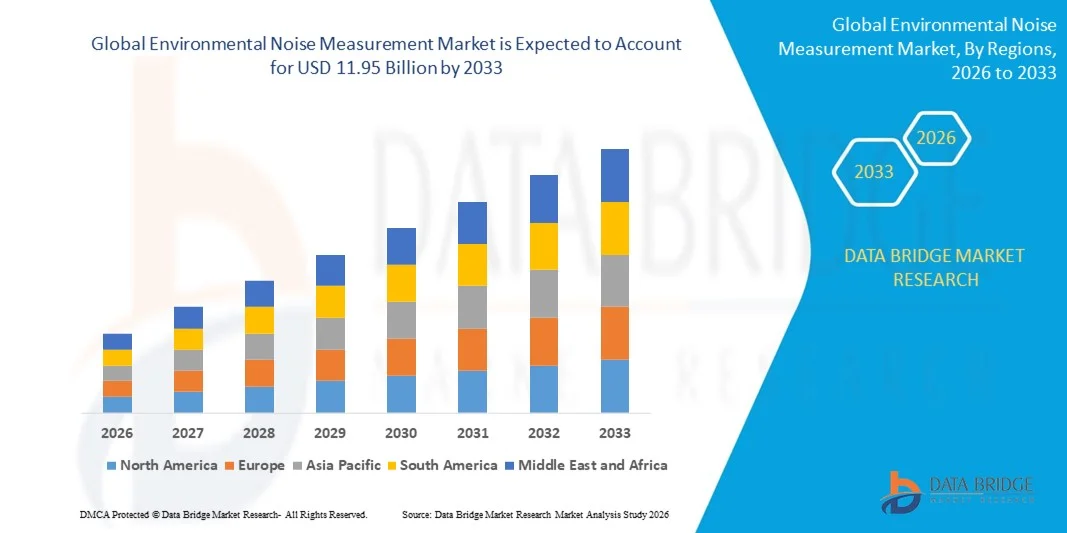
- The global environmental noise measurement market size was valued at USD 8.40 billion in 2025 and is expected to reach USD 11.95 billion by 2033, at a CAGR of 4.50% during the forecast period
- The market growth is largely fuelled by the rising enforcement of noise pollution regulations across industrial, commercial, and urban environments
- Increasing urbanization and infrastructure development are driving the demand for continuous noise monitoring systems
Environmental Noise Measurement Market Analysis
- The market is witnessing steady expansion due to the increasing deployment of smart noise monitoring networks in cities, airports, industrial zones, and transportation corridors
- Advancements in sensor technology, cloud-based analytics, and integrated monitoring platforms are enabling more accurate, real-time environmental noise assessment
- North America dominated the environmental noise measurement market with the largest revenue share in 2025, driven by stringent noise regulations, rapid urbanization, and the widespread deployment of smart city infrastructure across major metropolitan areas
- Asia-Pacific region is expected to witness the highest growth rate in the global environmental noise measurement market, driven by expanding infrastructure projects, growing urban populations, and heightened emphasis on environmental quality and compliance
- The Outdoor Monitors segment held the largest market revenue share in 2025 driven by the rising deployment of fixed monitoring stations across urban, industrial, and transportation environments. These systems offer high-accuracy, real-time data and are widely used by regulatory bodies and city authorities for compliance monitoring and noise mapping
Report Scope and Environmental Noise Measurement Market Segmentation
|
Attributes |
Environmental Noise Measurement Key Market Insights |
|
Segments Covered |
|
|
Countries Covered |
North America
Europe
Asia-Pacific
Middle East and Africa
South America
|
|
Key Market Players |
|
|
Market Opportunities |
|
|
Value Added Data Infosets |
In addition to the insights on market scenarios such as market value, growth rate, segmentation, geographical coverage, and major players, the market reports curated by the Data Bridge Market Research also include in-depth expert analysis, geographically represented company-wise production and capacity, network layouts of distributors and partners, detailed and updated price trend analysis and deficit analysis of supply chain and demand. |
Environmental Noise Measurement Market Trends
Rise of Smart and Real-Time Noise Monitoring Technologies
- The growing shift toward smart, real-time environmental noise monitoring is transforming the global noise measurement landscape by enabling continuous, on-site data collection across urban, industrial, and transportation environments. The adoption of IoT-enabled sensors allows authorities to detect noise level spikes instantly, supporting timely mitigation and improved compliance with regulatory standards
- The rising demand for noise monitoring in densely populated urban regions is accelerating the use of advanced monitoring stations, mobile noise meters, and cloud-connected analytics platforms. These tools are highly effective in areas experiencing rapid urbanization and infrastructure expansion, helping city planners address noise pollution more proactively
- The affordability and improved accessibility of modern noise monitoring devices are making them suitable for routine environmental assessments. Government agencies, environmental bodies, and private industries benefit from automated reporting, real-time dashboards, and low-maintenance systems that enhance long-term noise control planning
- For instance, in 2023, several European cities reported improved regulatory compliance and faster response to noise-related complaints after deploying networked noise monitoring units equipped with AI-based analytics and geospatial mapping capabilities
- While smart noise monitoring is improving environmental management, its full potential depends on advanced analytics, regulatory alignment, and wider adoption across developing economies. Manufacturers must focus on cost-effective, scalable, and user-friendly solutions to fully leverage growing market demand
Environmental Noise Measurement Market Dynamics
Driver
Growing Focus on Urban Noise Control and Regulatory Compliance
- The rising incidence of urban noise pollution, driven by transportation, construction, and industrial expansion, is pushing governments and municipal bodies to adopt advanced noise measurement tools as a frontline solution for environmental monitoring. Increasing public awareness and health concerns are also intensifying demand for precise noise assessment technologies
- Industries and commercial establishments are increasingly aware of regulatory requirements and potential penalties for non-compliance. This is driving the adoption of high-accuracy noise meters, monitoring stations, and integrated software platforms to track noise levels and ensure adherence to standards across operational sites
- Government-backed environmental initiatives, city development plans, and noise mapping programs are further boosting the deployment of real-time monitoring systems. Investments in smart city infrastructure and improved environmental governance are contributing significantly to market growth
- For instance, in 2022, several Asia-Pacific metropolitan regions implemented continuous noise monitoring networks to support environmental action plans and strengthen oversight of high-noise industrial zones
- While regulatory support and rising awareness are accelerating market growth, continuous innovation, interoperability, and cost-effectiveness remain essential for wider adoption, particularly in developing regions
Restraint/Challenge
High Installation Costs and Limited Technological Adoption in Developing Regions
- The high cost of advanced noise measurement systems, including fixed monitoring stations and AI-enabled analysis tools, limits adoption among smaller municipalities, rural areas, and cost-constrained industries. These systems often require significant investment in infrastructure and maintenance
- Many developing regions lack the technical expertise and skilled personnel needed to operate and maintain sophisticated monitoring devices. Insufficient training and limited awareness reduce the effectiveness of noise monitoring initiatives and lead to reliance on outdated or manual measurement practices
- Market growth is also restricted by gaps in environmental policy implementation, inconsistent enforcement of noise regulations, and limited access to real-time monitoring technologies. As a result, noise pollution often remains underreported in developing economies, hindering effective action
- For instance, in 2023, environmental agencies in Latin America and parts of Africa highlighted that over half of urban noise monitoring projects faced delays due to insufficient technical resources and budget constraints
- While noise monitoring technology continues to advance, addressing cost barriers, training needs, and infrastructure limitations remains essential. Stakeholders must prioritize scalable, easy-to-deploy, and cost-efficient solutions to unlock the full growth potential of the environmental noise measurement market
Environmental Noise Measurement Market Scope
The market is segmented on the basis of product, component, sampling method, and application
- By Product
On the basis of product, the environmental noise measurement market is segmented into Indoor Monitors, Outdoor Monitors, Sensors, and Wearables. The Outdoor Monitors segment held the largest market revenue share in 2025 driven by the rising deployment of fixed monitoring stations across urban, industrial, and transportation environments. These systems offer high-accuracy, real-time data and are widely used by regulatory bodies and city authorities for compliance monitoring and noise mapping.
The Wearables segment is expected to witness the fastest growth rate from 2026 to 2033 driven by increasing public interest in personal noise exposure tracking and occupational safety monitoring. Wearable devices provide continuous, user-level noise data and are becoming popular among industrial workers, commuters, and health-conscious urban populations
- By Component
On the basis of component, the market is segmented into Particulate, Gas, Temperature, and Noise. The Noise segment held the largest market revenue share in 2025 driven by growing regulatory pressure to monitor urban noise pollution and rising demand for smart, automated noise assessment tools. Advanced noise sensors are increasingly implemented in smart city networks and industrial compliance systems due to their precision and real-time capabilities.
The Temperature component is expected to witness the fastest growth rate from 2026 to 2033 driven by the need for integrated environmental monitoring systems such as those used in weather analysis, industrial operations, and environmental impact assessments. Temperature sensors are being widely adopted due to their low cost, reliability, and compatibility with multi-parameter monitoring platforms
- By Sampling Method
On the basis of sampling method, the environmental noise measurement market is segmented into Continuous and Active. The Continuous segment held the largest market revenue share in 2025 driven by the increasing adoption of 24/7 real-time monitoring networks across metropolitan regions, industrial zones, and transportation corridors. Continuous sampling supports advanced noise mapping, compliance reporting, and early detection of abnormal noise levels.
The Active segment is expected to witness the fastest growth rate from 2026 to 2033 driven by its effectiveness in targeted assessments such as construction site audits, event-based monitoring, and regulatory inspections. Active sampling systems allow precise, controlled measurements and are widely used for short-term environmental evaluations.
- By Application
On the basis of application, the market is segmented into Air, Water, Soil, and Noise. The Noise segment held the largest market revenue share in 2025 driven by rising urban noise pollution, expansion of transportation networks, and stringent environmental regulations across major economies. Demand for accurate, real-time noise monitoring tools is increasing among municipal authorities, industrial operators, and infrastructure developers.
The Air application segment is expected to witness the fastest growth rate from 2026 to 2033 driven by growing awareness of air quality impacts on public health and the increasing adoption of integrated environmental monitoring systems. Air quality sensors and analyzers are becoming essential for smart city deployments, industrial emission monitoring, and environmental compliance programs.
Environmental Noise Measurement Market Regional Analysis
- North America dominated the environmental noise measurement market with the largest revenue share in 2025, driven by stringent noise regulations, rapid urbanization, and the widespread deployment of smart city infrastructure across major metropolitan areas
- Government bodies and environmental agencies in the region place high value on real-time monitoring, automated reporting, and compliance-driven noise assessment solutions, leading to strong adoption of advanced monitoring stations and IoT-enabled devices
- This broad uptake is further supported by high environmental awareness, strong regulatory enforcement, and increased investments in smart mobility and infrastructure projects, positioning North America as a leading market for noise measurement technologies
U.S. Environmental Noise Measurement Market Insight
The U.S. environmental noise measurement market captured the largest revenue share in 2025 within North America, driven by strict federal and state-level environmental regulations and growing public concern regarding urban noise exposure. The adoption of advanced monitoring systems is expanding across transportation hubs, industrial facilities, and construction sites. Increasing integration of cloud-based analytics, GIS mapping, and automated compliance tools is further driving demand. The country's ongoing smart city development projects and modernization of infrastructure have also accelerated the deployment of continuous monitoring networks.
Europe Environmental Noise Measurement Market Insight
The Europe environmental noise measurement market is expected to witness the fastest growth rate from 2026 to 2033, fuelled by the region’s stringent environmental policies and mandatory noise mapping requirements under regulatory frameworks such as the Environmental Noise Directive (END). Rising urban density and expanding transportation networks are prompting higher investments in noise monitoring infrastructure. European industries and municipalities are increasingly adopting advanced IoT-based sensors and long-term monitoring systems, driving significant demand across both public and private sectors.
U.K. Environmental Noise Measurement Market Insight
The U.K. environmental noise measurement market is expected to witness strong growth from 2026 to 2033, driven by rising awareness of environmental health impacts and growing emphasis on urban noise reduction. Expanding railway, road, and airport modernization projects are boosting the need for continuous noise monitoring systems. In addition, the country’s environmental compliance initiatives and the push towards smart city planning are supporting increased adoption of real-time noise assessment technologies across municipalities and industrial zones.
Germany Environmental Noise Measurement Market Insight
The Germany environmental noise measurement market is expected to witness rapid growth from 2026 to 2033, fuelled by the nation’s robust environmental regulations and long-standing commitment to sustainable urban development. Germany’s advanced industrial base, combined with strict noise compliance requirements, is accelerating the adoption of precision monitoring systems. Increasing integration of smart technologies in public infrastructure and a strong focus on environmental transparency are further supporting market expansion.
Asia-Pacific Environmental Noise Measurement Market Insight
The Asia-Pacific environmental noise measurement market is expected to witness the highest growth rate from 2026 to 2033, driven by large-scale urbanization, rapid industrial expansion, and increasing government focus on pollution control across countries such as China, Japan, and India. Growing investments in smart city projects and transportation infrastructure are contributing to rising demand for advanced monitoring systems. Expanding manufacturing activity and heightened public awareness of environmental health issues are also shaping strong market growth across the region.
Japan Environmental Noise Measurement Market Insight
The Japan environmental noise measurement market is expected to grow significantly from 2026 to 2033 due to the country’s advanced technological landscape and strong focus on urban planning and environmental quality. Japan’s dense metropolitan areas require continuous noise monitoring to manage transportation and commercial noise levels effectively. The widespread use of IoT-enabled sensors, AI-powered analytics, and integrated environmental monitoring platforms is further strengthening market demand.
China Environmental Noise Measurement Market Insight
The China environmental noise measurement market accounted for the largest market share in Asia Pacific in 2025, driven by rapid industrialization, accelerating infrastructure development, and major government-led noise control initiatives. China’s expanding urban centers and transportation networks are prompting higher adoption of real-time monitoring systems. Strong manufacturing capabilities, along with increased investment in digital environmental governance, continue to propel the country’s leadership in the regional noise measurement market.
Environmental Noise Measurement Market Share
The Environmental Noise Measurement industry is primarily led by well-established companies, including:
- Agilent Technologies Inc. (U.S.)
- Danaher Corporation (U.S.)
- Emerson Electric Co. (U.S.)
- General Electric Company (U.S.)
- Honeywell International Inc. (U.S.)
- Merck KGaA (Germany)
- Siemens AG (Germany)
- TE Connectivity (Switzerland)
- Teledyne Technologies Incorporated (U.S.)
- Thermo Fisher Scientific Inc. (U.S.)
- Environmental Sensors Inc. (U.S.)
- Raytheon Company (U.S.)
- Lockheed Martin Corporation (U.S.)
- Thales Group (France)
- Dürr Megtec LLC (U.S.)
- Gracey and Associates (U.K.)
- Ashtead Technology Ltd (U.K.)
- ENCO Engineers Combine (U.S.)
- Cambas, J. B., Ltd (U.K.)
SKU-
Get online access to the report on the World's First Market Intelligence Cloud

- Interactive Data Analysis Dashboard
- Company Analysis Dashboard for high growth potential opportunities
- Research Analyst Access for customization & queries
- Competitor Analysis with Interactive dashboard
- Latest News, Updates & Trend analysis
- Harness the Power of Benchmark Analysis for Comprehensive Competitor Tracking
Global Environmental Noise Measurement Market, Supply Chain Analysis and Ecosystem Framework
To support market growth and help clients navigate the impact of geopolitical shifts, DBMR has integrated in-depth supply chain analysis into its Global Environmental Noise Measurement Market research reports. This addition empowers clients to respond effectively to global changes affecting their industries. The supply chain analysis section includes detailed insights such as Global Environmental Noise Measurement Market consumption and production by country, price trend analysis, the impact of tariffs and geopolitical developments, and import and export trends by country and HSN code. It also highlights major suppliers with data on production capacity and company profiles, as well as key importers and exporters. In addition to research, DBMR offers specialized supply chain consulting services backed by over a decade of experience, providing solutions like supplier discovery, supplier risk assessment, price trend analysis, impact evaluation of inflation and trade route changes, and comprehensive market trend analysis.
Research Methodology
Data collection and base year analysis are done using data collection modules with large sample sizes. The stage includes obtaining market information or related data through various sources and strategies. It includes examining and planning all the data acquired from the past in advance. It likewise envelops the examination of information inconsistencies seen across different information sources. The market data is analysed and estimated using market statistical and coherent models. Also, market share analysis and key trend analysis are the major success factors in the market report. To know more, please request an analyst call or drop down your inquiry.
The key research methodology used by DBMR research team is data triangulation which involves data mining, analysis of the impact of data variables on the market and primary (industry expert) validation. Data models include Vendor Positioning Grid, Market Time Line Analysis, Market Overview and Guide, Company Positioning Grid, Patent Analysis, Pricing Analysis, Company Market Share Analysis, Standards of Measurement, Global versus Regional and Vendor Share Analysis. To know more about the research methodology, drop in an inquiry to speak to our industry experts.
Customization Available
Data Bridge Market Research is a leader in advanced formative research. We take pride in servicing our existing and new customers with data and analysis that match and suits their goal. The report can be customized to include price trend analysis of target brands understanding the market for additional countries (ask for the list of countries), clinical trial results data, literature review, refurbished market and product base analysis. Market analysis of target competitors can be analyzed from technology-based analysis to market portfolio strategies. We can add as many competitors that you require data about in the format and data style you are looking for. Our team of analysts can also provide you data in crude raw excel files pivot tables (Fact book) or can assist you in creating presentations from the data sets available in the report.












