




Global Ethylene Glycol Market
Market Size in USD Billion
CAGR :
% 
 USD
29.08 Billion
USD
40.22 Billion
2025
2033
USD
29.08 Billion
USD
40.22 Billion
2025
2033
 Forecast Period Forecast Period |
2026 –2033 |
 Market Size (Base Year) Market Size (Base Year) |
USD 29.08 Billion |
 Market Size (Forecast Year) Market Size (Forecast Year) |
USD 40.22 Billion |
 CAGR CAGR |
% |
| Major Markets Players |
|
Ethylene Glycol Market Size
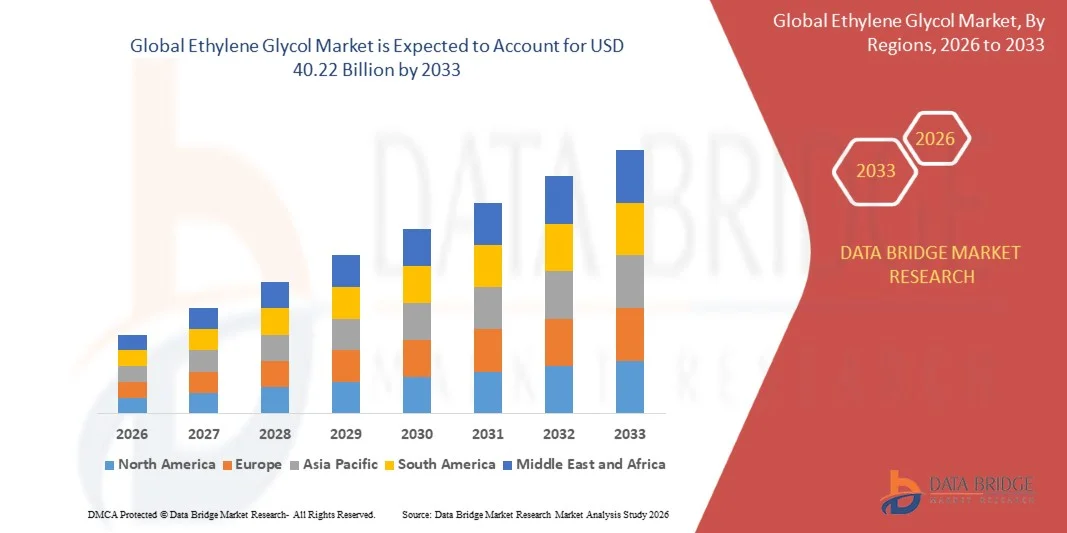
- The global ethylene glycol market size was valued at USD 29.08 billion in 2025 and is expected to reach USD 40.22 billion by 2033, at a CAGR of 4.14% during the forecast period
- The market growth is largely fueled by rising demand from automotive antifreeze applications, polyester fiber production, and PET resin manufacturing, where ethylene glycol serves as a key raw material in coolant systems and polymer synthesis. Expanding industrialization and growing consumption of packaging materials are further strengthening demand across multiple end-use sectors
- Furthermore, increasing focus on energy-efficient cooling systems, expansion of petrochemical production capacity, and continuous growth in transportation and textile industries are establishing ethylene glycol as a critical chemical intermediate. These converging factors are accelerating its adoption across both developed and emerging economies, thereby significantly boosting market expansion
Ethylene Glycol Market Analysis
- Ethylene glycol, widely used as an antifreeze agent and chemical intermediate, is increasingly vital in automotive, textile, and packaging industries due to its strong thermal stability, hygroscopic properties, and versatility in polyester production and industrial cooling systems
- The escalating demand for ethylene glycol is primarily fueled by rapid growth in vehicle production, rising consumption of PET-based packaging materials, and expanding industrial infrastructure, supported by strong downstream integration across global petrochemical value chains
- North America dominated the ethylene glycol market with a share of 41% in 2025, due to strong demand from automotive antifreeze applications and polyester fiber manufacturing, along with expanding industrial chemical consumption across the region
- Asia-Pacific is expected to be the fastest growing region in the ethylene glycol market during the forecast period due to rapid industrialization, expanding textile production, and rising automotive demand across emerging economies such as China, India, and Southeast Asia
- Tri-ethylene glycol segment dominated the market with a market share of 41.5% in 2025, due to its extensive use in natural gas dehydration and industrial drying applications. Its strong hygroscopic nature enables efficient moisture removal, making it highly suitable for gas processing operations across oil and gas infrastructure
Report Scope and Ethylene Glycol Market Segmentation
|
Attributes |
Ethylene Glycol Key Market Insights |
|
Segments Covered |
|
|
Countries Covered |
North America · U.S. · Canada · Mexico Europe · Germany · France · U.K. · Netherlands · Switzerland · Belgium · Russia · Italy · Spain · Turkey · Rest of Europe Asia-Pacific · China · Japan · India · South Korea · Singapore · Malaysia · Australia · Thailand · Indonesia · Philippines · Rest of Asia-Pacific Middle East and Africa · Saudi Arabia · U.A.E. · South Africa · Egypt · Israel · Rest of Middle East and Africa South America · Brazil · Argentina · Rest of South America |
|
Key Market Players |
· DuPont (U.S.) · Dow (U.S.) · H.B. Fuller Company (U.S.) · AVERY DENNISON CORPORATION (U.S.) · Sealed Air (U.S.) · SABIC (Saudi Arabia) · Arkema (France) · LyondellBasell Industries Holdings B.V. (Netherlands) · Exxon Mobil Corporation (U.S.) · Mitsui Chemicals Inc., (Japan) · Braskem (Brazil) · TotalEnergies (France) · Biome Bioplastics (U.K.) · PTT Global Chemical Public Company Limited (Thailand) · KURARAY CO., LTD. (Japan) |
|
Market Opportunities |
· Growth of Bio-Based Ethylene Glycol from Renewable Feedstocks · Rising Demand from EV Thermal Management Systems |
|
Value Added Data Infosets |
In addition to the insights on market scenarios such as market value, growth rate, segmentation, geographical coverage, and major players, the market reports curated by the Data Bridge Market Research also include import export analysis, production capacity overview, production consumption analysis, price trend analysis, climate change scenario, supply chain analysis, value chain analysis, raw material/consumables overview, vendor selection criteria, PESTLE Analysis, Porter Analysis, and regulatory framework. |
Ethylene Glycol Market Trends
“Rising Demand for Polyester and PET Packaging in Emerging Economies”
- A significant trend in the ethylene glycol market is the rising consumption of polyester fibers and PET-based packaging materials across rapidly industrializing economies, driven by expanding textile production and growing packaged consumer goods demand. This trend is strengthening ethylene glycol’s role as a key feedstock in large-scale polymer manufacturing and global supply chains
- For instance, Reliance Industries Limited in India operates one of the world’s largest integrated polyester and PET production networks, where ethylene glycol is a critical raw material for fiber and packaging resin output. Such large-scale downstream integration supports consistent ethylene glycol consumption and reinforces its importance in textile and packaging value chains
- The expansion of beverage and food packaging industries is further accelerating PET resin adoption, where ethylene glycol is used in combination with purified terephthalic acid to produce durable and lightweight plastic materials. This is increasing demand stability across packaging applications globally
- Rapid urbanization and rising disposable incomes in Asia-Pacific countries are also contributing to higher consumption of packaged goods, indirectly supporting ethylene glycol demand growth. This shift is reinforcing long-term structural expansion in polyester-based applications
- The textile industry’s continued reliance on polyester fibers for apparel and industrial fabrics is strengthening ethylene glycol usage across manufacturing hubs, particularly in China, India, and Southeast Asia. This is positioning the material as a core input in global fiber production systems
- Overall, the growing penetration of PET packaging and polyester textiles across emerging economies is reinforcing ethylene glycol’s demand base and supporting sustained long-term market expansion across key end-use sectors
Ethylene Glycol Market Dynamics
Driver
“Growth in Automotive Production and Antifreeze Applications”
- The growth of the ethylene glycol market is strongly driven by increasing automotive production and the widespread use of ethylene glycol in engine coolant and antifreeze formulations. Rising vehicle ownership and expanding transportation infrastructure are boosting consumption across both passenger and commercial vehicle segments
- For instance, ExxonMobil produces and supplies ethylene glycol-based coolant solutions used in automotive thermal management systems across global markets. This highlights the material’s critical role in ensuring engine efficiency, temperature regulation, and vehicle performance reliability
- The rising demand for efficient thermal management systems in modern engines is increasing the requirement for high-performance coolants derived from ethylene glycol. This is particularly important in regions experiencing extreme temperature variations
- Expansion of commercial transport fleets, including logistics and freight services, is further strengthening demand for antifreeze solutions that ensure uninterrupted vehicle operations. This is supporting consistent consumption across industrial transportation networks
- Overall, continuous growth in automotive production and reliance on antifreeze applications is sustaining strong and stable demand for ethylene glycol across global transportation markets
Restraint/Challenge
“Volatile Crude Oil and Feedstock Price Fluctuations”
- The ethylene glycol market faces significant challenges due to volatility in crude oil prices, as ethylene glycol production is heavily dependent on petrochemical feedstocks derived from crude oil. This price instability directly impacts production costs and profit margins for manufacturers
- For instance, SABIC operates large-scale ethylene value chain facilities where fluctuations in crude-linked ethylene pricing significantly influence ethylene glycol production economics. Such volatility creates uncertainty in long-term pricing and supply stability across global markets
- Unstable feedstock costs also disrupt planning and investment decisions for producers, as margins become highly sensitive to upstream petrochemical price movements. This increases operational risk across the supply chain
- Global energy market fluctuations and geopolitical factors further contribute to unpredictable raw material pricing, affecting consistent production economics for ethylene glycol manufacturers. This intensifies cost management challenges for industry participants
- Overall, dependence on crude oil-linked feedstocks and resulting price fluctuations remain a key challenge, limiting cost predictability and creating ongoing uncertainty in the ethylene glycol market
Ethylene Glycol Market Scope
The market is segmented on the basis of application, type, and other classifications.
- By Application
On the basis of application, the ethylene glycol market is segmented into polyester fiber and films, polyethylene terephthalate, antifreeze and coolant, and others. The polyethylene terephthalate (PET) segment dominated the market with the largest revenue share in 2025, driven by its extensive use in packaging applications across food, beverage, and consumer goods industries. Rising demand for lightweight, durable, and recyclable plastic materials continues to strengthen PET consumption globally. Expanding bottled beverage production and flexible packaging requirements further support market growth. Strong integration of ethylene glycol as a key raw material in PET production sustains its leading position in the overall application landscape.
The antifreeze and coolant segment is anticipated to witness the fastest growth rate from 2026 to 2033, supported by increasing automotive production and rising demand for efficient engine thermal management solutions. Growth in electric vehicles and hybrid vehicle platforms is further enhancing the need for advanced coolant formulations. Industrial machinery and HVAC systems also contribute to expanding usage of ethylene glycol-based coolants. Increasing focus on engine efficiency and longer equipment lifespan is accelerating adoption. Continuous technological improvements in heat transfer fluids are expected to reinforce segment expansion over the forecast period.
- By Type
On the basis of type, the ethylene glycol market is segmented into monoethylene glycol, diethylene glycol, and triethylene glycol. The triethylene glycol segment dominated the market with the largest revenue share of 41.5% in 2025, driven by its extensive use in natural gas dehydration and industrial drying applications. Its strong hygroscopic nature enables efficient moisture removal, making it highly suitable for gas processing operations across oil and gas infrastructure. Growing demand for reliable gas treatment solutions in large-scale energy projects further supports its widespread adoption. Expanding industrial processing activities and rising focus on operational efficiency in hydrocarbon handling continue to reinforce segment dominance.
The monoethylene glycol (MEG) segment is expected to witness the fastest growth rate from 2026 to 2033, driven by its critical role as a primary feedstock in polyester fiber and polyethylene terephthalate production. Rising demand from packaging, textiles, and automotive industries is significantly accelerating MEG consumption. Increasing production of lightweight and recyclable PET materials further strengthens its growth trajectory. Expanding industrial capacity for polyester manufacturing and growing downstream applications continue to support strong market expansion over the forecast period.
Ethylene Glycol Market Regional Analysis
- North America dominated the ethylene glycol market with the largest revenue share of 41% in 2025, driven by strong demand from automotive antifreeze applications and polyester fiber manufacturing, along with expanding industrial chemical consumption across the region
- End users in the region prefer ethylene glycol for its effective use in engine coolant systems, de-icing fluids, and PET resin production, supporting wide adoption across automotive and packaging industries
- This demand is further strengthened by well-established petrochemical infrastructure, high vehicle ownership rates, and continuous industrial processing activities, positioning ethylene glycol as a key chemical across both residential and industrial applications
U.S. Ethylene Glycol Market Insight
The U.S. ethylene glycol market captured the largest revenue share in North America in 2025, supported by strong automotive production and high consumption of polyester-based products. Demand is significantly driven by antifreeze and coolant formulations used in passenger and commercial vehicles. Growing utilization of PET resins in beverage packaging and textiles further accelerates market expansion. Integration of ethylene glycol in industrial heat transfer fluids and HVAC systems continues to reinforce steady consumption across end-use industries.
Europe Ethylene Glycol Market Insight
The Europe ethylene glycol market is projected to expand at a steady CAGR during the forecast period, supported by increasing demand from polyester fiber production and automotive coolant applications. Strict environmental regulations are encouraging efficient and high-performance chemical usage across industries. Rising adoption of PET-based packaging materials and expansion of textile manufacturing also contribute to market growth. Industrial modernization and focus on energy-efficient cooling systems further support ethylene glycol consumption across the region.
U.K. Ethylene Glycol Market Insight
The U.K. ethylene glycol market is anticipated to grow at a moderate CAGR during the forecast period, driven by increasing use in automotive antifreeze solutions and industrial processing applications. Demand is supported by the expansion of chemical distribution networks and packaging industries. Growing focus on sustainable manufacturing practices is encouraging efficient utilization of glycol-based products. Rising imports of PET raw materials also contribute to steady market development across end-use sectors.
Germany Ethylene Glycol Market Insight
The Germany ethylene glycol market is expected to expand at a considerable CAGR during the forecast period, fueled by strong automotive manufacturing and advanced chemical processing industries. Demand is driven by high usage in engine coolants and polyester fiber production across industrial applications. Germany’s focus on high-performance materials and energy-efficient systems supports adoption in manufacturing and HVAC sectors. Increasing integration of ethylene glycol in sustainable industrial processes aligns with the country’s environmental and efficiency standards.
Asia-Pacific Ethylene Glycol Market Insight
The Asia-Pacific ethylene glycol market is poised to grow at the fastest CAGR during 2026 to 2033, driven by rapid industrialization, expanding textile production, and rising automotive demand across emerging economies such as China, India, and Southeast Asia. Strong demand for polyester fibers and PET packaging materials significantly accelerates consumption in the region. Expanding manufacturing capacity and cost-efficient production base further enhance market accessibility. Growth in urban infrastructure and transportation networks continues to support large-scale ethylene glycol utilization.
Japan Ethylene Glycol Market Insight
The Japan ethylene glycol market is gaining steady momentum due to high demand from automotive coolant applications and advanced polyester fiber manufacturing. The country’s focus on high-quality materials and precision chemical processing supports consistent consumption across industrial sectors. Increasing use in energy-efficient cooling systems and electronic manufacturing also contributes to demand. Integration of ethylene glycol in compact industrial systems aligns with Japan’s technology-driven and efficiency-oriented industrial landscape.
China Ethylene Glycol Market Insight
The China ethylene glycol market accounted for the largest revenue share in Asia-Pacific in 2025, supported by large-scale polyester production, rapid urbanization, and strong automotive industry expansion. High demand for PET resin in packaging and textile applications significantly drives market growth. The presence of major domestic chemical manufacturers ensures cost-effective supply and large production capacity. Ongoing development of industrial clusters and infrastructure projects continues to strengthen ethylene glycol consumption across multiple end-use sectors.
Ethylene Glycol Market Share
The ethylene glycol industry is primarily led by well-established companies, including:
- DuPont (U.S.)
- Dow (U.S.)
- H.B. Fuller Company (U.S.)
- AVERY DENNISON CORPORATION (U.S.)
- Sealed Air (U.S.)
- SABIC (Saudi Arabia)
- Arkema (France)
- LyondellBasell Industries Holdings B.V. (Netherlands)
- Exxon Mobil Corporation (U.S.)
- Mitsui Chemicals Inc., (Japan)
- Braskem (Brazil)
- TotalEnergies (France)
- Biome Bioplastics (U.K.)
- PTT Global Chemical Public Company Limited (Thailand)
- KURARAY CO., LTD. (Japan)
Latest Developments in Global Ethylene Glycol Market
- In October 2024, INEOS announced optimization and efficiency upgrades across its ethylene oxide and ethylene glycol production assets in Europe aimed at improving operating efficiency and lowering carbon intensity across its value chain. This development is expected to enhance ethylene glycol supply stability in the European market by improving plant reliability and reducing unplanned downtime. It also supports the shift toward low-emission production processes, strengthening the competitiveness of sustainable glycol sourcing in downstream applications such as antifreeze and polyester manufacturing
- In July 2024, Sinopec, based in China, announced additional reductions in ethylene output following earlier cuts in June as part of a broader strategic adjustment in its production portfolio. The decision is likely to tighten ethylene availability in the regional market, which may influence ethylene glycol production costs and short-term supply balances. At the same time, the move reflects a prioritization of higher-value fuel production, reshaping feedstock allocation across petrochemical chains
- In May 2024, Asahi Kasei, Mitsui Chemicals, and Mitsubishi Chemical launched a joint feasibility study in Western Japan focused on feedstock and fuel conversion at ethylene production facilities to support carbon neutrality goals. This initiative is expected to gradually transform ethylene glycol production pathways by encouraging the use of lower-carbon feedstocks and improving process efficiency. It also strengthens long-term sustainability positioning for the ethylene value chain, particularly in high-demand industrial applications
- In March 2024, Dow Inc. announced an expansion investment plan for ethylene derivatives capacity in the U.S. including carbonate solvents used in lithium-ion battery materials along with completed capacity expansions across the U.S. Gulf Coast and Europe. This expansion is expected to improve ethylene glycol supply integration by strengthening upstream ethylene availability and enhancing derivative production efficiency. It also supports growing demand from energy storage and automotive sectors, indirectly reinforcing ethylene glycol consumption growth across advanced applications
- In January 2024, SABIC approved the final investment decision for the Fujian Petrochemical Complex in China featuring a mixed-feed steam cracker designed to produce up to 1.8 million tons of ethylene annually upon completion. This large-scale capacity addition is expected to significantly boost ethylene supply in the Asia-Pacific region, supporting downstream ethylene glycol production and improving feedstock availability for polyester and packaging industries. It also enhances regional petrochemical competitiveness by strengthening integrated production capabilities across the value chain
SKU-
Get online access to the report on the World's First Market Intelligence Cloud

- Interactive Data Analysis Dashboard
- Company Analysis Dashboard for high growth potential opportunities
- Research Analyst Access for customization & queries
- Competitor Analysis with Interactive dashboard
- Latest News, Updates & Trend analysis
- Harness the Power of Benchmark Analysis for Comprehensive Competitor Tracking
Global Ethylene Glycol Market, Supply Chain Analysis and Ecosystem Framework
To support market growth and help clients navigate the impact of geopolitical shifts, DBMR has integrated in-depth supply chain analysis into its Global Ethylene Glycol Market research reports. This addition empowers clients to respond effectively to global changes affecting their industries. The supply chain analysis section includes detailed insights such as Global Ethylene Glycol Market consumption and production by country, price trend analysis, the impact of tariffs and geopolitical developments, and import and export trends by country and HSN code. It also highlights major suppliers with data on production capacity and company profiles, as well as key importers and exporters. In addition to research, DBMR offers specialized supply chain consulting services backed by over a decade of experience, providing solutions like supplier discovery, supplier risk assessment, price trend analysis, impact evaluation of inflation and trade route changes, and comprehensive market trend analysis.
Research Methodology
Data collection and base year analysis are done using data collection modules with large sample sizes. The stage includes obtaining market information or related data through various sources and strategies. It includes examining and planning all the data acquired from the past in advance. It likewise envelops the examination of information inconsistencies seen across different information sources. The market data is analysed and estimated using market statistical and coherent models. Also, market share analysis and key trend analysis are the major success factors in the market report. To know more, please request an analyst call or drop down your inquiry.
The key research methodology used by DBMR research team is data triangulation which involves data mining, analysis of the impact of data variables on the market and primary (industry expert) validation. Data models include Vendor Positioning Grid, Market Time Line Analysis, Market Overview and Guide, Company Positioning Grid, Patent Analysis, Pricing Analysis, Company Market Share Analysis, Standards of Measurement, Global versus Regional and Vendor Share Analysis. To know more about the research methodology, drop in an inquiry to speak to our industry experts.
Customization Available
Data Bridge Market Research is a leader in advanced formative research. We take pride in servicing our existing and new customers with data and analysis that match and suits their goal. The report can be customized to include price trend analysis of target brands understanding the market for additional countries (ask for the list of countries), clinical trial results data, literature review, refurbished market and product base analysis. Market analysis of target competitors can be analyzed from technology-based analysis to market portfolio strategies. We can add as many competitors that you require data about in the format and data style you are looking for. Our team of analysts can also provide you data in crude raw excel files pivot tables (Fact book) or can assist you in creating presentations from the data sets available in the report.












