


Global Ev Test Equipment Market
Market Size in USD Billion
CAGR :
% 
 USD
83.80 Billion
USD
361.55 Billion
2025
2033
USD
83.80 Billion
USD
361.55 Billion
2025
2033
 Forecast Period Forecast Period |
2026 –2033 |
 Market Size (Base Year) Market Size (Base Year) |
USD 83.80 Billion |
 Market Size (Forecast Year) Market Size (Forecast Year) |
USD 361.55 Billion |
 CAGR CAGR |
% |
| Major Markets Players |
|
EV Test Equipment Market Size
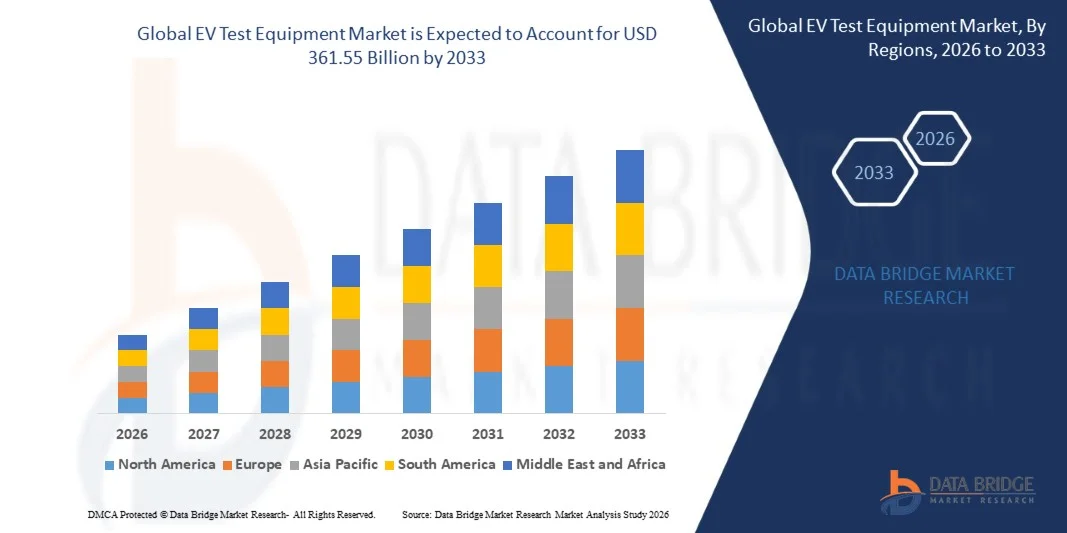
- The global EV test equipment market size was valued at USD 83.80 billion in 2025 and is expected to reach USD 361.55 billion by 2033, at a CAGR of 20.05% during the forecast period
- The market growth is largely fuelled by the rapid adoption of electric vehicles, increasing government incentives for EV production, and the growing need for advanced testing solutions to ensure vehicle safety, performance, and compliance with evolving regulations
EV Test Equipment Market Analysis
- The market is witnessing significant growth due to technological advancements in battery testing, powertrain diagnostics, and electric motor validation
- Rising investments by automotive OEMs and tier-1 suppliers in research and development are accelerating the adoption of sophisticated EV test equipment across laboratories and production lines
- North America dominated the EV test equipment market with the largest revenue share in 2025, driven by increasing adoption of electric vehicles, supportive government policies, and substantial investments in EV infrastructure
- Asia-Pacific region is expected to witness the highest growth rate in the global EV test equipment market, driven by rapid urbanization, growing EV production, and expanding infrastructure for electric mobility in countries such as China, Japan, and India
- The Passenger Car segment held the largest market revenue share in 2025, driven by the rapid adoption of electric passenger vehicles and the growing need for battery, powertrain, and motor testing. Test equipment for passenger EVs is increasingly used to ensure safety, performance, and compliance with global automotive standards, making it a preferred choice for OEMs and testing facilities
Report Scope and EV Test Equipment Market Segmentation
|
Attributes |
EV Test Equipment Key Market Insights |
|
Segments Covered |
|
|
Countries Covered |
North America
Europe
Asia-Pacific
Middle East and Africa
South America
|
|
Key Market Players |
• Arbin Instruments (U.S.) |
|
Market Opportunities |
• Increasing Adoption Of Electric Vehicles Globally |
|
Value Added Data Infosets |
In addition to the market insights such as market value, growth rate, market segments, geographical coverage, market players, and market scenario, the market report curated by the Data Bridge Market Research team includes in-depth expert analysis, import/export analysis, pricing analysis, production consumption analysis, and pestle analysis. |
EV Test Equipment Market Trends
“Rising Adoption Of Electric Vehicles And Advanced Testing Solutions”
• The accelerating adoption of electric vehicles (EVs) is significantly shaping the EV test equipment market, as manufacturers increasingly require precise testing solutions for batteries, powertrains, and motors. Advanced EV test equipment ensures vehicle safety, performance, and compliance with evolving regulatory standards, strengthening its adoption across automotive OEMs, component suppliers, and research laboratories
• Increasing awareness around vehicle safety, performance optimization, and emission reduction is driving demand for high-precision and automated testing systems. Governments and regulatory authorities are promoting EV deployment, which is encouraging manufacturers to invest in comprehensive testing solutions to ensure reliability and efficiency
• Sustainability trends and the push for low-emission transportation are influencing procurement decisions, with companies emphasizing energy-efficient testing equipment, modular solutions, and real-time monitoring capabilities. These factors are enabling EV test equipment providers to differentiate offerings in a competitive market and reinforce their technological leadership
• For instance, in 2024, Keysight Technologies in the U.S. and AVL in Austria expanded their EV test equipment portfolios with high-voltage battery testing and integrated powertrain validation systems. These launches addressed growing industry demand for accurate, scalable, and safe testing, distributed across OEM labs, testing centers, and pilot production lines
• While demand for EV test equipment is rising, sustained market growth depends on continuous R&D, technological innovation, and cost-efficient solutions. Manufacturers are focusing on improving test accuracy, system integration, and automation to meet global EV production targets and support the transition to sustainable mobility
EV Test Equipment Market Dynamics
Driver
“Growing Adoption Of Electric Vehicles And Need For Advanced Testing”
• Rapid global adoption of EVs is a major driver for the EV test equipment market. Automotive manufacturers are increasingly investing in testing solutions to ensure battery performance, powertrain efficiency, and regulatory compliance, supporting the overall growth of the sector
• Expanding applications across passenger vehicles, commercial fleets, and heavy-duty electric vehicles are influencing market growth. Advanced testing equipment helps enhance safety, reliability, and energy efficiency while meeting stringent international standards
• EV test equipment providers are actively promoting innovative solutions through technology upgrades, automation, and integration with digital twins and real-time analytics. These efforts are supported by government incentives, emission reduction mandates, and rising consumer demand for reliable EVs
• For instance, in 2023, AVL in Austria and Horiba in Japan reported increased deployment of EV testing systems across battery and powertrain validation facilities. This expansion followed higher adoption of EVs and stricter regulatory norms, reinforcing product differentiation and brand recognition
• Although rising EV adoption supports growth, wider uptake depends on affordability, technology standardization, and ease of integration. Investment in R&D, scalable solutions, and digital testing platforms will be critical for meeting global EV market demands and maintaining a competitive advantage
Restraint/Challenge
“High Equipment Costs And Complex Integration Requirements”
• The relatively high cost of advanced EV test equipment compared to conventional automotive testing solutions remains a key challenge, limiting adoption among smaller manufacturers and new entrants. High initial investment and maintenance costs can slow deployment in cost-sensitive markets
• Integration complexity with existing testing facilities, software platforms, and vehicle prototypes can hinder operational efficiency. Manufacturers must invest in skilled personnel, calibration systems, and process optimization to fully utilize the capabilities of EV test equipment
• Supply chain and distribution challenges also impact market growth, particularly for high-voltage and precision battery testing equipment. Ensuring reliable delivery, installation, and maintenance adds to operational complexity and cost
• For instance, in 2024, testing laboratories in India and Brazil reported slower adoption of high-voltage battery and powertrain testing systems due to high costs and technical integration challenges. This also affected smaller EV component manufacturers, limiting visibility and market reach
• Overcoming these challenges will require cost-effective production, standardized testing protocols, and modular, easy-to-integrate solutions. Collaboration with OEMs, regulatory bodies, and technology partners can help unlock long-term growth potential in the global EV test equipment market
EV Test Equipment Market Scope
The EV test equipment market is segmented on the basis of EV vehicle type, electric vehicle type, and application.
• By EV Vehicle Type
On the basis of EV vehicle type, the market is segmented into Passenger Car and Commercial Vehicle. The Passenger Car segment held the largest market revenue share in 2025, driven by the rapid adoption of electric passenger vehicles and the growing need for battery, powertrain, and motor testing. Test equipment for passenger EVs is increasingly used to ensure safety, performance, and compliance with global automotive standards, making it a preferred choice for OEMs and testing facilities.
The Commercial Vehicle segment is expected to witness the fastest growth rate from 2026 to 2033, driven by rising demand for electric buses, trucks, and delivery vehicles. Advanced test equipment for commercial EVs is essential for validating high-capacity batteries, drivetrains, and charging systems, supporting fleet electrification and improving operational efficiency.
• By Electric Vehicle Type
On the basis of electric vehicle type, the market is segmented into BEV and HEV. The BEV segment dominated the market in 2025, owing to the rapid expansion of fully electric vehicles and the increasing need for comprehensive battery and powertrain testing solutions. BEV testing ensures energy efficiency, safety, and regulatory compliance, making it critical for OEMs and component manufacturers.
The HEV segment is expected to witness strong growth from 2026 to 2033, fueled by increasing hybrid vehicle production and the need for testing both conventional and electric drivetrain components. Hybrid testing solutions help optimize fuel efficiency and emission performance while integrating battery and engine management systems.
• By Application
On the basis of application, the market is segmented into EV Component and Drivetrain, EV Charging, and Powertrain. The EV Component and Drivetrain segment held the largest revenue share in 2025, driven by the need for accurate testing of batteries, motors, inverters, and other critical EV components. Comprehensive testing improves vehicle safety, reliability, and performance.
The EV Charging segment is expected to witness the fastest growth rate from 2026 to 2033, due to increasing investments in high-speed charging infrastructure and advanced validation systems. Similarly, the Powertrain segment is gaining traction as manufacturers adopt integrated testing solutions for motor, gearbox, and battery interactions, ensuring efficient performance and compliance with evolving standards.
EV Test Equipment Market Regional Analysis
• North America dominated the EV test equipment market with the largest revenue share in 2025, driven by increasing adoption of electric vehicles, supportive government policies, and substantial investments in EV infrastructure
• The region’s strong focus on technological advancements and growing demand for efficient testing solutions for batteries, drivetrains, and charging systems is propelling market growth
• High investments by manufacturers and research institutions in R&D, combined with the presence of leading EV and component producers, further strengthen North America’s position in the global market
U.S. EV Test Equipment Market Insight
The U.S. EV test equipment market captured the largest revenue share in 2025 within North America, driven by rapid EV adoption and government incentives supporting clean energy and electric mobility. The demand for advanced testing solutions for EV batteries, motors, and charging infrastructure is increasing. Manufacturers are investing in high-performance test equipment to ensure reliability, safety, and efficiency, boosting the market growth. Furthermore, partnerships between EV makers and testing solution providers are enhancing innovation and accelerating deployment of state-of-the-art EV technologies.
Europe EV Test Equipment Market Insight
The Europe EV test equipment market is expected to witness the fastest growth rate from 2026 to 2033, fueled by stringent emission regulations, ambitious EV adoption targets, and increasing investments in charging infrastructure. Growing awareness of sustainability and government incentives for EV production and adoption are driving the deployment of advanced testing solutions. Europe is seeing rapid expansion across battery testing, powertrain validation, and EV component testing applications, catering to both passenger and commercial electric vehicles.
U.K. EV Test Equipment Market Insight
The U.K. EV test equipment market is expected to witness strong growth from 2026 to 2033, driven by the government’s push for zero-emission vehicles and expanding EV adoption across urban and commercial segments. Increased demand for reliable and accurate testing solutions for EV batteries and drivetrains is supporting market expansion. The presence of research institutions and collaborations with EV manufacturers further encourages innovation and accelerates the development of efficient testing technologies.
Germany EV Test Equipment Market Insight
The Germany EV test equipment market is expected to witness the fastest growth rate from 2026 to 2033, driven by the country’s leading automotive industry, growing EV production, and adoption of cutting-edge testing solutions. Germany’s emphasis on precision engineering and innovation promotes the use of advanced testing equipment for batteries, powertrains, and charging systems. The integration of smart testing platforms and automated solutions is becoming increasingly prevalent, enabling manufacturers to ensure high performance, safety, and compliance with global standards.
Asia-Pacific EV Test Equipment Market Insight
The Asia-Pacific EV test equipment market is expected to witness the highest growth rate from 2026 to 2033, driven by rising EV adoption, rapid urbanization, and government initiatives supporting electric mobility in countries such as China, Japan, and India. Increasing investments in battery production, powertrain validation, and charging infrastructure are propelling market demand. The region’s growing manufacturing capabilities and cost-effective solutions make EV test equipment increasingly accessible, supporting widespread adoption across passenger and commercial EV segments.
Japan EV Test Equipment Market Insight
The Japan EV test equipment market is expected to witness rapid growth from 2026 to 2033 due to the country’s high technological adoption, strong EV manufacturing base, and focus on innovation. Japan emphasizes advanced testing solutions for batteries, drivetrains, and charging systems to ensure high efficiency and safety. The integration of IoT and automation technologies in EV testing processes is driving market expansion, especially for passenger EVs and commercial fleets.
China EV Test Equipment Market Insight
The China EV test equipment market accounted for the largest market revenue share in Asia-Pacific in 2025, attributed to the country’s rapidly expanding EV industry, supportive government policies, and high adoption of electric vehicles. China is a leading hub for EV production, battery manufacturing, and component testing. The increasing need for efficient, reliable, and scalable testing solutions, combined with strong domestic equipment manufacturers, is driving market growth across both passenger and commercial EV segments.
EV Test Equipment Market Share
The EV Test Equipment industry is primarily led by well-established companies, including:
• Arbin Instruments (U.S.)
• Atesteo Gmbh (Germany)
• AVL List Gmbh (Austria)
• Blum-Novotest Gmbh (Germany)
• Burke Porter Group (U.S.)
• Chroma Ate (Taiwan)
• Dewesoft (Slovenia)
• FEV Group Gmbh (Germany)
• Horiba (Japan)
• Kuka AG (Germany)
• Keysight Technologies (U.S.)
• National Instruments (U.S.)
• Siemens AG (Germany)
• Hitachi Automotive Systems (Japan)
• Tektronix (U.S.)
Latest Developments in Global EV Test Equipment Market
- In May 2021, Chroma introduced its 8620 testbeds, adopted by a leading Taiwanese EV power supply manufacturer, to enhance ISO standard compliance and perform power-level HIL testing on DC-DC converters. The system evaluates both regular and abnormal functionalities, as well as failure modes, ensuring robust performance and reliability. This development strengthens product quality assurance and accelerates EV component testing processes, supporting manufacturers in meeting stringent safety and regulatory standards
- In April 2021, TÜV Rheinland received designation from the German Federal Motor Transport Authority (KBA) to provide certification and approval services for OEMs based on UN regulations. This enables faster compliance verification for electric vehicle components and systems, enhancing regulatory adherence while improving market trust in certified products. The designation positions TÜV Rheinland as a key partner for global EV manufacturers seeking recognized testing and certification solutions
SKU-
Get online access to the report on the World's First Market Intelligence Cloud

- Interactive Data Analysis Dashboard
- Company Analysis Dashboard for high growth potential opportunities
- Research Analyst Access for customization & queries
- Competitor Analysis with Interactive dashboard
- Latest News, Updates & Trend analysis
- Harness the Power of Benchmark Analysis for Comprehensive Competitor Tracking
Research Methodology
Data collection and base year analysis are done using data collection modules with large sample sizes. The stage includes obtaining market information or related data through various sources and strategies. It includes examining and planning all the data acquired from the past in advance. It likewise envelops the examination of information inconsistencies seen across different information sources. The market data is analysed and estimated using market statistical and coherent models. Also, market share analysis and key trend analysis are the major success factors in the market report. To know more, please request an analyst call or drop down your inquiry.
The key research methodology used by DBMR research team is data triangulation which involves data mining, analysis of the impact of data variables on the market and primary (industry expert) validation. Data models include Vendor Positioning Grid, Market Time Line Analysis, Market Overview and Guide, Company Positioning Grid, Patent Analysis, Pricing Analysis, Company Market Share Analysis, Standards of Measurement, Global versus Regional and Vendor Share Analysis. To know more about the research methodology, drop in an inquiry to speak to our industry experts.
Customization Available
Data Bridge Market Research is a leader in advanced formative research. We take pride in servicing our existing and new customers with data and analysis that match and suits their goal. The report can be customized to include price trend analysis of target brands understanding the market for additional countries (ask for the list of countries), clinical trial results data, literature review, refurbished market and product base analysis. Market analysis of target competitors can be analyzed from technology-based analysis to market portfolio strategies. We can add as many competitors that you require data about in the format and data style you are looking for. Our team of analysts can also provide you data in crude raw excel files pivot tables (Fact book) or can assist you in creating presentations from the data sets available in the report.












