


Global Exoskeleton Market
Market Size in USD Million
CAGR :
% 
 USD
590.52 Million
USD
9,598.28 Million
2025
2033
USD
590.52 Million
USD
9,598.28 Million
2025
2033
 Forecast Period Forecast Period |
2026 –2033 |
 Market Size (Base Year) Market Size (Base Year) |
USD 590.52 Million |
 Market Size (Forecast Year) Market Size (Forecast Year) |
USD 9,598.28 Million |
 CAGR CAGR |
% |
| Major Markets Players |
|
Exoskeleton Market Size
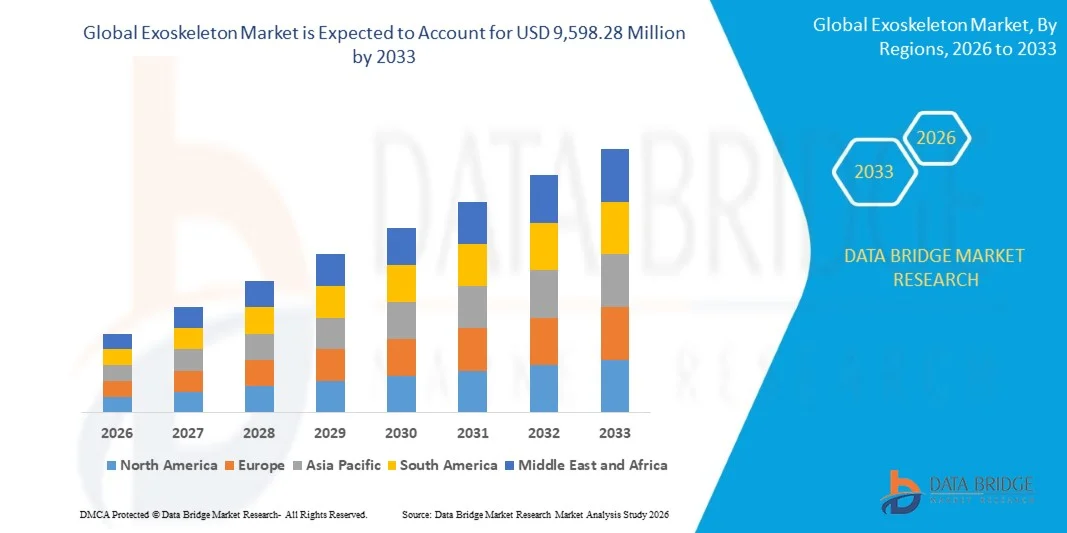
- The global exoskeleton market size was valued at USD 590.52 million in 2025 and is expected to reach USD 9,598.28 million by 2033, at a CAGR of 41.70% during the forecast period
- The market growth is largely fuelled by the rising prevalence of mobility impairments and workplace injuries, driving demand for assistive wearable robotic systems
- In addition, growing investments from governments and private organizations in enhancing worker safety and rehabilitation technologies are accelerating market penetration
Exoskeleton Market Analysis
- The market is experiencing strong momentum due to the convergence of robotics, artificial intelligence, and human augmentation technologies, enabling more efficient and adaptive exoskeleton systems
- In addition, companies are focusing on product innovation and strategic collaborations to enhance functionality and expand application scope across multiple industries
- North America dominated the exoskeleton market with the largest revenue share of 44.10% in 2025, driven by strong adoption of advanced robotic technologies and increasing demand for workplace safety and rehabilitation solutions
- Asia-Pacific region is expected to witness the highest growth rate in the global exoskeleton market, driven by rapid urbanization, expanding manufacturing sector, and increasing investments in robotics and healthcare technologies
- The mobile exoskeleton segment held the largest market revenue share in 2025 driven by its flexibility, portability, and wide range of applications across healthcare, industrial, and military sectors. These systems enable users to move freely while receiving mechanical support, making them highly suitable for rehabilitation, mobility assistance, and field operations
Report Scope and Exoskeleton Market Segmentation
|
Attributes |
Exoskeleton Key Market Insights |
|
Segments Covered |
|
|
Countries Covered |
North America
Europe
Asia-Pacific
Middle East and Africa
South America
|
|
Key Market Players |
• Ekso Bionics Holdings Inc. (U.S.) |
|
Market Opportunities |
• Increasing Adoption In Healthcare Rehabilitation |
|
Value Added Data Infosets |
In addition to the insights on market scenarios such as market value, growth rate, segmentation, geographical coverage, and major players, the market reports curated by the Data Bridge Market Research also include in-depth expert analysis, geographically represented company-wise production and capacity, network layouts of distributors and partners, detailed and updated price trend analysis and deficit analysis of supply chain and demand. |
Exoskeleton Market Trends
“Rising Demand for Workplace Safety and Human Augmentation”
• The increasing emphasis on reducing workplace injuries and enhancing worker productivity is significantly shaping the exoskeleton market, as industries adopt wearable robotic solutions to support physical tasks and minimize strain. Exoskeletons are gaining traction due to their ability to improve endurance, posture, and efficiency without compromising operational performance. This trend is strengthening their adoption across manufacturing, logistics, construction, and defense sectors, encouraging companies to invest in advanced ergonomic solutions that align with evolving workforce requirements
• Growing awareness around occupational health, safety regulations, and employee well-being has accelerated the demand for exoskeleton systems in physically intensive industries. Organizations are actively integrating these solutions to reduce fatigue, prevent musculoskeletal disorders, and enhance workforce efficiency. This has also led to increased collaboration between technology providers and industrial players to develop customized solutions tailored to specific operational needs
• Technological advancements in robotics, sensors, and lightweight materials are influencing purchasing decisions, with manufacturers focusing on improving comfort, adaptability, and cost-efficiency. These factors are helping companies differentiate their offerings in a competitive market while driving continuous innovation. In addition, integration with AI and IoT is enabling smarter and more responsive exoskeleton systems, further enhancing their functionality and user experience
• For instance, in 2024, leading companies such as Ekso Bionics in the U.S. and SuitX expanded their industrial exoskeleton portfolios with improved ergonomic designs and enhanced load-bearing capabilities. These product launches were introduced to address increasing demand from manufacturing and logistics sectors, with deployment across warehouses and production facilities. The solutions were also promoted as cost-effective tools for injury prevention and productivity enhancement
• While demand for exoskeletons is rising, sustained market expansion depends on continuous innovation, cost reduction, and ensuring ease of use across diverse applications. Manufacturers are focusing on improving battery life, scalability, and integration capabilities, while also addressing challenges related to user training and long-term reliability to support broader adoption
Exoskeleton Market Dynamics
Driver
“Growing Adoption of Exoskeletons for Rehabilitation and Mobility Assistance”
• Rising prevalence of mobility impairments and physical disabilities is a major driver for the exoskeleton market, as healthcare providers increasingly adopt robotic assistive devices for rehabilitation and mobility support. These systems enable patients to regain movement, improve muscle strength, and enhance recovery outcomes, supporting their integration into modern therapeutic practices
• Expanding applications in rehabilitation centers, hospitals, and home care settings are influencing market growth, as exoskeletons offer improved patient outcomes and reduce dependency on caregivers. Their ability to provide consistent and controlled movement therapy is encouraging adoption among medical professionals, while also supporting long-term recovery programs
• Healthcare and technology companies are actively promoting exoskeleton-based rehabilitation solutions through product innovation, clinical trials, and strategic partnerships. These efforts are supported by increasing demand for advanced medical technologies and personalized treatment options, encouraging collaboration between device manufacturers and healthcare institutions to enhance treatment effectiveness
• For instance, in 2023, ReWalk Robotics in Israel and CYBERDYNE Inc. expanded their rehabilitation-focused exoskeleton solutions across hospitals and therapy centers. This expansion followed rising demand for assistive mobility technologies, driving adoption among patients with spinal cord injuries and neurological disorders, while also strengthening brand presence in the healthcare segment
• Although growing healthcare demand supports market expansion, wider adoption depends on affordability, reimbursement policies, and clinical validation. Investment in research, regulatory approvals, and patient accessibility will be critical to ensure long-term growth and broader acceptance of exoskeleton technologies
Restraint/Challenge
“High Cost and Limited Accessibility of Advanced Exoskeleton Systems”
• The relatively high cost of exoskeleton systems compared to traditional assistive devices remains a key challenge, limiting adoption among small enterprises and healthcare providers. High development costs, advanced components, and complex manufacturing processes contribute to elevated pricing, restricting widespread deployment
• Awareness and accessibility remain uneven, particularly in developing markets where knowledge of exoskeleton benefits is still emerging. Limited understanding of functionality and return on investment slows adoption across various industries, while also affecting demand among smaller organizations with budget constraints
• Supply chain and operational challenges also impact market growth, as exoskeletons require specialized components, maintenance, and technical expertise. Integration into existing workflows and ensuring user training add to operational complexity, increasing overall implementation costs for organizations
• For instance, in 2024, distributors and healthcare providers in emerging markets reported slower adoption of advanced exoskeleton solutions due to high costs and limited reimbursement support, affecting uptake among hospitals and rehabilitation centers. Budget limitations and lack of skilled professionals were additional barriers, influencing procurement decisions and delaying large-scale implementation
• Overcoming these challenges will require cost-effective production, improved accessibility, and increased awareness among end users. Collaboration between manufacturers, policymakers, and healthcare providers can help enhance affordability and adoption, while advancements in technology and economies of scale will play a key role in reducing costs and expanding market reach
Exoskeleton Market Scope
The market is segmented on the basis of technology (type), technology (drive type), and end-user.
• By Technology (Type)
On the basis of technology (type), the exoskeleton market is segmented into mobile exoskeleton and stationary exoskeleton. The mobile exoskeleton segment held the largest market revenue share in 2025 driven by its flexibility, portability, and wide range of applications across healthcare, industrial, and military sectors. These systems enable users to move freely while receiving mechanical support, making them highly suitable for rehabilitation, mobility assistance, and field operations.
The stationary exoskeleton segment is expected to witness steady growth from 2026 to 2033, driven by its increasing use in controlled environments such as rehabilitation centers and research facilities. Stationary systems provide stable and precise movement support, making them ideal for physical therapy and training applications where consistent performance and monitoring are required.
• By Technology (Drive Type)
On the basis of technology (drive type), the exoskeleton market is segmented into pneumatic actuator, hydraulic, electric servo, electric actuator, fully mechanical, and shape memory alloy actuator. The electric actuator segment held the largest market revenue share in 2025 driven by its efficiency, precision, and ease of integration with advanced control systems. Electric actuators are widely preferred due to their lightweight nature, lower maintenance requirements, and compatibility with battery-powered systems, supporting their adoption across multiple applications.
The shape memory alloy actuator segment is expected to witness the fastest growth rate from 2026 to 2033, driven by its ability to provide compact, lightweight, and highly responsive actuation. These actuators offer significant potential for next-generation exoskeleton designs, particularly in applications requiring flexibility, energy efficiency, and improved user comfort, encouraging ongoing research and innovation.
• By End-User
On the basis of end-user, the exoskeleton market is segmented into healthcare, military, and industrial. The healthcare segment held the largest market revenue share in 2025 driven by the increasing use of exoskeletons in rehabilitation, physical therapy, and mobility assistance for patients with neurological and musculoskeletal conditions. These systems are widely adopted in hospitals and rehabilitation centers to enhance patient recovery and improve quality of life.
The industrial segment is expected to witness the fastest growth rate from 2026 to 2033, driven by the rising focus on worker safety, productivity, and injury prevention in manufacturing, construction, and logistics sectors. Industrial exoskeletons are increasingly being deployed to reduce physical strain and enhance operational efficiency, supporting their growing adoption across labor-intensive industries.
Exoskeleton Market Regional Analysis
• North America dominated the exoskeleton market with the largest revenue share of 44.10% in 2025, driven by strong adoption of advanced robotic technologies and increasing demand for workplace safety and rehabilitation solutions
• Organizations in the region highly value the efficiency, ergonomic support, and injury prevention capabilities offered by exoskeletons across industrial and healthcare settings
• This widespread adoption is further supported by high healthcare expenditure, strong technological infrastructure, and increasing investments in human augmentation technologies, establishing exoskeletons as a key solution for enhancing productivity and mobility
U.S. Exoskeleton Market Insight
The U.S. exoskeleton market captured the largest revenue share in 2025 within North America, fueled by the rapid adoption of wearable robotics and the growing focus on workplace safety and rehabilitation technologies. End users are increasingly prioritizing solutions that enhance worker productivity and patient recovery outcomes through advanced assistive systems. The presence of leading market players, strong R&D activities, and increasing demand for industrial and medical exoskeletons further propel the market. Moreover, the integration of AI, sensors, and IoT technologies is significantly contributing to market expansion.
Europe Exoskeleton Market Insight
The Europe exoskeleton market is expected to witness the fastest growth rate from 2026 to 2033, primarily driven by stringent workplace safety regulations and the rising demand for advanced rehabilitation solutions. Increasing aging population and growing awareness of assistive technologies are fostering the adoption of exoskeletons. European industries are also focusing on reducing workplace injuries and improving operational efficiency, further boosting demand across industrial and healthcare applications.
U.K. Exoskeleton Market Insight
The U.K. exoskeleton market is expected to witness the fastest growth rate from 2026 to 2033, driven by the increasing adoption of automation technologies and a strong emphasis on employee safety and well-being. In addition, the demand for advanced rehabilitation solutions is rising due to the growing prevalence of mobility impairments. The country’s focus on innovation, along with supportive healthcare infrastructure, is expected to continue driving market growth.
Germany Exoskeleton Market Insight
The Germany exoskeleton market is expected to witness the fastest growth rate from 2026 to 2033, fueled by the country’s strong industrial base and emphasis on advanced manufacturing technologies. The adoption of exoskeletons is increasing in automotive, construction, and logistics sectors to enhance worker efficiency and reduce physical strain. In addition, Germany’s focus on technological innovation and workplace safety is promoting the integration of exoskeleton solutions across industries.
Asia-Pacific Exoskeleton Market Insight
The Asia-Pacific exoskeleton market is expected to witness the fastest growth rate from 2026 to 2033, driven by rapid industrialization, increasing healthcare investments, and growing awareness of assistive technologies. The region's expanding manufacturing sector and rising focus on worker safety are encouraging the adoption of exoskeletons. Furthermore, supportive government initiatives and advancements in robotics are improving accessibility and affordability across emerging economies.
Japan Exoskeleton Market Insight
The Japan exoskeleton market is expected to witness the fastest growth rate from 2026 to 2033 due to the country’s aging population, advanced technological capabilities, and high demand for rehabilitation and mobility support solutions. The integration of exoskeletons in healthcare and elderly care is gaining traction, supported by the increasing need for assistive devices. In addition, Japan’s leadership in robotics innovation is accelerating the development and deployment of advanced exoskeleton systems.
China Exoskeleton Market Insight
The China exoskeleton market accounted for the largest market revenue share in Asia Pacific in 2025, attributed to rapid industrial growth, increasing investments in robotics, and rising demand for worker safety solutions. The country is emerging as a key manufacturing hub for exoskeleton components and systems, supporting cost-effective production and wider adoption. In addition, government support for automation and smart manufacturing is playing a crucial role in driving market expansion.
Exoskeleton Market Share
The Exoskeleton industry is primarily led by well-established companies, including:
• Ekso Bionics Holdings Inc. (U.S.)
• Panasonic Corporation (Japan)
• CYBERDYNE, Inc. (Japan)
• ReWalk Robotics (Israel)
• Lockheed Martin Corporation (U.S.)
• Rex Bionics plc. (U.K.)
• B-Temia Inc. (Canada)
• DIH Medical (China)
• Wearable Robotics srl (Italy)
• Ottobock (Germany)
• SuitX Inc. (U.S.)
• Gogoa.eu (Spain)
• Technaid (Spain)
• Honda Motor Company, Ltd. (Japan)
• Myomo, Inc. (U.S.)
• Bionik Laboratories Corp. (Canada)
• Atoun Inc. (Japan)
• RB3D (France)
• Hocoma (Switzerland)
• U.S. Bionics, Inc. (U.S.)
• Knots Plus Ltd. (U.K.)
Latest Developments in Global Exoskeleton Market
- In January 2026, Ascentiz, product innovation, introduced a modular exoskeleton at CES 2026 featuring interchangeable hip and knee modules powered by advanced drive technologies to support natural movement. The system utilizes AI trained on extensive gait cycle data to enable rapid mode switching and improved efficiency. It significantly reduces leg effort, joint stress, and energy loss during dynamic and load-bearing tasks, enhancing user comfort. This development is expected to strengthen technological advancement and accelerate adoption across industrial and rehabilitation applications
- In January 2026, OYMotion Technology and Melexis, strategic partnership, collaborated to enhance robotic perception and control by integrating advanced sensor technologies with AI-driven systems. The initiative focuses on developing dexterous robotic hands and rehabilitation exoskeletons with improved responsiveness and precision. Leveraging global supply chains and lightweight designs, the partnership aims to expand applications across medical and industrial sectors. This is expected to boost innovation and commercialization in next-generation exoskeleton solutions
- In February 2025, Wandercraft, clinical trial development, initiated a landmark trial for its personal exoskeleton, a self-balancing device designed to restore natural movement functions such as standing and walking. The system enhances independence for individuals with severe mobility impairments through advanced stabilization technology. Its success could significantly improve rehabilitation outcomes and patient mobility solutions. This development is likely to drive clinical adoption and strengthen the healthcare segment of the market
- In February 2025, Chulalongkorn University, product innovation, introduced an exoskeleton wheelchair designed to assist individuals with disabilities in performing sitting, standing, and walking functions. The robotic suit integrates mobility assistance with user-friendly design to improve accessibility and independence. It addresses key challenges in assistive mobility solutions while enhancing patient quality of life. This innovation is expected to support market growth by expanding applications in rehabilitation and personal mobility
- In November 2024, Hippos Exoskeleton, product launch, announced a knee brace integrated with airbag technology aimed at preventing ACL injuries during physical activities. The solution enhances joint protection by providing dynamic support and reducing impact stress. It is designed for use in sports, rehabilitation, and occupational settings to minimize injury risks. This development is anticipated to broaden the application scope of exoskeleton technologies in preventive healthcare and sports safety
- In June 2022, CYBERDYNE Inc., strategic collaboration, partnered with SOCSO in Malaysia to expand the use of Hybrid Assistive Limb (HAL) technology for rehabilitation treatments. The initiative focuses on improving recovery outcomes for patients with severe paralysis through advanced robotic assistance. It enhances accessibility to innovative therapy solutions while strengthening clinical adoption. This collaboration is expected to support long-term market growth by promoting wider acceptance of exoskeleton-based rehabilitation technologies
SKU-
Get online access to the report on the World's First Market Intelligence Cloud

- Interactive Data Analysis Dashboard
- Company Analysis Dashboard for high growth potential opportunities
- Research Analyst Access for customization & queries
- Competitor Analysis with Interactive dashboard
- Latest News, Updates & Trend analysis
- Harness the Power of Benchmark Analysis for Comprehensive Competitor Tracking
Global Exoskeleton Market, Supply Chain Analysis and Ecosystem Framework
To support market growth and help clients navigate the impact of geopolitical shifts, DBMR has integrated in-depth supply chain analysis into its Global Exoskeleton Market research reports. This addition empowers clients to respond effectively to global changes affecting their industries. The supply chain analysis section includes detailed insights such as Global Exoskeleton Market consumption and production by country, price trend analysis, the impact of tariffs and geopolitical developments, and import and export trends by country and HSN code. It also highlights major suppliers with data on production capacity and company profiles, as well as key importers and exporters. In addition to research, DBMR offers specialized supply chain consulting services backed by over a decade of experience, providing solutions like supplier discovery, supplier risk assessment, price trend analysis, impact evaluation of inflation and trade route changes, and comprehensive market trend analysis.
Research Methodology
Data collection and base year analysis are done using data collection modules with large sample sizes. The stage includes obtaining market information or related data through various sources and strategies. It includes examining and planning all the data acquired from the past in advance. It likewise envelops the examination of information inconsistencies seen across different information sources. The market data is analysed and estimated using market statistical and coherent models. Also, market share analysis and key trend analysis are the major success factors in the market report. To know more, please request an analyst call or drop down your inquiry.
The key research methodology used by DBMR research team is data triangulation which involves data mining, analysis of the impact of data variables on the market and primary (industry expert) validation. Data models include Vendor Positioning Grid, Market Time Line Analysis, Market Overview and Guide, Company Positioning Grid, Patent Analysis, Pricing Analysis, Company Market Share Analysis, Standards of Measurement, Global versus Regional and Vendor Share Analysis. To know more about the research methodology, drop in an inquiry to speak to our industry experts.
Customization Available
Data Bridge Market Research is a leader in advanced formative research. We take pride in servicing our existing and new customers with data and analysis that match and suits their goal. The report can be customized to include price trend analysis of target brands understanding the market for additional countries (ask for the list of countries), clinical trial results data, literature review, refurbished market and product base analysis. Market analysis of target competitors can be analyzed from technology-based analysis to market portfolio strategies. We can add as many competitors that you require data about in the format and data style you are looking for. Our team of analysts can also provide you data in crude raw excel files pivot tables (Fact book) or can assist you in creating presentations from the data sets available in the report.












