


Exosuit Materials Market Size
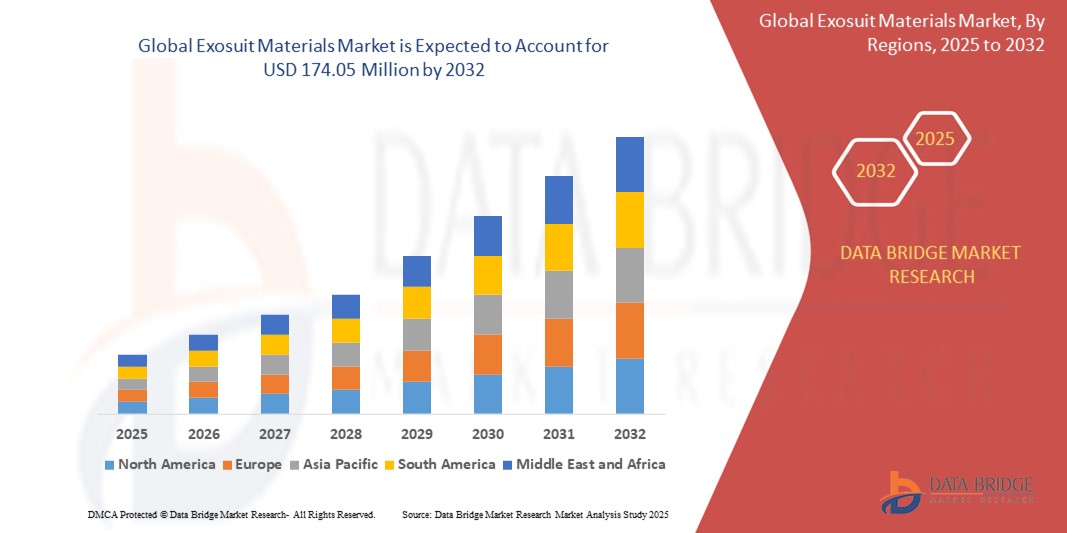
- The global exosuit materials market size was valued at USD 113.41 million in 2024 and is expected to reach USD 174.05 million by 2032, at a CAGR of 5.5% during the forecast period
- The market growth is primarily driven by the increasing adoption of exosuits in healthcare, military, and industrial applications, coupled with advancements in lightweight and durable materials such as composites and smart fabrics
- Rising demand for ergonomic, high-performance materials to enhance user comfort and exosuit functionality, along with growing investments in research and development, is accelerating market expansion
Exosuit Materials Market Analysis
- Exosuit materials, including advanced composites, lightweight metals, and smart textiles, are critical for developing exosuits that enhance human strength, mobility, and endurance in healthcare, defense, and industrial settings
- The demand for exosuit materials is fueled by the growing prevalence of mobility impairments, increasing workplace safety requirements, and the integration of exosuits in military applications for enhanced soldier performance
- North America dominated the exosuit materials market with the largest revenue share of 35.1% in 2024, driven by robust R&D ecosystems, high defense spending, and the presence of leading material innovators and exosuit manufacturers
- Asia-Pacific is expected to be the fastest-growing region during the forecast period, propelled by rapid industrialization, increasing healthcare needs, and government initiatives supporting advanced manufacturing in countries such as China, Japan, and India
- The composites segment dominated the largest market revenue share of 38.5% in 2024, driven by their high strength-to-weight ratio, durability, and versatility in applications such as healthcare, military, and industrial exosuits. Composites, including carbon fiber and glass fiber reinforced polymers, are widely adopted for their ability to reduce weight while maintaining structural integrity
Report Scope and Exosuit Materials Market Segmentation
|
Attributes |
Exosuit Materials Key Market Insights |
|
Segments Covered |
|
|
Countries Covered |
North America
Europe
Asia-Pacific
Middle East and Africa
South America
|
|
Key Market Players |
|
|
Market Opportunities |
|
|
Value Added Data Infosets |
In addition to the insights on market scenarios such as market value, growth rate, segmentation, geographical coverage, and major players, the market reports curated by the Data Bridge Market Research also include import export analysis, production capacity overview, production consumption analysis, price trend analysis, climate change scenario, supply chain analysis, value chain analysis, raw material/consumables overview, vendor selection criteria, PESTLE Analysis, Porter Analysis, and regulatory framework. |
Exosuit Materials Market Trends
“Increasing Integration of Advanced Materials and Smart Technologies”
- The global exosuit materials market is experiencing a notable trend toward the integration of advanced materials and smart technologies
- These technologies, including lightweight composites, flexible electronics, and smart textiles, enable enhanced functionality, comfort, and durability in exosuits
- Advanced materials such as carbon fiber and graphene-based composites provide superior strength-to-weight ratios, improving exosuit performance for industrial, medical, and military applications
- Smart technologies, such as embedded sensors and AI-driven actuators, allow real-time monitoring of user movements, health metrics, and environmental conditions, enabling adaptive assistance and predictive maintenance
- For instances, companies are developing exosuits with integrated sensors to analyze user fatigue levels, offering personalized ergonomic support or optimizing load distribution for workers in heavy industries
- This trend is increasing the appeal of exosuits across diverse sectors, enhancing their adoption by individual users, healthcare providers, and industrial operators.
- Smart materials can respond to external stimuli, such as temperature or pressure, to dynamically adjust exosuit properties, improving user safety and efficiency.
Exosuit Materials Market Dynamics
Driver
“Rising Demand for Enhanced Human Performance and Rehabilitation Solutions”
- The growing demand for exosuits that enhance human capabilities, such as strength, endurance, and mobility, is a key driver for the global exosuit materials market
- Exosuit materials enable advanced functionalities such as injury prevention, fatigue reduction, and mobility restoration, making them critical in industries, healthcare, and defense
- Government initiatives, particularly in North America, promoting workplace safety and rehabilitation technologies, are accelerating the adoption of exosuit
- The advancement of IoT and 5G connectivity supports the development of connected exosuits, enabling real-time data transmission for applications such as remote monitoring and predictive analytics
- Manufacturers are increasingly incorporating advanced materials as standard components in exosuits to meet user expectations for lightweight, durable, and high-performance solutions
Restraint/Challenge
“High Development Costs and Regulatory Compliance Issues”
- The significant costs associated with research, development, and production of advanced exosuit materials, such as nanomaterials and smart textiles, pose a barrier to market growth, particularly in cost-sensitive regions
- Integrating these materials into exosuits requires complex manufacturing processes, increasing production expenses
- Regulatory challenges related to safety standards, biocompatibility, and environmental impact of advanced materials present additional hurdles, especially in medical and industrial applications
- The lack of standardized regulations across countries for exosuit materials complicates compliance for global manufacturers and service provider
- These factors may slow market penetration in emerging markets such as Asia-Pacific, where cost sensitivity is high, and regulatory frameworks are still evolving
Exosuit Materials market Scope
The market is segmented on the basis of material type, application, technology, and end-Use.
- By Material Type
On the basis of material type, the global exosuit materials market is segmented into composites, metals & alloys, polymers, fabrics, ceramics, and others. The composites segment dominated the largest market revenue share of 38.5% in 2024, driven by their high strength-to-weight ratio, durability, and versatility in applications such as healthcare, military, and industrial exosuits. Composites, including carbon fiber and glass fiber reinforced polymers, are widely adopted for their ability to reduce weight while maintaining structural integrity.
The polymers segment is expected to witness the fastest growth rate of 18.2% from 2025 to 2032, propelled by advancements in flexible, lightweight polymer materials that enhance comfort and mobility in soft exosuits. Their increasing use in healthcare and consumer applications, coupled with innovations in biodegradable and smart polymers, is driving adoption.
- By Application
On the basis of application, the global exosuit materials market is segmented into healthcare, military, industrial, consumer, and others. The healthcare segment dominated the market with a revenue share of 45.7% in 2024, fueled by the rising demand for exosuits in rehabilitation and mobility assistance for patients with spinal cord injuries, stroke, or age-related mobility impairments. The integration of advanced materials such as composites and fabrics in soft exosuits enhances patient comfort and recovery outcomes.
The industrial segment is anticipated to experience the fastest growth rate of 19.8% from 2025 to 2032, driven by the adoption of exosuits in manufacturing, construction, and logistics to reduce worker fatigue, enhance productivity, and prevent injuries. Materials such as metals & alloys and composites are critical for providing strength and durability in these demanding environments.
- By Technology
On the basis of technology, the global exosuit materials market is segmented into powered exosuits, passive exosuits, and hybrid exosuits. The powered exosuits segment held the largest market revenue share of 52.3% in 2024, owing to their advanced functionality in providing amplified strength and mobility through actuators and motors. These exosuits rely heavily on robust materials such as metals & alloys and composites for structural support and durability, particularly in military and industrial applications.
The hybrid exosuits segment is expected to witness the fastest growth rate of 20.1% from 2025 to 2032, driven by their ability to combine the benefits of rigid and soft materials, offering both strength and flexibility. Innovations in fabrics and polymers are enabling lighter, more comfortable hybrid designs, increasing their adoption in healthcare and consumer markets.
- By End-Use
On the basis of end-use, the global exosuit materials market is segmented into rehabilitation, defense, manufacturing, construction, and others. The rehabilitation segment accounted for the largest market revenue share of 41.2% in 2024, driven by the critical role of exosuits in physical therapy and mobility assistance for patients with neurological disorders or injuries. Materials such as soft fabrics and lightweight polymers are extensively used to ensure comfort and effectiveness in rehabilitation exosuits.
The manufacturing segment is projected to exhibit rapid growth of 21.3% from 2025 to 2032, fueled by the increasing use of exosuits to enhance worker efficiency and safety in repetitive or heavy-lifting tasks. The demand for durable materials such as composites and metals & alloys is rising to support the structural requirements of industrial exosuits.
Exosuit Materials Market Regional Analysis
- North America dominated the exosuit materials market with the largest revenue share of 35.1% in 2024, driven by robust R&D ecosystems, high defense spending, and the presence of leading material innovators and exosuit manufacturers
- Consumers and industries prioritize exosuit materials for enhancing mobility, reducing physical strain, and improving durability, particularly in regions with advanced industrial and medical infrastructures
- Growth is supported by innovations in material science, including lightweight composites and flexible polymers, alongside increasing adoption in both powered and passive exosuit technologies across various end-use sectors
U.S. Exosuit Materials Market Insight
The U.S. exosuit materials market captured the largest revenue share of 67.4% in 2024 within North America, fueled by strong investments in research and development and growing demand for exosuits in rehabilitation and defense. The trend towards worker safety and advanced medical solutions drives material adoption. Leading manufacturers’ integration of high-performance materials such as carbon fiber composites and alloys in exosuits complements industrial and healthcare applications, fostering a dynamic market ecosystem.
Europe Exosuit Materials Market Insight
The Europe exosuit materials market is expected to witness significant growth, supported by stringent regulations promoting worker safety and advancements in rehabilitation technologies. Consumers and industries seek materials that enhance exosuit functionality while ensuring comfort and durability. Growth is prominent in both industrial and medical applications, with countries such as Germany and France showing notable uptake due to increasing focus on automation and aging populations.
U.K. Exosuit Materials Market Insight
The U.K. market for exosuit materials is expected to witness rapid growth, driven by demand for enhanced worker productivity and rehabilitation solutions in healthcare settings. Increased interest in lightweight and durable materials, such as polymers and fabrics, supports exosuit customization. Evolving safety standards and a focus on reducing workplace injuries influence material choices, balancing performance with regulatory compliance.
Germany Exosuit Materials Market Insight
Germany is expected to witness rapid growth in the exosuit materials market, attributed to its advanced manufacturing sector and emphasis on ergonomic solutions. German industries prefer high-tech materials such as composites and ceramics that enhance exosuit efficiency and reduce energy consumption. The integration of these materials in premium exosuits for industrial and defense applications supports sustained market expansion.
Asia-Pacific Exosuit Materials Market Insight
The Asia-Pacific region is expected to witness the fastest growth rate, driven by expanding industrial automation and rising healthcare needs in countries such as China, India, and Japan. Increasing awareness of worker safety, mobility enhancement, and rehabilitation benefits boosts demand for advanced exosuit materials. Government initiatives promoting smart manufacturing and healthcare innovation further encourage the adoption of cutting-edge materials.
Japan Exosuit Materials Market Insight
Japan’s exosuit materials market is expected to witness rapid growth due to strong consumer and industrial preference for high-quality, technologically advanced materials that improve exosuit performance and comfort. The presence of major robotics and exosuit manufacturers and the integration of materials such as lightweight alloys and polymers in powered exosuits accelerate market penetration. Rising demand for aftermarket exosuit solutions also contributes to growth.
China Exosuit Materials Market Insight
China holds the largest share of the Asia-Pacific exosuit materials market, propelled by rapid industrialization, increasing adoption of exosuits in manufacturing, and growing demand for rehabilitation solutions. The country’s expanding workforce and focus on automation support the use of advanced materials such as composites and fabrics. Strong domestic manufacturing capabilities and cost-effective production enhance market accessibility.
Exosuit Materials Market Share
The exosuit materials industry is primarily led by well-established companies, including:
- DuPont (U.S.)
- Toray Industries (Japan)
- Teijin Limited (Japan)
- 3M (U.S.)
- Solvay S.A. (Belgium)
- Hexcel Corporation (U.S.)
- Mitsubishi Chemical Corporation (Japan)
- BASF SE (Germany)
- DSM (Netherlands)
- Honeywell International Inc. (U.S.)
- Carbon (U.S.)
- Zoltek Companies, Inc. (U.S.)
- SGL Carbon (Germany)
- Hyosung Corporation (South Korea)
- Kolon Industries (South Korea)
What are the Recent Developments in Global Exosuit Materials Market?
- In October 2024, ExxonMobil Chemical Company deepened its partnership with Materia, Inc. to scale up production of Proxima™ polymers—lightweight, hydrocarbon-based materials engineered for exosuit applications in industrial and military settings. These advanced thermoset resins, derived from Nobel Prize-winning ROMP catalyst technology, offer exceptional strength, toughness, and chemical resistance while being significantly lighter than traditional materials such as epoxy or polyurethane. By combining ExxonMobil’s global manufacturing capabilities with Materia’s innovative chemistry, the collaboration aims to accelerate the adoption of high-performance composites in next-generation wearable robotics and protective gear
- In September 2024, Ekso Bionics expanded its capabilities by acquiring a materials division from Parker Hannifin Corporation, specifically focused on advanced lightweight composites used in the Indego exoskeleton line. This strategic move builds on Ekso’s earlier acquisition of Parker’s Human Motion and Control business and reinforces its commitment to enhancing durability, comfort, and performance in exosuits for rehabilitation and industrial use. By integrating proprietary composite technologies, Ekso aims to deliver more ergonomic and efficient wearable robotics, further solidifying its leadership in the exoskeleton market
- In July 2024, CYBERDYNE Inc. partnered with Svaya Robotics to co-develop a new generation of flexible, lightweight exosuit materials for medical rehabilitation. This collaboration centers on enhancing CYBERDYNE’s Hybrid Assistive Limb (HAL) system by integrating Svaya’s advanced material technologies, aiming to improve mobility and comfort for patients with spinal cord injuries. The partnership not only strengthens HAL’s therapeutic capabilities but also expands CYBERDYNE’s footprint in the global healthcare market, particularly in neurorehabilitation and assistive robotics
- In June 2024, Lockheed Martin Corporation, in collaboration with Singapore’s Defense Science and Technology Agency (DSTA), introduced a new line of advanced exosuit materials engineered for military applications. These materials are designed to deliver enhanced strength and reduced weight, significantly improving mobility, endurance, and comfort for soldiers operating in demanding environments. The initiative reflects a broader push toward next-generation soldier systems that integrate lightweight composites and ergonomic design to boost operational effectiveness.
- While specific technical details of the materials remain under wraps, you can explore Lockheed Martin’s broader innovation efforts on their official engineering materials page. Let me know if you’d such as a comparison with other military-grade exosuit technologies
- In April 2024, German Bionic unveiled a new carbon-fiber-based exosuit material for its powered exoskeletons, targeting industrial automation and physically demanding workplaces. This lightweight yet durable material enhances ergonomics, reduces worker fatigue, and improves safety during repetitive lifting and strenuous tasks. The launch was backed by a funding round, underscoring investor confidence in German Bionic’s mission to augment human labor with AI-powered wearable robotics. The new material is integrated into the company’s flagship Apogee and Apogee+ exosuits, which are already deployed across logistics, manufacturing, and healthcare sectors

- Interactive Data Analysis Dashboard
- Company Analysis Dashboard for high growth potential opportunities
- Research Analyst Access for customization & queries
- Competitor Analysis with Interactive dashboard
- Latest News, Updates & Trend analysis
- Harness the Power of Benchmark Analysis for Comprehensive Competitor Tracking
Global Exosuit Materials Market, Supply Chain Analysis and Ecosystem Framework
To support market growth and help clients navigate the impact of geopolitical shifts, DBMR has integrated in-depth supply chain analysis into its Global Exosuit Materials Market research reports. This addition empowers clients to respond effectively to global changes affecting their industries. The supply chain analysis section includes detailed insights such as Global Exosuit Materials Market consumption and production by country, price trend analysis, the impact of tariffs and geopolitical developments, and import and export trends by country and HSN code. It also highlights major suppliers with data on production capacity and company profiles, as well as key importers and exporters. In addition to research, DBMR offers specialized supply chain consulting services backed by over a decade of experience, providing solutions like supplier discovery, supplier risk assessment, price trend analysis, impact evaluation of inflation and trade route changes, and comprehensive market trend analysis.
Data collection and base year analysis are done using data collection modules with large sample sizes. The stage includes obtaining market information or related data through various sources and strategies. It includes examining and planning all the data acquired from the past in advance. It likewise envelops the examination of information inconsistencies seen across different information sources. The market data is analysed and estimated using market statistical and coherent models. Also, market share analysis and key trend analysis are the major success factors in the market report. To know more, please request an analyst call or drop down your inquiry.
The key research methodology used by DBMR research team is data triangulation which involves data mining, analysis of the impact of data variables on the market and primary (industry expert) validation. Data models include Vendor Positioning Grid, Market Time Line Analysis, Market Overview and Guide, Company Positioning Grid, Patent Analysis, Pricing Analysis, Company Market Share Analysis, Standards of Measurement, Global versus Regional and Vendor Share Analysis. To know more about the research methodology, drop in an inquiry to speak to our industry experts.
Data Bridge Market Research is a leader in advanced formative research. We take pride in servicing our existing and new customers with data and analysis that match and suits their goal. The report can be customized to include price trend analysis of target brands understanding the market for additional countries (ask for the list of countries), clinical trial results data, literature review, refurbished market and product base analysis. Market analysis of target competitors can be analyzed from technology-based analysis to market portfolio strategies. We can add as many competitors that you require data about in the format and data style you are looking for. Our team of analysts can also provide you data in crude raw excel files pivot tables (Fact book) or can assist you in creating presentations from the data sets available in the report.













