


Global Fashion Face Mask Market
Market Size in USD Billion
CAGR :
% 
 USD
1.27 Billion
USD
5.83 Billion
2025
2033
USD
1.27 Billion
USD
5.83 Billion
2025
2033
 Forecast Period Forecast Period |
2026 –2033 |
 Market Size (Base Year) Market Size (Base Year) |
USD 1.27 Billion |
 Market Size (Forecast Year) Market Size (Forecast Year) |
USD 5.83 Billion |
 CAGR CAGR |
% |
| Major Markets Players |
|
Fashion Face Mask Market Size
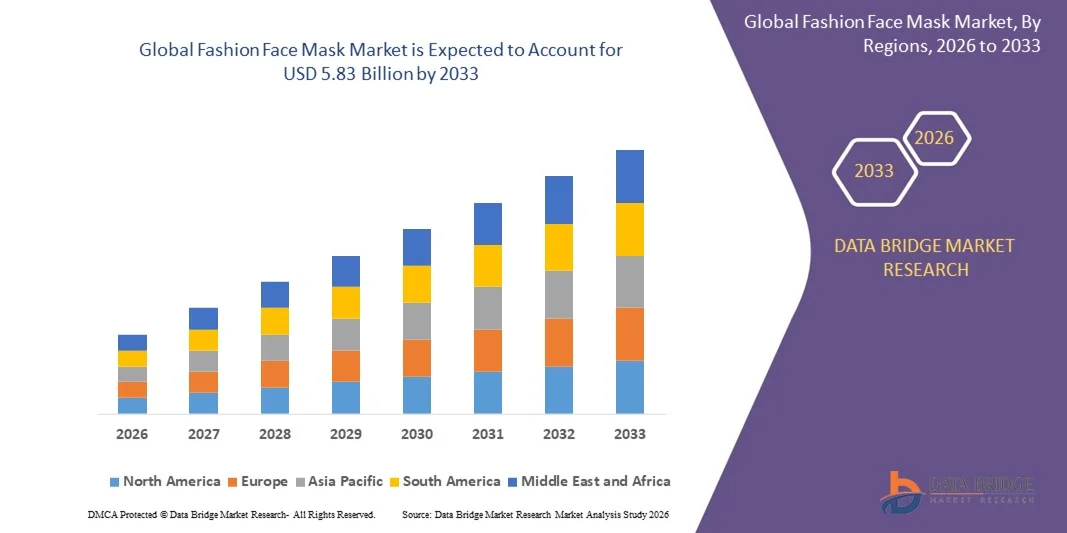
- The global fashion face mask market size was valued at USD 1.27 billion in 2025 and is expected to reach USD 5.83 billion by 2033, at a CAGR of 21.00% during the forecast period
- The market growth is largely fueled by rising awareness of personal health and hygiene, increasing exposure to urban air pollution, and the transformation of face masks into everyday fashion accessories across multiple age groups
- Furthermore, growing consumer preference for reusable, stylish, and customizable masks that balance functionality with aesthetic appeal is strengthening sustained demand. These converging factors are accelerating the adoption of fashion face masks, thereby significantly supporting overall market growth
Fashion Face Mask Market Analysis
- Fashion face masks, combining protective, comfort, and design-oriented features, have evolved into lifestyle and fashion products used across casual, professional, and social settings, supported by changing consumer behavior and fashion trends
- The escalating demand for fashion face masks is primarily driven by heightened health consciousness, rising environmental concerns favoring reusable products, and increasing influence of social media, celebrity branding, and online retail platforms on purchasing decisions
- Asia-Pacific dominated fashion face mask market with a share of 34.6% in 2025, due to high population density, rising urban pollution levels, and strong demand for affordable and stylish protective accessories
- North America is expected to be the fastest growing region in the fashion face mask market during the forecast period due to high disposable income, strong fashion influence, and sustained use of masks in specific environments
- Anti-pollution fashion mask segment dominated the market with a market share of 71.9% in 2025, due to rising urban air pollution levels, increasing health awareness, and growing consumer preference for masks that combine filtration efficiency with aesthetic appeal. These masks often incorporate multi-layer filtration, activated carbon layers, and breathable fabrics, making them suitable for daily commuting and prolonged outdoor use. Consumers in metropolitan areas increasingly prioritize anti-pollution fashion masks for protection against dust, smoke, and particulate matter while maintaining style. The availability of reusable and washable designs further supports sustained demand in this segment. Strong marketing by fashion and wellness brands and higher perceived value also contribute to its dominant position
Report Scope and Fashion Face Mask Market Segmentation
|
Attributes |
Fashion Face Mask Key Market Insights |
|
Segments Covered |
|
|
Countries Covered |
North America
Europe
Asia-Pacific
Middle East and Africa
South America
|
|
Key Market Players |
|
|
Market Opportunities |
|
|
Value Added Data Infosets |
In addition to the insights on market scenarios such as market value, growth rate, segmentation, geographical coverage, and major players, the market reports curated by the Data Bridge Market Research also include in-depth expert analysis, pricing analysis, brand share analysis, consumer survey, demography analysis, supply chain analysis, value chain analysis, raw material/consumables overview, vendor selection criteria, PESTLE Analysis, Porter Analysis, and regulatory framework. |
Fashion Face Mask Market Trends
Rising Popularity of Fashion-Forward and Reusable Face Masks
- A prominent trend in the fashion face mask market is the rising popularity of fashion-forward and reusable face masks, driven by consumer preference for products that combine aesthetic appeal with everyday utility. As face masks transitioned from purely protective equipment to lifestyle accessories, design, fabric quality, and brand identity have become key differentiating factors in purchasing decisions
- For instance, brands such as Adidas and Nike introduced reusable fabric face masks that aligned with their athleisure collections and brand aesthetics, increasing acceptance among style-conscious consumers. These products demonstrated how established fashion and sportswear brands leveraged design consistency to normalize mask usage as part of daily apparel
- Customization and pattern diversity are gaining traction as consumers seek masks that complement personal style, seasonal trends, and social occasions. This has encouraged designers and apparel companies to treat face masks as coordinated fashion items rather than standalone protective gear
- The growing emphasis on sustainability is reinforcing demand for washable and reusable masks made from organic cotton, bamboo fibers, and recycled textiles. This trend aligns with broader consumer interest in reducing single-use waste and supporting environmentally responsible fashion choices
- E-commerce and social media platforms are playing a major role in promoting fashion face masks by enabling rapid trend dissemination and influencer-driven visibility. Online channels allow brands to showcase design versatility and reach global audiences with minimal distribution barriers
- Overall, the convergence of fashion, sustainability, and personal expression is shaping the evolution of the fashion face mask market. This trend is supporting continued product innovation and positioning masks as functional accessories within modern apparel ecosystems
Fashion Face Mask Market Dynamics
Driver
Increasing Awareness of Air Pollution and Personal Health Protection
- Growing awareness of air pollution and its impact on respiratory health is a key driver for the fashion face mask market, particularly in urban areas with high pollution levels. Consumers are increasingly adopting face masks as preventive tools to reduce exposure to particulate matter and airborne pollutants during daily activities
- For instance, organizations such as the World Health Organization have consistently highlighted the health risks associated with air pollution, encouraging the use of protective measures in highly polluted regions. This guidance has contributed to sustained consumer interest in masks that offer both filtration efficiency and wearable comfort
- Rising concerns over seasonal smog, vehicular emissions, and industrial pollution are encouraging regular mask usage beyond pandemic-related needs. Fashion-oriented masks provide a balance between protection and social acceptability, supporting wider adoption across different age groups
- Public awareness campaigns and media coverage around respiratory health are reinforcing preventive behavior among urban populations. This growing health consciousness continues to support steady demand for protective yet stylish face masks
- The increasing focus on personal well-being and pollution-related risk management is strengthening this driver. As consumers seek practical solutions that fit into daily routines, fashion face masks remain relevant as accessible health-protection accessories
Restraint/Challenge
Declining Usage Frequency Due to Reduced Mandatory Mask Regulations
- The fashion face mask market faces a notable challenge from declining usage frequency as mandatory mask regulations are relaxed across many regions. With reduced enforcement in public spaces, consumer motivation to wear masks on a daily basis has weakened
- For instance, government authorities such as the Centers for Disease Control and Prevention revised mask guidance following improvements in public health conditions, leading to reduced routine usage in many markets. This policy shift directly affected demand patterns for both medical and fashion-oriented face masks
- As masks become optional rather than required, consumers are increasingly limiting usage to specific situations such as high-pollution days or crowded environments. This selective adoption reduces overall purchase frequency and impacts repeat sales volumes
- The reduced visibility of masks in social and professional settings further diminishes their role as fashion statements. This shift weakens impulse purchases and trend-driven demand that previously supported market growth
- Collectively, the easing of regulations and changing social norms are constraining market momentum. These factors require brands to reposition fashion face masks around pollution protection and lifestyle utility to sustain relevance in a post-mandate environment
Fashion Face Mask Market Scope
The market is segmented on the basis of product type and distribution channel.
- By Product Type
On the basis of product type, the fashion face mask market is segmented into anti-pollution fashion masks and non anti-pollution fashion masks. The anti-pollution fashion mask segment dominated the market with the largest revenue share of 71.9% in 2025, driven by rising urban air pollution levels, increasing health awareness, and growing consumer preference for masks that combine filtration efficiency with aesthetic appeal. These masks often incorporate multi-layer filtration, activated carbon layers, and breathable fabrics, making them suitable for daily commuting and prolonged outdoor use. Consumers in metropolitan areas increasingly prioritize anti-pollution fashion masks for protection against dust, smoke, and particulate matter while maintaining style. The availability of reusable and washable designs further supports sustained demand in this segment. Strong marketing by fashion and wellness brands and higher perceived value also contribute to its dominant position.
The non anti-pollution fashion mask segment is expected to witness the fastest growth rate from 2026 to 2033, supported by rising demand for affordable, lightweight, and style-focused masks. These masks are widely used for casual wear, social outings, and fashion coordination rather than functional protection. Rapid changes in fashion trends, seasonal designs, and celebrity influence drive repeat purchases in this segment. Growth is further fueled by younger consumers seeking customizable colors, prints, and patterns. The lower price point and broad availability across retail channels make non anti-pollution fashion masks accessible to a wider consumer base, supporting faster volume growth.
- By Distribution Channel
On the basis of distribution channel, the fashion face mask market is segmented into hypermarkets and supermarkets, convenience stores, specialty stores, online stores, and others. The hypermarkets and supermarkets segment accounted for the largest market revenue share in 2025, driven by high footfall, wide product visibility, and the ability to offer multiple brands and price ranges under one roof. Consumers prefer these outlets for immediate purchase and the opportunity to physically assess fabric quality, fit, and design. Bulk purchasing options and frequent promotional discounts further enhance sales through this channel. Strong presence in urban and suburban areas supports consistent demand from regular shoppers.
The online stores segment is anticipated to register the fastest growth rate from 2026 to 2033, driven by expanding e-commerce penetration and changing consumer buying behavior. Online platforms offer extensive design variety, customization options, and easy price comparison, appealing to digitally active consumers. The convenience of home delivery and access to global fashion brands significantly boost online sales. Social media marketing, influencer promotions, and direct-to-consumer brand strategies further accelerate growth. The increasing use of mobile shopping apps and secure digital payment systems continues to strengthen the position of online stores as the fastest growing distribution channel.
Fashion Face Mask Market Regional Analysis
- Asia-Pacific dominated the fashion face mask market with the largest revenue share of 34.6% in 2025, driven by high population density, rising urban pollution levels, and strong demand for affordable and stylish protective accessories
- Rapid growth of e-commerce platforms, increasing fashion consciousness among young consumers, and widespread acceptance of masks as daily wear are accelerating market expansion across the region
- Cost-efficient manufacturing, availability of raw materials, and strong presence of textile and apparel hubs are supporting large-scale production and consumption of fashion face masks
China Fashion Face Mask Market Insight
China held the largest share in the Asia-Pacific fashion face mask market in 2025, owing to its well-established textile manufacturing ecosystem and large domestic consumer base. The country’s ability to produce fashion masks at scale, combined with rapid design innovation and strong online retail penetration, continues to drive demand. Export-oriented production and quick response to changing fashion trends further strengthen China’s market position.
India Fashion Face Mask Market Insight
India is witnessing the fastest growth in the Asia-Pacific region, fueled by rising air pollution in major cities, increasing health awareness, and growing adoption of reusable fabric masks. Expansion of domestic textile manufacturing, strong presence of local fashion brands, and rapid growth of online marketplaces are supporting market expansion. Government support for local manufacturing and increasing preference for affordable fashion accessories further boost demand.
Europe Fashion Face Mask Market Insight
The Europe fashion face mask market is expanding steadily, supported by strong fashion culture, emphasis on sustainability, and demand for reusable and eco-friendly masks. Consumers in the region increasingly prefer masks that combine functionality with premium design and comfort. Strict quality standards and growing interest in ethically produced fashion accessories are influencing product offerings.
Germany Fashion Face Mask Market Insight
Germany’s fashion face mask market is driven by high consumer awareness regarding health, quality, and sustainability. Demand is supported by preference for reusable, certified, and environmentally responsible products. Strong retail infrastructure and growing popularity of minimalist and functional designs contribute to stable market growth.
U.K. Fashion Face Mask Market Insight
The U.K. market is supported by a strong fashion retail sector, high adoption of online shopping, and demand for trend-driven accessories. Consumers increasingly view fashion face masks as style statements, encouraging frequent design updates and premium offerings. Local designer collaborations and influencer-driven marketing continue to support market presence.
North America Fashion Face Mask Market Insight
North America is projected to grow at the fastest CAGR from 2026 to 2033, driven by high disposable income, strong fashion influence, and sustained use of masks in specific environments. Growing preference for customized, branded, and premium fabric masks is boosting demand. Expansion of direct-to-consumer brands and strong digital marketing strategies further support market growth.
U.S. Fashion Face Mask Market Insight
The U.S. accounted for the largest share in the North America market in 2025, underpinned by a mature apparel industry and high consumer spending on fashion accessories. Demand is driven by preference for comfort, design variety, and brand recognition. Strong presence of online retailers, fashion brands, and customization options continues to reinforce the U.S.’s leading position in the regional market.
Fashion Face Mask Market Share
The fashion face mask industry is primarily led by well-established companies, including:
- AirPop (U.S.)
- Cambridge Mask Co. (U.K.)
- idMASK (U.S.)
- TECMASK (U.S.)
- RZ Mask (U.S.)
- Respro (U.K.) Ltd (U.K.)
- Honeywell International Inc. (U.S.)
- 3M (U.S.)
- KCWW (South Korea)
- Vogmask (U.S.)
- Masklab (Singapore)
- Totobobo (Singapore)
- Uniqlo Co., Ltd. (Japan)
- Adidas AG (Germany)
Latest Developments in Global Fashion Face Mask Market
- In January 2026, L’Oréal Group announced the launch of an LED eye mask at CES, marking a significant advancement in the integration of beauty, skincare, and consumer electronics. This development highlights the growing shift toward device-based facial care solutions that deliver clinically inspired results at home. Recognition as a CES 2026 Innovation Award honoree enhances credibility and accelerates consumer adoption of smart face mask technologies. The launch strengthens the premium segment of the face mask market by positioning masks as long-term beauty devices rather than short-term skincare products. It also encourages increased R&D investments and cross-industry collaborations between beauty brands and technology providers
- In July 2025, Skims unveiled its first beauty product by introducing face shapewear, signaling the expansion of fashion-led brands into facial aesthetics and contour-focused solutions. This launch broadens the definition of face masks beyond skincare and protection, moving toward appearance enhancement and sculpting. The strong brand influence and celebrity backing drive rapid consumer interest and market visibility. It supports the growth of the fashion face mask segment by blending beauty, wellness, and lifestyle positioning. The development also intensifies competition as apparel and shapewear brands explore adjacent facial accessory categories
- In June 2025, HYPHEN launched the Ice Dunk Cooling Face Mask, transforming a viral social media skincare trend into a mass-market product. This innovation addresses consumer demand for instant cooling, de-puffing, and soothing benefits without the discomfort associated with traditional ice facials. The launch accelerates growth in the functional skincare mask segment by emphasizing sensory experience and daily usability. Seasonal relevance and strong digital marketing further expand consumer reach. It also demonstrates how trend-driven product innovation can quickly translate into commercial success within the face mask market
- In January 2025, the Skin Fetish Glass 001 Artistry Mask was launched to the public, reinforcing the influence of editorial, runway, and professional makeup trends on consumer purchasing behavior. Positioned as a high-performance, artistry-inspired product, the mask supports the premiumization of the facial mask market. Early exposure through beauty editors and industry insiders enhanced brand authority and consumer trust. The launch drives demand for masks that deliver instant aesthetic results for events, content creation, and professional use. It also strengthens the role of luxury branding and expert endorsement in market growth
- In July 2020, Nandan Denim introduced the reusable CareMask, contributing to early structural growth of the reusable face mask segment. The launch supported a shift from disposable to sustainable fabric masks, influencing long-term consumer habits. Emphasis on reusability, durability, and comfort helped establish fabric masks as everyday lifestyle products. This development laid the foundation for the fashion face mask market by combining functionality with textile expertise. It also encouraged broader adoption of eco-conscious face mask solutions across price-sensitive markets
SKU-
Get online access to the report on the World's First Market Intelligence Cloud

- Interactive Data Analysis Dashboard
- Company Analysis Dashboard for high growth potential opportunities
- Research Analyst Access for customization & queries
- Competitor Analysis with Interactive dashboard
- Latest News, Updates & Trend analysis
- Harness the Power of Benchmark Analysis for Comprehensive Competitor Tracking
Research Methodology
Data collection and base year analysis are done using data collection modules with large sample sizes. The stage includes obtaining market information or related data through various sources and strategies. It includes examining and planning all the data acquired from the past in advance. It likewise envelops the examination of information inconsistencies seen across different information sources. The market data is analysed and estimated using market statistical and coherent models. Also, market share analysis and key trend analysis are the major success factors in the market report. To know more, please request an analyst call or drop down your inquiry.
The key research methodology used by DBMR research team is data triangulation which involves data mining, analysis of the impact of data variables on the market and primary (industry expert) validation. Data models include Vendor Positioning Grid, Market Time Line Analysis, Market Overview and Guide, Company Positioning Grid, Patent Analysis, Pricing Analysis, Company Market Share Analysis, Standards of Measurement, Global versus Regional and Vendor Share Analysis. To know more about the research methodology, drop in an inquiry to speak to our industry experts.
Customization Available
Data Bridge Market Research is a leader in advanced formative research. We take pride in servicing our existing and new customers with data and analysis that match and suits their goal. The report can be customized to include price trend analysis of target brands understanding the market for additional countries (ask for the list of countries), clinical trial results data, literature review, refurbished market and product base analysis. Market analysis of target competitors can be analyzed from technology-based analysis to market portfolio strategies. We can add as many competitors that you require data about in the format and data style you are looking for. Our team of analysts can also provide you data in crude raw excel files pivot tables (Fact book) or can assist you in creating presentations from the data sets available in the report.












