

Global Fatty Acid Methyl Ester Fame Market
Market Size in USD Billion
CAGR :
% 
 USD
19.19 Billion
USD
31.52 Billion
2025
2033
USD
19.19 Billion
USD
31.52 Billion
2025
2033
 Forecast Period Forecast Period |
2026 –2033 |
 Market Size (Base Year) Market Size (Base Year) |
USD 19.19 Billion |
 Market Size (Forecast Year) Market Size (Forecast Year) |
USD 31.52 Billion |
 CAGR CAGR |
% |
| Major Markets Players |
|
Fatty Acid Methyl Ester (FAME) Market Size
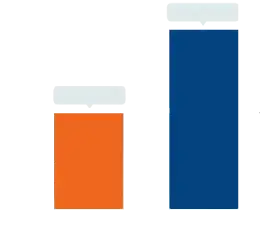
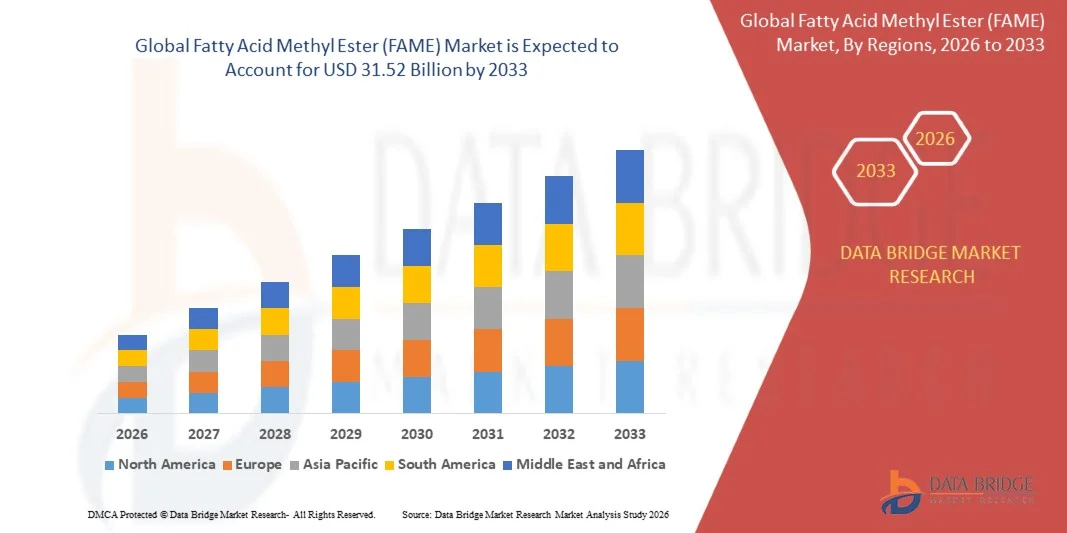
- The global fatty acid methyl ester (FAME) market size was valued at USD 19.19 billion in 2025 and is expected to reach USD 31.52 billion by 2033, at a CAGR of 6.40% during the forecast period
- The market growth is largely fuelled by the increasing demand for biodiesel as a renewable and environmentally friendly alternative to conventional fossil fuels in transportation and industrial applications
- Rising government regulations promoting biofuel blending mandates and carbon emission reduction targets are encouraging the adoption of fatty acid methyl ester across multiple energy markets
Fatty Acid Methyl Ester (FAME) Market Analysis
- The market is witnessing steady growth due to increasing investments in renewable energy infrastructure and expanding biodiesel production capacities across developed and emerging economies
- Technological advancements in transesterification processes and improvements in feedstock utilization are enhancing production efficiency and supporting the large-scale adoption of fatty acid methyl ester in the global biofuel industry
- North America dominated the fatty acid methyl ester (FAME) market with the largest revenue share in 2025, driven by strong demand for biodiesel and renewable fuel alternatives across transportation and industrial sectors
- Asia-Pacific region is expected to witness the highest growth rate in the global fatty acid methyl ester (FAME) market, driven by expanding biodiesel production, abundant availability of feedstocks such as palm oil and soybean oil, and increasing government initiatives supporting renewable energy adoption
- The Soya Methyl Ester segment held the largest market revenue share in 2025 driven by its abundant availability, well-established supply chain, and extensive use in biodiesel production. Soya methyl ester is widely preferred due to its favorable fuel properties, including improved combustion efficiency and reduced emissions, making it a key component in renewable diesel blends and sustainable fuel applications
Report Scope and Fatty Acid Methyl Ester (FAME) Market Segmentation
|
Attributes |
Fatty Acid Methyl Ester (FAME) Key Market Insights |
|
Segments Covered |
|
|
Countries Covered |
North America
Europe
Asia-Pacific
Middle East and Africa
South America
|
|
Key Market Players |
• Alnor Oil Company (U.S.) |
|
Market Opportunities |
• Expansion Of Biodiesel Blending Mandates Across Emerging Economies |
|
Value Added Data Infosets |
In addition to the insights on market scenarios such as market value, growth rate, segmentation, geographical coverage, and major players, the market reports curated by the Data Bridge Market Research also include import export analysis, production capacity overview, production consumption analysis, price trend analysis, climate change scenario, supply chain analysis, value chain analysis, raw material/consumables overview, vendor selection criteria, PESTLE Analysis, Porter Analysis, and regulatory framework. |
Fatty Acid Methyl Ester (FAME) Market Trends
“Increasing Adoption Of Biodiesel And Renewable Fuel Alternatives”
• The rising focus on sustainable and renewable energy sources is significantly shaping the fatty acid methyl ester (FAME) market, as governments and industries seek alternatives to conventional fossil fuels. FAME, widely used as biodiesel, is gaining strong traction due to its ability to reduce greenhouse gas emissions and improve fuel sustainability. This trend is encouraging greater adoption across transportation, power generation, and industrial fuel applications while supporting global decarbonization initiatives
• Growing awareness regarding environmental protection and energy security has accelerated the demand for biodiesel derived from fatty acid methyl esters. Many countries are introducing fuel blending mandates that require a specific percentage of biodiesel in conventional diesel, increasing the consumption of FAME in the transportation sector. This is prompting fuel producers and energy companies to expand production capacity and invest in renewable fuel technologies
• Sustainability and circular economy trends are influencing production strategies, with manufacturers increasingly focusing on the use of renewable and waste-based feedstocks such as vegetable oils, animal fats, and used cooking oils. These sustainable feedstocks help reduce production costs and environmental impact while ensuring a steady supply of raw materials for biodiesel manufacturing. Companies are also investing in advanced processing technologies to improve conversion efficiency and fuel quality
• For instance, in 2024, Neste and Archer Daniels Midland Company expanded their biodiesel production capabilities by increasing investments in renewable feedstock processing and biofuel refining infrastructure. These developments were introduced to meet rising global demand for sustainable transportation fuels and reduce carbon emissions across energy markets
• While the demand for fatty acid methyl ester continues to increase, long-term market expansion will depend on technological advancements, feedstock availability, and supportive government policies. Manufacturers are focusing on improving production efficiency, optimizing supply chains, and developing advanced biodiesel blends that maintain performance standards comparable to conventional diesel fuels
Fatty Acid Methyl Ester (FAME) Market Dynamics
Driver
“Rising Demand For Renewable And Low-Carbon Transportation Fuels”
• Increasing global emphasis on reducing carbon emissions and transitioning toward renewable energy sources is a major driver for the fatty acid methyl ester market. Governments and regulatory bodies across many regions are implementing biodiesel blending mandates and incentives that encourage the use of FAME as an alternative fuel. These policies are supporting the growth of biodiesel production and expanding the demand for renewable fuel solutions
• Expanding applications across transportation, agriculture, marine, and industrial sectors are also influencing market growth. Fatty acid methyl ester-based biodiesel provides improved combustion efficiency and lower emissions compared to traditional diesel fuels. This makes it a suitable option for reducing environmental impact while maintaining fuel performance in diesel-powered engines
• Energy companies and fuel producers are actively promoting biodiesel adoption through investments in bio-refineries, partnerships with feedstock suppliers, and technological advancements in biofuel processing. These initiatives are helping improve fuel quality, reduce production costs, and enhance the scalability of biodiesel manufacturing to meet global energy demand
• For instance, in 2023, Wilmar International and Cargill, Incorporated increased their biodiesel production investments to support growing demand for renewable transportation fuels. The companies expanded feedstock processing facilities and strengthened supply chain partnerships to improve the availability of sustainable raw materials for biodiesel production
• Although the demand for renewable fuels continues to rise, sustained growth in the fatty acid methyl ester market will depend on technological innovation, stable feedstock supply, and continued regulatory support. Investments in advanced biofuel technologies and sustainable feedstock sourcing will remain critical to maintaining market competitiveness
Restraint/Challenge
“Feedstock Price Volatility And Competition With Food Supply”
• Fluctuating prices of key feedstocks such as vegetable oils, animal fats, and waste oils remain a major challenge for the fatty acid methyl ester market. Variations in agricultural production, climate conditions, and global commodity markets can significantly affect feedstock availability and cost stability. These fluctuations may increase production costs and impact profit margins for biodiesel manufacturers
• Competition between biofuel production and food supply chains also creates concerns in certain regions. Vegetable oils such as soybean oil and palm oil are widely used in both food processing and biodiesel manufacturing, leading to supply pressures and price volatility. These factors can limit the large-scale adoption of FAME in markets where food security and agricultural resource allocation remain critical concerns
• Supply chain and logistics challenges can also influence market growth, as biodiesel production requires reliable feedstock sourcing, transportation, and storage infrastructure. Limited availability of sustainable raw materials and inefficient distribution networks may increase operational costs and affect production efficiency for manufacturers
• For instance, in 2024, biodiesel producers in regions such as Indonesia and Brazil reported increased production costs due to fluctuations in palm oil and soybean oil prices, which are major feedstocks used in fatty acid methyl ester production. These price variations also created challenges in maintaining competitive biodiesel pricing in global fuel markets
• Addressing these challenges will require diversification of feedstock sources, improved agricultural productivity, and investment in advanced biofuel technologies that utilize waste-based and non-food feedstocks. Strengthening supply chain resilience and developing cost-effective production processes will be essential for sustaining long-term growth in the global fatty acid methyl ester market
Fatty Acid Methyl Ester (FAME) Market Scope
The market is segmented on the basis of product, type, and application.
• By Type
On the basis of type, the fatty acid methyl ester (FAME) market is segmented into Rapeseed Methyl Ester, Soya Methyl Ester, Palm Oil Methyl Ester, and Other. The Soya Methyl Ester segment held the largest market revenue share in 2025 driven by its abundant availability, well-established supply chain, and extensive use in biodiesel production. Soya methyl ester is widely preferred due to its favorable fuel properties, including improved combustion efficiency and reduced emissions, making it a key component in renewable diesel blends and sustainable fuel applications.
The Rapeseed Methyl Ester segment is expected to witness the fastest growth rate from 2026 to 2033, driven by increasing biodiesel mandates in Europe and the growing demand for low-emission renewable fuels. Rapeseed-based biodiesel offers superior cold flow properties and high oxidative stability, making it suitable for transportation and industrial fuel applications, particularly in colder climates.
• By Product
On the basis of product, the fatty acid methyl ester market is segmented into Glyceryl Monostearate, Medium Chain Triglycerides, Polyol Esters, Glycol Esters, Isopropyl Palmitate, and Sucrose Esters. The Glyceryl Monostearate segment held the largest market revenue share in 2025 due to its widespread usage as an emulsifier and stabilizing agent across food, personal care, and pharmaceutical industries. Its multifunctional properties such as improving texture, enhancing stability, and extending product shelf life make it a widely utilized ingredient in various industrial formulations.
The Polyol Esters segment is expected to witness the fastest growth rate from 2026 to 2033 driven by increasing demand for high-performance biodegradable lubricants and environmentally friendly industrial fluids. Polyol esters are gaining traction due to their excellent thermal stability, lubricity, and oxidation resistance, making them suitable for advanced lubrication and specialty chemical applications.
• By Application
On the basis of application, the fatty acid methyl ester market is segmented into Lubricants and Fuels, Surfactants and Detergents, Personal Care and Cosmetics, and Food and Pharmaceutical. The Lubricants and Fuels segment held the largest market revenue share in 2025 driven by the increasing use of fatty acid methyl esters in biodiesel production and renewable fuel blends. Their biodegradability, lower toxicity, and improved lubrication properties make them an attractive alternative to petroleum-based fuels and lubricants.
The Personal Care and Cosmetics segment is expected to witness the fastest growth rate from 2026 to 2033 driven by rising consumer preference for bio-based and sustainable ingredients in cosmetic formulations. Fatty acid methyl esters are increasingly used as emollients, solvents, and conditioning agents in skincare and haircare products due to their mildness, skin compatibility, and environmentally friendly characteristics.
Fatty Acid Methyl Ester (FAME) Market Regional Analysis
• North America dominated the fatty acid methyl ester (FAME) market with the largest revenue share in 2025, driven by strong demand for biodiesel and renewable fuel alternatives across transportation and industrial sectors
• Governments in the region are actively promoting the use of biofuels through blending mandates, emission reduction targets, and incentives for renewable energy adoption, encouraging the large-scale use of fatty acid methyl esters in fuel formulations
• This widespread adoption is further supported by advanced biofuel production infrastructure, increasing environmental awareness, and the presence of major biodiesel producers, establishing fatty acid methyl ester as a preferred renewable fuel component across multiple industries
U.S. Fatty Acid Methyl Ester (FAME) Market Insight
The U.S. fatty acid methyl ester market captured the largest revenue share in 2025 within North America, fueled by the strong presence of biodiesel producers and increasing government initiatives promoting renewable fuels. The country has well-established biodiesel blending programs that encourage the use of FAME in diesel fuel. Growing environmental concerns and the push for reducing greenhouse gas emissions are driving the demand for bio-based fuels. In addition, investments in bio-refineries and sustainable feedstock supply chains are further strengthening the market in the U.S.
Europe Fatty Acid Methyl Ester (FAME) Market Insight
The Europe fatty acid methyl ester market is expected to witness the fastest growth rate from 2026 to 2033, primarily driven by strict environmental regulations and ambitious carbon neutrality targets set by regional governments. The European Union continues to promote biodiesel usage through renewable energy directives and emission reduction policies. The increasing focus on sustainable transportation fuels and the widespread availability of feedstocks such as rapeseed oil are supporting market expansion across the region.
U.K. Fatty Acid Methyl Ester (FAME) Market Insight
The U.K. fatty acid methyl ester market is expected to witness the fastest growth rate from 2026 to 2033, driven by the country’s commitment to reducing carbon emissions and transitioning toward low-carbon energy sources. Biodiesel blending mandates and renewable fuel standards are encouraging the adoption of FAME-based fuels. Furthermore, increasing investments in renewable energy infrastructure and sustainable fuel technologies are supporting the growth of the fatty acid methyl ester market in the U.K.
Germany Fatty Acid Methyl Ester (FAME) Market Insight
The Germany fatty acid methyl ester market is expected to witness the fastest growth rate from 2026 to 2033, fueled by the country’s strong focus on sustainability, energy efficiency, and renewable fuel adoption. Germany has one of the most developed biodiesel production industries in Europe, supported by advanced refining technologies and established supply chains. The growing use of biodiesel in transportation and industrial applications continues to strengthen the demand for fatty acid methyl esters in the country.
Asia-Pacific Fatty Acid Methyl Ester (FAME) Market Insight
The Asia-Pacific fatty acid methyl ester market is expected to witness the fastest growth rate from 2026 to 2033, driven by rapid industrialization, rising energy demand, and increasing government initiatives supporting biofuel adoption. Several countries in the region are implementing biodiesel blending mandates to reduce dependence on fossil fuels and improve energy security. In addition, the abundance of feedstocks such as palm oil and soybean oil is encouraging the large-scale production of fatty acid methyl esters.
Japan Fatty Acid Methyl Ester (FAME) Market Insight
The Japan fatty acid methyl ester market is expected to witness the fastest growth rate from 2026 to 2033 due to the country’s focus on sustainable energy solutions and emission reduction strategies. Japan is actively promoting renewable fuel alternatives to meet its climate targets and reduce dependence on imported fossil fuels. Increasing investments in advanced biofuel technologies and the growing use of biodiesel in transportation and industrial sectors are supporting the adoption of fatty acid methyl esters in the country.
China Fatty Acid Methyl Ester (FAME) Market Insight
The China fatty acid methyl ester market accounted for the largest market revenue share in Asia Pacific in 2025, attributed to the country’s expanding energy demand, rapid industrial growth, and strong government support for renewable energy development. China is increasingly investing in biodiesel production facilities and encouraging the use of sustainable fuels in transportation and manufacturing sectors. The availability of diverse feedstocks and the presence of large-scale biodiesel manufacturers are further accelerating the market growth in China.
Fatty Acid Methyl Ester (FAME) Market Share
The Fatty Acid Methyl Ester (FAME) industry is primarily led by well-established companies, including:
• Alnor Oil Company (U.S.)
• ADM (U.S.)
• Berg + Schmidt GmbH & Co. KG (Germany)
• Cargill, Incorporated (U.S.)
• Emery Oleochemicals Group (Malaysia)
• Longyan Zhuoyue New Energy Co. Ltd. (China)
• Wilmar International Ltd (Singapore)
• P&G Chemicals (U.S.)
• BASF SE (Germany)
• KLK Oleo (Malaysia)
• Avantor Performance Materials (U.S.)
• Eastman Chemical Company (U.S.)
• FUSHIMI Pharmaceutical Co. (Japan)
• The Chemical Company (U.S.)
• Velsicol Chemical LLC (U.S.)
• Smart Chemicals Group Co (China)
• Swastik Industries (India)
• Nitro Química (Brazil)
• Dow (U.S.)
• DuPont (U.S.)
• Zhejiang Honghao Technology Co. Ltd. (China)
• SK Chemicals (South Korea)
• Hemadri Chemicals (India)
Latest Developments in Global Fatty Acid Methyl Ester (FAME) Market
- In January, 2025, Wilmar International Ltd, Capacity Expansion, inaugurated a 500,000-ton palm-oil methyl ester refinery in Dumai, Indonesia equipped with continuous reactor systems and zero-liquid-discharge technology. The facility is designed to support large-scale biodiesel production aligned with Indonesia’s B50 biodiesel blending mandate. This expansion is expected to enhance sustainable fuel production capacity, strengthen Wilmar’s biodiesel supply chain, and contribute to the growing demand for renewable fuels in the Asia-Pacific region
- In August, 2024, Cargill, Incorporated and Bunge Limited, Joint Venture, established a strategic partnership to develop approximately 1.8 million tons of soybean-crushing and fatty acid methyl ester production capacity in Brazil. The collaboration aims to ensure a stable feedstock supply and strengthen biodiesel production for Petrobras fuel auctions. This initiative is anticipated to improve feedstock security, expand biodiesel availability, and reinforce Brazil’s position as a key supplier in the global biofuel market
SKU-
Get online access to the report on the World's First Market Intelligence Cloud

- Interactive Data Analysis Dashboard
- Company Analysis Dashboard for high growth potential opportunities
- Research Analyst Access for customization & queries
- Competitor Analysis with Interactive dashboard
- Latest News, Updates & Trend analysis
- Harness the Power of Benchmark Analysis for Comprehensive Competitor Tracking
Global Fatty Acid Methyl Ester Fame Market, Supply Chain Analysis and Ecosystem Framework
To support market growth and help clients navigate the impact of geopolitical shifts, DBMR has integrated in-depth supply chain analysis into its Global Fatty Acid Methyl Ester Fame Market research reports. This addition empowers clients to respond effectively to global changes affecting their industries. The supply chain analysis section includes detailed insights such as Global Fatty Acid Methyl Ester Fame Market consumption and production by country, price trend analysis, the impact of tariffs and geopolitical developments, and import and export trends by country and HSN code. It also highlights major suppliers with data on production capacity and company profiles, as well as key importers and exporters. In addition to research, DBMR offers specialized supply chain consulting services backed by over a decade of experience, providing solutions like supplier discovery, supplier risk assessment, price trend analysis, impact evaluation of inflation and trade route changes, and comprehensive market trend analysis.
Research Methodology
Data collection and base year analysis are done using data collection modules with large sample sizes. The stage includes obtaining market information or related data through various sources and strategies. It includes examining and planning all the data acquired from the past in advance. It likewise envelops the examination of information inconsistencies seen across different information sources. The market data is analysed and estimated using market statistical and coherent models. Also, market share analysis and key trend analysis are the major success factors in the market report. To know more, please request an analyst call or drop down your inquiry.
The key research methodology used by DBMR research team is data triangulation which involves data mining, analysis of the impact of data variables on the market and primary (industry expert) validation. Data models include Vendor Positioning Grid, Market Time Line Analysis, Market Overview and Guide, Company Positioning Grid, Patent Analysis, Pricing Analysis, Company Market Share Analysis, Standards of Measurement, Global versus Regional and Vendor Share Analysis. To know more about the research methodology, drop in an inquiry to speak to our industry experts.
Customization Available
Data Bridge Market Research is a leader in advanced formative research. We take pride in servicing our existing and new customers with data and analysis that match and suits their goal. The report can be customized to include price trend analysis of target brands understanding the market for additional countries (ask for the list of countries), clinical trial results data, literature review, refurbished market and product base analysis. Market analysis of target competitors can be analyzed from technology-based analysis to market portfolio strategies. We can add as many competitors that you require data about in the format and data style you are looking for. Our team of analysts can also provide you data in crude raw excel files pivot tables (Fact book) or can assist you in creating presentations from the data sets available in the report.