


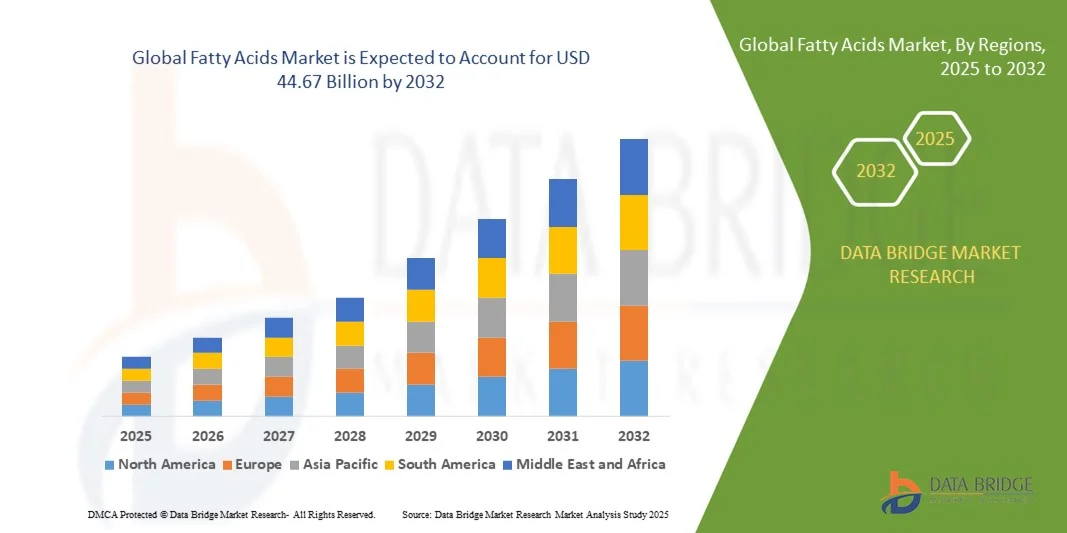
Fatty Acids Market Size
- The global fatty acids market size was valued at USD 30.24 billion in 2024 and is expected to reach USD 44.67 billion by 2032, at a CAGR of 5.0% during the forecast period
- The market growth is largely fueled by increasing health-consciousness among consumers and the rising adoption of functional foods, dietary supplements, and nutraceuticals, driving demand for fatty acids across diverse applications
- Furthermore, growing awareness of cardiovascular, cognitive, and metabolic health benefits, along with innovations in plant-based, marine, and sustainable fatty acid sources, is expanding their use in food, pharmaceutical, cosmetic, and animal nutrition sectors. These converging factors are accelerating product adoption, thereby significantly boosting the industry’s growth
Fatty Acids Market Analysis
- Fatty acids are organic compounds commonly derived from plant, marine, and animal sources, used in pharmaceuticals, dietary supplements, functional foods, cosmetics, and animal feed. They include Omega-3, Omega-6, Omega-7, and Omega-9 fatty acids, which play critical roles in human and animal health
- The escalating demand for fatty acids is primarily driven by the rising preference for heart-healthy and cognitive-enhancing diets, growing functional food and nutraceutical markets, and increasing research and innovation in specialty fatty acid formulations for therapeutic and cosmetic applications
- Asia-Pacific dominated the fatty acids market with a share of 42.4% in 2024, due to increasing health-conscious consumer populations, rising adoption of functional foods and dietary supplements, and a strong presence of nutraceutical and pharmaceutical manufacturing hubs
- North America is expected to be the fastest growing region in the fatty acids market during the forecast period due to strong consumer demand for functional foods, dietary supplements, and nutraceuticals
- Oil form segment dominated the market with a market share of 54.7% in 2024, due to its versatility and ease of incorporation into pharmaceuticals, dietary supplements, food, and personal care products. Oils derived from fish, nuts, seeds, and vegetable sources are widely preferred for their bioavailability and functional benefits. The segment also benefits from strong consumer familiarity, established production methods, and widespread distribution channels. Rising demand for functional oils in cooking, supplementation, and nutraceutical formulations supports continued market dominance
Report Scope and Fatty Acids Market Segmentation
|
Attributes |
Fatty Acids Key Market Insights |
|
Segments Covered |
|
|
Countries Covered |
North America
Europe
Asia-Pacific
Middle East and Africa
South America
|
|
Key Market Players |
|
|
Market Opportunities |
|
|
Value Added Data Infosets |
In addition to the insights on market scenarios such as market value, growth rate, segmentation, geographical coverage, and major players, the market reports curated by the Data Bridge Market Research also include in-depth expert analysis, pricing analysis, brand share analysis, consumer survey, demography analysis, supply chain analysis, value chain analysis, raw material/consumables overview, vendor selection criteria, PESTLE Analysis, Porter Analysis, and regulatory framework. |
Fatty Acids Market Trends
Growing Preference for Plant-Based and Sustainable Fatty Acids
- The fatty acids market is undergoing a steady transformation driven by the increasing preference for plant-based and environmentally sustainable sources. Consumers and manufacturers are moving away from animal-derived feedstocks toward plant-based or algae-based fatty acids as part of a broader shift toward ethical sourcing, clean-label formulations, and eco-friendly manufacturing practices
- For instance, BASF SE has expanded its range of vegetable oil-based fatty acids derived from sustainable palm and rapeseed oil certified under the Roundtable on Sustainable Palm Oil (RSPO). Similarly, Corbion N.V. is developing algae-based omega fatty acids to provide renewable alternatives to marine oils used in nutritional and cosmetic applications
- Growing environmental concerns surrounding overfishing and deforestation have intensified the push for sustainable fatty acid production. Plant-based feedstocks such as soybean, palm, canola, and sunflower oil are increasingly preferred for their renewability and reduced carbon footprint compared to animal fats or traditional petrochemical sources
- In addition, technological innovations in oleochemical processing are improving yield efficiency and reducing waste generation. Manufacturers are investing in circular bio-based systems that utilize renewable biomass inputs to minimize environmental impact and align with sustainability goals across industries including food, personal care, and pharmaceuticals
- The increasing use of plant-based fatty acids in vegan and natural product formulations reflects shifting consumer values focused on traceability, transparency, and ethical ingredient sourcing. This evolution aligns with the rising appeal of plant-derived and biodegradable ingredients across both industrial and consumer markets
- As the momentum for greener and sustainable chemistry continues to strengthen, plant-based fatty acids are expected to dominate future growth. The trend reinforces the industry’s transition toward renewable feedstocks and positions sustainable fatty acids as a critical component of the global bioeconomy
Fatty Acids Market Dynamics
Driver
Rising Health-Consciousness and Supplement Consumption
- The growing global emphasis on preventive health, wellness, and nutrition is a primary driver of fatty acids market growth. Consumers are increasingly aware of the health benefits associated with essential fatty acids such as omega-3, omega-6, and omega-9, which are linked to cardiovascular, cognitive, and metabolic health improvements
- For instance, Croda International Plc manufactures high-purity omega fatty acid concentrates for functional foods and dietary supplements targeting heart and joint health. Similarly, DSM is developing microbial and algal omega-3 products as part of its “life’s” series to cater to vegetarian consumers seeking sustainable nutritional solutions
- The rising popularity of nutritional supplements and fortified foods is contributing to higher demand for fatty acids in both pharmaceutical and nutraceutical formulations. These compounds are widely used to support healthy aging and immunity, increasing their adoption among health-conscious populations across developed and emerging markets
- In addition, the trend toward personalized nutrition and clean-label dietary products has increased demand for natural and traceable fatty acid ingredients. Food and beverage manufacturers are incorporating these oils into cereals, spreads, and beverages to appeal to consumers prioritizing functional health benefits
- With growing awareness of the importance of nutritional balance and long-term wellness, fatty acids have become essential components in preventive healthcare and dietary applications. The expanding influence of health-conscious lifestyles and consistent supplement consumption is expected to sustain growth momentum across the global fatty acids market
Restraint/Challenge
Raw Material Price Volatility
- The fatty acids market faces significant challenges due to fluctuations in the prices of raw materials such as vegetable oils and tallow, which directly affect production costs and profit margins. Climate conditions, supply chain disruptions, and geopolitical uncertainties contribute to unpredictable variations in feedstock availability and pricing
- For instance, frequent price swings in palm oil and soybean oil markets have impacted producers such as Wilmar International and Oleon Group, leading to cost management difficulties across food ingredient and industrial sectors. These fluctuations often force companies to adjust pricing strategies or reformulate products to maintain market competitiveness
- High dependency on agricultural commodities exposes fatty acid manufacturers to risks associated with crop yield variations and global trade policies. Inconsistent supply conditions can also affect contract stability with downstream users in cosmetic, pharmaceutical, and detergent segments
- In addition, rising logistics costs and sustainability certification requirements for vegetable oils further elevate operational expenses. Producers often face challenges balancing between sourcing sustainably certified materials and maintaining affordable product prices for end users
- Although diversification of supply sources and investment in alternative feedstocks such as algae and waste oils can mitigate price risks, raw material volatility remains a persistent concern. Addressing these challenges through strategic sourcing and supply chain optimization will be crucial for stabilizing growth and profitability across the global fatty acids market
Fatty Acids Market Scope
The market is segmented on the basis of product, application, source, form, and type.
- By Product
On the basis of product, the fatty acids market is segmented into Omega-3, Omega-6, Omega-7, and Omega-9. The Omega-3 segment dominated the largest market revenue share in 2024, driven by its well-established health benefits, including cardiovascular protection, anti-inflammatory properties, and cognitive support. Consumers and healthcare professionals increasingly prefer Omega-3 for its proven role in promoting overall wellness and preventing lifestyle-related diseases. The segment benefits from strong awareness campaigns, fortified food products, and dietary supplements, which further enhance its adoption. In addition, Omega-3 fatty acids have a versatile presence across pharmaceutical, nutraceutical, and food industries, boosting their market demand.
The Omega-9 segment is expected to witness the fastest growth from 2025 to 2032, fueled by rising consumer preference for plant-based and heart-healthy dietary fats. Omega-9 is gaining traction in functional foods, cooking oils, and cosmetics due to its favorable impact on cholesterol management and skin health. Innovations in extraction technologies and incorporation into ready-to-consume products are accelerating its adoption globally. Moreover, increasing awareness of Omega-9’s non-essential yet beneficial properties is driving new applications across dietary supplements and personal care products.
- By Application
On the basis of application, the fatty acids market is segmented into Pharmaceutical, Dietary Supplement, Food and Beverages, Cosmetics, Animal Feed, Healthcare, Agrochemicals, Lubricants, and Infant Formula. The Dietary Supplement segment dominated the largest revenue share in 2024, owing to the surge in health-conscious consumers seeking immunity-boosting, heart-friendly, and cognitive-enhancing supplements. Strong growth in the nutraceutical sector and the rising popularity of preventive healthcare products contribute to the segment’s dominance. The segment also benefits from easy accessibility through e-commerce platforms, fortified products, and professional endorsements by healthcare practitioners, which collectively enhance adoption globally.
The Food and Beverages segment is expected to witness the fastest growth from 2025 to 2032, driven by the trend of functional foods and fortified beverages enriched with fatty acids. Manufacturers are increasingly incorporating Omega-3 and Omega-6 into bakery products, dairy, and beverages to meet growing consumer demand for health-oriented diets. The segment growth is further propelled by innovation in flavors, formulations, and clean-label products. Rising awareness about heart and brain health among all age groups is expanding the target consumer base for these applications.
- By Source
On the basis of source, the fatty acids market is segmented into Vegetable Oil, Marine, Nut and Seeds, and Soy Products. The Marine segment dominated the largest market revenue share in 2024, primarily driven by the high concentration of long-chain Omega-3 fatty acids such as EPA and DHA in fish oil. Marine-sourced fatty acids are preferred in pharmaceutical and dietary supplement applications due to their proven bioavailability and health benefits. Rising awareness about cardiovascular and neurological health, coupled with a growing elderly population, supports strong demand. Moreover, advancements in sustainable fish oil extraction and purification methods have further strengthened the segment’s market position.
The Nut and Seeds segment is expected to witness the fastest growth from 2025 to 2032, fueled by increasing adoption of plant-based diets and vegan lifestyles. Nut and seed oils, rich in Omega-6 and Omega-9 fatty acids, are widely used in dietary supplements, functional foods, and cosmetics. Consumer preference for natural, organic, and non-animal sources of fatty acids is driving rapid market expansion. In addition, innovations in extraction techniques and fortified products are enabling manufacturers to capitalize on this growing segment.
- By Form
On the basis of form, the fatty acids market is segmented into Powder, Syrup, Oil, and Other. The Oil segment dominated the largest revenue share of 54.7% in 2024, owing to its versatility and ease of incorporation into pharmaceuticals, dietary supplements, food, and personal care products. Oils derived from fish, nuts, seeds, and vegetable sources are widely preferred for their bioavailability and functional benefits. The segment also benefits from strong consumer familiarity, established production methods, and widespread distribution channels. Rising demand for functional oils in cooking, supplementation, and nutraceutical formulations supports continued market dominance.
The Powder segment is expected to witness the fastest growth from 2025 to 2032, driven by the increasing use of powdered fatty acids in infant formula, bakery products, and ready-to-mix beverages. Powdered forms offer better stability, longer shelf life, and ease of transport compared to oils. Growing innovation in encapsulation and spray-drying techniques enhances their usability across diverse applications. In addition, the demand for convenient, on-the-go functional products is further accelerating the adoption of powdered fatty acids.
- By Type
On the basis of type, the fatty acids market is segmented into Monounsaturated, Polyunsaturated, Saturated, and Trans Fat. The Polyunsaturated segment dominated the largest market revenue share in 2024, driven by widespread recognition of Omega-3 and Omega-6 fatty acids as essential nutrients for heart, brain, and joint health. Polyunsaturated fatty acids are incorporated in pharmaceuticals, dietary supplements, and fortified foods, reflecting high consumer trust. The segment benefits from scientific validation, public health campaigns, and increasing prevalence of lifestyle-related diseases, reinforcing steady market growth.
The Monounsaturated segment is expected to witness the fastest growth from 2025 to 2032, owing to rising consumer awareness about heart-healthy diets and cholesterol management. Monounsaturated fats, predominantly sourced from olive, canola, and avocado oils, are increasingly used in functional foods, cooking oils, and nutraceuticals. The segment is also supported by growing vegan and plant-based dietary trends, as well as innovations in product formulation and fortification. Its adoption in cosmetic applications for skin hydration and anti-aging benefits is further driving market expansion.
Fatty Acids Market Regional Analysis
- Asia-Pacific dominated the fatty acids market with the largest revenue share of 42.4% in 2024, driven by increasing health-conscious consumer populations, rising adoption of functional foods and dietary supplements, and a strong presence of nutraceutical and pharmaceutical manufacturing hubs
- The region’s cost-effective production landscape, abundant availability of raw materials (such as marine oils, nuts, and seeds), and growing investments in plant-based and marine-derived fatty acid production are accelerating market growth
- The availability of skilled labor, favorable government policies supporting food fortification and health supplement initiatives, and rapid urbanization across developing economies are contributing to increased consumption of fatty acids in both human and animal nutrition sectors
China Fatty Acids Market Insight
China held the largest share in the Asia-Pacific fatty acids market in 2024, owing to its leading position in both pharmaceutical and nutraceutical production. Strong domestic demand for Omega-3 and Omega-6-enriched products, coupled with favorable government policies promoting health supplements, is driving growth. The country’s robust manufacturing infrastructure, advanced R&D capabilities, and extensive export network for functional foods and dietary supplements further strengthen its market dominance.
India Fatty Acids Market Insight
India is witnessing the fastest growth in the Asia-Pacific region, fueled by increasing awareness of health and wellness, growing consumption of fortified foods, and expansion of the nutraceutical sector. Government initiatives supporting domestic supplement production and plant-based fatty acids, along with rising exports of Omega-enriched ingredients, are accelerating market expansion. In addition, the growing middle-class population and rising per capita income are further boosting adoption across multiple applications.
Europe Fatty Acids Market Insight
The Europe fatty acids market is expanding steadily, supported by stringent food safety regulations, high demand for functional foods, and rising preference for sustainable and plant-based sources. The region emphasizes high-quality, non-GMO, and organic fatty acids for pharmaceuticals, dietary supplements, and cosmetics. Growing awareness about cardiovascular and cognitive health, combined with innovations in fortified food and beverage products, is driving sustained demand.
Germany Fatty Acids Market Insight
Germany’s fatty acids market is driven by its well-established nutraceutical and pharmaceutical industries, high consumer awareness about health benefits, and strong focus on sustainability. The country has extensive R&D infrastructure and collaborations between academic institutions and industry, fostering innovation in specialty fatty acids, including Omega-3 concentrates and customized formulations. Demand is particularly high in fortified foods, infant nutrition, and dietary supplements.
U.K. Fatty Acids Market Insight
The U.K. market is supported by a mature dietary supplement industry, growing preference for functional foods, and increasing focus on locally sourced and sustainable ingredients. Rising R&D investments in marine and plant-based fatty acids, coupled with high consumer awareness of heart and brain health, are enhancing market penetration. The region also benefits from partnerships between research organizations and manufacturers for innovative product development.
North America Fatty Acids Market Insight
North America is projected to grow at the fastest CAGR from 2025 to 2032, driven by strong consumer demand for functional foods, dietary supplements, and nutraceuticals. Increasing prevalence of lifestyle-related health issues, rising adoption of Omega-3 and Omega-9 products, and advancements in encapsulation and delivery technologies are boosting demand. In addition, growing awareness of plant-based and sustainable fatty acids is supporting market expansion.
U.S. Fatty Acids Market Insight
The U.S. accounted for the largest share in the North America market in 2024, underpinned by a mature nutraceutical sector, robust R&D infrastructure, and high per capita health supplement consumption. Rising demand for Omega-enriched foods, dietary supplements, and cosmetic applications is driving growth. Presence of key manufacturers, well-established distribution networks, and government regulations promoting health and nutrition further solidify the U.S.'s leading position in the region.
Fatty Acids Market Share
The fatty acids industry is primarily led by well-established companies, including:
- Akzo Nobel N.V. (Netherlands)
- Wujiang Jinyu Lanolin Co. Ltd (China)
- BASF SE (Germany)
- Vantage Specialty Chemicals (U.S.)
- Arizona Chemicals (U.S.)
- Colgate-Palmolive Company (U.S.)
- Godrej Industries Limited (India)
- Eastman Chemical Company (U.S.)
- Croda International Plc (U.K.)
- Oleon N.V. (Belgium)
- FMC Corporation (U.S.)
- Dow (U.S.)
- Enzymotec Ltd. (Israel)
- Omega Protein Corporation (U.S.)
- AKER BIOMARINE ANTARCTIC AS (Norway)
- Polaris (U.S.)
- Cargill Incorporated (U.S.)
- GOLDEN OMEGA (U.S.)
- Acasti Pharma Inc. (Canada)
- Stepan Company (U.S.)
- Maruha Nichiro Corporation (Japan)
- Sinomega Biotech Engineering Co., Ltd (China)
- Nippon Suisan Kaisha Ltd. (Japan)
- GC Rieber Oils AS (Norway)
- sSOLUTEX (France)
Latest Developments in Global Fatty Acids Market
- In May 2024, Emery Oleochemicals partnered with LEHVOSS Functional Fluids to exclusively distribute its products, including esters, polyols, and carbon/fatty acids, across Europe. This strategic partnership is expected to significantly strengthen Emery Oleochemicals’ presence in the European fatty acids market by expanding its distribution network, increasing accessibility to key industrial and specialty applications, and enhancing competitiveness against regional and global suppliers
- In October 2023, BASF SE launched Emulgade Verde 10 MS, a versatile O/W emulsifier, to extend its polyglyceryl fatty acid ester technology for natural formulations. This product launch supports the growing demand for sustainable and high-performance fatty acid derivatives, catering to industries such as cosmetics, personal care, and food. The innovation enhances BASF’s ability to meet current market trends toward clean-label, environmentally friendly ingredients while maintaining proven performance standards
- In August 2022, Seraphina Therapeutics reported the discovery of a new fatty acid, targeting the development of a C15:0 supplement formulation. This breakthrough could potentially create a novel segment in the fatty acids market, as C15:0 plays a critical role in the production of a full-acting endocannabinoid known as PDC. Its introduction opens opportunities for functional supplements and nutraceutical applications, positioning the company as an innovator in health-focused fatty acid research
- In September 2021, Vantage Oleochemicals, a division of Vantage Specialty Chemicals, announced a $0.06 per pound price increase for all grades of tallow oleic fatty acids effective October 1, 2021. This price adjustment reflects strong global and domestic demand and underscores the tight supply-demand dynamics in the fatty acids market. The move is expected to reinforce Vantage’s revenue performance and emphasizes the strategic value of its Chicago-based oleochemical facility, one of North America’s largest state-of-the-art production hubs
- In July 2020, Croda, a U.K.-based specialty chemicals firm, acquired Avanti Polar Lipids to broaden its life sciences portfolio, including pharmaceutical services and cGMP production capabilities. This acquisition expands Croda’s footprint in the global fatty acids and biotechnology markets, enhancing its capacity to serve research, pharmaceutical, and biotechnology customers with advanced lipid-based solutions. The deal strengthens Croda’s competitive positioning and accelerates growth in high-value segments such as specialty fatty acids and bioactive lipids

- Interactive Data Analysis Dashboard
- Company Analysis Dashboard for high growth potential opportunities
- Research Analyst Access for customization & queries
- Competitor Analysis with Interactive dashboard
- Latest News, Updates & Trend analysis
- Harness the Power of Benchmark Analysis for Comprehensive Competitor Tracking
Global Fatty Acids Market, Supply Chain Analysis and Ecosystem Framework
To support market growth and help clients navigate the impact of geopolitical shifts, DBMR has integrated in-depth supply chain analysis into its Global Fatty Acids Market research reports. This addition empowers clients to respond effectively to global changes affecting their industries. The supply chain analysis section includes detailed insights such as Global Fatty Acids Market consumption and production by country, price trend analysis, the impact of tariffs and geopolitical developments, and import and export trends by country and HSN code. It also highlights major suppliers with data on production capacity and company profiles, as well as key importers and exporters. In addition to research, DBMR offers specialized supply chain consulting services backed by over a decade of experience, providing solutions like supplier discovery, supplier risk assessment, price trend analysis, impact evaluation of inflation and trade route changes, and comprehensive market trend analysis.
Data collection and base year analysis are done using data collection modules with large sample sizes. The stage includes obtaining market information or related data through various sources and strategies. It includes examining and planning all the data acquired from the past in advance. It likewise envelops the examination of information inconsistencies seen across different information sources. The market data is analysed and estimated using market statistical and coherent models. Also, market share analysis and key trend analysis are the major success factors in the market report. To know more, please request an analyst call or drop down your inquiry.
The key research methodology used by DBMR research team is data triangulation which involves data mining, analysis of the impact of data variables on the market and primary (industry expert) validation. Data models include Vendor Positioning Grid, Market Time Line Analysis, Market Overview and Guide, Company Positioning Grid, Patent Analysis, Pricing Analysis, Company Market Share Analysis, Standards of Measurement, Global versus Regional and Vendor Share Analysis. To know more about the research methodology, drop in an inquiry to speak to our industry experts.
Data Bridge Market Research is a leader in advanced formative research. We take pride in servicing our existing and new customers with data and analysis that match and suits their goal. The report can be customized to include price trend analysis of target brands understanding the market for additional countries (ask for the list of countries), clinical trial results data, literature review, refurbished market and product base analysis. Market analysis of target competitors can be analyzed from technology-based analysis to market portfolio strategies. We can add as many competitors that you require data about in the format and data style you are looking for. Our team of analysts can also provide you data in crude raw excel files pivot tables (Fact book) or can assist you in creating presentations from the data sets available in the report.













