What is the Feed Anticoccidials Market Size and Growth Rate?
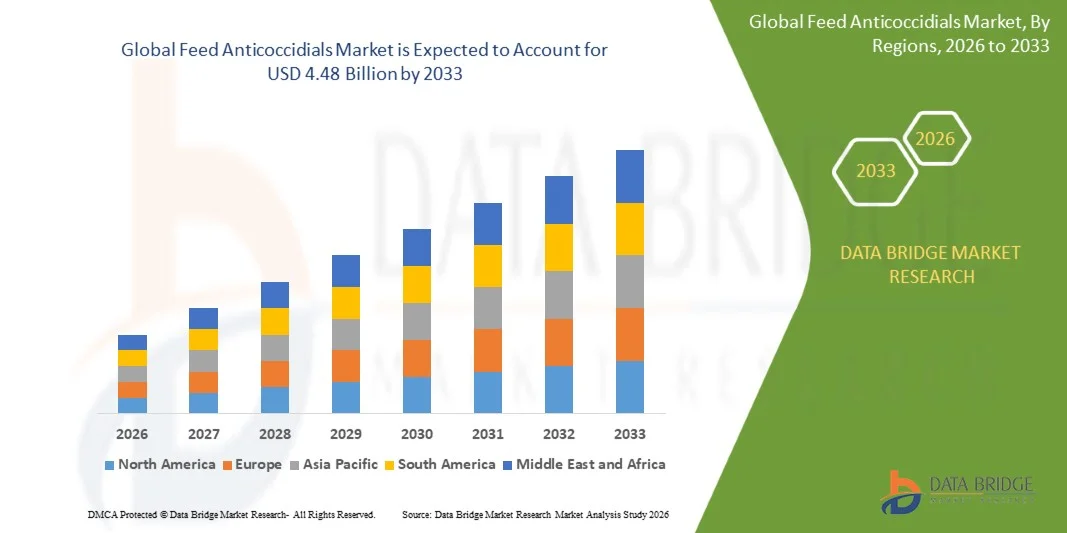
- As per Data Bridge Market Research analysis, the feed anticoccidials market was valued at USD 2.73 billion in 2025 and is projected to reach USD 4.48 billion by 2033, growing at a CAGR of 6.40% from 2026 to 2033.
- The market is experiencing consistent growth driven by rising demand for effective coccidiosis prevention in livestock production, increasing adoption of preventive animal-health measures, and growing emphasis on improving feed efficiency and animal productivity.
- The persistent incidence of coccidiosis in poultry and other food-producing animals, combined with the expansion of intensive livestock farming and rising global demand for meat and animal protein, is compelling farmers and feed manufacturers to adopt feed-based anticoccidial solutions. Chemical and ionophore anticoccidials remain important for disease control, while growing concerns regarding antimicrobial resistance, regulatory restrictions, and consumer preference for natural animal-health products are encouraging the development and adoption of natural and phytogenic alternatives.
Market Size & Forecast
- Global Market Value (2025): USD 2.73 Billion
- Expected Market Value (2033): USD 4.48 Billion
- Forecast CAGR (2026–2033): 6.40%
- Leading Region in 2025: North America
- Fastest Growing Region: Asia Pacific
What are the Major Takeaways of the Feed Anticoccidials Market?
- North America dominated the feed anticoccidials market with the largest revenue share of 30.2% in 2025, supported by large-scale poultry and livestock production, established commercial feed industries, stringent animal health standards, and widespread adoption of preventive coccidiosis-control programs.
- Asia-Pacific is expected to be the fastest-growing region at a CAGR of 6.8% from 2026 to 2033, fueled by rapid urbanization, expansion of intensive livestock farming, and increasing adoption of anticoccidial products across China, India, and other emerging markets.
- The poultry segment led the market with a 79.7% share in 2025, driven by the high prevalence of coccidiosis in commercial poultry production.
- Swine are the fastest-growing livestock type, projected to register a CAGR of 6.2%, reflecting the surge in commercial pig farming and increasing emphasis on preventive animal-health management.
- The monensin segment dominated the type category with a 35.0% revenue share in 2025, led by its established efficacy and extensive use in commercial poultry and livestock feed programs.
- Dry accounted for 62% of the market share in 2025, preferred by its ease of handling, storage stability, and compatibility with commercial feed manufacturing
- The natural segment is the fastest-growing source category, with a CAGR of 7.1%, driven by increasing demand for antibiotic-free and residue-conscious animal products.
Report Scope and Feed Anticoccidials Market Segmentation
|
Attributes |
Feed Anticoccidials Key Market Insights |
|
Segments Covered |
|
|
Countries Covered |
North America
Europe
Asia-Pacific
Middle East and Africa
South America
|
|
Key Market Players |
|
|
Market Opportunities |
|
|
Value Added Data Infosets |
In addition to the insights on market scenarios such as market value, growth rate, segmentation, geographical coverage, and major players, the market reports curated by the Data Bridge Market Research also include import export analysis, production capacity overview, production consumption analysis, price trend analysis, climate change scenario, supply chain analysis, value chain analysis, raw material/consumables overview, vendor selection criteria, PESTLE Analysis, Porter Analysis, and regulatory framework. |
What is the Key Trend in the Feed Anticoccidials Market?
- The feed anticoccidials market is increasingly shifting toward natural and phytogenic solutions, including plant extracts, essential oils, and botanical compounds, as poultry producers respond to antimicrobial-resistance concerns and growing demand for antibiotic-free animal products.
- For instance, in August 2024, researchers at Huazhong Agricultural University published a study on a botanical anticoccidial formulation containing eucalyptus oil, apigenin, and eugenol, which achieved an anticoccidial index (ACI) of 169.3 against Eimeria tenella in broilers, demonstrating the potential of plant-based alternatives to conventional anticoccidials
- Natural anticoccidials are gaining attention because they can support coccidiosis control while addressing consumer preferences for residue-free poultry products and reducing dependence on conventional chemical anticoccidials in intensive production systems.
- Feed manufacturers are also developing combination anticoccidial programs that use multiple mechanisms of action to improve efficacy and reduce the likelihood of resistance associated with prolonged exposure to individual compounds.
- For instance, in January 2024, Boehringer Ingelheim launched VAXXILIVE COCCI 3, a poultry coccidiosis vaccine positioned as a biological alternative to in-feed anticoccidial drugs, reflecting the industry's movement toward non-drug approaches for coccidiosis prevention.
- Producers are increasingly integrating anticoccidial programs with vaccination, biosecurity, litter management, and intestinal-health strategies to establish broader and more sustainable approaches to coccidiosis prevention.
What are the Key Drivers of the Feed Anticoccidials Market?
- The rising prevalence and economic impact of coccidiosis in intensive poultry production is increasing demand for preventive feed anticoccidials that help maintain flock health, reduce mortality, improve feed conversion, and stabilize production performance.
- For instance, in September 2025, Brazil’s animal-feed industry reported that poultry feed demand reached 18.9 million tons in the first half of 2025, highlighting the scale of poultry production and the resulting demand for feed-based health and disease-management solutions such as anticoccidials
- Expanding poultry production in emerging economies, particularly across Asia-Pacific, is strengthening demand for anticoccidial feed additives as producers intensify farming systems to satisfy growing consumption of poultry meat and improve production efficiency.
- Increasing awareness of animal health and disease prevention is encouraging commercial farms to adopt structured anticoccidial programs, particularly where high stocking densities and rapid production cycles increase exposure to Eimeria species.
- For instance, in May 2025, a study in Poultry Science identified coccidiosis as the number-one disease in the broiler poultry industry based on a 2023 industry survey, noting that the disease reduces growth rate, feed efficiency, and body-weight uniformity, reinforcing the need for effective preventive anticoccidial programs
- With poultry remaining the principal livestock application and disease prevention becoming increasingly important for productivity and food security, continued expansion of intensive animal production will sustain demand for feed-based anticoccidial solutions.
Which Factors are Challenging the Growth of the Feed Anticoccidials Market?
- The emergence of anticoccidial resistance is challenging market growth because repeated exposure to the same active ingredients can reduce treatment effectiveness, requiring producers to adopt rotation, combination, vaccination, and alternative disease-management strategies.
- For instance, in June 2024, EFSA’s assessment of monensin sodium (Coxidin) reported that the available evidence did not allow confirmation that the existing maximum authorized level of 125 mg/kg feed remained safe for chickens for fattening and laying hens, highlighting the safety and regulatory challenges associated with anticoccidial use
- Increasing regulatory scrutiny surrounding feed additives and antimicrobial use is creating additional compliance requirements for manufacturers, particularly in regions where authorities emphasize animal safety, environmental protection, residue control, and responsible veterinary use.
- For instance, in August 2024, EFSA’s assessment of diclazuril (Clinacox 0.5%) concluded that field Eimeria strains should be monitored for development of resistance, demonstrating the continuing resistance-management challenge that can limit the long-term effectiveness of conventional feed anticoccidials.
- Product safety considerations can also restrict adoption because certain coccidiostats have relatively narrow safety margins, while modern poultry production can create different exposure levels than those assessed in older tolerance studies
How is the Feed Anticoccidials Market Segmented?
The feed anticoccidials market is segmented on the basis of livestock, type, form, source, and distribution channel.
- By Livestock
On the basis of livestock, the feed anticoccidials market is segmented into poultry, ruminant, and swine. The poultry segment dominated the market with 79.7% share in 2025, owing to the high prevalence of coccidiosis in commercial poultry production. Poultry producers extensively use anticoccidials to prevent intestinal infections and maintain flock health. The large global production base of broilers and layers generates substantial demand for medicated feed solutions. Intensive poultry farming and high stocking densities further increase the need for preventive coccidiosis management. Growing consumption of poultry meat and eggs is also supporting continued adoption of anticoccidial feed products.
The swine segment is projected to witness the fastest growth at 6.2% CAGR during forecast period, supported by the expansion of commercial pig farming and increasing emphasis on preventive animal-health management. Intensive swine production is increasing the need for effective disease-control and feed-management practices. Producers are placing greater emphasis on maintaining intestinal health and consistent animal performance. Growing pork consumption is encouraging investment in organized and high-density pig production systems. Improvements in veterinary awareness are also supporting the adoption of specialized feed additives.
- By Type
On the basis of type, the feed anticoccidials market is segmented into monensin, salinomycin, narasin, and diclazuril. The monensin segment dominated the market with a share of 35.0% in 2025, supported by its established efficacy and extensive use in commercial poultry and livestock feed programs. Monensin is widely incorporated into preventive coccidiosis-control programs because of its proven effectiveness against important Eimeria species. Its long-standing commercial availability has established strong adoption among feed manufacturers and livestock producers. The product is also compatible with large-scale compound-feed manufacturing systems. Its established regulatory and production infrastructure further supports widespread availability.
The diclazuril segment is projected to register the fastest growth at 6.5% CAGR during forecast period, driven by increasing demand for targeted anticoccidial solutions and greater emphasis on effective disease management. Diclazuril provides targeted activity against coccidial parasites and is used in poultry and other livestock applications. Increasing attention to anticoccidial resistance is encouraging producers to diversify and rotate active ingredients. Regulatory monitoring of conventional products is also supporting interest in alternative treatment options. The product's established use in modern coccidiosis-control programs supports its commercial potential. Growing adoption of structured disease-prevention programs is expected to strengthen demand for diclazuril-based feed solutions.
- By Form
On the basis of form, the feed anticoccidials market is segmented into dry and liquid. The dry segment dominated the market with 62% share in 2025, owing to its ease of handling, storage stability, and compatibility with commercial feed manufacturing. Dry anticoccidials can be incorporated efficiently into premixes and compound feed. Their stable characteristics make them suitable for transportation and storage across large distribution networks. Commercial feed mills widely use dry formulations because they can be incorporated into standardized production processes. The established infrastructure for dry feed manufacturing further supports their widespread adoption.
The liquid segment is projected to witness the fastest growth at 6.7% CAGR during forecast period, driven by increasing demand for flexible dosing and efficient feed-management systems. Liquid formulations can provide greater flexibility in administration and dosage adjustment across livestock production environments. They are increasingly attractive where producers require controlled delivery of feed additives. Modern feeding technologies are improving the ability of producers to apply liquid products consistently. Their ease of mixing and application is supporting adoption among commercial livestock producers. Increasing demand for precise animal-health management is further supporting the segment.
- By Source
On the basis of source, the feed anticoccidials market is segmented into chemical and natural. The chemical segment dominated the market with 65.78% share in 2025, supported by the established efficacy and widespread use of conventional anticoccidial products. Chemical solutions remain important for preventive coccidiosis management in intensive poultry and livestock production. Their established performance gives producers predictable disease-control outcomes. Extensive availability through established feed and veterinary distribution networks further supports adoption. Chemical anticoccidials can also be incorporated into established commercial feed programs
The natural segment is expected to be the fastest-growing source category at 7.1% CAGR during forecast period, driven by increasing demand for antibiotic-free and residue-conscious animal products. Producers are showing greater interest in botanical extracts, phytogenic compounds, and other plant-derived feed solutions. Growing concerns surrounding antimicrobial resistance are encouraging exploration of alternatives to conventional products. Consumer preference for naturally produced animal products is further supporting this shift. Feed manufacturers are investing in innovative natural formulations designed to support intestinal health and coccidiosis management.
- By Distribution Channel
On the basis of distribution channel, the feed anticoccidials market is segmented into integrated feed manufacturers, commercial feed mills, and direct sales. The integrated feed manufacturers segment dominated the market with 46% share in 2025, supported by the vertically integrated structure of major poultry and livestock producers. Integrated manufacturers can coordinate feed formulation, animal production, and health-management activities within a unified production system. This structure allows efficient incorporation of anticoccidials into feed programs. Large-scale producers also benefit from centralized procurement and standardized disease-management practices. Integrated operations can maintain greater control over product quality, dosage, and feed distribution.
The direct sales segment is projected to register the fastest growth at 6.8% CAGR during forecast period, driven by increasing direct procurement by large commercial livestock producers. Direct purchasing enables producers to establish closer relationships with anticoccidial manufacturers and suppliers. It can also facilitate customized product selection according to specific livestock and feed requirements. Large farms increasingly seek reliable supply arrangements for recurring animal-health inputs. Direct supplier relationships can provide greater access to technical guidance and product-support services. The expansion of commercial and vertically organized livestock operations is strengthening demand for direct procurement.
Which Region Holds the Largest Share of the Feed Anticoccidials Market?
- North America dominated the feed anticoccidials market with the largest revenue share of 30.2% in 2025, supported by large-scale poultry and livestock production, established commercial feed industries, stringent animal health standards, and widespread adoption of preventive coccidiosis-control programs.
- The region also benefits from well-established veterinary healthcare systems, stringent animal-health standards, high adoption of medicated feed, and strong presence of major feed and animal-health companies. Increasing emphasis on disease prevention, feed efficiency, and livestock productivity continues to strengthen North America's leadership position in the global market.
U.S. Feed Anticoccidials Market Insight
The U.S. feed anticoccidials market is witnessing steady growth due to the country’s large-scale poultry and livestock production, established feed manufacturing infrastructure, and strong emphasis on coccidiosis prevention. The widespread use of preventive animal-health solutions, along with stringent standards for livestock health and food safety, is driving demand for anticoccidials across commercial poultry and livestock operations. In addition, increasing concerns regarding disease resistance, feed efficiency, and animal productivity are encouraging producers to adopt effective feed-based anticoccidial programs.
Asia-Pacific Feed Anticoccidials Market Insight
The Asia-Pacific feed anticoccidials market is expected to witness rapid growth, driven by expanding poultry and swine production, increasing adoption of intensive livestock farming, and rising investments in animal-health management across countries such as China, India, and Japan. Growing awareness regarding coccidiosis prevention, increasing demand for efficient feed utilization, and rising adoption of natural and non-ionophore anticoccidials are supporting regional market expansion. In addition, China’s large poultry and livestock production base and growing emphasis on food safety are accelerating the adoption of feed anticoccidials across commercial farming operations.
Japan Feed Anticoccidials Market Insight
The Japan feed anticoccidials market is witnessing consistent growth due to rising emphasis on livestock health, food safety, and effective disease prevention in commercial animal production. Poultry and livestock producers are increasingly adopting feed-based anticoccidial solutions to control coccidiosis, improve animal health, and maintain production efficiency. Moreover, stringent standards for veterinary medicines and feed additives, along with growing interest in natural and nonchemical alternatives, are further contributing to market growth in Japan.
China Feed Anticoccidials Market Insight
The China feed anticoccidials market is growing rapidly, driven by the country’s large poultry and livestock production base, expansion of intensive farming operations, and increasing focus on animal health and food safety. Growing adoption of anticoccidial solutions across commercial poultry and swine production is significantly boosting market demand, while increasing awareness of disease-related production losses is supporting preventive feed management. In addition, government emphasis on veterinary drug safety, rising adoption of natural and nonchemical anticoccidials, and continued modernization of the feed industry are positioning China as a major market for feed anticoccidials in Asia-Pacific.
U.K. Feed Anticoccidials Market Insight
The U.K. feed anticoccidials market is experiencing steady growth, supported by strong livestock production standards, increasing emphasis on animal welfare, and growing demand for effective coccidiosis management. Feed manufacturers and livestock producers are increasingly focusing on responsible anticoccidial use, disease prevention, and feed efficiency while complying with stringent veterinary and food-safety requirements. Furthermore, growing interest in alternatives to conventional anticoccidials, including natural solutions and vaccination-based approaches, is influencing product adoption and market development in the U.K.
Germany Feed Anticoccidials Market Insight
The Germany feed anticoccidials market is expanding steadily due to the country’s established livestock and feed industry, stringent animal-health regulations, and increasing focus on sustainable disease-control practices. Poultry, swine, and other livestock producers are increasingly utilizing anticoccidial solutions to manage coccidiosis and maintain animal health and feed efficiency. Continuous emphasis on responsible antimicrobial use, regulatory compliance, and the development of alternative disease-management solutions is further driving market growth in Germany.
Which are the Top Companies in Feed Anticoccidials Market?
The feed anticoccidials industry is primarily led by well-established companies, including:
- Elanco Animal Health Incorporated (U.S.)
- Huvepharma EOOD (Bulgaria)
- Phibro Animal Health Corporation (U.S.)
- Zoetis Inc. (U.S.)
- Merck & Co., Inc. (U.S.)
- Vetoquinol SA (France)
- Ceva Santé Animale (France)
- HIPRA (Spain)
- Kemin Industries, Inc. (U.S.)
- Alltech (U.S.)
- EW Nutrition GmbH (Germany)
- Impextraco NV (Belgium)
- NOVUS International, Inc. (U.S.)
- dsm-firmenich (Netherlands)
- Nutreco N.V. (Netherlands)
- Trouw Nutrition (Netherlands)
- Adisseo France S.A.S. (France)
- Jefo Nutrition Inc. (Canada)
- Animine (France)
- Norel S.A. (Spain)
What are Latest Developments in Feed Anticoccidials Market?
- In January 2024, Boehringer Ingelheim launched VAXXILIVE COCCI 3, a poultry coccidiosis vaccine previously known as Hatchpak Cocci III. The product provides a biological alternative to in-feed anticoccidial drugs and uses three genetically stable precocious Eimeria strains to stimulate immunity while reducing tissue damage, supporting the industry's move toward alternative coccidiosis-control approaches.
- In May 2023, HIPRA India launched Evant, a live vaccine against coccidiosis in broilers, during its Hatchery Solutions event in Agra, India. The launch introduced an additional preventive approach for commercial poultry producers and highlighted the increasing use of vaccination alongside conventional coccidiosis-control programs.
- In June 2022, Elanco highlighted the continued development and use of ionophore-based anticoccidial programs for poultry producers, emphasizing their role in controlling coccidiosis while supporting flock performance. The company also highlighted Maxiban, which combines narasin and nicarbazin through a dual mode of action designed to provide effective coccidiosis control while reducing resistance pressure. This development reflects the market’s continued shift toward combination-based anticoccidial strategies.
- In May 2022, Royal Pas Reform announced the launch of SmartVac, an in-ovo vaccination and nutrition system designed to provide accurate and consistent delivery of vaccines directly into the amniotic fluid. The system supports the application of coccidiosis vaccines in hatcheries, strengthening the integration of early-life vaccination into poultry health and disease-prevention programs.
- In May 2021, Elanco launched ZoaShield in the U.S., providing poultry producers with a flexible zoalene-based anticoccidial solution for coccidiosis control. The product was positioned particularly for poultry operations seeking reliable anticoccidial programs, including No Antibiotics Ever production systems, expanding Elanco’s anticoccidial portfolio

- Interactive Data Analysis Dashboard
- Company Analysis Dashboard for high growth potential opportunities
- Research Analyst Access for customization & queries
- Competitor Analysis with Interactive dashboard
- Latest News, Updates & Trend analysis
- Harness the Power of Benchmark Analysis for Comprehensive Competitor Tracking
Data collection and base year analysis are done using data collection modules with large sample sizes. The stage includes obtaining market information or related data through various sources and strategies. It includes examining and planning all the data acquired from the past in advance. It likewise envelops the examination of information inconsistencies seen across different information sources. The market data is analysed and estimated using market statistical and coherent models. Also, market share analysis and key trend analysis are the major success factors in the market report. To know more, please request an analyst call or drop down your inquiry.
The key research methodology used by DBMR research team is data triangulation which involves data mining, analysis of the impact of data variables on the market and primary (industry expert) validation. Data models include Vendor Positioning Grid, Market Time Line Analysis, Market Overview and Guide, Company Positioning Grid, Patent Analysis, Pricing Analysis, Company Market Share Analysis, Standards of Measurement, Global versus Regional and Vendor Share Analysis. To know more about the research methodology, drop in an inquiry to speak to our industry experts.
Data Bridge Market Research is a leader in advanced formative research. We take pride in servicing our existing and new customers with data and analysis that match and suits their goal. The report can be customized to include price trend analysis of target brands understanding the market for additional countries (ask for the list of countries), clinical trial results data, literature review, refurbished market and product base analysis. Market analysis of target competitors can be analyzed from technology-based analysis to market portfolio strategies. We can add as many competitors that you require data about in the format and data style you are looking for. Our team of analysts can also provide you data in crude raw excel files pivot tables (Fact book) or can assist you in creating presentations from the data sets available in the report.