What is the Feed Binders Market Size and Growth Rate?
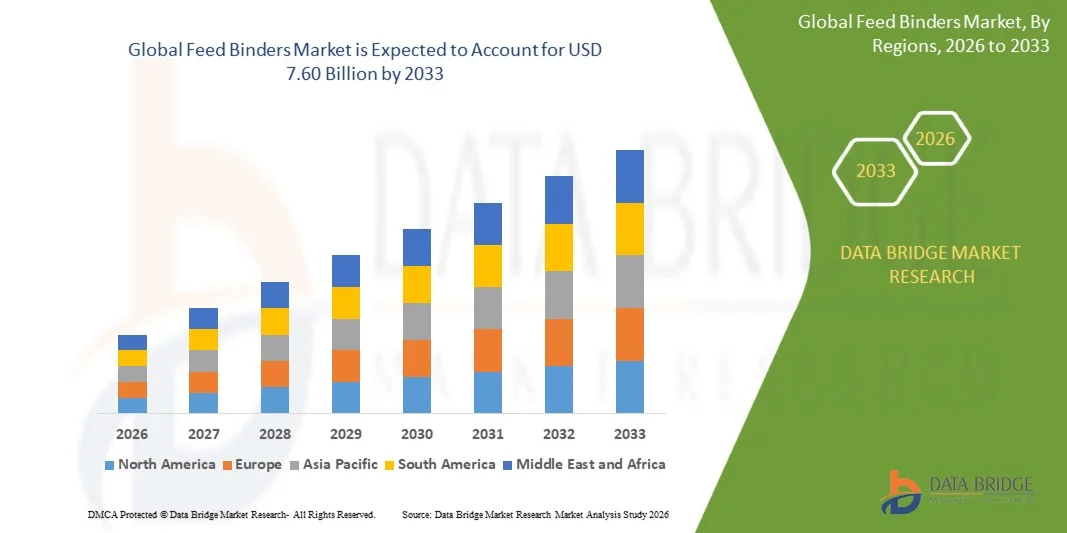
- As per Data Bridge Market Research analysis, the Feed Binders market was valued at USD 5.25 billion in 2025 and is projected to reach USD 7.60 billion by 2033, growing at a CAGR of 4.75% from 2026 to 2033.
- The market is experiencing consistent growth driven by the increasing demand for high-quality animal feed, rising livestock and poultry production, growing adoption of feed binders to improve pellet quality and feed durability, increasing demand for efficient feed utilization, and the expanding use of binders in compound feed and aquaculture applications.
- The growing demand for nutritionally balanced, stable, and efficiently processed animal feed is encouraging manufacturers to expand feed binder offerings. The increasing use of binders to improve pellet strength, reduce fines, enhance feed handling, and support efficient feed processing is further supporting market growth, while the development of natural and plant-based binders, improved binding performance, and customized formulations is broadening application opportunities.
Market Size & Forecast
- Global Market Value (2025): USD 5.25 Billion
- Expected Market Value (2033): USD 7.60 Billion
- Forecast CAGR (2026–2033): 4.75%
- Leading Region in 2025: North America
- Fastest Growing Region: Asia Pacific
What are the Major Takeaways of the Feed Binders Market?
- • Asia-Pacific dominated the feed binders market with the largest revenue share of 30.4% in 2025, supported by expanding poultry and livestock production, increasing aquaculture activity, rising protein consumption, growing compound feed production, and increasing adoption of specialized feed formulations.
- North America is expected to be the fastest-growing region during the forecast period, fueled by increasing commercial livestock production, rising demand for high-quality animal feed, growing adoption of feed additives, increasing focus on feed efficiency, and expansion of modern feed-processing facilities.
- The synthetic binders segment led the source category with a 61.2% share in 2025, driven by consistent binding performance, predictable processing characteristics, effectiveness in improving pellet quality, and widespread use in commercial poultry, swine, and livestock feed production.
- The natural binders segment is the fastest-growing source category, projected to register a CAGR of 4.48%, supported by increasing demand for bio-based feed ingredients, sustainability initiatives, growing preference for natural feed additives, and development of plant-based binder formulations.
- The poultry segment dominated the livestock category with a 44.62% revenue share in 2025, supported by large-scale commercial poultry production, high feed consumption, increasing demand for efficient feed conversion, and the need for improved pellet durability and reduced feed losses.
- The aquaculture segment is expected to be the fastest-growing livestock category, with a CAGR of 5.02%, driven by the expansion of intensive fish and shrimp farming, increasing demand for water-stable feed pellets, reduced nutrient leaching, and growing adoption of specialized aquaculture feed formulations.
- The lignosulfonates segment accounted for a significant share of the natural binders category in 2025, supported by its strong binding efficiency, cost-effectiveness, compatibility with pelletized feed production, and established use across poultry, livestock, and aquaculture feed applications.
- The aquaculture application segment is expected to register the fastest growth, driven by increasing global aquaculture production, rising demand for water-stable feed, the need to minimize nutrient loss during feeding, and growing adoption of specialized feed formulations for fish and shrimp farming.
Report Scope and Feed Binders Market Segmentation
|
Attributes |
Feed Binders Key Market Insights |
|
Segments Covered |
|
|
Countries Covered |
North America
Europe
Asia-Pacific
Middle East and Africa
South America
|
|
Key Market Players |
|
|
Market Opportunities |
|
|
Value Added Data Infosets |
In addition to the insights on market scenarios such as market value, growth rate, segmentation, geographical coverage, and major players, the market reports curated by the Data Bridge Market Research also include import export analysis, production capacity overview, production consumption analysis, price trend analysis, climate change scenario, supply chain analysis, value chain analysis, raw material/consumables overview, vendor selection criteria, PESTLE Analysis, Porter Analysis, and regulatory framework. |
What is the Key Trend in the Feed Binders Market?
- Feed binders manufacturers are increasingly focusing on high-performance formulations that improve pellet durability, reduce fines, enhance feed stability, and maintain structural integrity during processing, storage, and transportation.
- For instance, in November 2024, Borregaard filed a patent application for a binder for animal feed pellets, covering binder compositions intended to improve pellet quality and performance during feed production.
- Manufacturers are increasingly developing feed binder products with improved binding efficiency, pellet hardness, moisture stability, and compatibility with different feed formulations, supporting their use across poultry, livestock, and aquaculture applications.
- For instance, in July 2025, research published in Veterinary Integrative Sciences reported that pellet binders significantly improved pellet durability index, pellet hardness, and moisture content, highlighting continued development of binder applications for improving physical feed quality.
- The market is also witnessing increased adoption of natural and plant-derived feed binders, including starches, gums, lignosulfonates, and agricultural by-product-based materials, as feed manufacturers seek effective binding solutions with improved sustainability characteristics.
- For instance, in 2024, research published in the International Journal of Biological Macromolecules examined a novel animal feed binder derived from soybean hulls, demonstrating continued research into plant-based alternatives for feed pellet binding.
- Product innovation is increasingly focused on multifunctional feed binders that combine pellet binding with other nutritional or processing benefits, including improved feed stability, reduced wastage, and support for animal health.
- For instance, in October 2024, ADM Animal Nutrition introduced an improved multifunctional binder in the U.S. combining pelleting efficiency with probiotic support for poultry applications.
- As feed manufacturers increasingly prioritize pellet quality, production efficiency, natural ingredients, and specialized aquaculture feed performance, feed binder manufacturers are expanding their portfolios around multifunctional, plant-based, and high-performance binding solutions..
What are the Key Drivers of the Feed Binders Market?
- The growing demand for high-quality animal nutrition is driving adoption of feed binders across poultry, cattle, swine, aquaculture, and other livestock feed applications because binders help improve pellet integrity and reduce physical feed losses.
- For instance, in July 2025, a meta-analysis published in Veterinary Integrative Sciences evaluated 21 published studies and found that pellet binders improved pellet durability, hardness, and moisture characteristics, supporting their role in feed-quality improvement.
- The expansion of commercial livestock and compound-feed production is supporting demand for binders that maintain pellet structure during processing, storage, transportation, and feeding.
- Increasing adoption of pelleted feed is driving demand for binding solutions that reduce fines, improve pellet durability, and support efficient feed-mill operations.
- For instance, in November 2024, Borregaard's patent application for a binder for animal feed pellets addressed the continuing development of technologies designed specifically for improving animal-feed pellet production.
- Growing aquaculture production is increasing demand for feed binders that provide water stability and help maintain pellet integrity, particularly for fish and shrimp feed.
- For instance, Dr Katre Premix Lab's FeedBind, marketed for shrimp feed, is designed to improve feed stability, nutrient retention, pellet durability, and reduce feed waste in aquaculture applications.
- Increasing demand for natural and sustainable feed additives is encouraging manufacturers to develop binders derived from plant-based materials, agricultural by-products, gums, starches, and other naturally sourced ingredients.
Which Factors are Challenging the Growth of the Feed Binders Market?
- Regulatory requirements related to feed safety, additive authorization, labeling, permitted inclusion levels, and efficacy can create challenges for feed binder manufacturers operating across multiple markets.
- For instance, in 2025, the European Union continued updating authorization requirements for technological feed additives, including substances used within functional groups such as binders and stabilizers, requiring manufacturers to comply with specified conditions of use.
- Increasing scrutiny of the safety and efficacy of feed additives can increase product-development costs and require manufacturers to generate additional technical and scientific evidence before commercialization.
- For instance, EFSA's scientific assessments of bentonite have examined its safety and efficacy as a feed additive, including its proposed use as an aflatoxin B1 binder, demonstrating the regulatory evaluation required for binder-based feed additives.
- Fluctuations in the prices and availability of raw materials such as lignosulfonates, starches, gums, clay minerals, and molasses can increase manufacturing costs and create supply-chain challenges for feed binder producers.
- ·Variations in feed formulations, animal species, processing equipment, moisture levels, and pelleting conditions can make it difficult to achieve consistent binder performance across different feed-production environments.
- The availability of alternative feed-processing approaches and formulation technologies can create competitive pressure on conventional binder products, particularly where feed manufacturers can achieve adequate pellet durability through optimized moisture, conditioning, extrusion, or pelleting processes.
- For instance, in 2024, the feed industry continued adopting processing technologies such as cold pelleting and extrusion, increasing the need for binder formulations that can perform effectively under different production conditions.
- Growing demand for sustainable and traceable feed additives can also increase sourcing and formulation requirements because manufacturers must demonstrate ingredient quality, regulatory compliance, safety, and environmental characteristics while maintaining cost-effective performance.
How is the Feed Binders Market Segmented?
The feed binders market is segmented on the basis of type, source, livestock and application.
- By Type
On the basis of type, the feed binders market is segmented into lignosulfonates, plant gums and starches, gelatin and other hydrocolloids, molasses, clay, and others. The lignosulfonates segment dominated the market with a 31.6% share in 2025, supported by its strong binding, dispersing, and emulsifying properties, which improve pellet durability and maintain feed structural integrity during processing, storage, and transportation. Lignosulfonates are widely used in compound feed production because they provide effective binding performance across livestock and poultry feed applications.
The plant gums and starches segment is projected to witness the fastest growth at a CAGR of 10.2% during the forecast period of 2026 to 2033, driven by increasing demand for bio-based and sustainable feed binder solutions. Guar gum, xanthan gum, agar, and starch-based binders are increasingly used to improve pellet structure and binding performance across livestock and aquaculture feed applications.
- By Source
On the basis of source, the feed binders market is segmented into natural and synthetic. The synthetic segment dominated the market with a 61.2% share in 2025, supported by its consistent binding performance, formulation flexibility, and ability to provide uniform pellet quality during industrial feed processing. Synthetic binders also provide controlled functional characteristics that support feed stability during processing and storage.
The natural segment is projected to witness the fastest growth at a CAGR of 4.48% during the forecast period of 2026 to 2033, driven by increasing demand for plant-derived, bio-based, and naturally sourced feed additives. Lignosulfonates, starches, gums, molasses, and clay-based binders are increasingly considered in formulations seeking effective binding performance alongside natural ingredient characteristics.
- By Livestock
On the basis of livestock, the feed binders market is segmented into poultry, cattle, swine, aquatic animals, dogs and cats, and others. The poultry segment dominated the market with a 44.62% share in 2025, supported by high compound-feed consumption, extensive commercial poultry production, and widespread use of pelleted feed. Feed binders improve pellet durability, reduce fines, and maintain feed quality during handling, storage, and transportation.
The aquatic animals segment is projected to witness the fastest growth at a CAGR of 5.02% during the forecast period of 2026 to 2033, driven by expansion of aquaculture production and increasing demand for water-stable feed formulations. Feed binders help maintain pellet integrity in water, reduce nutrient leaching, and improve feed utilization in fish and shrimp farming.
- By Application
On the basis of application, the feed binders market is segmented into moist feed, pellets, crumbles, and others. The pellets segment dominated the market with a 52.8% share in 2025, supported by the extensive use of pelletized feed in commercial livestock and poultry production. Feed binders improve pellet durability, reduce the formation of fines, and support consistent feed structure during production, storage, transportation, and handling.
The crumbles segment is projected to witness the fastest growth at a CAGR of 4.6% during the forecast period of 2026 to 2033, driven by increasing use of crumble feed for young poultry and other livestock. Feed binders help maintain structural integrity and reduce excessive fines during crushing, handling, and transportation.
Which Region Holds the Largest Share of the Feed Binders Market?
- Asia-Pacific dominated the feed binders market with the largest revenue share of 30.4% in 2025, supported by large livestock and poultry populations, expanding compound-feed production, growing aquaculture activities, and increasing adoption of commercial feed-processing technologies.
- The region also benefits from expanding animal husbandry and aquaculture industries, rising demand for processed animal feed, increasing investments in modern feed mills, and growing adoption of pelleted feed. China, India, Japan, and other Asia-Pacific countries are contributing to demand for feed binders through expanding livestock production and feed manufacturing activities.
U.S. Feed Binders Market Insight
The U.S. feed binders market is witnessing steady growth due to established livestock and poultry production, advanced compound-feed manufacturing infrastructure, and widespread use of pelleted animal feed. Demand for feed binders is supported by the need to improve pellet durability, reduce fines, maintain feed quality during transportation, and improve processing efficiency. The country's established feed industry and continued investment in animal nutrition technologies further support the U.S. feed binders market.
Asia-Pacific Feed Binders Market Insight
The Asia-Pacific feed binders market is expected to witness strong growth, supported by expanding livestock and poultry production, increasing compound-feed consumption, growing aquaculture activities, and investments in modern feed-processing facilities across countries such as China, India, Japan, and Australia. The region's large animal-feed manufacturing base is increasing demand for binders that improve pellet durability, reduce feed wastage, and maintain structural integrity during storage and transportation. Growing aquaculture production is also supporting demand for water-stable feed binder solutions.
Japan Feed Binders Market Insight
The Japan feed binders market is witnessing steady growth due to established livestock production, advanced feed manufacturing technologies, and increasing emphasis on feed quality and processing efficiency. Demand for feed binders is supported by the use of pelleted feed in poultry, swine, cattle, and aquaculture applications. The country's advanced animal nutrition industry and focus on efficient feed utilization are contributing to continued adoption of specialized feed binder formulations.
China Feed Binders Market Insight
The China feed binders market is expanding steadily, supported by the country's large livestock and poultry production base, extensive compound-feed manufacturing industry, and growing aquaculture sector. Increasing production of pelleted feed is creating demand for binders that improve pellet durability, reduce fines, and maintain feed integrity during handling and transportation. The expansion of commercial aquaculture and increasing adoption of modern feed-processing technologies are further supporting demand for feed binders.
U.K. Feed Binders Market Insight
The U.K. feed binders market is experiencing steady growth, supported by established livestock farming, compound-feed production, and increasing emphasis on feed quality and animal nutrition. Demand for feed binders is driven by the need to improve pellet structure, reduce feed losses, and maintain consistent feed quality during processing and storage. Increasing attention to sustainable and naturally derived feed additives is also supporting the development of alternative feed binder formulations.
Germany Feed Binders Market Insight
The Germany feed binders market is expanding steadily due to its established livestock industry, advanced animal-feed manufacturing sector, and strong focus on feed efficiency and quality. Feed binders are used across poultry, swine, cattle, and other animal-feed applications to improve pellet durability and reduce fines during processing and transportation. Increasing adoption of efficient feed-processing technologies and growing interest in sustainable and naturally derived feed additives are contributing to market development.
Which are the Top Companies in Feed Binders Market?
The Feed Binders industry is primarily led by well-established companies, including:
- Alltech (U.S.)
- Archer Daniels Midland Company (U.S.)
- DuPont (U.S.)
- Darling Ingredients Inc. (U.S.)
- Roquette Frères (France)
- Borregaard ASA (Norway)
- CP Kelco Inc. (U.S.)
- Beneo GmbH (Germany)
- Emsland Group (Germany)
- BASF SE (Germany)
- Kemin Industries, Inc. (U.S.)
- The Cooperative Royal Avebe U.A. (Netherlands)
- Ingredion Incorporated (U.S.)
- Kerry Group plc (Ireland)
- Gelita AG (Germany)
- Bentoli AgriNutrition Pvt. Ltd. (India)
- Nutreco N.V. (Netherlands)
- Phibro Animal Health Corporation (U.S.)
- Trouw Nutrition (Netherlands)
- Visco Starch (Thailand)
- FMC Corporation (U.S.)
- Cargill, Incorporated (U.S.)
What are Latest Developments in Feed Binders Market?
- In March 2024, the European Commission authorized lignosulphonate as a feed additive for all animal species under the technological additives category and functional group “binders,” supporting its continued use in animal nutrition and feed-pellet applications.
- In October 2024, Borregaard reported the development and launch of a new feed-binder formulation for the aquaculture industry. The company highlighted growing demand for non-synthetic, sustainable binders as alternatives to synthetic binders in shrimp feed applications.
- In October 2024, Borregaard continued to promote lignin-based pellet binders designed to improve pellet durability, reduce fines, prevent feed segregation, and support consistent pellet quality across livestock and aquaculture feed applications.
- In November 2024, developments in calcium-based binder systems combined with lignosulfonate demonstrated opportunities to improve pelleting efficiency, pellet durability, and water stability, particularly for animal-feed pellets and aquaculture feed applications.
- In December 2024, feed-binder solutions based on lignosulfonates continued to support the production of durable pellets by improving adhesion between feed particles, reducing fines, and enhancing feed handling and processing performance.

- Interactive Data Analysis Dashboard
- Company Analysis Dashboard for high growth potential opportunities
- Research Analyst Access for customization & queries
- Competitor Analysis with Interactive dashboard
- Latest News, Updates & Trend analysis
- Harness the Power of Benchmark Analysis for Comprehensive Competitor Tracking
Data collection and base year analysis are done using data collection modules with large sample sizes. The stage includes obtaining market information or related data through various sources and strategies. It includes examining and planning all the data acquired from the past in advance. It likewise envelops the examination of information inconsistencies seen across different information sources. The market data is analysed and estimated using market statistical and coherent models. Also, market share analysis and key trend analysis are the major success factors in the market report. To know more, please request an analyst call or drop down your inquiry.
The key research methodology used by DBMR research team is data triangulation which involves data mining, analysis of the impact of data variables on the market and primary (industry expert) validation. Data models include Vendor Positioning Grid, Market Time Line Analysis, Market Overview and Guide, Company Positioning Grid, Patent Analysis, Pricing Analysis, Company Market Share Analysis, Standards of Measurement, Global versus Regional and Vendor Share Analysis. To know more about the research methodology, drop in an inquiry to speak to our industry experts.
Data Bridge Market Research is a leader in advanced formative research. We take pride in servicing our existing and new customers with data and analysis that match and suits their goal. The report can be customized to include price trend analysis of target brands understanding the market for additional countries (ask for the list of countries), clinical trial results data, literature review, refurbished market and product base analysis. Market analysis of target competitors can be analyzed from technology-based analysis to market portfolio strategies. We can add as many competitors that you require data about in the format and data style you are looking for. Our team of analysts can also provide you data in crude raw excel files pivot tables (Fact book) or can assist you in creating presentations from the data sets available in the report.