What is the Feed Phosphates Market Size and Growth Rate?
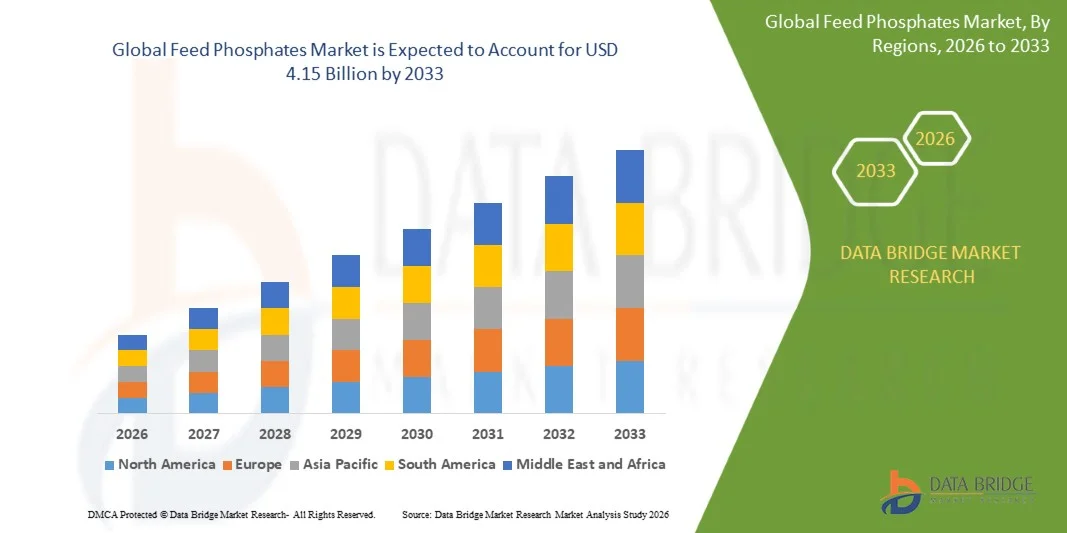
- As per Data Bridge Market Research analysis, the feed phosphates market was valued at USD 2.97 billion in 2025 and is projected to reach USD 4.15 billion by 2033, growing at a CAGR of 4.30% from 2026 to 2033.
- The market is experiencing consistent growth driven by increasing demand for high-quality animal nutrition, rising livestock and poultry production, growing awareness of mineral supplementation, and the expanding use of feed phosphates to support animal growth, bone development, fertility, and feed efficiency.
- The increasing global consumption of meat, dairy, eggs, and aquaculture products, combined with the expansion of commercial livestock farming and the need to improve animal productivity, is encouraging feed manufacturers to incorporate phosphate-based mineral supplements. Dicalcium phosphate, monocalcium phosphate, and other feed phosphates provide bioavailable phosphorus and calcium, supporting healthy skeletal development and overall animal performance.
Market Size & Forecast
- Global Market Value (2025): USD 2.97 Billion
- Expected Market Value (2033): USD 4.15 Billion
- Forecast CAGR (2026–2033): 4.30%
- Leading Region in 2025: North America
- Fastest Growing Region: Asia Pacific
What are the Major Takeaways of the Feed Phosphates Market?
- North America dominated the feed phosphates market with the largest revenue share of 38.18% in 2025, supported by high meat consumption, technologically advanced livestock farming, strong demand for animal-feed supplements, and established feed manufacturing infrastructure
- Asia-Pacific is expected to be the fastest-growing region at a CAGR of 5.1% from 2026 to 2033, fueled by expanding livestock production, rising demand for animal protein, growing poultry and aquaculture sectors, and increasing adoption of mineral supplementation
- The calcium phosphate segment led the market with a 70% share in 2025, driven by its extensive use as a source of calcium and phosphorus in animal-feed formulations.
- Ammonium phosphate are the fastest-growing type, projected to register a CAGR of 5%, reflecting the surge in demand for concentrated phosphorus sources in specialized animal-feed formulations.
- The poultry segment dominated the livestock category with a 48.3% revenue share in 2025, led by extensive global poultry production base and increasing demand for poultry meat and eggs.
- Granule accounted for 55% of the market share in 2025, preferred by its favorable handling characteristics, reduced dust generation, and suitability for large-scale feed manufacturing.
- The powder segment is the fastest-growing form category, with a CAGR of 5.9%, driven by its ease of blending and flexibility in different animal-feed formulations.
Report Scope and Feed Phosphates Market Segmentation
|
Attributes |
Feed Phosphates Key Market Insights |
|
Segments Covered |
|
|
Countries Covered |
North America
Europe
Asia-Pacific
Middle East and Africa
South America
|
|
Key Market Players |
|
|
Market Opportunities |
|
|
Value Added Data Infosets |
In addition to the insights on market scenarios such as market value, growth rate, segmentation, geographical coverage, and major players, the market reports curated by the Data Bridge Market Research also include import export analysis, production capacity overview, production consumption analysis, price trend analysis, climate change scenario, supply chain analysis, value chain analysis, raw material/consumables overview, vendor selection criteria, PESTLE Analysis, Porter Analysis, and regulatory framework. |
What is the Key Trend in the Feed Phosphates Market?
- The feed phosphates market is increasingly shifting toward precision phosphorus nutrition, with feed manufacturers adopting highly bioavailable phosphate sources, phytase technologies, and optimized formulations to improve phosphorus utilization while reducing unnecessary supplementation.
- For instance, in April 2025, Phosphea presented research at NutriForum 2025 demonstrating that its calcium humophosphate (HumIPHORA) achieved better phosphorus digestibility than monocalcium phosphate (MCP) in broilers at all tested phytase doses (P<0.001), supporting the shift toward higher-bioavailability phosphate solutions and precision phosphorus nutrition
- This trend is being reinforced by growing environmental pressure to reduce phosphorus excretion and nutrient runoff, encouraging manufacturers to develop phosphate products that deliver greater nutritional value at lower inclusion levels.
- Granular feed phosphates are also gaining preference among large feed mills because of improved flowability, reduced dust generation, easier handling, and more accurate automated dosing during feed production.
- Manufacturers are simultaneously investing in functional and innovative phosphate formulations that improve phosphorus digestibility and help animals utilize nutrients more efficiently, particularly in poultry and swine nutrition.
- For instance, in March 2025, Phosphea highlighted technological parameters such as particle size, granulometry, and product stability as important considerations when selecting and switching between inorganic feed phosphates, reflecting the industry's increasing focus on optimized phosphate formulations and efficient feed manufacturing.
- The increasing emphasis on phosphorus efficiency, environmental sustainability, and precision feed formulation is expected to accelerate demand for higher-bioavailability phosphate solutions, creating a gradual shift from conventional volume-based supplementation toward performance-oriented products.
What are the Key Drivers of the Feed Phosphates Market?
- The rising global demand for animal protein, including poultry, pork, dairy, and seafood, is increasing commercial livestock production and consequently driving demand for mineral-balanced feed containing bioavailable phosphorus and calcium.
- For instance, in October 2025, De Heus inaugurated a new animal-feed plant in Patiala, India, with an initial production capacity of 180,000 tonnes annually and expansion potential to 240,000 tonnes, demonstrating continued investment in industrial animal-feed production to support the country's growing livestock and poultry nutrition demand.
- Rapid expansion of industrial poultry, swine, dairy, and aquaculture operations is increasing the need for scientifically formulated feeds that support bone development, growth, reproductive performance, metabolism, and feed conversion efficiency.
- The increasing adoption of phytase and precision nutrition is also stimulating demand for higher-quality phosphate products by enabling nutritionists to optimize digestible phosphorus while maintaining animal performance and controlling feed costs.
- For instance, in February 2026, Cargill India announced a USD 31.75 million investment in its second dairy-feed manufacturing plant in Punjab, with a planned production capacity of 400,000 tonnes per year, reflecting increasing commercial dairy production and demand for nutritionally balanced animal feed in India.
- With global meat and aquaculture production continuing to expand and feed manufacturers focusing increasingly on nutritional efficiency, the demand for reliable, bioavailable, and precisely formulated feed phosphates is expected to remain a major growth driver
Which Factors are Challenging the Growth of the Feed Phosphates Market?
- Feed phosphate manufacturers face significant raw-material price volatility and supply-chain risks, as phosphate rock availability is geographically concentrated and production costs are influenced by energy, sulfur, phosphoric acid, logistics, and trade conditions.
- For instance, in July 2026, Feed Strategy reported that rising feed-phosphate prices and constrained supply were putting pressure on feed formulators, with higher phosphoric-acid costs, tighter sulfur and sulfuric-acid supply, restricted producer offers, and reduced export availability increasing the cost and uncertainty of MCP, DCP, and MDCP.
- Environmental regulations concerning phosphorus discharge and nutrient runoff are also becoming more stringent, encouraging livestock producers to reduce excess phosphorus supplementation and potentially limiting inorganic phosphate volumes in some mature markets.
- The increasing use of phytase enzymes and precision feeding can reduce the quantity of inorganic phosphate required in feed formulations, creating a volume-growth challenge for conventional DCP, MCP, and MDCP suppliers.
- In addition, manufacturers must meet increasingly stringent specifications for fluorine, cadmium, heavy metals, solubility, particle size, and bioavailability, increasing quality-control requirements and production costs across the supply chain.
- For instance, in February 2026, the European Commission reiterated that animal-feed ingredients must meet strict safety requirements for undesirable substances, while EU rules establish maximum limits for contaminants including cadmium, lead, and fluorine in feed materials and phosphates, increasing compliance and quality-control requirements for phosphate suppliers.
- These cost, regulatory, and substitution pressures can constrain phosphate consumption growth, particularly in mature markets where phytase adoption and precision formulation are already widespread, making cost-efficient and highly bioavailable phosphate products increasingly important for suppliers.
How is the Feed Phosphates Market Segmented?
The feed phosphates market is segmented on the basis of type, livestock, form, and application.
- By Type
On the basis of type, the feed phosphates market is segmented into calcium phosphate, sodium phosphate, ammonium phosphate, and others. The calcium phosphate segment dominated the market with 70% share in 2025, owing to its extensive use as a source of calcium and phosphorus in animal-feed formulations. These products are widely incorporated into poultry, swine, and ruminant diets to support bone development, growth, and metabolic functions. Dicalcium phosphate and monocalcium phosphate are particularly important because of their established nutritional performance and broad application across commercial feed formulations. Their high availability and compatibility with compound-feed manufacturing further support widespread adoption. Increasing demand for balanced animal nutrition continues to strengthen the position of calcium phosphate products.
The ammonium phosphate segment is projected to register the fastest growth at 5% CAGR during the forecast period, driven by increasing demand for concentrated phosphorus sources in specialized animal-feed formulations. These products provide readily available phosphorus that can support mineral nutrition in livestock diets. Growing emphasis on efficient nutrient utilization is encouraging feed manufacturers to consider different phosphate sources according to species requirements. Increasing commercial livestock production is further supporting demand for mineral-rich feed ingredients. Improvements in feed formulation technologies are also creating opportunities for alternative phosphate products. The growing focus on feed efficiency and animal performance is expected to support segment expansion.
- By Livestock
On the basis of livestock, the feed phosphates market is segmented into poultry, swine, ruminants, aquaculture, and others. The poultry segment dominated the market with 48.3% share in 2025, supported by the extensive global poultry production base and increasing demand for poultry meat and eggs. Poultry diets require balanced levels of phosphorus and calcium to support skeletal development, growth, metabolism, and productivity. Feed phosphates such as dicalcium phosphate and monocalcium phosphate are extensively used in broiler and layer feed formulations. The rapid production cycle of poultry also increases the importance of efficient nutrient utilization. Expansion of commercial poultry farming is increasing demand for formulated feeds containing essential minerals.
The aquaculture segment is projected to register the fastest growth at a 5.4% CAGR during the forecast period, driven by increasing fish and shrimp production and the expansion of intensive aquaculture farming. Commercial aquaculture operations increasingly depend on formulated feeds containing balanced levels of minerals and other essential nutrients. Feed phosphates support skeletal development, phosphorus metabolism, growth, and overall animal performance in aquatic species. Rising seafood consumption is encouraging producers to expand aquaculture capacity across major producing regions. Increasing use of commercial aquatic feeds is consequently creating additional demand for phosphate ingredients. Asia-Pacific remains an important growth area because of its extensive aquaculture production and expanding feed industry.
- By Form
On the basis of form, the feed phosphates market is segmented into powder and granule. The granule segment dominated the market with 55% share in 2025, owing to its favorable handling characteristics, reduced dust generation, and suitability for large-scale feed manufacturing. Granular phosphates can be transported, stored, and incorporated into animal-feed mixtures efficiently. Their physical characteristics help improve the uniformity of phosphate distribution during feed processing. They are particularly suitable for automated feed-milling and blending operations. Reduced dust formation can also improve workplace handling conditions compared with very fine powdered materials. Growing industrialization of animal-feed production is supporting the adoption of granular phosphate products.
The powder segment is projected to register the fastest growth at 5.9% CAGR during the forecast period, supported by its ease of blending and flexibility in different animal-feed formulations. Powdered phosphates can be efficiently incorporated into premixes and complete-feed formulations. Their fine particle characteristics allow manufacturers to achieve consistent distribution of phosphorus and calcium throughout feed mixtures. They are widely suitable for poultry, swine, ruminant, and other animal-feed applications. Powdered products also provide flexibility for manufacturers developing species-specific and customized feed formulations. Increasing demand for precision mineral supplementation is further supporting their use.
- By Application
On the basis of application, the feed phosphates market is segmented into poultry feed, swine feed, cattle feed, dairy feed, aquaculture feed, pet feed, and other animal feed. The poultry feed segment dominated the market with 45% share in 2025, supported by the extensive use of phosphate supplements in broiler and layer diets. Phosphorus and calcium are essential for bone development, growth, metabolism, and egg production, making phosphate supplementation important in poultry nutrition. Feed manufacturers widely use phosphate ingredients to formulate nutritionally balanced commercial poultry diets. Rising demand for poultry meat and eggs is encouraging continued expansion of commercial poultry production. Increasing adoption of compound feeds is further strengthening demand for feed phosphates.
The aquaculture feed segment is projected to register the fastest growth at 6.0% CAGR during the forecast period, driven by increasing fish and shrimp production and the growing adoption of formulated aquatic feeds. Phosphates are important components of balanced aquatic diets because they contribute to phosphorus nutrition and skeletal development. Increasing intensification of aquaculture is encouraging producers to rely on scientifically formulated feeds rather than traditional feeding practices. Rising seafood consumption is further supporting expansion of commercial aquaculture operations. Increasing demand for efficient feed utilization is also encouraging the incorporation of optimized mineral sources. The expansion of aquaculture production in Asia-Pacific and other emerging markets is creating additional opportunities.
Which Region Holds the Largest Share of the Feed Phosphates Market?
- North America dominated the feed phosphates market with the largest revenue share of 38.18% in 2025, supported by high meat consumption, technologically advanced livestock farming, strong demand for animal-feed supplements, and established feed manufacturing infrastructure
- The region also benefits from high adoption of precision animal nutrition, established animal-feed manufacturers, and stringent feed-quality standards across poultry, swine, and ruminant production. Strong commercial farming practices and increasing emphasis on feed efficiency continue to support phosphate consumption. The presence of a mature livestock industry and advanced feed-processing capabilities further strengthens North America's position in the global market
U.S. Feed Phosphates Market Insight
The U.S. feed phosphates market is witnessing strong growth due to the country’s large-scale livestock production, well-established animal-feed manufacturing industry, and increasing demand for balanced animal nutrition. The country’s mature poultry, swine, dairy, and cattle sectors, along with increasing adoption of precision nutrition practices, are driving demand for feed phosphates across commercial feed applications. In addition, growing emphasis on phosphorus digestibility, feed efficiency, and animal health is accelerating the incorporation of optimized phosphate sources into livestock diets.
Asia-Pacific Feed Phosphates Market Insight
The Asia-Pacific feed phosphates market is expected to witness rapid growth, driven by increasing livestock and aquaculture production, rising meat and seafood consumption, and expanding commercial feed manufacturing across countries such as China, India, and Japan. Growing adoption of scientifically formulated animal diets, increasing awareness regarding animal nutrition, and rising demand for efficient feed ingredients are supporting regional market expansion. In addition, the growing presence of large-scale poultry, swine, dairy, and aquaculture operations is accelerating feed phosphate consumption across the region.
Japan Feed Phosphates Market Insight
The Japan feed phosphates market is witnessing consistent growth due to rising demand for high-quality animal nutrition, advanced livestock farming practices, and increasing emphasis on feed efficiency. Poultry, swine, dairy, and aquaculture producers are increasingly utilizing nutritionally balanced feed formulations containing phosphate supplements to support animal growth and health. Moreover, increasing adoption of precision feeding technologies and the country’s focus on efficient livestock production are further contributing to market growth.
China Feed Phosphates Market Insight
The China feed phosphates market is growing rapidly, driven by the country’s extensive livestock and aquaculture industries, expanding compound-feed production, and rising demand for animal protein. Growing adoption of scientifically formulated poultry, swine, cattle, and aquatic feeds is significantly boosting demand for phosphate ingredients. In addition, increasing investments in modern feed manufacturing, greater focus on animal health and feed efficiency, and the rapid development of aquaculture are positioning China as one of the fastest-growing markets for feed phosphates globally.
U.K. Feed Phosphates Market Insight
The U.K. feed phosphates market is experiencing steady growth, supported by increasing adoption of advanced animal nutrition practices, established livestock production, and growing demand for nutritionally balanced compound feeds. Increasing emphasis on phosphorus utilization, animal health, and sustainable feed formulation is contributing to the use of efficient phosphate sources across poultry, swine, cattle, and dairy applications. Furthermore, stringent feed-quality requirements and increasing adoption of precision nutrition technologies are improving feed formulation efficiency and supporting market growth in the U.K.
Germany Feed Phosphates Market Insight
The Germany feed phosphates market is expanding steadily due to the country’s strong livestock sector, advanced feed manufacturing capabilities, and increasing adoption of precision animal nutrition technologies. Poultry, swine, cattle, and dairy producers are increasingly utilizing phosphate supplements to maintain balanced mineral nutrition and improve animal performance. Continuous advancements in feed formulation, growing emphasis on phosphorus digestibility, and strong regulatory focus on feed quality and environmental sustainability are further driving market growth in Germany.
Which are the Top Companies in Feed Phosphates Market?
The feed phosphates industry is primarily led by well-established companies, including:
- The Mosaic Company (U.S.)
- Nutrien Ltd. (Canada)
- OCP (Morocco)
- Phosphea (France)
- Yara International ASA (Norway)
- EuroChem Group AG (Switzerland)
- PhosAgro (Russia)
- Fosfitalia S.p.A. (Italy)
- J.R. Simplot Company (U.S.)
- ICL Group Ltd. (Israel)
- Prayon (Belgium)
- KEMAPCO (Jordan)
- Maaden (Saudi Arabia)
- TIMAB Industries (France)
- Wengfu Group Co., Ltd. (China)
- Yunnan Phosphorus Chemicals Group Co., Ltd. (China)
- SICHUAN CHANHEN HOLDING GROUP CO., LTD (China)
- Sichuan Lomon Phosphorus Chemical Co., Ltd. (China)
- Jiangsu Khonor Chemicals Co., Limited (China)
What are Latest Developments in Feed Phosphates Market?
- In December 2025, Phosphea highlighted new research on HumIPHORA for poultry nutrition, showing its potential to improve phosphorus and calcium utilization compared with conventional phosphate sources. The research focused on improving nutrient absorption and reducing the dependence on conventional phosphate incorporation in poultry diets. HumIPHORA is designed to interact with nutrients in the gastrointestinal tract and improve the utilization of plant-based phosphorus. The development supports the broader movement toward more sustainable and nutritionally efficient feed-phosphate solutions.
- In October 2025, Phosphea published research on the characteristics of organic and inorganic phosphorus sources used in animal feed, highlighting the role of highly digestible inorganic feed phosphates in precision animal nutrition. The research examined commonly used monocalcium phosphate, monodicalcium phosphate, and dicalcium phosphate sources and their differences in phosphorus and calcium content. The development emphasized selecting phosphate sources according to digestibility and nutritional requirements. The work demonstrates the industry's increasing focus on optimizing phosphate selection rather than simply increasing mineral supplementation.
- In December 2024, Phosphea and MOFVET organized an event to launch HumIPHORA in the Algerian market, expanding the availability of the company's phosphate innovation in North Africa. The launch introduced the product to customers and highlighted its application as an alternative phosphate solution for animal nutrition. HumIPHORA is designed to provide high-quality phosphorus while improving the utilization of plant-based phosphorus. The Algerian launch demonstrates the expansion of innovative feed-phosphate products into additional international markets.
- In March 2025, Phosphea published an assessment of the technological parameters of inorganic feed phosphates, highlighting the importance of properties such as pH and particle characteristics during feed manufacturing. The company noted that differences in phosphate properties can influence feed-processing conditions and equipment performance. The research emphasized that manufacturers need to consider technological parameters when changing from one phosphate source to another. The development highlights how feed-phosphate innovation is increasingly addressing both nutritional and manufacturing requirements.
- In April 2022, Phosphea launched HumIPHORA as a new phosphate innovation based on calcium humophosphate for animal nutrition. The product was developed to provide a high-quality phosphorus source while improving the utilization of plant-based phosphorus in feed formulations. Its development represented a shift toward phosphate solutions designed to improve nutrient efficiency rather than relying solely on conventional mineral supplementation. This launch marked an important product-development step toward more sustainable and precision-oriented feed-phosphate solutions.

- Interactive Data Analysis Dashboard
- Company Analysis Dashboard for high growth potential opportunities
- Research Analyst Access for customization & queries
- Competitor Analysis with Interactive dashboard
- Latest News, Updates & Trend analysis
- Harness the Power of Benchmark Analysis for Comprehensive Competitor Tracking
Data collection and base year analysis are done using data collection modules with large sample sizes. The stage includes obtaining market information or related data through various sources and strategies. It includes examining and planning all the data acquired from the past in advance. It likewise envelops the examination of information inconsistencies seen across different information sources. The market data is analysed and estimated using market statistical and coherent models. Also, market share analysis and key trend analysis are the major success factors in the market report. To know more, please request an analyst call or drop down your inquiry.
The key research methodology used by DBMR research team is data triangulation which involves data mining, analysis of the impact of data variables on the market and primary (industry expert) validation. Data models include Vendor Positioning Grid, Market Time Line Analysis, Market Overview and Guide, Company Positioning Grid, Patent Analysis, Pricing Analysis, Company Market Share Analysis, Standards of Measurement, Global versus Regional and Vendor Share Analysis. To know more about the research methodology, drop in an inquiry to speak to our industry experts.
Data Bridge Market Research is a leader in advanced formative research. We take pride in servicing our existing and new customers with data and analysis that match and suits their goal. The report can be customized to include price trend analysis of target brands understanding the market for additional countries (ask for the list of countries), clinical trial results data, literature review, refurbished market and product base analysis. Market analysis of target competitors can be analyzed from technology-based analysis to market portfolio strategies. We can add as many competitors that you require data about in the format and data style you are looking for. Our team of analysts can also provide you data in crude raw excel files pivot tables (Fact book) or can assist you in creating presentations from the data sets available in the report.