


Global Ferroelectric Random Access Memory Fram Market
Market Size in USD Million
CAGR :
% 
 USD
336.55 Million
USD
453.56 Million
2025
2033
USD
336.55 Million
USD
453.56 Million
2025
2033
 Forecast Period Forecast Period |
2026 –2033 |
 Market Size (Base Year) Market Size (Base Year) |
USD 336.55 Million |
 Market Size (Forecast Year) Market Size (Forecast Year) |
USD 453.56 Million |
 CAGR CAGR |
% |
| Major Markets Players |
|
Ferroelectric Random-Access Memory (FRAM) Market Size
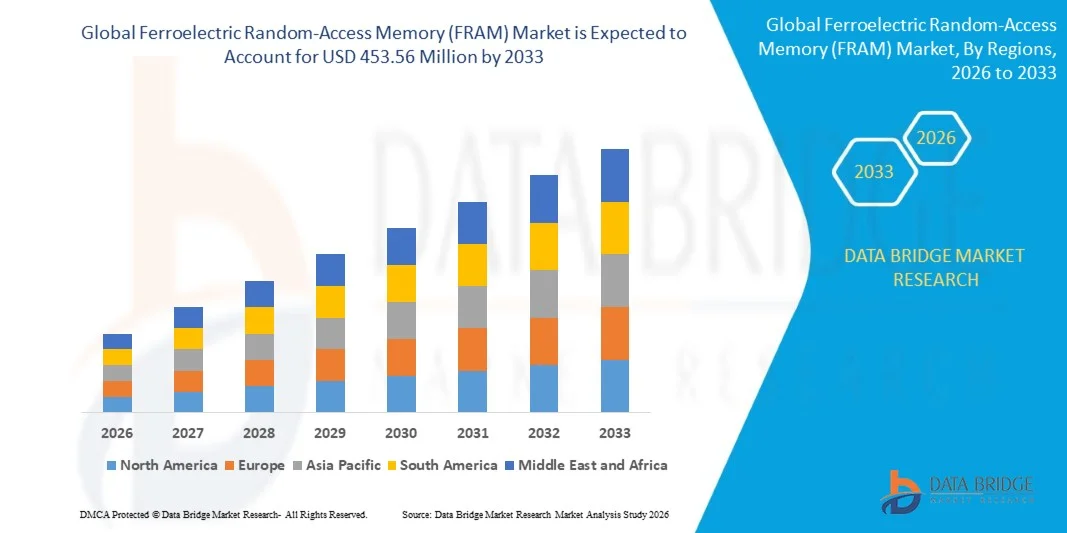
- The global ferroelectric random-access memory (FRAM) market size was valued at USD 336.55 million in 2025 and is expected to reach USD 453.56 million by 2033, at a CAGR of 3.80% during the forecast period
- The market growth is largely fuelled by rising demand for low-power, high-speed, and non-volatile memory solutions across industrial, automotive, and consumer electronics applications
- Increasing adoption of IoT devices, smart sensors, and embedded systems is further driving the demand for FRAM technology
Ferroelectric Random-Access Memory (FRAM) Market Analysis
- FRAM is increasingly used in applications requiring low power consumption and high reliability, including industrial automation, smart cards, and medical devices
- Rising integration of FRAM in automotive electronics, such as electronic control units and sensor modules, is propelling market growth
- North America dominated the FRAM market with the largest revenue share of 38.5% in 2025, driven by increasing deployment in automotive electronics, industrial automation, and smart meters. The region’s strong emphasis on energy-efficient, high-endurance memory solutions supports widespread adoption across both enterprise and consumer applications
- Asia-Pacific region is expected to witness the highest growth rate in the global ferroelectric random-access memory (FRAM) market, driven by rising industrial automation, adoption of electric and connected vehicles, expanding IoT deployment, government-backed smart city initiatives, and the presence of local memory manufacturers enhancing affordability and accessibility
- The 64K segment held the largest market revenue share in 2025, driven by its balanced combination of storage capacity and cost-effectiveness, making it suitable for a wide range of applications such as metering and industrial automation. 64K FRAM devices offer faster read/write cycles and lower power consumption compared to traditional non-volatile memories, which enhances their adoption in energy-sensitive applications. These devices are particularly favored in applications where frequent data updates are required without compromising memory longevity. The maturity of 64K FRAM technology also ensures wider availability and integration support across various embedded systems
Report Scope and Ferroelectric Random-Access Memory (FRAM) Market Segmentation
|
Attributes |
Ferroelectric Random-Access Memory (FRAM) Key Market Insights |
|
Segments Covered |
|
|
Countries Covered |
North America
Europe
Asia-Pacific
Middle East and Africa
South America
|
|
Key Market Players |
• Cypress Semiconductor Corporation (U.S.) • Future Electronics (Canada) |
|
Market Opportunities |
• Increasing Adoption Of IoT And Smart Devices |
|
Value Added Data Infosets |
In addition to the insights on market scenarios such as market value, growth rate, segmentation, geographical coverage, and major players, the market reports curated by the Data Bridge Market Research also include in-depth expert analysis, geographically represented company-wise production and capacity, network layouts of distributors and partners, detailed and updated price trend analysis and deficit analysis of supply chain and demand. |
Ferroelectric Random-Access Memory (FRAM) Market Trends
“Rising Adoption of Low-Power and High-Endurance Memory Solutions”
• The growing need for fast, low-power, and high-endurance memory solutions is significantly shaping the FRAM market, as industries increasingly require reliable non-volatile memory for real-time applications. FRAM is gaining traction due to its low energy consumption, high-speed operation, and long endurance, which make it suitable for embedded systems, industrial automation, and consumer electronics. This trend strengthens its adoption across automotive, healthcare, and industrial electronics, encouraging manufacturers to innovate with high-performance FRAM products
• Increasing demand for IoT-enabled devices, wearable electronics, and automotive control systems has accelerated the need for FRAM in mission-critical applications. Developers are actively seeking memory solutions that combine speed, durability, and energy efficiency, prompting collaborations between FRAM manufacturers and electronics companies to enhance device performance and reliability
• Energy efficiency and reliability trends are influencing product design, with manufacturers emphasizing low-power operation, high endurance, and integration capabilities. These factors are helping brands differentiate solutions in a competitive market and build customer confidence, while also driving the adoption of FRAM in energy-sensitive and safety-critical systems
• For instance, in 2024, Texas Instruments in the U.S. and Fujitsu in Japan launched new FRAM solutions targeting automotive and industrial applications. These offerings were introduced to address growing requirements for low-power, high-speed, and durable memory modules, with integration across embedded devices, IoT sensors, and industrial control units. The solutions also contributed to enhanced operational efficiency and system reliability in their respective markets
• While demand for FRAM is growing, sustained market expansion depends on ongoing R&D, cost-effective manufacturing, and maintaining compatibility with evolving electronic systems. Manufacturers are also focusing on improving memory density, scalability, and integration with advanced semiconductor processes for broader adoption
Ferroelectric Random-Access Memory (FRAM) Market Dynamics
Driver
“Growing Preference for Low-Power, High-Endurance Memory”
• Rising demand for energy-efficient and reliable memory solutions is a major driver for the FRAM market. Companies are increasingly replacing traditional non-volatile memory such as EEPROM and flash with FRAM to reduce power consumption, enhance device lifespan, and improve system performance. This trend is also encouraging innovation in memory architecture and packaging, supporting product diversification
• Expanding applications in automotive, industrial automation, medical devices, smart cards, and consumer electronics are influencing market growth. FRAM offers advantages such as fast write/read speeds, low power operation, and high endurance, enabling manufacturers to meet performance and reliability expectations. The increasing adoption of connected and IoT-enabled devices globally further reinforces this trend
• Electronics and semiconductor manufacturers are actively promoting FRAM-based solutions through product development, integration partnerships, and certifications. These efforts are supported by the growing emphasis on energy efficiency, safety, and reliability, and they also encourage collaborations with system integrators to improve functional performance and reduce environmental impact
• For instance, in 2023, Texas Instruments in the U.S. and Fujitsu in Japan expanded FRAM solutions for automotive and industrial IoT applications. This expansion followed increasing demand for non-volatile, low-power, and high-endurance memory solutions, driving product differentiation and adoption. Both companies highlighted durability, energy efficiency, and system reliability in marketing campaigns to strengthen client trust and loyalty
• Although growing low-power and high-reliability trends support market expansion, wider adoption depends on cost optimization, production efficiency, and integration with modern electronics. Investment in advanced fabrication technologies, scalable production, and system-level compatibility will be critical for meeting global demand and maintaining competitive advantage
Restraint/Challenge
“Higher Cost And Limited Awareness Compared to Conventional Memory”
• The relatively higher cost of FRAM compared to traditional memory solutions such as EEPROM and flash remains a key challenge, limiting adoption among price-sensitive manufacturers. High production costs and complex fabrication processes contribute to elevated pricing. In addition, supply fluctuations for specialized FRAM components can further affect cost stability and market penetration
• Awareness among system designers and end-users remains uneven, particularly in developing markets where low-power and high-endurance memory demand is still emerging. Limited understanding of FRAM benefits restricts adoption across certain applications. This also leads to slower integration in emerging economies where educational and marketing initiatives are minimal
• Supply chain and integration challenges also impact market growth, as FRAM requires advanced semiconductor processes and adherence to stringent quality standards. Logistical complexities and integration with legacy systems increase operational and development costs. Companies must invest in design compatibility, testing, and validation to maintain product reliability
• For instance, in 2024, distributors in India and Brazil supplying industrial and automotive electronics reported slower uptake due to higher FRAM costs and limited awareness of performance advantages compared to conventional memory. Integration complexity and production scalability were additional barriers. These factors also prompted some system integrators to postpone adoption, affecting market visibility and sales
• Overcoming these challenges will require cost-efficient production, targeted educational initiatives, and collaborations with system integrators and semiconductor manufacturers. Furthermore, developing cost-competitive FRAM solutions and highlighting functional benefits such as low-power operation, high endurance, and reliability will be essential for widespread adoption
Ferroelectric Random-Access Memory (FRAM) Market Scope
The market is segmented on the basis of type, interface, and application.
• By Type
On the basis of type, the FRAM market is segmented into 4K, 6.18K, 16K, 32K, 64K, 128K, 256K, 512K, and Others. The 64K segment held the largest market revenue share in 2025, driven by its balanced combination of storage capacity and cost-effectiveness, making it suitable for a wide range of applications such as metering and industrial automation. 64K FRAM devices offer faster read/write cycles and lower power consumption compared to traditional non-volatile memories, which enhances their adoption in energy-sensitive applications. These devices are particularly favored in applications where frequent data updates are required without compromising memory longevity. The maturity of 64K FRAM technology also ensures wider availability and integration support across various embedded systems.
The 256K segment is expected to witness the fastest growth rate from 2026 to 2033, driven by increasing demand for higher-capacity memory in automotive electronics, enterprise storage, and IoT devices. 256K FRAM provides higher data retention and endurance, making it an ideal choice for applications requiring frequent data logging and real-time processing. The growth is further supported by advancements in miniaturization, which allow higher-capacity FRAM to fit into compact modules. In addition, industries such as industrial automation and smart grids are increasingly adopting 256K FRAM for improved system reliability and performance.
• By Interface
On the basis of interface, the market is segmented into Serial and Parallel. The Serial interface segment held the largest market share in 2025 due to its compatibility with microcontrollers and ease of integration in compact devices. Serial FRAM is widely used in wearable devices and smart meters where board space is limited and low-power operation is critical. The low pin count and simpler wiring requirements of serial FRAM reduce system complexity and overall cost. Moreover, serial FRAM supports standard communication protocols, making it easier to integrate into existing electronic systems without extensive redesign.
The Parallel interface segment is expected to grow significantly during the forecast period owing to its higher data transfer rates, which are essential for enterprise storage and industrial automation systems requiring rapid memory access. Parallel FRAM is often deployed in applications where speed is crucial, such as high-frequency data acquisition and real-time control systems. The growth is further fueled by the rising adoption of high-performance embedded systems and the need for low-latency memory solutions. In addition, parallel FRAM can handle larger volumes of simultaneous data operations, making it ideal for advanced computing and industrial analytics.
• By Application
On the basis of application, the market is segmented into Metering/Measurement, Enterprise Storage, Automotive, Factory Automation, Telecommunication, Medical, Wearable Devices, Smart Meters, and Others. The Metering/Measurement segment held the largest revenue share in 2025, driven by the increasing deployment of smart meters and energy management systems that require reliable, non-volatile memory with high endurance. FRAM is preferred in these applications due to its low power consumption, fast write capabilities, and ability to withstand frequent read/write cycles. Governments’ push toward digital energy monitoring and renewable energy integration further supports market growth. In addition, FRAM ensures data integrity during power interruptions, which is critical in utility metering applications.
The Automotive segment is expected to register the fastest growth from 2026 to 2033, propelled by the rising adoption of advanced driver-assistance systems (ADAS), electric vehicles, and connected car technologies that rely on FRAM for high-speed data logging, energy efficiency, and long-term reliability. The increasing complexity of automotive electronics and the need for safety-critical memory solutions drive this demand. FRAM is used in applications such as infotainment systems, engine control units, and battery management systems due to its endurance and non-volatility. Furthermore, the push toward autonomous vehicles is expected to further boost the adoption of FRAM in automotive applications.
Ferroelectric Random-Access Memory (FRAM) Market Regional Analysis
- North America dominated the FRAM market with the largest revenue share of 38.5% in 2025, driven by increasing deployment in automotive electronics, industrial automation, and smart meters. The region’s strong emphasis on energy-efficient, high-endurance memory solutions supports widespread adoption across both enterprise and consumer applications
- High awareness of advanced memory technologies, coupled with the presence of key FRAM manufacturers and robust R&D facilities, contributes to market growth
- In addition, demand for low-power, fast-read/write memory in IoT and wearable devices is further boosting adoption in North America
U.S. FRAM Market Insight
The U.S. FRAM market captured the largest revenue share in North America in 2025, propelled by growing adoption in smart metering, connected vehicles, and industrial automation systems. Manufacturers are increasingly integrating FRAM into sensors, controllers, and IoT-enabled devices to ensure high-speed data logging with minimal energy consumption. Government initiatives promoting smart grid infrastructure and digital industrialization further accelerate market growth. Moreover, strong investments in research and development for automotive and medical applications support continuous technological advancements in FRAM solutions.
Europe FRAM Market Insight
The Europe FRAM market is expected to witness the fastest growth rate from 2026 to 2033, driven by stringent industrial and automotive regulations, alongside rising adoption of smart metering and factory automation solutions. Energy efficiency and long-term reliability of FRAM devices are particularly appealing to European consumers and enterprises. The region’s focus on sustainable and eco-friendly technologies is also encouraging the use of low-power, high-endurance memory solutions. Increased investments in industrial IoT, telecommunication, and connected infrastructure contribute to the expanding demand for FRAM in Europe.
U.K. FRAM Market Insight
The U.K. FRAM market is anticipated to record significant growth from 2026 to 2033, supported by the country’s push toward industrial automation, smart utilities, and connected devices. High demand for secure, reliable, and energy-efficient memory solutions in automotive, medical, and telecommunication applications is driving adoption. The proliferation of smart grid initiatives, wearable devices, and data-logging systems also bolsters market expansion. In addition, the U.K.’s focus on innovation and digitalization creates opportunities for FRAM manufacturers to introduce advanced memory solutions tailored for high-performance applications.
Germany FRAM Market Insight
The Germany FRAM market is expected to witness strong growth from 2026 to 2033, fueled by increasing adoption in automotive electronics, industrial machinery, and smart energy management systems. Germany’s emphasis on technologically advanced and eco-friendly solutions encourages the integration of FRAM in critical applications requiring durability and fast memory access. The market benefits from well-established industrial infrastructure and a growing focus on Industry 4.0 adoption. Furthermore, FRAM’s low power consumption and high endurance are well-aligned with local demand for sustainable and reliable electronic solutions.
Asia-Pacific FRAM Market Insight
The Asia-Pacific FRAM market is expected to witness the fastest growth from 2026 to 2033, driven by rising industrial automation, automotive electrification, and IoT adoption in countries such as China, Japan, and India. The region’s rapidly growing manufacturing sector and focus on smart city initiatives promote increased FRAM deployment. Growing awareness of energy-efficient memory solutions, coupled with government incentives for digitalization and smart infrastructure, is further propelling market expansion. In addition, the presence of domestic FRAM manufacturers enhances affordability and availability, expanding adoption across both consumer and industrial applications.
Japan FRAM Market Insight
The Japan FRAM market is projected to grow rapidly from 2026 to 2033, attributed to high adoption of connected vehicles, smart devices, and industrial automation systems. Japan’s strong technological ecosystem and emphasis on energy-efficient, high-endurance memory solutions support FRAM adoption in automotive, medical, and wearable applications. Integration with IoT-enabled systems, robotics, and sensor networks is further accelerating demand. Moreover, Japan’s aging population and focus on smart healthcare devices drive the need for reliable, low-power memory solutions in both residential and commercial sectors.
China FRAM Market Insight
The China FRAM market accounted for the largest revenue share in Asia-Pacific in 2025, driven by rapid industrialization, urbanization, and technological adoption in automotive, telecommunication, and smart metering applications. The expanding middle class, increasing IoT deployments, and government-backed smart city initiatives are key growth drivers. China’s strong manufacturing base and local FRAM producers ensure competitive pricing and widespread availability. The market benefits from high demand for high-speed, energy-efficient memory solutions, particularly in electric vehicles, industrial automation, and consumer electronics applications
Ferroelectric Random-Access Memory (FRAM) Market Share
The Ferroelectric Random-Access Memory (FRAM) industry is primarily led by well-established companies, including:
• Cypress Semiconductor Corporation (U.S.)
• FUJITSU (Japan)
• Texas Instruments Incorporated (U.S.)
• Infineon Technologies AG (Germany)
• Everspin Technologies Inc. (U.S.)
• Future Electronics (Canada)
• LAPIS Semiconductor Co., Ltd (Japan)
• Symetrix Corporation USA (U.S.)
• TOSHIBA CORPORATION (Japan)
• ROHM CO. LTD (Japan)
• Ferroelectric Memory Company (U.S.)
• Avalanche Technology (U.S.)
• Digi-Key Electronics (U.S.)
• Apogeeweb (China)
• TX Marine Messsysteme GmbH (Germany)
• Mouser Electronics, Inc. (U.S.)
Latest Developments in Global Ferroelectric Random-Access Memory (FRAM) Market
- In August 2025, Ferroelectric Memory Company (FMC) announced a strategic partnership with Neumonda to produce its “DRAM+” non-volatile memory technology in Germany, leveraging hafnium oxide (HfO₂)-based ferroelectric layers to scale FeRAM to gigabit capacities. This development is expected to enhance memory performance for high-speed applications and strengthen European production capabilities, supporting regional memory sovereignty
- In August 2025, FMC also revealed plans to establish a memory-chip manufacturing facility in Saxony-Anhalt, Germany, aimed at producing FeRAM and DRAM+ devices locally. The move is set to bolster European supply chains, reduce dependency on imports, and accelerate adoption of high-performance, low-power memory solutions in automotive and industrial sectors
- In June 2023, Taiwan Semiconductor Manufacturing Company (TSMC) published research on ferroelectric films and stacks, including Hf-Zr-O, for high-density, high-capacity digital memory integrated with advanced CMOS technology. This innovation could significantly improve storage efficiency and energy performance, enabling next-generation memory solutions for consumer electronics and industrial applications
- In August 2023, Fujitsu Semiconductor Limited launched the MB85RC512LY 512 Kbit automotive-grade I²C-interface FeRAM, capable of operating at high temperatures up to 125 °C with extremely low power consumption (0.4 mA at 3.4 MHz). Targeted for automotive and industrial applications such as ADAS, this launch enhances system reliability, supports energy-efficient operation, and drives broader adoption of FeRAM in critical environments
SKU-
Get online access to the report on the World's First Market Intelligence Cloud

- Interactive Data Analysis Dashboard
- Company Analysis Dashboard for high growth potential opportunities
- Research Analyst Access for customization & queries
- Competitor Analysis with Interactive dashboard
- Latest News, Updates & Trend analysis
- Harness the Power of Benchmark Analysis for Comprehensive Competitor Tracking
Global Ferroelectric Random Access Memory Fram Market, Supply Chain Analysis and Ecosystem Framework
To support market growth and help clients navigate the impact of geopolitical shifts, DBMR has integrated in-depth supply chain analysis into its Global Ferroelectric Random Access Memory Fram Market research reports. This addition empowers clients to respond effectively to global changes affecting their industries. The supply chain analysis section includes detailed insights such as Global Ferroelectric Random Access Memory Fram Market consumption and production by country, price trend analysis, the impact of tariffs and geopolitical developments, and import and export trends by country and HSN code. It also highlights major suppliers with data on production capacity and company profiles, as well as key importers and exporters. In addition to research, DBMR offers specialized supply chain consulting services backed by over a decade of experience, providing solutions like supplier discovery, supplier risk assessment, price trend analysis, impact evaluation of inflation and trade route changes, and comprehensive market trend analysis.
Research Methodology
Data collection and base year analysis are done using data collection modules with large sample sizes. The stage includes obtaining market information or related data through various sources and strategies. It includes examining and planning all the data acquired from the past in advance. It likewise envelops the examination of information inconsistencies seen across different information sources. The market data is analysed and estimated using market statistical and coherent models. Also, market share analysis and key trend analysis are the major success factors in the market report. To know more, please request an analyst call or drop down your inquiry.
The key research methodology used by DBMR research team is data triangulation which involves data mining, analysis of the impact of data variables on the market and primary (industry expert) validation. Data models include Vendor Positioning Grid, Market Time Line Analysis, Market Overview and Guide, Company Positioning Grid, Patent Analysis, Pricing Analysis, Company Market Share Analysis, Standards of Measurement, Global versus Regional and Vendor Share Analysis. To know more about the research methodology, drop in an inquiry to speak to our industry experts.
Customization Available
Data Bridge Market Research is a leader in advanced formative research. We take pride in servicing our existing and new customers with data and analysis that match and suits their goal. The report can be customized to include price trend analysis of target brands understanding the market for additional countries (ask for the list of countries), clinical trial results data, literature review, refurbished market and product base analysis. Market analysis of target competitors can be analyzed from technology-based analysis to market portfolio strategies. We can add as many competitors that you require data about in the format and data style you are looking for. Our team of analysts can also provide you data in crude raw excel files pivot tables (Fact book) or can assist you in creating presentations from the data sets available in the report.












