




Global Fiber Optic Connectivity Market
Market Size in USD Billion
CAGR :
% 
 USD
7.37 Billion
USD
17.22 Billion
2025
2033
USD
7.37 Billion
USD
17.22 Billion
2025
2033
 Forecast Period Forecast Period |
2026 –2033 |
 Market Size (Base Year) Market Size (Base Year) |
USD 7.37 Billion |
 Market Size (Forecast Year) Market Size (Forecast Year) |
USD 17.22 Billion |
 CAGR CAGR |
% |
| Major Markets Players |
|
Fiber Optic Connectivity Market Size
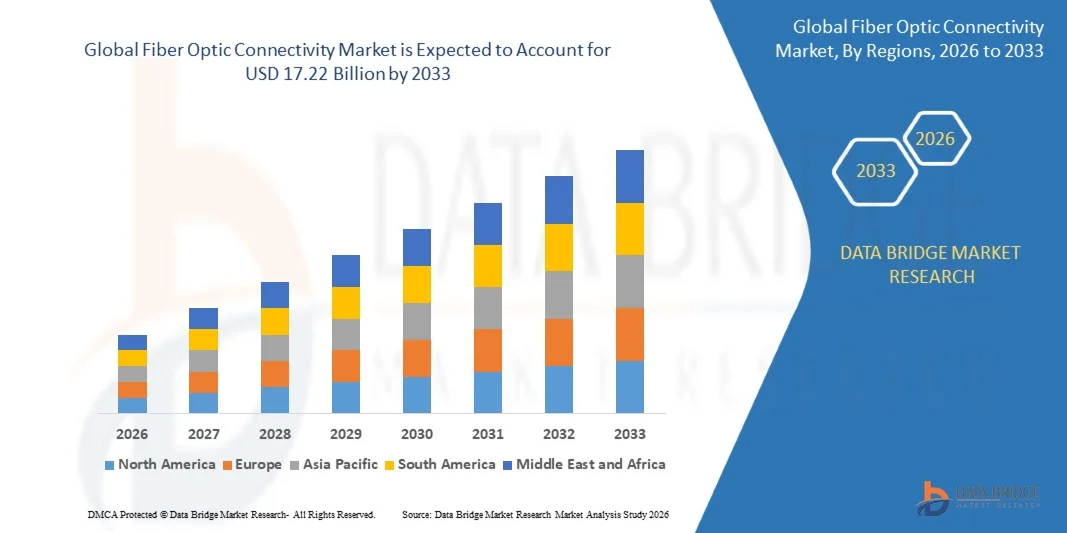
- The global fiber optic connectivity market size was valued at USD 7.37 billion in 2025 and is expected to reach USD 17.22 billion by 2033, at a CAGR of 11.18% during the forecast period
- The market growth is largely fuelled by the increasing demand for high-speed data transmission, rapid expansion of data centers, and rising adoption of 5G networks and cloud computing infrastructure worldwide
- Growing investments in broadband infrastructure, especially in emerging economies, along with government initiatives to expand fiber-to-the-home (FTTH) networks, are further accelerating market expansion
Fiber Optic Connectivity Market Analysis
- The fiber optic connectivity market is witnessing strong growth due to the rapid surge in internet traffic, digital transformation initiatives, and the deployment of next-generation communication networks
- North America dominated the fiber optic connectivity market with the largest revenue share in 2025, driven by the strong presence of advanced telecommunications infrastructure, large-scale data center deployments, and increasing demand for high-speed internet connectivity.
- Asia-Pacific region is expected to witness the highest growth rate in the global fiber optic connectivity market, driven by increasing telecom infrastructure development, rising internet users, expanding 5G deployment, and strong government and private investments in fiber network expansion across emerging economies
- The hardware segment held the largest market revenue share in 2025 driven by the extensive use of fiber optic cables, connectors, transceivers, and related equipment required for establishing high-speed communication networks. Hardware components form the backbone of fiber optic infrastructure and are widely deployed across telecommunications, data centers, and enterprise networking environments
Report Scope and Fiber Optic Connectivity Market Segmentation
|
Attributes |
Fiber Optic Connectivity Key Market Insights |
|
Segments Covered |
|
|
Countries Covered |
North America
Europe
Asia-Pacific
Middle East and Africa
South America
|
|
Key Market Players |
• Adtell Integration (U.S.) |
|
Market Opportunities |
• Expansion Of Fiber-To-The-Home (FTTH) And Fiber-To-The-Building (FTTB) Deployments |
|
Value Added Data Infosets |
In addition to the market insights such as market value, growth rate, market segments, geographical coverage, market players, and market scenario, the market report curated by the Data Bridge Market Research team includes in-depth expert analysis, import/export analysis, pricing analysis, production consumption analysis, and pestle analysis. |
Fiber Optic Connectivity Market Trends
“Rising Deployment of 5G Networks and High-Speed Data Infrastructure”
• The increasing deployment of 5G networks and next-generation communication infrastructure is significantly shaping the fiber optic connectivity market, as telecommunications providers require high-capacity networks capable of supporting faster data transmission and low-latency communication. Fiber optic connectivity is widely adopted due to its ability to deliver high bandwidth, improved reliability, and long-distance data transmission without signal degradation. This trend is strengthening adoption across telecommunications, data centers, and enterprise networks, encouraging manufacturers to develop advanced fiber solutions that meet evolving connectivity demands
• Rapid growth in digital services, cloud computing, video streaming, and IoT applications has accelerated the demand for fiber optic connectivity across multiple industries. Businesses and service providers are increasingly investing in fiber networks to support rising data traffic and maintain seamless connectivity. The expansion of broadband networks, along with increasing demand for high-speed internet services, is further driving adoption of fiber optic technologies across both urban and rural areas
• Technological advancements and increasing investment in telecommunications infrastructure are influencing purchasing decisions, with network operators emphasizing high-performance, scalable, and energy-efficient connectivity solutions. These factors are helping companies strengthen their network capabilities while supporting the transition toward next-generation digital ecosystems. Manufacturers are also focusing on product innovation, improved cable designs, and enhanced network management solutions to address growing connectivity requirements
• For instance, in 2024, Corning Incorporated in the U.S. and Prysmian Group in Italy expanded their fiber optic connectivity portfolios by introducing high-capacity optical cables designed for 5G networks and large-scale broadband infrastructure. These solutions were introduced to support telecom operators and data center providers seeking reliable, high-speed connectivity. The products were deployed through telecommunications projects and infrastructure upgrades across North America and Europe, strengthening network performance and scalability
• While demand for fiber optic connectivity continues to grow, sustained market expansion depends on continuous infrastructure investments, efficient deployment strategies, and cost-effective manufacturing processes. Companies are also focusing on improving network scalability, reducing installation complexities, and developing innovative connectivity solutions that support the increasing demand for high-speed data transmission and digital connectivity worldwide
Fiber Optic Connectivity Market Dynamics
Driver
“Increasing Demand for High-Speed Data Transmission and Data Center Expansion”
• The rapid increase in global data consumption is a major driver for the fiber optic connectivity market. Businesses, telecom providers, and cloud service companies are increasingly deploying fiber optic networks to support faster data transmission and improved network performance. Fiber connectivity enables high bandwidth capacity and minimal signal loss, making it essential for supporting modern digital applications and enterprise operations
• Expanding data center infrastructure across industries such as cloud computing, e-commerce, and digital services is influencing market growth. Fiber optic connectivity plays a critical role in enabling efficient data transfer within and between data centers while ensuring high reliability and scalability. As organizations continue adopting digital platforms and cloud-based solutions, the demand for advanced fiber connectivity solutions continues to increase
• Telecommunications and technology companies are actively promoting fiber-based network solutions through infrastructure investments, partnerships, and product innovation. These initiatives are supported by increasing government programs aimed at improving broadband connectivity and digital infrastructure. Collaborations between telecom operators and fiber technology providers are also helping improve network performance and support large-scale connectivity projects
• For instance, in 2023, AT&T in the U.S. and Huawei Technologies in China expanded fiber network deployments to strengthen broadband infrastructure and support the growing demand for high-speed internet and cloud services. These initiatives included expanding fiber-to-the-home (FTTH) and enterprise connectivity solutions, which helped enhance network capacity and improve service delivery across urban and developing regions
• Although increasing demand for digital connectivity supports market growth, continued expansion depends on ongoing investment in network infrastructure, technological innovation, and efficient deployment strategies. Strengthening partnerships between telecom providers, infrastructure developers, and technology companies will remain essential for meeting the rising demand for high-performance fiber connectivity solutions
Restraint/Challenge
“High Infrastructure Costs and Complex Installation Requirements”
• The relatively high cost associated with fiber optic network deployment remains a significant challenge for market growth. Installation of fiber optic infrastructure requires substantial capital investment in cables, connectors, network equipment, and skilled labor. These costs can limit adoption among small telecommunications providers and organizations with limited infrastructure budgets
• Infrastructure deployment challenges remain particularly evident in rural and remote regions where installing fiber networks can be complex and time-consuming. Geographic barriers, regulatory requirements, and right-of-way permissions can delay project timelines and increase operational costs. These factors often discourage network operators from expanding fiber connectivity in less densely populated areas
• Supply chain and logistical challenges also influence market expansion, as fiber optic components require precise manufacturing, transportation, and installation processes. The need for specialized equipment and trained technicians further increases operational expenses. Companies must also invest in maintenance, network upgrades, and monitoring systems to ensure consistent network performance and reliability
• For instance, in 2024, telecommunications infrastructure providers in Southeast Asia reported slower deployment of fiber networks due to high installation costs and regulatory complexities. Network operators working with companies such as Nokia and Ericsson indicated that infrastructure development projects required additional investment in permitting processes, specialized equipment, and skilled workforce training, which delayed project implementation in certain regions
• Overcoming these challenges will require strategic investment in cost-efficient technologies, improved deployment methods, and stronger collaboration between governments and private sector companies. Expanding infrastructure funding programs, developing advanced installation technologies, and improving supply chain efficiency will be critical for supporting the long-term growth of the global fiber optic connectivity market.
Fiber Optic Connectivity Market Scope
The market is segmented on the basis of component, type, and application.
• By Component
On the basis of component, the fiber optic connectivity market is segmented into hardware, software, and service. The hardware segment held the largest market revenue share in 2025 driven by the extensive use of fiber optic cables, connectors, transceivers, and related equipment required for establishing high-speed communication networks. Hardware components form the backbone of fiber optic infrastructure and are widely deployed across telecommunications, data centers, and enterprise networking environments.
The service segment is expected to witness the fastest growth rate from 2026 to 2033, driven by the increasing need for installation, maintenance, and network management services for expanding fiber infrastructure. As organizations deploy large-scale fiber networks, demand for professional services such as system integration, consulting, and network optimization is rising to ensure efficient performance and long-term operational reliability.
• By Types
On the basis of type, the fiber optic connectivity market is segmented into single mode, multi-mode, and plastic optical fiber. The single mode segment held the largest market revenue share in 2025 due to its ability to transmit data over long distances with minimal signal loss and high bandwidth capacity. Single mode fiber is widely used in telecommunications networks, long-haul communication systems, and high-speed broadband infrastructure, making it the preferred choice for large-scale network deployments.
The multi-mode*segment is expected to witness the fastest growth rate from 2026 to 2033, driven by its cost-effectiveness and suitability for short-distance high-speed data transmission. Multi-mode fiber is commonly used in data centers, enterprise networks, and local area networks where high bandwidth and reliable connectivity are required within shorter distances.
• By Application
On the basis of application, the fiber optic connectivity market is segmented into mining, oil & gas, wind power, BFSI, telecom, electric substation, military and aerospace, medical, railways, and smart cities. The telecom segment held the largest market revenue share in 2025 driven by the rapid expansion of broadband networks, increasing deployment of 5G infrastructure, and growing demand for high-speed internet connectivity worldwide. Fiber optic connectivity is essential for supporting modern telecommunications systems that require high bandwidth and reliable data transmission.
The smart cities segment is expected to witness the fastest growth rate from 2026 to 2033, driven by increasing government investments in digital infrastructure, intelligent transportation systems, and connected urban services. Fiber optic networks play a crucial role in enabling smart city applications such as surveillance systems, traffic management, and high-speed public connectivity, supporting the development of advanced urban ecosystems.
Fiber Optic Connectivity Market Regional Analysis
• North America dominated the fiber optic connectivity market with the largest revenue share in 2025, driven by the strong presence of advanced telecommunications infrastructure, large-scale data center deployments, and increasing demand for high-speed internet connectivity.
• Organizations and service providers in the region prioritize high-bandwidth communication networks capable of supporting cloud computing, video streaming, and data-intensive enterprise applications.
• This widespread adoption is further supported by significant investments in digital infrastructure, early adoption of next-generation technologies, and increasing deployment of fiber networks for 5G services, establishing fiber optic connectivity as a critical component for modern communication systems across multiple industries.
U.S. Fiber Optic Connectivity Market Insight
The U.S. fiber optic connectivity market captured the largest revenue share in 2025 within North America, fueled by large-scale investments in broadband infrastructure and the rapid expansion of data centers. Telecommunications providers and enterprises are increasingly deploying fiber optic networks to support high-speed internet services and growing data traffic. The rising demand for cloud computing, streaming services, and enterprise connectivity solutions further propels the market. Moreover, the ongoing rollout of 5G networks and government initiatives aimed at expanding nationwide broadband coverage are significantly contributing to market expansion.
Europe Fiber Optic Connectivity Market Insight
The Europe fiber optic connectivity market is expected to witness the fastest growth rate from 2026 to 2033, primarily driven by increasing demand for high-speed broadband services and the expansion of digital infrastructure across the region. Governments and telecom operators are investing in fiber-to-the-home (FTTH) and fiber-to-the-building (FTTB) networks to improve connectivity and support digital transformation initiatives. The rising adoption of cloud services, smart infrastructure, and connected devices is fostering the deployment of fiber optic networks across residential, commercial, and industrial sectors.
U.K. Fiber Optic Connectivity Market Insight
The U.K. fiber optic connectivity market is expected to witness the fastest growth rate from 2026 to 2033, driven by the rapid expansion of broadband infrastructure and increasing demand for reliable high-speed internet services. Government initiatives promoting nationwide fiber deployment, combined with rising adoption of digital services, are encouraging telecom providers to upgrade existing networks. The growing use of cloud computing, remote work solutions, and digital entertainment platforms is further supporting market growth in the country.
Germany Fiber Optic Connectivity Market Insight
The Germany fiber optic connectivity market is expected to witness the fastest growth rate from 2026 to 2033, fueled by increasing investments in telecommunications infrastructure and the country’s strong focus on digital transformation. Germany’s advanced industrial base and the expansion of Industry 4.0 technologies are creating demand for high-performance connectivity solutions. The integration of fiber optic networks across industrial facilities, smart infrastructure, and enterprise networks is also contributing to the growing adoption of fiber connectivity solutions.
Asia-Pacific Fiber Optic Connectivity Market Insight
The Asia-Pacific fiber optic connectivity market is expected to witness the fastest growth rate from 2026 to 2033, driven by rapid urbanization, increasing internet penetration, and large-scale telecommunications infrastructure development across the region. Countries such as China, Japan, and India are investing heavily in broadband expansion and next-generation network technologies. The growing demand for high-speed connectivity to support digital services, smart cities, and data center development is significantly boosting the adoption of fiber optic connectivity solutions.
Japan Fiber Optic Connectivity Market Insight
The Japan fiber optic connectivity market is expected to witness the fastest growth rate from 2026 to 2033 due to the country’s advanced technological infrastructure and strong demand for high-speed communication networks. Japan’s focus on digital innovation and smart city initiatives is encouraging the deployment of fiber networks across residential and commercial environments. The increasing adoption of cloud services, IoT applications, and high-definition digital services is further driving demand for reliable fiber optic connectivity.
China Fiber Optic Connectivity Market Insight
The China fiber optic connectivity market accounted for the largest market revenue share in Asia-Pacific in 2025, attributed to the country’s large population, rapid digitalization, and strong government support for telecommunications infrastructure. China is one of the leading markets for broadband and fiber network deployment, with extensive investments in 5G networks and smart city projects. The presence of major telecommunications equipment manufacturers and the increasing adoption of high-speed internet services across residential and commercial sectors are key factors propelling market growth in China.
Fiber Optic Connectivity Market Share
The Fiber Optic Connectivity industry is primarily led by well-established companies, including:
• Adtell Integration (U.S.)
• ADTRAN Inc. (U.S.)
• ADVA Optical Networking (Germany)
• Broadcom (U.S.)
• Reliance Communications, LLC (U.S.)
• Ciena Corporation (U.S.)
• Corning Incorporated (U.S.)
• Fiber Optic Services (U.S.)
• Finisar Corporation (U.S.)
• Fujitsu Optical Components Limited (Japan)
• Hamamatsu Photonics K.K. (Japan)
• Huawei Technologies Co. Ltd (China)
• HUBER+SUHNER (Switzerland)
• Infinera Corporation (U.S.)
• Lumentum Operations LLC (U.S.)
• OptiLayer GmbH (Germany)
• Optiwave Systems, Inc. (Canada)
• Fiber Instrument Sales, Inc. (U.S.)
SKU-
Get online access to the report on the World's First Market Intelligence Cloud

- Interactive Data Analysis Dashboard
- Company Analysis Dashboard for high growth potential opportunities
- Research Analyst Access for customization & queries
- Competitor Analysis with Interactive dashboard
- Latest News, Updates & Trend analysis
- Harness the Power of Benchmark Analysis for Comprehensive Competitor Tracking
Research Methodology
Data collection and base year analysis are done using data collection modules with large sample sizes. The stage includes obtaining market information or related data through various sources and strategies. It includes examining and planning all the data acquired from the past in advance. It likewise envelops the examination of information inconsistencies seen across different information sources. The market data is analysed and estimated using market statistical and coherent models. Also, market share analysis and key trend analysis are the major success factors in the market report. To know more, please request an analyst call or drop down your inquiry.
The key research methodology used by DBMR research team is data triangulation which involves data mining, analysis of the impact of data variables on the market and primary (industry expert) validation. Data models include Vendor Positioning Grid, Market Time Line Analysis, Market Overview and Guide, Company Positioning Grid, Patent Analysis, Pricing Analysis, Company Market Share Analysis, Standards of Measurement, Global versus Regional and Vendor Share Analysis. To know more about the research methodology, drop in an inquiry to speak to our industry experts.
Customization Available
Data Bridge Market Research is a leader in advanced formative research. We take pride in servicing our existing and new customers with data and analysis that match and suits their goal. The report can be customized to include price trend analysis of target brands understanding the market for additional countries (ask for the list of countries), clinical trial results data, literature review, refurbished market and product base analysis. Market analysis of target competitors can be analyzed from technology-based analysis to market portfolio strategies. We can add as many competitors that you require data about in the format and data style you are looking for. Our team of analysts can also provide you data in crude raw excel files pivot tables (Fact book) or can assist you in creating presentations from the data sets available in the report.












