




Global Filling Machines Market
Market Size in USD Billion
CAGR :
% 
 USD
8.69 Billion
USD
12.45 Billion
2025
2033
USD
8.69 Billion
USD
12.45 Billion
2025
2033
 Forecast Period Forecast Period |
2026 - 2033 |
 Market Size (Base Year) Market Size (Base Year) |
USD 8.69 Billion |
 Market Size (Forecast Year) Market Size (Forecast Year) |
USD 12.45 Billion |
 CAGR CAGR |
% |
| Major Markets Players |
|
Filling Machines Market Overview
The Filling Machines Market was valued at USD 8.69 Billion in 2025 and is projected to reach USD 12.45 Billion by 2033, growing at a CAGR of 4.60% from 2026 to 2033. The market is experiencing consistent growth driven by increasing demand for automated packaging solutions, rising adoption of high-speed filling technologies, and growing expansion of the food, beverage, pharmaceutical, and personal care industries. Advancements in precision filling systems, integration of smart manufacturing technologies, and increasing investments in flexible and sustainable packaging equipment are further supporting market expansion across developed and emerging economies.
The growing focus on production efficiency, product consistency, and hygiene standards, combined with increasing demand for packaged consumer goods, is encouraging manufacturers to deploy advanced filling machine systems across multiple industries. Automated and digitally integrated filling equipment is increasingly replacing conventional manual and semi-automatic systems, helping companies improve operational productivity, reduce product wastage, and enhance packaging accuracy while meeting evolving regulatory and consumer quality requirements.
Key Market Trends & Insights
- Asia-Pacific dominated the Filling Machines Market with the largest revenue share of 39.70% in 2025, supported by rapid industrialization, expanding food and beverage manufacturing activities, and increasing adoption of automated packaging technologies across emerging economies
- The automatic segment led the market with a 58.30% share in 2025, driven by rising industrial automation and increasing demand for high-speed packaging operations across manufacturing industries
- North America is expected to be the fastest-growing region at a CAGR of 5.8% from 2026 to 2033, fueled by increasing adoption of smart manufacturing technologies and rising investments in automated packaging infrastructure
- Pharmaceuticals are the fastest-growing application type, projected to register a CAGR of 14.2% from 2026 to 2033, supported by increasing pharmaceutical manufacturing activities and rising demand for sterile and precision-based packaging systems
- The liquid segment dominated the product form category with a 49% revenue share in 2025, led by extensive application across beverage processing, pharmaceutical formulations, personal care products, and industrial chemicals
- Liquid filling machine accounted for 46% of the market in 2025, preferred by widespread utilization across beverage, pharmaceutical, chemical, and personal care manufacturing sectors
- The form-fill-seal machine segment is the fastest-growing mode of operation category, with a CAGR of 14% from 2026 to 2033, driven by rising demand for integrated packaging solutions capable of forming, filling, and sealing products within a single automated process
Market Size & Forecast
- Global Market Value (2025): USD 8.69 Billion
- Expected Market Value (2033): USD 12.45 Billion
- Forecast CAGR (2026–2033): 4.60%
- Leading Region in 2025: Asia-Pacific
- Fastest Growing Region: North America
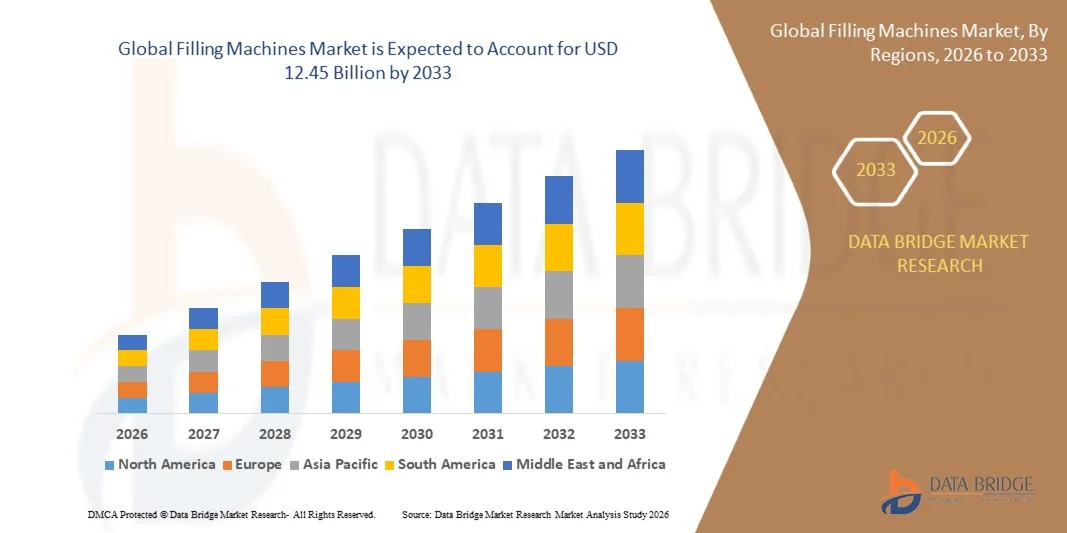
Report Scope and Filling Machines Market Segmentation
|
Attributes |
Filling Machines Key Market Insights |
|
Segments Covered |
|
|
Countries Covered |
North America · U.S. · Canada · Mexico Europe · Germany · France · U.K. · Netherlands · Switzerland · Belgium · Russia · Italy · Spain · Turkey · Rest of Europe Asia-Pacific · China · Japan · India · South Korea · Singapore · Malaysia · Australia · Thailand · Indonesia · Philippines · Rest of Asia-Pacific Middle East and Africa · Saudi Arabia · U.A.E. · South Africa · Egypt · Israel · Rest of Middle East and Africa South America · Brazil · Argentina · Rest of South America |
|
Key Market Players |
· Barry-Wehmiller Companies, Inc. (U.S.) · Ronchi Mario S.p.A. (Italy) · KHS GmbH (Germany) · Accutek Packaging Equipment Companies, Inc. (U.S.) · GEA Group Aktiengesellschaft (Germany) · Tetra Laval International S.A. (Switzerland) · Krones AG (Germany) · JBT Europe B.V. (Netherlands) · Coesia S.p.A. (Italy) · Robert Bosch GmbH (Germany) · Inline Filling Systems (U.S.) · AllFill Inc. (U.S.) · JDA PROGRESS Ind. (South Korea) · ARPAC LLC. (U.S.) · Bossar Packaging S.A. (Spain) · Fres-co System USA, Inc. (U.S.) · FUJI MACHINERY CO., LTD. (Japan) · Matrix Packaging Machinery, LLC. (U.S.) · MESPACK S.L. (Spain) · Nichrome Packaging Solutions (India) · Omori Machinery Co., Ltd. (Japan) · Ossid, LLC (U.S.) |
|
Market Opportunities |
· Expansion of Sustainable and Eco-Friendly Packaging Solutions · Increasing Demand for Flexible Filling Machines in Pharmaceutical Manufacturing · Growth of E-commerce and Small-Batch Packaging Operations |
|
Value Added Data Infosets |
In addition to the insights on market scenarios such as market value, growth rate, segmentation, geographical coverage, and major players, the market reports curated by the Data Bridge Market Research also include import export analysis, production capacity overview, production consumption analysis, price trend analysis, climate change scenario, supply chain analysis, value chain analysis, raw material/consumables overview, vendor selection criteria, PESTLE Analysis, Porter Analysis, and regulatory framework. |
Filling Machines Market Trends
Trend: Rising Adoption of Smart and Automated Filling Systems
Manufacturers across the food, beverage, pharmaceutical, and personal care industries are increasingly adopting smart and automated filling machines to improve production efficiency, reduce operational errors, and support high-volume packaging requirements. Integration of Industry 4.0 technologies, IoT-enabled monitoring systems, servo-driven controls, and robotic automation is enhancing filling accuracy, reducing downtime, and enabling predictive maintenance across packaging facilities. Growing demand for flexible filling systems capable of handling multiple packaging formats and product viscosities is further accelerating automation investments globally.
Companies such as Krones AG are expanding advanced automated filling and packaging technologies for beverage production lines, supporting higher-speed operations and digitally connected manufacturing environments across global processing facilities.
Filling Machines Market Dynamics
Key Market Driver: Growing Demand for Packaged Food and Beverage Products
The rising global consumption of packaged foods, ready-to-drink beverages, dairy products, sauces, and convenience products is significantly driving demand for advanced filling machines. Rapid urbanization, changing consumer lifestyles, increasing preference for hygienic packaged products, and expansion of organized retail and e-commerce channels are encouraging manufacturers to increase production capacity through automated filling equipment. Stringent food safety regulations and growing focus on product consistency are also supporting investments in precision filling technologies across production facilities.
Major companies such as Tetra Pak and GEA Group Aktiengesellschaft are expanding aseptic and high-speed filling solutions to support growing global demand for packaged beverages, dairy products, and liquid food processing applications.
Key Restraint/Challenge: High Initial Investment and Maintenance Costs
A major challenge in the filling machines market is the high capital investment associated with advanced automated filling systems and integrated packaging lines. Modern filling equipment requires substantial expenditure on automation software, robotic systems, precision sensors, conveyor integration, and clean-in-place technologies, particularly for pharmaceutical and food-grade applications. High maintenance costs, skilled workforce requirements, and operational downtime during equipment upgrades further increase the financial burden for small and medium-sized manufacturers.
The expansion of high-speed automated beverage filling facilities by companies such as KHS GmbH highlights the significant infrastructure investment and technical complexity involved in deploying advanced filling and packaging systems across large-scale production operations.
Key Market Opportunity: Growth of E-commerce and Small-Batch Packaging Operations
The rapid expansion of e-commerce platforms, direct-to-consumer brands, and customized product manufacturing is creating strong growth opportunities for flexible and compact filling machine solutions. Small-batch production trends across cosmetics, nutraceuticals, specialty beverages, and premium food products are increasing demand for modular filling systems capable of supporting multiple packaging sizes and quick production changeovers. Advancements in digital controls, compact automation systems, and multi-product filling technologies are improving operational flexibility for manufacturers targeting niche and online consumer markets.
Companies such as Accutek Packaging Equipment Companies, Inc. and Inline Filling Systems are expanding flexible filling equipment portfolios designed for small-scale and medium-scale packaging operations, supporting growing demand from emerging e-commerce-driven consumer product manufacturers.
Filling Machines Market Scope
The filling machines market is segmented on the basis of product, type, packaging type, packaging capacity, mode of operation, operating speed, application, and product form.
- By Product
On the basis of product, the Filling Machines Market is segmented into aseptic, rotary, net weight, volumetric, and others. The Rotary segment dominated the market with the largest share of 23.60% in 2025, driven by its high-speed operational efficiency and extensive adoption across beverage, food, and pharmaceutical production facilities. Rotary filling systems support continuous filling operations with improved precision and reduced product wastage, making them highly suitable for large-scale manufacturing environments. Manufacturers increasingly prefer these systems due to their ability to handle diverse container sizes and maintain production consistency under high throughput conditions. Integration of automated control technologies and real-time monitoring systems further enhances operational productivity and equipment reliability. Strong demand for flexible and cost-efficient packaging machinery across high-volume industries continues to reinforce segment dominance.
The Aseptic segment is projected to register the fastest growth at a CAGR of 12.8% from 2026 to 2033, driven by rising demand for contamination-free packaging solutions in pharmaceutical, dairy, and ready-to-drink beverage industries. Increasing consumer preference for preservative-free and extended shelf-life products is accelerating deployment of advanced aseptic filling technologies globally. The segment is benefiting from growing investments in sterile processing infrastructure and cleanroom-compatible packaging systems. Technological advancements in microbial control, automated sterilization, and sealed filling operations are further improving product safety and operational efficiency. Expanding healthcare manufacturing activities and stringent regulatory standards regarding hygiene and product integrity are significantly supporting market expansion.
- By Type
On the basis of type, the Filling Machines Market is segmented into liquid filling machine, bottle filling machine, and powder filling machine. The Liquid Filling Machine segment dominated the market with a share of 46% in 2025, supported by widespread utilization across beverage, pharmaceutical, chemical, and personal care manufacturing sectors. These machines offer superior filling accuracy, reduced spillage, and high-speed processing capabilities, which improve operational productivity in liquid packaging applications. Rising production of packaged beverages, liquid medicines, edible oils, and cosmetic formulations is strengthening segment demand globally. Manufacturers are increasingly integrating smart automation and touchless filling technologies to improve hygiene compliance and minimize downtime. Strong adoption across both large-scale industrial facilities and medium-sized production units continues to reinforce the segment’s leading position.
The Powder Filling Machine segment is projected to register the fastest growth at a CAGR of 11.9% from 2026 to 2033, driven by increasing demand for powdered food products, nutritional supplements, pharmaceutical powders, and industrial chemicals. Growth in packaged protein powders, instant beverages, and dry pharmaceutical formulations is significantly accelerating installation of precision powder filling equipment. Advanced auger filling and vacuum-assisted technologies are improving filling consistency and minimizing material loss during operations. Rising focus on dust-free processing environments and accurate weight management is further supporting equipment modernization. Expanding applications across healthcare, food processing, and specialty chemical manufacturing industries are contributing to rapid segment growth.
- By Packaging Type
On the basis of packaging type, the Filling Machines Market is segmented into tubes, cups, pouches, bottles, and blisters. The Bottles segment dominated the market with the largest share of 35.60% in 2025, driven by extensive usage in beverage, pharmaceutical, household chemical, and personal care packaging applications. Bottle filling systems offer strong compatibility with automated production lines and support efficient high-volume packaging operations across multiple industries. Growing consumption of bottled water, soft drinks, liquid healthcare products, and cosmetic solutions is significantly strengthening market demand. Manufacturers continue to invest in high-speed bottle filling technologies to improve packaging precision and operational throughput. Increasing adoption of recyclable and lightweight bottle packaging formats is further reinforcing segment expansion globally.
The Pouches segment is projected to register the fastest growth at a CAGR of 13.4% from 2026 to 2033, driven by rising consumer preference for lightweight, flexible, and convenient packaging solutions. Pouch packaging enables lower transportation costs, improved storage efficiency, and enhanced product shelf visibility, making it highly attractive across food and beverage sectors. Rapid expansion of single-serve packaging and ready-to-consume products is increasing deployment of pouch-compatible filling machinery. Technological advancements in spouted pouch filling, resealable packaging, and multilayer flexible materials are further improving packaging efficiency. Growing sustainability initiatives encouraging reduced material consumption are significantly accelerating segment adoption across global markets.
- By Packaging Capacity
On the basis of packaging capacity, the Filling Machines Market is segmented into 0.25 to 4 ml, 5 to 10 ml, 11 to 20 ml, and 21 to 25 ml. The 11 to 20 ml segment dominated the market with a share of 36.2% in 2025, supported by strong demand across pharmaceutical syrups, cosmetic products, personal care items, and specialty chemical packaging applications. This packaging range provides an optimal balance between portability, dosage convenience, and cost-efficient product utilization. Manufacturers increasingly prefer this capacity range for premium and single-use packaging formats due to its versatility across end-use industries. Automated filling systems designed for mid-range packaging volumes are improving production efficiency and reducing material wastage. Rising adoption of compact and travel-friendly consumer packaging solutions continues to strengthen segment dominance.
The 0.25 to 4 ml segment is projected to register the fastest growth at a CAGR of 12.5% from 2026 to 2033, driven by increasing demand for miniature pharmaceutical doses, diagnostic reagents, eye drops, and cosmetic sample packaging. The growing focus on precision dosing and compact packaging formats is accelerating deployment of highly accurate micro-filling technologies. Advancements in robotic dispensing systems and sterile filling equipment are improving consistency in small-volume packaging operations. Rising healthcare demand for injectable drugs and personalized treatment solutions is further supporting market expansion. Increasing utilization of small-capacity packaging in premium skincare and laboratory applications is significantly contributing to rapid segment growth.
- By Mode of Operation
On the basis of mode of operation, the Filling Machines Market is segmented into automatic, semi-automatic, and form-fill-seal machine. The Automatic segment dominated the market with the largest share of 58.30% in 2025, driven by rising industrial automation and increasing demand for high-speed packaging operations across manufacturing industries. Automatic filling systems improve production consistency, reduce labor dependency, and enhance operational efficiency in large-scale processing facilities. Industries such as food and beverages, pharmaceuticals, and personal care are increasingly adopting automated equipment to maintain hygiene standards and minimize operational errors. Integration of smart sensors, programmable logic controllers, and AI-enabled monitoring systems is further optimizing machine productivity. Growing emphasis on cost reduction and streamlined production workflows continues to reinforce segment leadership globally.
The Form-Fill-Seal Machine segment is projected to register the fastest growth at a CAGR of 14% from 2026 to 2033, driven by rising demand for integrated packaging solutions capable of forming, filling, and sealing products within a single automated process. These systems reduce packaging time, minimize material handling, and improve operational efficiency across flexible packaging applications. Increasing demand for compact packaging machinery in food, pharmaceutical, and snack processing industries is significantly accelerating adoption. Technological advancements in multi-lane sealing systems and high-speed pouch handling are improving production scalability. Expanding preference for sustainable and flexible packaging formats is further contributing to rapid segment expansion.
- By Operating Speed
On the basis of operating speed, the Filling Machines Market is segmented into 5,000 to 10,000 PPH, 10,001 to 15,000 PPH, and 15,001 to 20,000 PPH. The 10,001 to 15,000 PPH segment dominated the market with a share of 41% in 2025, supported by its ability to balance production efficiency, operational flexibility, and cost-effectiveness across medium and large-scale manufacturing facilities. This speed range is widely utilized in beverage bottling, pharmaceutical packaging, and processed food manufacturing operations where stable high-volume output is required. Manufacturers increasingly prefer these systems due to their lower maintenance complexity and compatibility with automated packaging lines. Advancements in servo-driven filling technologies and precision monitoring systems are improving operational reliability. Strong demand for efficient yet scalable production infrastructure continues to strengthen segment dominance.
The 15,001 to 20,000 PPH segment is projected to register the fastest growth at a CAGR of 13.6% from 2026 to 2033, driven by increasing industrial focus on ultra-high-speed production and mass packaging efficiency. Large beverage manufacturers and pharmaceutical companies are rapidly investing in advanced filling lines capable of supporting continuous high-output operations. Integration of AI-enabled inspection systems and predictive maintenance technologies is significantly improving machine uptime and packaging accuracy. Rising demand for packaged consumer goods and expansion of global manufacturing capacities are further accelerating adoption. Growing competition among manufacturers to improve productivity and reduce operational turnaround time is contributing to rapid segment growth.
- By Application
On the basis of application, the Filling Machines Market is segmented into beverages, food, chemicals, personal care, pharmaceuticals, and others. The Beverages segment dominated the market with the largest share of 38.7% in 2025, driven by rapidly increasing global consumption of bottled water, carbonated drinks, juices, dairy beverages, and energy drinks. Beverage manufacturers require high-speed and highly accurate filling systems to maintain large-scale production efficiency and packaging consistency. Rising investments in automated bottling infrastructure and smart packaging technologies are significantly strengthening equipment demand. The segment also benefits from growing consumer preference for hygienically packaged ready-to-drink products across developed and emerging economies. Continuous expansion of beverage manufacturing facilities worldwide further reinforces segment leadership.
The Pharmaceuticals segment is projected to register the fastest growth at a CAGR of 14.2% from 2026 to 2033, driven by increasing pharmaceutical manufacturing activities and rising demand for sterile and precision-based packaging systems. Strict regulatory requirements regarding dosage accuracy, contamination prevention, and product traceability are accelerating adoption of advanced pharmaceutical filling machinery. Growth in injectable drugs, biologics, and liquid formulations is further increasing demand for highly specialized automated filling technologies. Technological advancements in aseptic filling, robotic handling, and real-time quality monitoring are significantly improving operational efficiency. Expanding global healthcare expenditure and rising investments in pharmaceutical production infrastructure are strongly supporting market growth.
- By Product Form
On the basis of product form, the Filling Machines Market is segmented into liquid, powder, and granules. The Liquid segment dominated the market with a share of 49% in 2025, supported by extensive application across beverage processing, pharmaceutical formulations, personal care products, and industrial chemicals. Liquid filling systems offer superior filling precision, high-speed operational performance, and compatibility with diverse packaging formats, making them highly preferred in industrial production lines. Rising demand for packaged beverages, liquid healthcare products, and cosmetic solutions is significantly strengthening segment expansion globally. Manufacturers are increasingly integrating automated dosing and anti-spillage technologies to improve operational efficiency and reduce product wastage. Strong demand for hygienic and large-scale liquid packaging solutions continues to reinforce segment dominance.
The Powder segment is projected to register the fastest growth at a CAGR of 12.7% from 2026 to 2033, driven by rising demand for powdered nutritional supplements, pharmaceutical formulations, food additives, and specialty chemicals. Increasing consumption of instant food products and protein supplements is accelerating deployment of advanced powder filling systems across food processing industries. Technological advancements in auger-based dispensing, vacuum-assisted filling, and dust control technologies are significantly improving packaging precision and workplace safety. Growing preference for accurate portion control and contamination-free powder handling is further supporting market modernization. Expanding pharmaceutical and nutraceutical manufacturing activities worldwide are contributing strongly to segment growth.
Filling Machines Market Regional Analysis
Asia-Pacific dominated the filling machines market and accounted for the largest revenue share of 39.70% in 2025, supported by rapid industrialization, expanding food and beverage manufacturing activities, and increasing adoption of automated packaging technologies across emerging economies. The region benefits from strong manufacturing infrastructure, cost-efficient production capabilities, and rising investments in pharmaceutical and consumer goods packaging facilities. Increasing demand for packaged foods, bottled beverages, personal care products, and healthcare formulations is significantly accelerating deployment of advanced filling machinery. Growing focus on production efficiency, hygiene compliance, and smart factory automation is further supporting long-term regional market expansion.
China Filling Machines Market Insight
China held the largest share in the Asia-Pacific Filling Machines market in 2025, supported by its extensive manufacturing ecosystem and strong presence of food, beverage, pharmaceutical, and chemical processing industries. The country has a highly developed industrial automation sector that enables large-scale production and deployment of advanced filling equipment across domestic and export-oriented manufacturing facilities. Rising investments in high-speed packaging lines and intelligent manufacturing technologies are significantly strengthening market growth. In addition, strong export demand for packaged consumer goods and expanding beverage production capacities are reinforcing China’s leadership position in regional filling machinery adoption.
India Filling Machines Market Insight
India is witnessing the fastest growth in the Asia-Pacific region, driven by rapid expansion of packaged food production, pharmaceutical manufacturing, and personal care industries. Increasing consumer demand for hygienically packaged products and rising investments in automated production facilities are significantly supporting market expansion. The country is also benefiting from strong growth in dairy processing, beverage bottling, and nutraceutical packaging activities. In addition, increasing adoption of smart packaging technologies and government support for industrial manufacturing modernization are accelerating long-term market growth across the filling equipment sector.
Europe Filling Machines Market Insight
The Europe Filling Machines market is expanding steadily, supported by increasing adoption of automated packaging systems and strong demand for precision filling technologies across food, pharmaceutical, and cosmetic industries. Manufacturers across the region are focusing on improving operational efficiency, reducing packaging waste, and complying with strict hygiene and sustainability regulations. Growing utilization of aseptic and high-speed filling systems in beverage and healthcare manufacturing is further supporting regional market growth. In addition, rising investments in Industry 4.0 technologies and energy-efficient packaging machinery are strengthening modernization across European production facilities.
Germany Filling Machines Market Insight
Germany accounted for the largest share in the Europe Filling Machines market in 2025, driven by its strong industrial automation capabilities and extensive presence of food processing, pharmaceutical, and engineering industries. The country has a well-established machinery manufacturing sector that supports continuous innovation in high-speed and precision-based filling technologies. Rising adoption of smart factory systems and robotic packaging equipment is significantly strengthening market demand. In addition, increasing focus on sustainable manufacturing operations and advanced production efficiency is reinforcing Germany’s leadership position in regional packaging machinery development.
U.K. Filling Machines Market Insight
The U.K. market is supported by increasing demand for automated packaging solutions across beverage, healthcare, and personal care manufacturing sectors. Rising investments in pharmaceutical production infrastructure and growing utilization of hygienic filling technologies are accelerating equipment adoption across industrial facilities. The country is also witnessing strong demand for flexible packaging systems due to increasing consumption of ready-to-drink beverages and convenience food products. In addition, expansion of e-commerce packaging operations and growing focus on production efficiency are further supporting market growth.
North America Filling Machines Market Insight
North America is projected to grow at the fastest CAGR of 5.8% from 2026 to 2033, driven by increasing adoption of smart manufacturing technologies and rising investments in automated packaging infrastructure. Strong demand for packaged foods, pharmaceuticals, bottled beverages, and nutraceutical products is significantly supporting regional market expansion. Manufacturers across the region are increasingly deploying AI-enabled and high-speed filling systems to improve production efficiency and reduce operational downtime. In addition, growing emphasis on sustainable packaging operations and strict regulatory compliance regarding product hygiene and safety are accelerating adoption of advanced filling machinery technologies.
U.S. Filling Machines Market Insight
The U.S. accounted for the largest share in the North America Filling Machines market in 2025, supported by strong demand from food processing, beverage bottling, pharmaceutical, and personal care industries. The country benefits from advanced manufacturing infrastructure and extensive deployment of automated production systems across large-scale industrial facilities. Rising investments in aseptic packaging, robotic filling equipment, and intelligent packaging technologies are significantly strengthening market growth. In addition, increasing demand for high-speed production lines and sustainable packaging operations is reinforcing the U.S. leadership position in the regional filling machinery market.
Filling Machines Market Share
The filling machines industry is primarily led by well-established companies, including:
- Barry-Wehmiller Companies, Inc. (U.S.)
- Ronchi Mario S.p.A. (Italy)
- KHS GmbH (Germany)
- Accutek Packaging Equipment Companies, Inc. (U.S.)
- GEA Group Aktiengesellschaft (Germany)
- Tetra Laval International S.A. (Switzerland)
- Krones AG (Germany)
- JBT Europe B.V. (Netherlands)
- Coesia S.p.A. (Italy)
- Robert Bosch GmbH (Germany)
- Inline Filling Systems (U.S.)
- AllFill Inc. (U.S.)
- JDA PROGRESS Ind. (South Korea)
- ARPAC LLC. (U.S.)
- Bossar Packaging S.A. (Spain)
- Fres-co System USA, Inc. (U.S.)
- FUJI MACHINERY CO., LTD. (Japan)
- Matrix Packaging Machinery, LLC. (U.S.)
- MESPACK S.L. (Spain)
- Nichrome Packaging Solutions (India)
- Omori Machinery Co., Ltd. (Japan)
- Ossid, LLC (U.S.)
Latest Developments in Filling Machines Market
- In January 2025, JBT Corporation completed the acquisition of Marel to establish JBT Marel Corporation, significantly strengthening its presence in advanced food processing and filling technologies. The acquisition expanded the company’s capabilities in extrusion and pet-food filling systems, enabling broader product diversification and stronger penetration across high-growth food packaging applications. The development is expected to accelerate innovation in automated filling solutions and enhance competitive positioning in the Filling Machines Market
- In January 2025, Antares Vision acquired FT System for EUR 67.7 million, adding more than 5,200 installed vision-inspection machines globally to its operational portfolio. The acquisition strengthened Antares Vision’s inspection and quality assurance capabilities across beverage, pharmaceutical, and packaging industries, improving its ability to deliver integrated filling and inspection solutions. This strategic move is expected to support increasing demand for automated quality control systems and smart packaging technologies across global manufacturing facilities
- In January 2025, Lifecore Biomedical divested a 10-head pharmaceutical filling machine for USD 17 million to improve liquidity and strengthen financial flexibility for future operational expansion. The transaction enabled the company to optimize capital allocation while maintaining focus on core pharmaceutical manufacturing activities and specialized production capabilities. The development reflects the increasing emphasis on operational restructuring and asset optimization within the pharmaceutical filling equipment market
- In November 2024, Krones acquired W.M. Sprinkman Corporation to strengthen its dairy and brewing processing portfolio in the U.S. market. The acquisition enhanced Krones’ ability to provide integrated processing and filling solutions across beverage and dairy production facilities. This strategic expansion is expected to improve regional market penetration and support rising demand for automated and high-efficiency filling systems within North American food and beverage industries
- In August 2024, DUBAG Group acquired Osgood Industries and Ampack from Syntegon and rebranded them under Ceratech Group. The acquisition strengthened DUBAG Group’s presence in filling, sealing, and packaging technologies while expanding its operational footprint across food and beverage processing industries. The development is expected to accelerate innovation in cup filling, pouch packaging, and aseptic filling systems, supporting increasing global demand for advanced packaging automation solutions
SKU-
Get online access to the report on the World's First Market Intelligence Cloud

- Interactive Data Analysis Dashboard
- Company Analysis Dashboard for high growth potential opportunities
- Research Analyst Access for customization & queries
- Competitor Analysis with Interactive dashboard
- Latest News, Updates & Trend analysis
- Harness the Power of Benchmark Analysis for Comprehensive Competitor Tracking
Global Filling Machines Market, Supply Chain Analysis and Ecosystem Framework
To support market growth and help clients navigate the impact of geopolitical shifts, DBMR has integrated in-depth supply chain analysis into its Global Filling Machines Market research reports. This addition empowers clients to respond effectively to global changes affecting their industries. The supply chain analysis section includes detailed insights such as Global Filling Machines Market consumption and production by country, price trend analysis, the impact of tariffs and geopolitical developments, and import and export trends by country and HSN code. It also highlights major suppliers with data on production capacity and company profiles, as well as key importers and exporters. In addition to research, DBMR offers specialized supply chain consulting services backed by over a decade of experience, providing solutions like supplier discovery, supplier risk assessment, price trend analysis, impact evaluation of inflation and trade route changes, and comprehensive market trend analysis.
Research Methodology
Data collection and base year analysis are done using data collection modules with large sample sizes. The stage includes obtaining market information or related data through various sources and strategies. It includes examining and planning all the data acquired from the past in advance. It likewise envelops the examination of information inconsistencies seen across different information sources. The market data is analysed and estimated using market statistical and coherent models. Also, market share analysis and key trend analysis are the major success factors in the market report. To know more, please request an analyst call or drop down your inquiry.
The key research methodology used by DBMR research team is data triangulation which involves data mining, analysis of the impact of data variables on the market and primary (industry expert) validation. Data models include Vendor Positioning Grid, Market Time Line Analysis, Market Overview and Guide, Company Positioning Grid, Patent Analysis, Pricing Analysis, Company Market Share Analysis, Standards of Measurement, Global versus Regional and Vendor Share Analysis. To know more about the research methodology, drop in an inquiry to speak to our industry experts.
Customization Available
Data Bridge Market Research is a leader in advanced formative research. We take pride in servicing our existing and new customers with data and analysis that match and suits their goal. The report can be customized to include price trend analysis of target brands understanding the market for additional countries (ask for the list of countries), clinical trial results data, literature review, refurbished market and product base analysis. Market analysis of target competitors can be analyzed from technology-based analysis to market portfolio strategies. We can add as many competitors that you require data about in the format and data style you are looking for. Our team of analysts can also provide you data in crude raw excel files pivot tables (Fact book) or can assist you in creating presentations from the data sets available in the report.












