


What is the Flavored Spirits Market Size and Growth Rate?
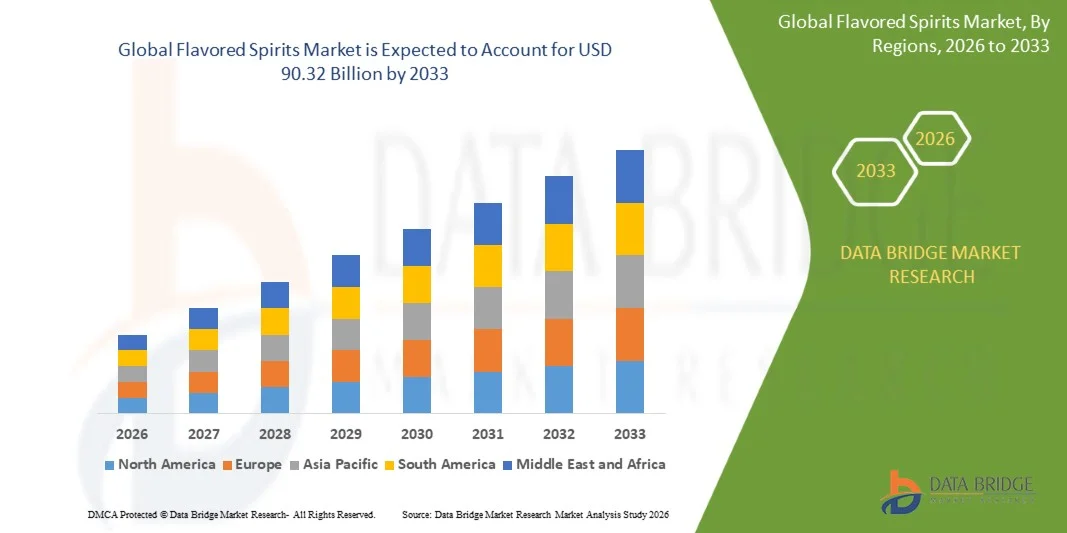
- As per Data Bridge Market Research analysis, the flavored spirits market was valued at USD 28.52 billion in 2025 and is projected to reach USD 90.32 billion by 2033, growing at a CAGR of 15.50% from 2026 to 2033.
- The market is experiencing consistent growth driven by rising consumer demand for distinctive and innovative flavor profiles, expanding cocktail and mixology culture, increasing premiumization, and the growing popularity of experiential drinking occasions.
- The increasing preference for fruit, citrus, botanical, herbal, and other unconventional flavors, combined with product innovation by spirits manufacturers and expanding on-trade, off-trade, and online distribution channels, is encouraging consumers to experiment with flavored alcoholic beverages. Premium and craft offerings, particularly among younger adult consumers, are further supporting market expansion.
Market Size & Forecast
- Global Market Value (2025): USD 28.52 Billion
- Expected Market Value (2033): USD 90.32 Billion
- Forecast CAGR (2026–2033): 15.50%
- Leading Region in 2025: North America
- Fastest Growing Region: Asia Pacific
What are the Major Takeaways of the Flavored Spirits Market?
- North America dominated the flavored spirits market with the largest revenue share of 38.2% in 2025, supported by strong cocktail culture, high disposable incomes, and growing consumer preference for innovative and premium flavored spirits.
- Asia-Pacific is expected to be the fastest-growing region at a CAGR of 8.2% from 2026 to 2033, fueled by rising urbanization, expanding disposable incomes, increasing exposure to international drinking trends, and growing demand for innovative flavored and premium spirits.
- The vodka segment led the market with a 36.4% share in 2025, driven by vodka's neutral base and strong compatibility with diverse flavor infusions.
- Tequila are the fastest-growing type, projected to register a CAGR of 8.5%, reflecting the surge in consumer interest in agave-based spirits and expanding cocktail and mixology culture.
- The fruits segment dominated the flavours category with a 34.2% revenue share in 2025, led by strong consumer preference for familiar, approachable, and refreshing flavor profiles.
- Millennials & Gen Z Consumers accounted for 35% of the market share in 2025, preferred by strong interest in novel flavors, experimentation, and experience-oriented consumption.
- The herbs & spices segment is the fastest-growing flavours category, with a CAGR of 7.5%, driven by increasing consumer interest in complex, botanical, and distinctive flavor combinations.
Report Scope and Flavored Spirits Market Segmentation
|
Attributes |
Flavored Spirits Key Market Insights |
|
Segments Covered |
|
|
Countries Covered |
North America
Europe
Asia-Pacific
Middle East and Africa
South America
|
|
Key Market Players |
|
|
Market Opportunities |
|
|
Value Added Data Infosets |
In addition to the insights on market scenarios such as market value, growth rate, segmentation, geographical coverage, and major players, the market reports curated by the Data Bridge Market Research also include in-depth expert analysis, pricing analysis, brand share analysis, consumer survey, demography analysis, supply chain analysis, value chain analysis, raw material/consumables overview, vendor selection criteria, PESTLE Analysis, Porter Analysis, and regulatory framework. |
What is the Key Trend in the Flavored Spirits Market?
- Flavored spirits manufacturers are increasingly moving beyond conventional citrus and berry profiles toward locally inspired, botanical, spicy, savory, and exotic flavors, reflecting consumer demand for distinctive taste experiences and greater experimentation in cocktails.
- For instance, in June 2025, Radico Khaitan launched Magic Moments Flavours of India with Alphonso Mango and Thandaai variants, initially across Rajasthan and Uttarakhand, demonstrating the growing use of culturally relevant flavors in spirits.
- Cocktail culture and at-home mixology are strengthening demand for flavored spirits that can be consumed neat, mixed with simple mixers, or incorporated into creative cocktails and social drinking occasions.
- Manufacturers are increasingly using regional ingredients and flavor combinations to differentiate products, particularly as younger legal-drinking-age consumers seek approachable, experimental, and culturally familiar alternatives to traditional spirits.
- For instance, in November 2024, Bacardi’s 2025 Cocktail Trends Report identified savory flavors, culinary craftsmanship, immersive experiences, and bartender expertise as major trends shaping cocktail culture, supporting continued experimentation with flavored spirits.
- The increasing emphasis on bold flavor innovation and localized product development is expected to reinforce flavored spirits as an important platform for attracting new consumers and creating differentiated cocktail experiences.
What are the Key Drivers of the Flavored Spirits Market?
- The growing consumer preference for novel taste experiences and premium product innovation is increasing demand for fruit, botanical, herbal, spicy, and exotic flavored spirits across both established and emerging beverage markets.
- For instance, in September 2025, Radico Khaitan launched Magic Moments Jamun SpicyMint vodka, combining jamun with mint and spice to address growing consumer interest in distinctive, locally relevant flavor combinations.
- The expansion of cocktail and mixology culture is encouraging consumers to experiment with flavored spirits as versatile bases for cocktails, home-mixed drinks, and social occasions, supporting broader product adoption.
- For instance, in May 2025, BevNET reported expanding launches of spicy spirits and cocktails, including Gran Malo’s spicy tamarind shot and Captain Morgan Sweet Chili Lime, highlighting increasing commercialization of fruit-and-spice flavor combinations.
- With younger adult consumers increasingly seeking experimentation, convenience, and distinctive flavor experiences, manufacturers are expanding localized portfolios and using flavor innovation to strengthen consumer engagement and broaden spirits consumption occasions.
Which Factors are Challenging the Growth of the Flavored Spirits Market?
- Increasing consumer focus on moderation, health, and wellness is creating pressure on alcoholic beverage consumption, potentially limiting demand for flavored spirits despite continued product innovation and cocktail experimentation.
- For instance, in July 2025, IWSR reported that 22% of legal-drinking-age consumers across its 15 key markets had completely abstained from alcohol during the previous six months, while 41% had temporarily abstained.
- Economic pressure is also affecting discretionary alcohol spending, while consumers increasingly evaluate products based on value, quality, and occasion relevance rather than purchasing flavored products solely for novelty.
- For instance, in April 2026, IWSR reported that beverage alcohol volume declined 2% and value declined 4% across 22 major markets during 2025, with spirits volume declining 4% and value declining 9% amid economic and moderation pressures.
- These moderation trends, combined with changing consumer priorities and economic uncertainty, can restrict the frequency of alcohol consumption and create challenges for flavored spirit brands seeking sustained volume growth across mature markets.
How is the Flavored Spirits Market Segmented?
The flavored spirits market is segmented on the basis of type, flavors, end user, and distribution channel.
- By Type
On the basis of type, the flavored spirits market is segmented into whiskey, rum, vodka, tequila, gin, and others. The vodka segment dominated the market with 36.4% share in 2025, owing to vodka's neutral base and strong compatibility with diverse flavor infusions. Vodka provides manufacturers with flexibility to develop fruit, citrus, botanical, spice, and other flavored expressions. Its versatility also makes it a widely used base for cocktails and mixed beverages. Growing experimentation among younger adult consumers is supporting demand for innovative flavored vodka products. Established distribution networks and strong brand recognition are further supporting the segment.
The tequila segment is projected to register the fastest growth at a CAGR of 8.5% during forecast period, driven by increasing consumer interest in agave-based spirits and expanding cocktail and mixology culture. Flavored tequila provides producers with opportunities to combine traditional agave characteristics with fruit, citrus, spice, and other distinctive profiles. Growing popularity among younger adult consumers is encouraging experimentation with tequila-based beverages. The expansion of premium and innovative tequila portfolios is also creating greater product differentiation. Bars and restaurants are increasingly incorporating flavored tequila into contemporary cocktails and specialty serves.
- By Flavors
On the basis of flavors, the flavored spirits market is segmented into herbs & spices, fruits, nuts & seeds, and others. The fruits segment dominated the market with 34.2% share in 2025, supported by strong consumer preference for familiar, approachable, and refreshing flavor profiles. Berry, citrus, tropical, and stone-fruit expressions provide broad compatibility with different spirit bases. Fruit flavors are particularly suitable for cocktails and mixed beverages, increasing their appeal among consumers and bartenders. Their familiarity also makes fruit-infused spirits accessible to consumers experimenting with flavored alcoholic beverages. Manufacturers are increasingly combining fruit profiles with botanical and regional ingredients to create differentiated products.
The herbs & spices segment is projected to register the fastest growth at a CAGR of 7.5% during forecast period, supported by increasing consumer interest in complex, botanical, and distinctive flavor combinations. Herbal and spicy ingredients allow producers to differentiate products beyond conventional sweet and fruity profiles. Mint, ginger, cinnamon, chilli, rosemary, basil, and other botanicals can provide distinctive sensory characteristics in flavored spirits. Growing craft distilling and mixology culture is encouraging bartenders and consumers to experiment with more sophisticated flavor combinations. Regional herbs and spices are also enabling producers to develop products reflecting local tastes and cultural preferences.
- By End User
On the basis of end user, the flavored spirits market is segmented into Millennials & Gen Z consumers, premium & super-premium consumers, casual drinkers, cocktail & mixology enthusiasts, and others. The Millennials & Gen Z consumers segment dominated the market with 35% share in 2025, supported by strong interest in novel flavors, experimentation, and experience-oriented consumption. Younger adult consumers are increasingly attracted to products that offer distinctive taste profiles and contemporary drinking experiences. Their engagement with cocktail culture is supporting experimentation with flavored vodka, gin, tequila, rum, and whiskey. Social media and digital discovery are also increasing awareness of new and limited-edition flavored spirit launches. At-home mixology and social drinking occasions are creating additional consumption opportunities among this consumer group.
The premium & super-premium consumers segment is projected to register the fastest growth at a CAGR of 9.2% during forecast period, driven by increasing consumer interest in higher-quality ingredients, craftsmanship, provenance, and distinctive flavor formulations. Premiumization is encouraging manufacturers to develop sophisticated flavored spirits using specialty fruits, botanicals, herbs, spices, and other differentiated ingredients. Consumers are increasingly seeking products that provide authenticity and a more distinctive drinking experience. Premium bars, restaurants, specialist retailers, and hospitality venues are providing important channels for product discovery. Limited-edition and small-batch flavored expressions are also supporting consumer interest in higher-value offerings.
- By Distribution Channel
On the basis of distribution channel, the flavored spirits market is segmented into supermarket/hypermarket, specialty retailers, convenience stores, e-commerce, and others. The supermarket/hypermarket segment dominated the market with 31% share in 2025, supported by broad product availability, established retail infrastructure, and convenient access to multiple spirits categories. Large-format retailers provide consumers with extensive selections of flavored spirits across different brands, price points, and flavor profiles. Promotional displays and seasonal campaigns also increase product visibility and encourage consumer trial. Supermarkets and hypermarkets provide manufacturers with broad geographic reach across established spirits markets. Consumers can compare products and discover new flavors within a single shopping environment.
The e-commerce segment is projected to register the fastest growth at a CAGR of 9.8% during forecast period, driven by increasing digital alcohol purchasing, convenience, and wider access to specialty and limited-edition flavored spirits. Online platforms allow consumers to discover products that may have limited availability through conventional retail stores. Digital channels also enable comparison of brands, flavor profiles, product information, and customer reviews. The growing use of online retail is particularly supportive of niche flavored spirits targeting consumers seeking new and differentiated products. Direct-to-consumer models and digital marketing are further helping brands engage consumers and expand product visibility.
Which Region Holds the Largest Share of the Flavored Spirits Market?
- North America dominated the flavored spirits market with the largest revenue share of 38.2% in 2025, supported by strong cocktail culture, high disposable incomes, and growing consumer preference for innovative and premium flavored spirits
- · The region also benefits from rising demand for flavored vodka, whiskey, and other innovative spirit varieties, strong premiumization trends, and widespread availability through supermarkets, specialty retailers, bars, and restaurants. Growing consumer experimentation with distinctive flavors and expanding interest in craft and premium offerings continue to strengthen North America's leadership position in the global market.
U.S. Flavored Spirits Market Insight
The U.S. flavored spirits market is witnessing strong growth due to rising consumer interest in innovative flavor profiles, premium spirits, and cocktail-based consumption. The country's mature spirits industry, extensive on-trade and off-trade distribution network, and strong cocktail culture are driving demand across flavored vodka, whiskey, tequila, rum, and gin categories. In addition, growing consumer experimentation with fruit, botanical, and spice-infused spirits is accelerating product launches and strengthening flavored spirits adoption across bars, restaurants, and retail channels.
Asia-Pacific Flavored Spirits Market Insight
The Asia-Pacific flavored spirits market is expected to witness rapid growth, driven by rising disposable incomes, expanding urban populations, and increasing exposure to international drinking and cocktail trends across countries such as China, India, Japan, and Australia. Growing interest in innovative flavors, premium beverages, and locally inspired spirit products is supporting regional market expansion. In addition, the increasing presence of modern retail, e-commerce platforms, bars, and hospitality establishments is accelerating flavored spirits adoption across the region.
Japan Flavored Spirits Market Insight
The Japan flavored spirits market is witnessing consistent growth due to rising consumer interest in premium beverages, innovative flavor combinations, and contemporary cocktail experiences. Spirits manufacturers, bars, and restaurants are increasingly introducing fruit, citrus, botanical, and locally inspired flavored products to attract consumers seeking distinctive drinking experiences. Moreover, growing interest in premiumization, craft beverages, and sophisticated mixology, along with continued product innovation, is further contributing to market growth.
China Flavored Spirits Market Insight
The China flavored spirits market is growing rapidly, driven by rising disposable incomes, expanding urban consumer populations, and increasing demand for premium and innovative alcoholic beverages. Growing adoption of fruit-infused, botanical, and other distinctive spirit varieties across modern retail, bars, and hospitality establishments is significantly boosting market demand. In addition, rising interest in cocktail culture, premiumization, and products incorporating locally familiar flavors is supporting new product development and positioning China as an important growth market for flavored spirits.
U.K. Flavored Spirits Market Insight
The U.K. flavored spirits market is experiencing steady growth, supported by strong cocktail culture, increasing consumer experimentation, and rising demand for premium and craft spirit offerings. Growing investments in innovative product development and expanding availability of flavored gin, vodka, whiskey, and other spirits are contributing to market growth. Furthermore, the integration of botanical, fruit, and seasonal flavors into contemporary cocktails is improving product differentiation and consumer engagement, positioning the U.K. as a key market for flavored spirits innovation.
Germany Flavored Spirits Market Insight
The Germany flavored spirits market is expanding steadily due to growing consumer interest in premium beverages, innovative flavor profiles, and evolving cocktail and mixology culture. Spirits companies, bars, restaurants, and specialty retailers are increasingly offering flavored products to meet demand for distinctive and experiential drinking options. Continuous development of fruit, botanical, herbal, and spice-based formulations, along with growing premiumization and expanding specialty retail availability, is further driving market growth in Germany.
Which are the Top Companies in Flavored Spirits Market?
The flavored spirits industry is primarily led by well-established companies, including:
- Bacardi Limited (Bermuda)
- Diageo plc (U.K.)
- Pernod Ricard (France)
- Suntory Global Spirits (U.S.)
- Brown-Forman (U.S.)
- Campari America (U.S.)
- Proximo Spirits (U.S.)
- William Grant & Sons (U.K.)
- Rémy Cointreau (France)
- Constellation Brands, Inc. (U.S.)
- Heaven Hill Brands (U.S.)
- Sazerac Company, Inc. (U.S.)
- Radico Khaitan Limited (India)
- Stock Spirits Group (U.K.)
- Luxco, Inc. (U.S.)
- Stoli Group (Luxembourg)
- Lucas Bols N.V. (Netherlands)
- Brown-Forman Beverages (U.S.)
- Beam Suntory India Private Limited (India)
What are Latest Developments in Flavored Spirits Market?
- In June 2025, Radico Khaitan launched Magic Moments Flavours of India, introducing Alphonso Mango and Thandaai flavored vodkas as a new range inspired by Indian taste and cultural traditions. The launch initially covered Rajasthan and Uttarakhand, with planned expansion to additional Indian states.
- In May 2025, Suntory Global Spirits launched -196 nationwide in the U.S., introducing a Strawberry vodka seltzer made with whole-fruit flavor, premium vodka, and three grams of sugar. The new permanent flavor complemented the brand's existing Lemon, Grapefruit, and Peach offerings, expanding its fruit-forward vodka portfolio.
- In June 2024, Spirit of Gallo released Heat Check, its first hot-pepper-flavored vodka, through a partnership between New Amsterdam Vodka and Hot Ones. The limited-edition vodka was designed around spice-forward consumption and could be used in cocktails such as Bloody Marys and Martinis.
- In September 2023, SKYY Vodka launched SKYY Infusions Espresso and SKYY Infusions Agave Lime, expanding its flavored vodka portfolio with products designed around popular cocktail profiles. The Espresso expression targeted the growing espresso martini occasion, while Agave Lime was positioned for cocktails such as margaritas and mules.
- In January 2022, Jameson Irish Whiskey introduced Jameson Orange in the U.S., combining its triple-distilled Irish whiskey with natural orange flavor. The launch expanded Jameson's portfolio with a flavored whiskey expression designed to provide a whiskey-forward taste with a citrus twist.

- Interactive Data Analysis Dashboard
- Company Analysis Dashboard for high growth potential opportunities
- Research Analyst Access for customization & queries
- Competitor Analysis with Interactive dashboard
- Latest News, Updates & Trend analysis
- Harness the Power of Benchmark Analysis for Comprehensive Competitor Tracking
Global Flavored Spirits Market, Supply Chain Analysis and Ecosystem Framework
To support market growth and help clients navigate the impact of geopolitical shifts, DBMR has integrated in-depth supply chain analysis into its Global Flavored Spirits Market research reports. This addition empowers clients to respond effectively to global changes affecting their industries. The supply chain analysis section includes detailed insights such as Global Flavored Spirits Market consumption and production by country, price trend analysis, the impact of tariffs and geopolitical developments, and import and export trends by country and HSN code. It also highlights major suppliers with data on production capacity and company profiles, as well as key importers and exporters. In addition to research, DBMR offers specialized supply chain consulting services backed by over a decade of experience, providing solutions like supplier discovery, supplier risk assessment, price trend analysis, impact evaluation of inflation and trade route changes, and comprehensive market trend analysis.
Data collection and base year analysis are done using data collection modules with large sample sizes. The stage includes obtaining market information or related data through various sources and strategies. It includes examining and planning all the data acquired from the past in advance. It likewise envelops the examination of information inconsistencies seen across different information sources. The market data is analysed and estimated using market statistical and coherent models. Also, market share analysis and key trend analysis are the major success factors in the market report. To know more, please request an analyst call or drop down your inquiry.
The key research methodology used by DBMR research team is data triangulation which involves data mining, analysis of the impact of data variables on the market and primary (industry expert) validation. Data models include Vendor Positioning Grid, Market Time Line Analysis, Market Overview and Guide, Company Positioning Grid, Patent Analysis, Pricing Analysis, Company Market Share Analysis, Standards of Measurement, Global versus Regional and Vendor Share Analysis. To know more about the research methodology, drop in an inquiry to speak to our industry experts.
Data Bridge Market Research is a leader in advanced formative research. We take pride in servicing our existing and new customers with data and analysis that match and suits their goal. The report can be customized to include price trend analysis of target brands understanding the market for additional countries (ask for the list of countries), clinical trial results data, literature review, refurbished market and product base analysis. Market analysis of target competitors can be analyzed from technology-based analysis to market portfolio strategies. We can add as many competitors that you require data about in the format and data style you are looking for. Our team of analysts can also provide you data in crude raw excel files pivot tables (Fact book) or can assist you in creating presentations from the data sets available in the report.













