




Global Fluoroscopy Equipment Market
Market Size in USD Billion
CAGR :
% 
 USD
7.88 Billion
USD
11.37 Billion
2025
2033
USD
7.88 Billion
USD
11.37 Billion
2025
2033
 Forecast Period Forecast Period |
2026 –2033 |
 Market Size (Base Year) Market Size (Base Year) |
USD 7.88 Billion |
 Market Size (Forecast Year) Market Size (Forecast Year) |
USD 11.37 Billion |
 CAGR CAGR |
% |
| Major Markets Players |
|
Fluoroscopy Equipment Market Size
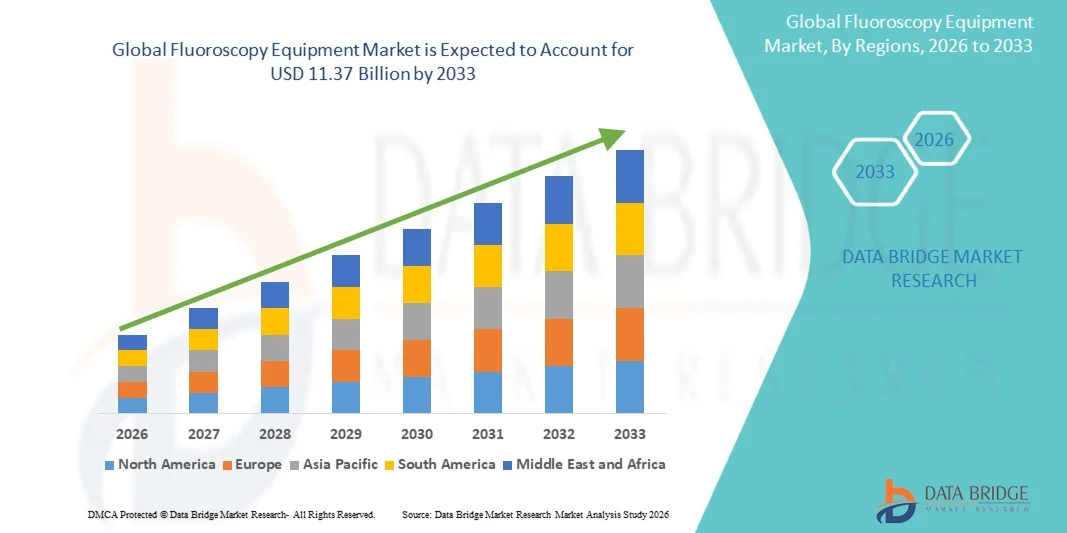
- The global fluoroscopy equipment market size was valued at USD 7.88 billion in 2025 and is expected to reach USD 11.37 billion by 2033, at a CAGR of 4.70% during the forecast period
- The market growth is largely fueled by the increasing demand for real-time imaging in diagnostic and interventional procedures, particularly in cardiology, orthopedics, and gastrointestinal applications, leading to higher adoption of fluoroscopy equipment across hospitals and diagnostic centers
- Furthermore, rising preference for minimally invasive procedures, along with continuous technological advancements such as digital fluoroscopy systems, improved imaging quality, and reduced radiation exposure, is establishing fluoroscopy equipment as a critical component of modern medical imaging. These converging factors are accelerating the uptake of Fluoroscopy Equipment solutions, thereby significantly boosting the industry's growth
Fluoroscopy Equipment Market Analysis
- Fluoroscopy equipment, which provides real-time X-ray imaging for diagnostic and interventional procedures, is widely used across cardiology, orthopedics, gastroenterology, and urology. These systems are essential in guiding minimally invasive procedures and improving clinical accuracy and patient outcomes in modern healthcare settings
- The escalating demand for fluoroscopy equipment is primarily fueled by the rising number of minimally invasive surgeries, increasing prevalence of chronic diseases requiring imaging guidance, and growing demand for advanced diagnostic solutions. Technological advancements such as digital imaging, low-dose radiation systems, and integration with AI are further supporting market growth
- North America dominated the fluoroscopy equipment market with the largest revenue share of 39.5% in 2025, characterized by advanced healthcare infrastructure, high adoption of imaging technologies, and strong presence of leading medical device manufacturers. The U.S. continues to witness steady growth due to increasing procedural volumes and continuous technological innovation
- Asia-Pacific is expected to be the fastest growing region in the fluoroscopy equipment market during the forecast period due to rising healthcare investments, expanding hospital infrastructure, and increasing demand for diagnostic imaging in countries such as China and India
- The Diagnostic segment accounted for the largest market revenue share of 61.3% in 2025, driven by the growing need for accurate and real-time imaging in disease diagnosis
Report Scope and Fluoroscopy Equipment Market Segmentation
|
Attributes |
Fluoroscopy Equipment Key Market Insights |
|
Segments Covered |
|
|
Countries Covered |
North America
Europe
Asia-Pacific
Middle East and Africa
South America
|
|
Key Market Players |
|
|
Market Opportunities |
|
|
Value Added Data Infosets |
In addition to the insights on market scenarios such as market value, growth rate, segmentation, geographical coverage, and major players, the market reports curated by the Data Bridge Market Research also include in-depth expert analysis, patient epidemiology, pipeline analysis, pricing analysis, and regulatory framework. |
Fluoroscopy Equipment Market Trends
“Enhanced Imaging Precision Through AI Integration and Real-Time Visualization Technologies”
- A significant and accelerating trend in the global fluoroscopy equipment market is the integration of artificial intelligence (AI), advanced imaging software, and real-time data processing technologies to improve diagnostic accuracy and procedural efficiency. This evolution is significantly enhancing the capability of clinicians to perform minimally invasive procedures with greater precision and safety
- For instance, leading medical imaging companies are introducing AI-powered fluoroscopy systems that assist in automatically optimizing image quality while reducing radiation exposure during procedures such as cardiac catheterization and gastrointestinal studies.
- AI-enabled image enhancement tools are increasingly being used to provide clearer visualization of anatomical structures, enabling better guidance during interventional procedures and reducing the risk of complications
- For instance, advanced fluoroscopy platforms now incorporate motion correction algorithms that help maintain image clarity even during patient movement, improving procedural outcomes in complex cases
- The integration of digital imaging systems with hospital IT infrastructure, including PACS and electronic health records, is enabling seamless data access and real-time collaboration among healthcare professionals
- For instance, hospitals in developed regions are deploying integrated imaging suites where fluoroscopy systems are connected with surgical navigation tools and diagnostic imaging databases for enhanced clinical decision-making
- This trend toward more intelligent, precise, and connected imaging solutions is reshaping interventional radiology and surgical workflows, encouraging healthcare providers to adopt technologically advanced fluoroscopy systems
- For instance, hybrid operating rooms equipped with advanced fluoroscopy systems are becoming increasingly common in large hospitals, supporting complex cardiovascular and orthopedic procedures
- The demand for next-generation fluoroscopy equipment with enhanced imaging capabilities and reduced radiation exposure is growing rapidly across hospitals and diagnostic centers, driven by the need for safer and more efficient procedures
Fluoroscopy Equipment Market Dynamics
Driver
“Rising Demand for Minimally Invasive Procedures and Advanced Diagnostic Imaging”
- The increasing preference for minimally invasive surgical procedures, along with the growing need for real-time diagnostic imaging, is a major driver for the fluoroscopy equipment market. These systems play a critical role in guiding procedures with precision, reducing recovery time and improving patient outcomes
- For instance, the rising number of cardiovascular interventions such as angioplasty and stent placements is significantly boosting the demand for fluoroscopy systems in hospitals worldwide
- The growing prevalence of chronic diseases, including cardiovascular disorders, gastrointestinal conditions, and orthopedic issues, is further driving the need for advanced imaging technologies for accurate diagnosis and treatment
- For instance, fluoroscopy is widely used in pain management procedures and spinal surgeries, where real-time imaging is essential for precise needle placement
- Technological advancements in imaging systems, including digital detectors and low-dose radiation technologies, are further enhancing the adoption of fluoroscopy equipment
- For instance, modern systems now offer pulsed fluoroscopy and dose-reduction features, minimizing radiation exposure for both patients and healthcare professionals
- In addition, increasing healthcare investments and expansion of hospital infrastructure, particularly in emerging markets, are supporting the widespread adoption of advanced imaging systems
- For instance, new multi-specialty hospitals in Asia-Pacific are equipping their operating rooms with fluoroscopy systems to support a wide range of diagnostic and interventional procedures
Restraint/Challenge
“High Equipment Costs and Radiation Exposure Concerns”
- One of the key challenges in the fluoroscopy equipment market is the high cost associated with advanced imaging systems, including installation, maintenance, and training requirements, which can limit adoption in smaller healthcare facilities
- For instance, the setup of a fully integrated fluoroscopy suite requires significant capital investment, making it difficult for small clinics and rural hospitals to adopt such technologies
- Concerns regarding radiation exposure to both patients and healthcare professionals also pose a significant challenge, particularly with prolonged or repeated procedures
- For instance, interventional radiologists and cardiologists are at risk of cumulative radiation exposure, necessitating strict safety protocols and protective equipment
- In addition, the need for skilled professionals to operate complex fluoroscopy systems and interpret imaging results can create operational challenges in regions with limited trained personnel
- For instance, developing countries often face shortages of trained radiologists and technicians, impacting the efficient utilization of advanced imaging equipment
- Addressing these challenges requires ongoing innovation in low-dose imaging technologies, increased training programs, and cost-effective equipment solutions to expand accessibility
- For instance, manufacturers are focusing on developing compact and affordable fluoroscopy systems tailored for smaller healthcare settings to improve market penetration
Fluoroscopy Equipment Market Scope
The market is segmented on the basis of product and application.
• By Product
On the basis of product, the Fluoroscopy Equipment market is segmented into Fixed Fluoroscopy Equipment and C-Arms. The Fixed Fluoroscopy Equipment segment dominated the largest market revenue share of 58.6% in 2025, driven by its extensive use in hospitals for complex diagnostic and interventional procedures. These systems offer superior imaging quality, stability, and continuous imaging capabilities, making them ideal for high-volume healthcare settings. Their integration in operating rooms and catheterization labs further strengthens their demand. Hospitals prefer fixed systems due to their ability to support advanced procedures such as cardiovascular imaging and gastrointestinal studies. In addition, technological advancements such as digital imaging and reduced radiation exposure enhance their adoption. The availability of high-end infrastructure in developed healthcare systems also supports segment growth. Fixed systems are widely used in specialized departments, increasing utilization rates. Their reliability and precision make them essential for critical procedures. Moreover, increasing investments in hospital infrastructure globally contribute to sustained demand. The segment continues to benefit from rising surgical volumes and diagnostic imaging needs. Overall, fixed fluoroscopy equipment remains the dominant segment due to its performance, efficiency, and widespread institutional usage.
The C-Arms segment is expected to witness the fastest CAGR of 7.9% from 2026 to 2033, driven by increasing demand for mobile and flexible imaging solutions. C-Arms are widely used in orthopedic, pain management, and emergency procedures due to their portability and ease of use. Their ability to provide real-time imaging in operating rooms enhances surgical precision and outcomes. Growing adoption in ambulatory surgical centers and outpatient facilities further fuels growth. Technological advancements such as mini C-Arms and improved image intensifiers support market expansion. The rising number of minimally invasive procedures also contributes to increasing demand. C-Arms require lower installation costs compared to fixed systems, making them accessible to smaller healthcare facilities. In addition, their compact design allows use in space-constrained environments. Increasing healthcare investments in emerging markets further accelerate adoption. Their versatility across multiple applications makes them highly desirable. Overall, C-Arms are the fastest-growing segment due to mobility, cost-effectiveness, and expanding procedural applications.
• By Application
On the basis of application, the Fluoroscopy Equipment market is segmented into Diagnostic and Surgical. The Diagnostic segment accounted for the largest market revenue share of 61.3% in 2025, driven by the growing need for accurate and real-time imaging in disease diagnosis. Fluoroscopy plays a crucial role in gastrointestinal, cardiovascular, and urological diagnostics, enabling dynamic visualization of internal organs. The increasing prevalence of chronic diseases significantly boosts demand for diagnostic imaging procedures. Hospitals and diagnostic centers rely heavily on fluoroscopy for early disease detection and monitoring. Technological advancements improving image clarity and reducing radiation exposure further support segment growth. The integration of digital systems enhances workflow efficiency and diagnostic accuracy. Rising awareness regarding preventive healthcare also contributes to increased diagnostic procedures. In addition, government initiatives to improve diagnostic infrastructure strengthen market expansion. High patient inflow in hospitals ensures consistent utilization of diagnostic fluoroscopy systems. The segment benefits from continuous innovation and expanding clinical applications. Overall, diagnostic applications dominate due to their critical role in disease detection and management.
The Surgical segment is expected to witness the fastest CAGR of 8.4% from 2026 to 2033, driven by the rising number of minimally invasive and image-guided surgeries. Fluoroscopy is extensively used in orthopedic, cardiovascular, and neurological surgeries to provide real-time imaging guidance. Increasing preference for minimally invasive procedures enhances demand for intraoperative imaging solutions. Surgeons rely on fluoroscopy for precision, reducing complications and improving patient outcomes. Growth in ambulatory surgical centers further accelerates segment adoption. Technological advancements enabling 3D imaging and improved navigation systems support expansion. The rising aging population and associated surgical needs also contribute to growth. In addition, increasing investments in surgical infrastructure drive demand for advanced imaging systems. The ability to enhance surgical accuracy and efficiency makes fluoroscopy indispensable in modern operating rooms. Emerging markets are witnessing rapid adoption due to improving healthcare facilities. Overall, the surgical segment is the fastest growing due to technological advancements and increasing procedural volumes.
Fluoroscopy Equipment Market Regional Analysis
- North America dominated the fluoroscopy equipment market with the largest revenue share of 39.5% in 2025, characterized by advanced healthcare infrastructure, high adoption of imaging technologies, and a strong presence of leading medical device manufacturers. The region continues to benefit from well-established hospital networks, increasing utilization of minimally invasive procedures, and continuous technological advancements in imaging systems
- Healthcare providers in the region increasingly rely on advanced fluoroscopy systems for real-time imaging in diagnostic and interventional procedures, which is supporting higher equipment adoption across hospitals and specialty clinics
- This growth is further supported by strong investment in medical technology, favorable reimbursement policies, and ongoing innovation in low-dose imaging and digital fluoroscopy systems, making North America a key revenue-contributing region in the global fluoroscopy equipment market
U.S. Fluoroscopy Equipment Market Insight
The U.S. fluoroscopy equipment market captured the largest revenue share within North America in 2025, driven by increasing procedural volumes, strong adoption of advanced imaging systems, and continuous technological innovation. The country benefits from a well-developed healthcare system, high demand for minimally invasive procedures, and widespread availability of skilled professionals. For instance, hospitals across the U.S. are increasingly utilizing fluoroscopy systems in cardiovascular interventions, orthopedic surgeries, and gastrointestinal procedures. In addition, strong presence of leading medical device companies and ongoing R&D investments are further enhancing the availability of next-generation fluoroscopy technologies.
Europe Fluoroscopy Equipment Market Insight
The Europe fluoroscopy equipment market is projected to expand at a steady CAGR during the forecast period, supported by advanced healthcare systems, increasing aging population, and rising demand for diagnostic imaging procedures. Strong regulatory frameworks and emphasis on patient safety are encouraging the adoption of low-radiation imaging technologies. For instance, several European countries are upgrading hospital imaging infrastructure to incorporate digital fluoroscopy systems with enhanced imaging capabilities. The region’s focus on improving healthcare efficiency and clinical outcomes is further supporting market growth.
U.K. Fluoroscopy Equipment Market Insight
The U.K. fluoroscopy equipment market is anticipated to grow steadily during the forecast period, driven by increasing demand for diagnostic and interventional imaging procedures and strong support from the National Health Service (NHS). For instance, NHS hospitals are expanding the use of fluoroscopy in minimally invasive surgeries and real-time diagnostic applications. Growing focus on early diagnosis and improved patient care pathways is further contributing to market expansion.
Germany Fluoroscopy Equipment Market Insight
The Germany fluoroscopy equipment market is expected to expand at a considerable CAGR during the forecast period, fueled by advanced healthcare infrastructure, strong medical device manufacturing capabilities, and high adoption of innovative imaging technologies. For instance, German hospitals are increasingly investing in hybrid operating rooms equipped with advanced fluoroscopy systems for complex surgical procedures. The country’s emphasis on precision medicine and high-quality care standards is further driving market growth.
Asia-Pacific Fluoroscopy Equipment Market Insight
The Asia-Pacific fluoroscopy equipment market is expected to be the fastest growing region during the forecast period due to rising healthcare investments, expanding hospital infrastructure, and increasing demand for diagnostic imaging in countries such as China and India. For instance, governments in these countries are investing heavily in healthcare modernization and upgrading imaging facilities in public hospitals. Increasing awareness of early disease diagnosis and growing access to healthcare services are further accelerating market growth in the region.
Japan Fluoroscopy Equipment Market Insight
The Japan fluoroscopy equipment market is gaining momentum due to its advanced healthcare system, high adoption of medical technologies, and increasing demand for diagnostic imaging among the aging population. For instance, Japanese hospitals are widely using fluoroscopy in cardiovascular and orthopedic procedures to improve treatment precision. Continuous technological innovation and strong healthcare infrastructure are further supporting market expansion.
China Fluoroscopy Equipment Market Insight
The China fluoroscopy equipment market accounted for a significant revenue share in Asia Pacific in 2025, driven by rapid urbanization, expanding healthcare infrastructure, and increasing demand for advanced diagnostic imaging. For instance, large hospitals in urban centers are increasingly adopting digital fluoroscopy systems to support a growing number of diagnostic and interventional procedures. Strong government initiatives, rising healthcare expenditure, and growing domestic manufacturing capabilities are further enhancing the accessibility and adoption of fluoroscopy equipment across the country.
Fluoroscopy Equipment Market Share
The Fluoroscopy Equipment industry is primarily led by well-established companies, including:
- Siemens Healthineers (Germany)
- GE HealthCare (U.S.)
- Koninklijke Philips N.V. (Netherlands)
- Canon Medical Systems Corporation (Japan)
- Shimadzu Corporation (Japan)
- Ziehm Imaging GmbH (Germany)
- Hologic, Inc. (U.S.)
- Fujifilm Holdings Corporation (Japan)
- Hitachi, Ltd. (Japan)
- Toshiba Medical Systems (Japan)
- Carestream Health (U.S.)
- Agfa-Gevaert Group (Belgium)
- Samsung Medison (South Korea)
- Mindray Medical International Limited (China)
- Lepu Medical Technology (China)
- Allengers Medical Systems (India)
- Trivitron Healthcare (India)
- BPL Medical Technologies (India)
- Narang Medical Limited (India)
- SternMed GmbH (Germany)
Latest Developments in Global Fluoroscopy Equipment Market
- In August 2022, Xoran Technologies announced that it had received U.S. Food and Drug Administration (FDA) 510(k) clearance for its TRON mobile fluoroscopy-CT imaging system, a fully mobile platform designed to deliver real-time imaging and improve intraoperative visualization, marking a significant advancement in portable fluoroscopy solutions
- In August 2023, Biosense Webster, part of Johnson & Johnson MedTech, received U.S. FDA approval for a zero-fluoroscopy workflow for multiple atrial fibrillation ablation products, enabling procedures to be performed with minimal or no fluoroscopy exposure, thereby reducing radiation risks and advancing safer interventional techniques
- In January 2024, Carestream Health launched the DRX-Excel Plus imaging system, an enhanced radiography and fluoroscopy platform designed to improve workflow efficiency, patient experience, and imaging performance through advanced digital capabilities and system flexibility
- In November 2024, Augmedics received U.S. FDA 510(k) clearance for its CT-to-fluoroscopy registration technology integrated into the xvision Spine System, enabling surgeons to use augmented reality with fluoroscopic imaging for improved navigation accuracy and reduced dependence on intraoperative 3D imaging
- In December 2024, Canon Medical Systems received U.S. FDA clearance for its Adora DRFi hybrid imaging system, combining radiography and low-dose fluoroscopy into a single platform, aimed at enhancing workflow efficiency and imaging flexibility in clinical settings
- In March 2025, Canon Medical Systems USA officially launched the Adora DRFi system in the U.S. market, introducing advanced positioning technology, wireless detectors, and integrated radiography-fluoroscopy capabilities to improve patient access and diagnostic efficiency
- In July 2025, Siemens Healthineers received U.S. FDA clearance for its Luminos Q.namix R and Luminos Q.namix T radiography/fluoroscopy platforms, featuring AI-powered workflow optimization, ergonomic design, and reduced radiation exposure, enhancing efficiency for complex imaging procedures
- In November 2025, Shimadzu Medical Systems USA announced the release of the SC15 advanced fluoroscopy system, incorporating flat panel detector technology and large display interfaces to improve surgical visualization, workflow efficiency, and real-time imaging accuracy during procedures
SKU-
Get online access to the report on the World's First Market Intelligence Cloud

- Interactive Data Analysis Dashboard
- Company Analysis Dashboard for high growth potential opportunities
- Research Analyst Access for customization & queries
- Competitor Analysis with Interactive dashboard
- Latest News, Updates & Trend analysis
- Harness the Power of Benchmark Analysis for Comprehensive Competitor Tracking
Research Methodology
Data collection and base year analysis are done using data collection modules with large sample sizes. The stage includes obtaining market information or related data through various sources and strategies. It includes examining and planning all the data acquired from the past in advance. It likewise envelops the examination of information inconsistencies seen across different information sources. The market data is analysed and estimated using market statistical and coherent models. Also, market share analysis and key trend analysis are the major success factors in the market report. To know more, please request an analyst call or drop down your inquiry.
The key research methodology used by DBMR research team is data triangulation which involves data mining, analysis of the impact of data variables on the market and primary (industry expert) validation. Data models include Vendor Positioning Grid, Market Time Line Analysis, Market Overview and Guide, Company Positioning Grid, Patent Analysis, Pricing Analysis, Company Market Share Analysis, Standards of Measurement, Global versus Regional and Vendor Share Analysis. To know more about the research methodology, drop in an inquiry to speak to our industry experts.
Customization Available
Data Bridge Market Research is a leader in advanced formative research. We take pride in servicing our existing and new customers with data and analysis that match and suits their goal. The report can be customized to include price trend analysis of target brands understanding the market for additional countries (ask for the list of countries), clinical trial results data, literature review, refurbished market and product base analysis. Market analysis of target competitors can be analyzed from technology-based analysis to market portfolio strategies. We can add as many competitors that you require data about in the format and data style you are looking for. Our team of analysts can also provide you data in crude raw excel files pivot tables (Fact book) or can assist you in creating presentations from the data sets available in the report.












