


Global Flying Cars Market
Market Size in USD Billion
CAGR :
% 
 USD
1.27 Billion
USD
36.36 Billion
2025
2033
USD
1.27 Billion
USD
36.36 Billion
2025
2033
 Forecast Period Forecast Period |
2026 –2033 |
 Market Size (Base Year) Market Size (Base Year) |
USD 1.27 Billion |
 Market Size (Forecast Year) Market Size (Forecast Year) |
USD 36.36 Billion |
 CAGR CAGR |
% |
| Major Markets Players |
|
What is the Global Flying Cars Market Size and Growth Rate?
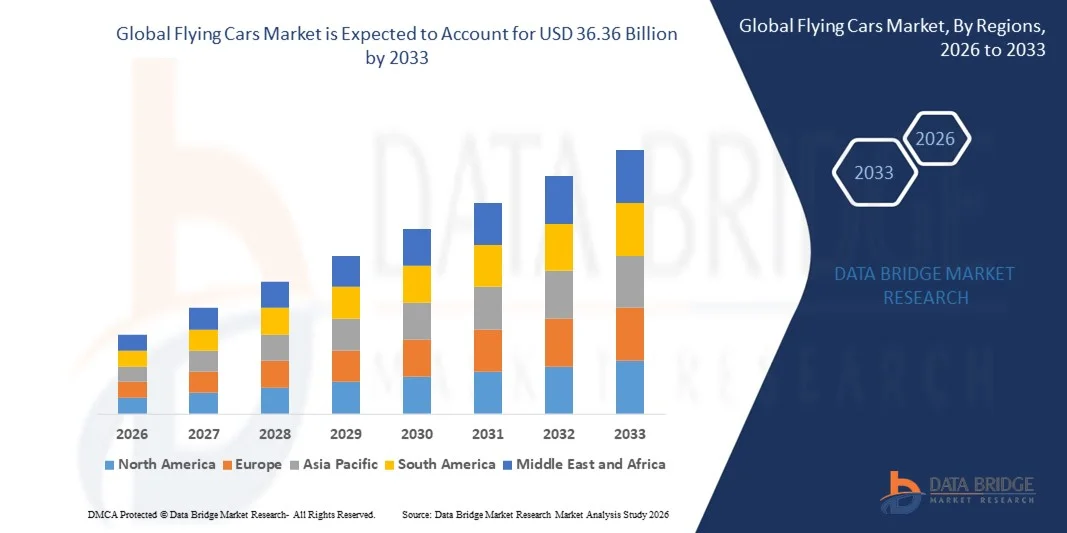
- The global flying cars market size was valued at USD 1.27 billion in 2025 and is expected to reach USD 36.36 billion by 2033, at a CAGR of 52.0% during the forecast period
- The increasing purchasing power and the constantly changing lifestyles and preferences across the globe are anticipated to drive the market’s growth significantly
- The increasing focus on flying vehicles for transport purposes, rising traffic congestion and increasing urban population improves the overall demand of the market
What are the Major Takeaways of Flying Cars Market?
- The higher cost of flying vehicles and the concerns and issues regarding the safety and security is expected to hamper the potential growth of the market. In addition, the adoption of adoption of advanced and innovative technology is predicted to offer robust opportunities for the flying cars market
- The dearth of organized business infrastructure, increasing government tax on flying cars services and various other risk factors can challenge the growth of the flying cars market in the above mentioned forecast period
- North America dominated the flying cars market with a 41.8% revenue share in 2025, driven by strong investments in urban air mobility (UAM), electric vertical take-off and landing (eVTOL) aircraft development, and advanced aerospace technologies across the U.S. and Canada
- Asia-Pacific is projected to register the fastest CAGR of 11.2% from 2026 to 2033, driven by rapid urbanization, rising investments in smart city infrastructure, electric mobility technologies, and next-generation aviation systems across China, Japan, South Korea, India, and Southeast Asia
- The Manned Flying Cars segment dominated the market with a 62.5% share in 2025, as most current flying car prototypes and early commercial models are designed to transport passengers with a pilot onboard
Report Scope and Flying Cars Market Segmentation
|
Attributes |
Flying Cars Key Market Insights |
|
Segments Covered |
|
|
Countries Covered |
North America
Europe
Asia-Pacific
Middle East and Africa
South America
|
|
Key Market Players |
|
|
Market Opportunities |
|
|
Value Added Data Infosets |
In addition to the insights on market scenarios such as market value, growth rate, segmentation, geographical coverage, and major players, the market reports curated by the Data Bridge Market Research also include in-depth expert analysis, pricing analysis, brand share analysis, consumer survey, demography analysis, supply chain analysis, value chain analysis, raw material/consumables overview, vendor selection criteria, PESTLE Analysis, Porter Analysis, and regulatory framework. |
What is the Key Trend in the Flying Cars Market?
Growing Development of Electric Vertical Take-Off and Landing (eVTOL) Flying Cars
- The flying cars market is witnessing strong innovation in electric vertical take-off and landing (eVTOL) technologies, enabling vehicles to take off and land vertically while reducing the need for traditional runways
- Manufacturers are focusing on lightweight composite structures, electric propulsion systems, and autonomous flight technologies to improve operational efficiency, safety, and urban mobility capabilities
- Increasing development of compact air mobility vehicles designed for short-distance transportation is expanding applications in urban transportation, air taxi services, and emergency response
- For instance, companies such as Joby Aviation, Volocopter, EHang, and Airbus are actively developing next-generation eVTOL aircraft designed for commercial urban air mobility services
- Growing investments in urban air mobility (UAM) infrastructure, battery technology, and AI-based flight control systems are accelerating the development and commercialization of flying cars
- As cities experience rising traffic congestion and demand for faster transportation, flying cars are expected to play a significant role in transforming future urban mobility systems
What are the Key Drivers of Flying Cars Market?
- Rising traffic congestion in major urban areas is increasing the demand for alternative transportation solutions capable of reducing travel time and improving urban mobility efficiency
- For instance, in 2024–2025, companies such as Hyundai Motor Company, Joby Aviation, and EHang accelerated development of commercial eVTOL vehicles and conducted advanced flight testing programs
- Growing investments from governments, aerospace companies, and technology firms are supporting research and development of flying car technologies and air mobility infrastructure
- Advancements in battery energy density, lightweight materials, electric propulsion systems, and autonomous flight control technologies are improving aircraft efficiency and safety
- Increasing interest in urban air taxi services, emergency medical transport, and smart city transportation networks is further supporting the expansion of the flying cars market
- Supported by rapid innovation in aerospace engineering, electric mobility, and intelligent navigation systems, the flying cars market is expected to experience strong long-term growth
Which Factor is Challenging the Growth of the Flying Cars Market?
- High development and manufacturing costs associated with advanced eVTOL aircraft, electric propulsion systems, and aviation-grade safety technologies remain a major barrier for widespread commercialization
- For instance, during 2024–2025, several flying car developers faced increased R&D expenses and regulatory approval costs related to aircraft certification and safety testing
- Strict aviation regulations and airspace management requirements create challenges for integrating flying cars into existing aviation and urban transportation systems
- Limited charging infrastructure, vertiports, and air traffic management systems for urban air mobility can delay the deployment of commercial flying car services
- Public concerns regarding flight safety, noise levels, and operational reliability may also influence adoption in densely populated cities
- To address these challenges, companies are focusing on advanced battery technologies, improved aircraft certification processes, infrastructure development, and regulatory collaboration to accelerate the commercialization of flying cars globally
How is the Flying Cars Market Segmented?
The market is segmented on the basis of product, application, and capacity.
- By Product
On the basis of product, the flying cars market is segmented into Manned Flying Cars and Unmanned Flying Cars. The Manned Flying Cars segment dominated the market with a 62.5% share in 2025, as most current flying car prototypes and early commercial models are designed to transport passengers with a pilot onboard. These vehicles are being developed for urban air mobility (UAM), air taxi services, and short-distance transportation, offering faster travel across congested metropolitan areas. Aerospace companies and automotive manufacturers are investing heavily in electric vertical take-off and landing (eVTOL) aircraft, which combine the convenience of helicopters with the efficiency of electric propulsion systems.
The Unmanned Flying Cars segment is expected to grow at the fastest CAGR from 2026 to 2033, driven by rapid advancements in autonomous navigation systems, AI-based flight control technologies, and remote piloting capabilities. Increasing use of autonomous aerial vehicles for logistics, surveillance, emergency response, and cargo transport is accelerating adoption. As regulatory frameworks for autonomous air mobility evolve, unmanned flying cars are expected to gain significant traction in smart city transportation networks.
- By Applications
On the basis of applications, the market is segmented into Military, Commercial, and Civil. The Commercial segment dominated the market with a 45.8% share in 2025, supported by the growing development of urban air taxi services, aerial ride-sharing platforms, and premium urban transportation solutions. Companies across the aerospace and mobility sectors are working to introduce flying cars as on-demand air mobility services that reduce travel time in congested cities. These vehicles are being integrated into smart city transportation ecosystems, supported by infrastructure such as vertiports and digital air traffic management systems.
The Military segment is expected to grow at the fastest CAGR from 2026 to 2033, driven by increasing interest in advanced aerial mobility platforms for surveillance, reconnaissance, tactical transport, and rapid deployment missions. Defense organizations are exploring flying car technologies for flexible battlefield mobility and logistics operations. Continuous investment in hybrid propulsion systems, stealth technologies, and autonomous flight capabilities is further supporting growth in military applications of flying cars.
- By Capacity
On the basis of capacity, the flying cars market is segmented into 2-Person Sitter, 3 and 4-Person Sitter, and 5-Person Sitter. The 2-Person Sitter segment dominated the market with a 48.6% share in 2025, as most early-stage flying car models are designed for personal mobility and small-scale air taxi operations. These compact vehicles offer lightweight structures, improved energy efficiency, and easier flight control, making them ideal for initial commercial deployment in urban environments. Manufacturers are prioritizing smaller capacity aircraft to simplify certification processes, reduce operational costs, and optimize battery performance.
The 3 and 4-Person Sitter segment is expected to grow at the fastest CAGR from 2026 to 2033, driven by increasing demand for shared air mobility services and urban passenger transportation. These vehicles can accommodate multiple passengers while maintaining operational efficiency, making them suitable for air taxi fleets, tourism transport, and corporate travel services. As urban air mobility infrastructure expands globally, mid-capacity flying cars are expected to play a crucial role in scalable commercial deployment.
Which Region Holds the Largest Share of the Flying Cars Market?
- North America dominated the flying cars market with a 41.8% revenue share in 2025, driven by strong investments in urban air mobility (UAM), electric vertical take-off and landing (eVTOL) aircraft development, and advanced aerospace technologies across the U.S. and Canada. The region has a well-established aviation ecosystem supported by leading aerospace manufacturers, technology startups, and research institutions that are actively developing next-generation flying vehicles. Growing interest in air taxi services, smart city mobility solutions, and sustainable transportation technologies is accelerating the adoption of flying cars across major metropolitan areas
- Leading companies in North America are focusing on electric propulsion systems, autonomous flight technologies, and lightweight composite materials to improve flight efficiency, safety, and operational performance. Continuous investments in advanced battery systems, air traffic management technologies, and urban vertiport infrastructure further strengthen the region’s technological leadership
- Strong government support for aerospace innovation, high concentration of aviation engineers, and active testing of urban air mobility platforms further reinforce North America’s leadership position in the global flying cars market
U.S. Flying Cars Market Insight
The U.S. is the largest contributor to the North American market, supported by strong innovation in aerospace engineering, electric mobility technologies, and autonomous aviation systems. Leading flying car developers and aerospace companies are conducting extensive flight testing and prototype development programs for commercial urban air mobility services. Increasing investment in air taxi networks, smart mobility platforms, and advanced aviation research continues to drive market expansion. The presence of major technology firms, aerospace startups, and supportive regulatory initiatives for emerging aviation technologies further strengthens the country’s leadership in the global flying cars market.
Canada Flying Cars Market Insight
Canada contributes significantly to regional growth, driven by expanding aerospace research programs, innovation hubs, and government-backed initiatives supporting advanced aviation technologies. Universities, aerospace laboratories, and technology companies are actively exploring flying car concepts for urban transportation, logistics, and emergency services. Increasing collaboration between aerospace manufacturers, mobility startups, and technology developers is accelerating research and development activities. In addition, Canada’s strong engineering workforce and supportive regulatory environment for emerging mobility solutions are encouraging continued innovation in the flying cars industry.
Asia-Pacific Flying Cars Market
Asia-Pacific is projected to register the fastest CAGR of 11.2% from 2026 to 2033, driven by rapid urbanization, rising investments in smart city infrastructure, electric mobility technologies, and next-generation aviation systems across China, Japan, South Korea, India, and Southeast Asia. Growing traffic congestion in major cities and increasing government interest in urban air mobility solutions are encouraging the development of flying car technologies. Expanding aerospace manufacturing capabilities and strong technological innovation across the region are accelerating market growth.
China Flying Cars Market Insight
China is the largest contributor to the Asia-Pacific market due to strong government support for advanced aviation technologies, autonomous flight systems, and electric air mobility platforms. Domestic companies and research institutions are rapidly developing eVTOL aircraft and autonomous aerial vehicles designed for urban transportation and logistics applications. Increasing investments in smart transportation infrastructure and digital aviation ecosystems are further strengthening the country’s position in the flying cars market.
Japan Flying Cars Market Insight
Japan is witnessing steady growth supported by strong technological innovation in robotics, autonomous systems, and advanced mobility solutions. Several Japanese companies and research institutions are developing flying car prototypes designed for urban passenger transport and disaster response operations. Government initiatives supporting next-generation mobility technologies and smart city development are accelerating the adoption of flying car technologies in the country.
India Flying Cars Market Insight
India is emerging as an important growth hub driven by increasing investments in aerospace research, smart transportation infrastructure, and advanced mobility technologies. Government initiatives promoting innovation in aviation technology and urban mobility solutions are encouraging startups and aerospace companies to explore flying car development. Rapid urbanization and growing demand for efficient transportation solutions are expected to support long-term market expansion.
South Korea Flying Cars Market Insight
South Korea contributes significantly to the Asia-Pacific market due to strong advancements in electric mobility technologies, aerospace engineering, and digital infrastructure development. The country is actively investing in urban air mobility programs, vertiport infrastructure, and autonomous flight technologies. Collaboration between aerospace companies, technology firms, and government organizations is accelerating the development and testing of flying car platforms, supporting sustained market growth in the region.
Which are the Top Companies in Flying Cars Market?
The flying cars industry is primarily led by well-established companies, including:
- Volocopter GmbH (Germany)
- Airbus (Netherlands)
- AeroMobil (Slovakia)
- Boeing (U.S.)
- CARTIVATOR (Japan)
- EHang (China)
- Joby Aviation (U.S.)
- Moller International (U.S.)
- Samson Motors Inc (U.S.)
- Hyundai Motor Company (South Korea)
- KITTY HAWK (U.S.)
- Uber Technologies Inc (U.S.)
- Volocopter GmbH (Germany)
- Opener (U.S.)
- Jaunt Air Mobility LLC (U.S.)
- Aston Martin (U.K.)
What are the Recent Developments in Global Flying Cars Market?
- In January 2025, Chinese engineers introduced an innovative flying car concept that can be compressed into a ground vehicle resembling Tesla’s Cybertruck for easier transportation, effectively transforming it into a portable aircraft carrier. The aerial component is an electric vertical take-off and landing (eVTOL) aircraft that operates using distributed electric propulsion, where multiple motors and propellers are placed along the airframe to generate lift and enable flight. This design enhances operational flexibility and demonstrates new possibilities for compact urban air mobility systems, thereby highlighting growing technological innovation in the flying cars market
- In January 2025, Covestro partnered with China’s Guangzhou Automobile Group (GAC) to accelerate the development of battery-powered flying vehicles capable of vertical take-off and landing. Under the collaboration, Covestro will supply lightweight polycarbonate materials for several components including glazing and lighting systems. Part of the polycarbonate used by the company is produced from chemically recycled post-consumer waste, supporting GAC’s objective of incorporating low-carbon materials in its vehicles. The prototype flying vehicle has demonstrated the ability to travel 200 km in approximately 40 minutes, thereby supporting the advancement of sustainable flying car technologies
- In December 2024, Joby Aviation, Inc. announced that it had successfully completed a significant series of aerostructure tests required for certification with the Federal Aviation Administration (FAA) for its electric air taxi aircraft. The company conducted static load testing on the aircraft’s tail structure, marking the first time a major aerostructure was tested for certification credit with FAA representatives present. These tests are an essential step toward regulatory approval and commercial deployment of electric air taxi services, thereby accelerating progress toward commercial flying car operations
- In October 2024, Boeing revealed plans to raise USD 25 billion in new capital and secured a USD 10 billion credit facility to strengthen its financial position amid operational challenges caused by a large labor union strike. According to a company filing, the aerospace manufacturer intends to raise funds through debt or equity over a three-year period to maintain financial flexibility and support future business operations. The funding initiative is expected to stabilize the company’s financial structure and sustain ongoing aerospace innovation programs, thereby reinforcing long-term investments in advanced aviation technologies including flying vehicles
SKU-
Get online access to the report on the World's First Market Intelligence Cloud

- Interactive Data Analysis Dashboard
- Company Analysis Dashboard for high growth potential opportunities
- Research Analyst Access for customization & queries
- Competitor Analysis with Interactive dashboard
- Latest News, Updates & Trend analysis
- Harness the Power of Benchmark Analysis for Comprehensive Competitor Tracking
Research Methodology
Data collection and base year analysis are done using data collection modules with large sample sizes. The stage includes obtaining market information or related data through various sources and strategies. It includes examining and planning all the data acquired from the past in advance. It likewise envelops the examination of information inconsistencies seen across different information sources. The market data is analysed and estimated using market statistical and coherent models. Also, market share analysis and key trend analysis are the major success factors in the market report. To know more, please request an analyst call or drop down your inquiry.
The key research methodology used by DBMR research team is data triangulation which involves data mining, analysis of the impact of data variables on the market and primary (industry expert) validation. Data models include Vendor Positioning Grid, Market Time Line Analysis, Market Overview and Guide, Company Positioning Grid, Patent Analysis, Pricing Analysis, Company Market Share Analysis, Standards of Measurement, Global versus Regional and Vendor Share Analysis. To know more about the research methodology, drop in an inquiry to speak to our industry experts.
Customization Available
Data Bridge Market Research is a leader in advanced formative research. We take pride in servicing our existing and new customers with data and analysis that match and suits their goal. The report can be customized to include price trend analysis of target brands understanding the market for additional countries (ask for the list of countries), clinical trial results data, literature review, refurbished market and product base analysis. Market analysis of target competitors can be analyzed from technology-based analysis to market portfolio strategies. We can add as many competitors that you require data about in the format and data style you are looking for. Our team of analysts can also provide you data in crude raw excel files pivot tables (Fact book) or can assist you in creating presentations from the data sets available in the report.












