




Global Foliar Spray Market
Market Size in USD Billion
CAGR :
% 
 USD
8.39 Billion
USD
14.10 Billion
2025
2033
USD
8.39 Billion
USD
14.10 Billion
2025
2033
 Forecast Period Forecast Period |
2026 –2033 |
 Market Size (Base Year) Market Size (Base Year) |
USD 8.39 Billion |
 Market Size (Forecast Year) Market Size (Forecast Year) |
USD 14.10 Billion |
 CAGR CAGR |
% |
| Major Markets Players |
|
Foliar Spray Market Size
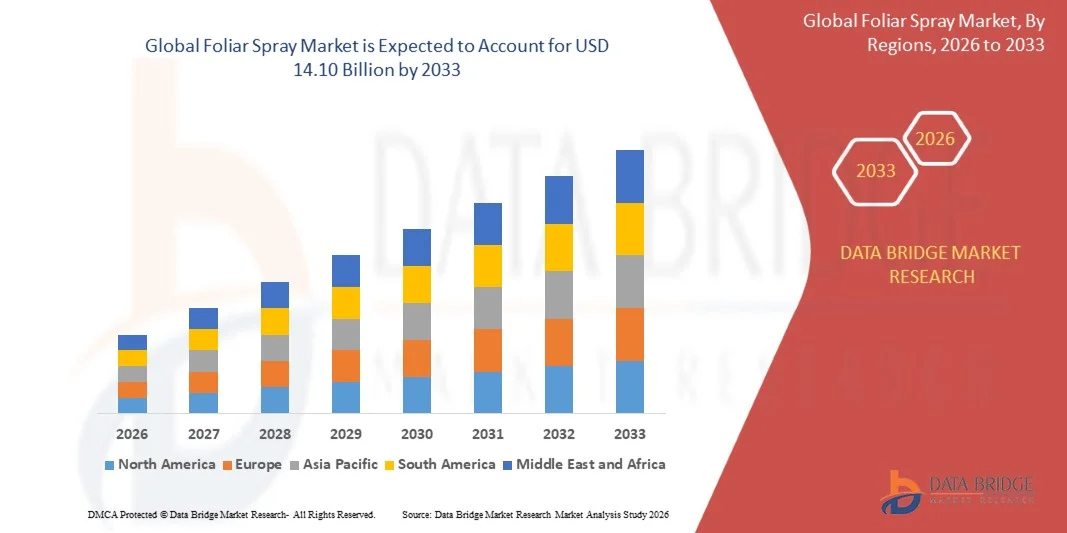
- The global foliar spray market size was valued at USD 8.39 billion in 2025 and is expected to reach USD 14.10 billion by 2033, at a CAGR of 6.70% during the forecast period
- The market growth is largely fuelled by the increasing need for efficient nutrient delivery systems that enhance crop yield and improve plant health across modern agricultural practices
- Rising adoption of precision farming techniques and advanced agrochemical application methods is further supporting market expansion
Foliar Spray Market Analysis
- The market is witnessing strong growth due to increasing awareness among farmers regarding crop protection and nutrient management efficiency
- Expanding agricultural activities and rising global food demand are encouraging the use of foliar spray products for better productivity
- North America dominated the foliar spray market with the largest revenue share in 2025, driven by advanced agricultural practices, high adoption of precision farming techniques, and increasing focus on improving crop yield and nutrient efficiency across large-scale farming operations
- The Asia-Pacific region is expected to witness the highest growth rate in the global foliar spray market, driven by rapid agricultural modernization, growing population-driven food demand, and increasing government initiatives supporting improved farm productivity and sustainable agriculture practices
- The liquid segment held the largest market revenue share in 2025 driven by its high solubility, ease of application, and faster absorption efficiency through plant leaves, making it highly effective for immediate nutrient delivery. Liquid foliar sprays are widely preferred by farmers due to their compatibility with modern spraying equipment, uniform coverage, and ability to quickly correct nutrient deficiencies during critical crop growth stages
Report Scope and Foliar Spray Market Segmentation
|
Attributes |
Foliar Spray Key Market Insights |
|
Segments Covered |
|
|
Countries Covered |
North America
Europe
Asia-Pacific
Middle East and Africa
South America
|
|
Key Market Players |
• Tessenderlo Group (Belgium) |
|
Market Opportunities |
• Rising Adoption Of Precision Agriculture Technologies |
|
Value Added Data Infosets |
In addition to the insights on market scenarios such as market value, growth rate, segmentation, geographical coverage, and major players, the market reports curated by the Data Bridge Market Research also include import export analysis, production capacity overview, production consumption analysis, price trend analysis, climate change scenario, supply chain analysis, value chain analysis, raw material/consumables overview, vendor selection criteria, PESTLE Analysis, Porter Analysis, and regulatory framework. |
Foliar Spray Market Trends
“Rising Demand For Precision Farming And Efficient Nutrient Delivery Solutions”
• The increasing focus on improving crop productivity, yield quality, and nutrient use efficiency is significantly shaping the foliar spray market, as farmers adopt advanced crop nutrition methods that deliver essential nutrients directly through plant leaves in a more controlled and targeted manner. Foliar sprays are gaining traction due to their rapid absorption rate, ability to bypass soil limitations, and effectiveness in correcting nutrient deficiencies at critical crop growth stages. This trend is strengthening adoption across modern agricultural practices, encouraging manufacturers to develop advanced formulations tailored for specific crops, soil conditions, and climatic zones to maximize agricultural output and efficiency
• Growing awareness regarding sustainable agriculture practices and long-term soil health preservation is accelerating the use of foliar spray solutions among farmers and agribusinesses. Farmers are increasingly shifting toward targeted nutrient application methods that reduce dependency on excessive soil fertilization and enhance overall crop yield quality while minimizing environmental impact. This shift is further supported by rising concerns over soil degradation, nutrient leaching, and fertilizer overuse, prompting the adoption of more efficient and environmentally responsible crop nutrition strategies
• Increasing adoption of micronutrient-based fertilizers and bio-stimulant formulations is influencing market growth, with manufacturers focusing on improving plant immunity, crop resistance, growth performance, and stress tolerance under changing climatic conditions. These innovations are helping farmers achieve higher productivity while maintaining environmental balance and reducing dependency on conventional chemical fertilizers. The integration of advanced nutrient delivery systems is also enabling better crop resilience against pests, diseases, and drought stress, further supporting agricultural sustainability goals
• For instance, in 2024, companies in the U.S. and India introduced advanced foliar spray formulations enriched with micronutrients and bio-stimulants designed for cereals, pulses, and horticultural crops to address nutrient deficiency challenges and improve yield efficiency. These products were launched in response to increasing demand for climate-resilient agricultural inputs and were distributed through agro-dealers, cooperatives, and digital agriculture platforms. The launches also emphasized precision application benefits, helping farmers achieve improved productivity and cost-effective farming practices
• While demand for foliar sprays is increasing, sustained market growth depends on farmer education, cost efficiency, and widespread product availability across rural and semi-urban regions. Manufacturers are also focusing on improving formulation stability, compatibility with modern spraying equipment, and ease of application to ensure better adoption across diverse agricultural environments and farming practices globally
Foliar Spray Market Dynamics
Driver
“Increasing Need For High Crop Yield And Nutrient Efficiency”
• Rising global food demand driven by population growth, changing dietary patterns, and urbanization is a major driver for the foliar spray market, encouraging farmers to adopt efficient crop nutrition solutions that significantly improve yield, quality, and overall agricultural productivity. Foliar sprays help deliver nutrients directly to plant leaves, ensuring faster absorption, better utilization, and improved plant health during critical growth stages, making them an essential tool for modern high-efficiency farming systems
• Expanding use of precision agriculture technologies, data-driven farming practices, and modern irrigation systems is further supporting market growth across developed and developing agricultural economies. Farmers are increasingly using foliar sprays to quickly address nutrient deficiencies, enhance crop uniformity, and optimize input usage, leading to better productivity outcomes and reduced wastage of fertilizers. The integration of advanced farming tools is also enabling more targeted and efficient application of foliar nutrients across large-scale cultivation areas
• Agrochemical companies are actively promoting foliar spray solutions through continuous product innovation, farmer awareness programs, field demonstrations, and expanded distribution networks. These efforts are strongly supported by increasing demand for high-quality agricultural output, improved farm profitability, and sustainable farming practices. Companies are also investing in research and development to introduce crop-specific and climate-adaptive formulations that enhance nutrient uptake efficiency and support long-term agricultural productivity
• For instance, in 2023, leading agrochemical companies in Europe and Brazil reported increased adoption of foliar sprays in soybean, wheat, and maize cultivation due to rising fertilizer efficiency concerns, yield optimization requirements, and pressure to improve export-quality produce. This trend strengthened product demand significantly, improved farmer productivity outcomes, and encouraged wider adoption of integrated nutrient management practices across commercial farming regions
• Although strong demand supports growth, wider adoption depends on affordability, improved awareness in rural regions, and access to modern spraying equipment and technical guidance. Investment in farmer education programs, rural distribution infrastructure, and government-supported agricultural extension services will be essential for sustained market expansion and improved global penetration of foliar spray solutions
Restraint/Challenge
“Limited Awareness And High Dependency On Climatic Conditions”
• Limited awareness among farmers in developing and underdeveloped agricultural regions remains a key challenge for the foliar spray market, restricting optimal usage and slowing adoption of advanced crop nutrition techniques. Many farmers still rely heavily on traditional fertilization methods due to lack of technical knowledge, limited training exposure, and insufficient access to agricultural advisory services regarding the benefits and correct application of foliar sprays, which impacts overall market penetration and efficiency of usage
• Effectiveness of foliar sprays is highly dependent on environmental and climatic conditions such as temperature, humidity, rainfall patterns, and wind speed, which can significantly influence absorption efficiency and overall crop response. This variability creates uncertainty in outcomes and may reduce farmer confidence in certain regions, especially where weather conditions are unpredictable, thereby affecting consistent adoption rates and limiting large-scale usage in climate-sensitive agricultural zones
• Distribution challenges in rural, remote, and infrastructure-limited regions also impact market penetration, as access to high-quality agrochemical products, proper storage facilities, and technical guidance remains limited. In addition, foliar spray products often require specific storage conditions and careful handling to maintain stability and effectiveness, increasing logistical complexity and operational costs for manufacturers and distributors operating in fragmented agricultural supply chains
• For instance, in 2024, agricultural distributors in parts of Africa and Southeast Asia reported slower adoption of foliar spray solutions due to limited farmer awareness, inconsistent field results under varying climatic conditions, and lack of access to proper spraying equipment. These factors led to cautious usage patterns, reduced repeat purchases, and slower market expansion in several emerging agricultural economies despite growing potential demand
• Overcoming these challenges will require strong farmer training programs, improved rural distribution infrastructure, and development of climate-resilient and highly stable foliar formulations. Collaboration between agrochemical companies, governments, and agricultural extension services will be essential to improve awareness, ensure proper usage practices, and unlock the long-term growth potential of the global foliar spray market
Foliar Spray Market Scope
The foliar spray market is segmented into three notable segments based on product type, chemical, and application.
• By Product Type
On the basis of product type, the foliar spray market is segmented into powder and liquid. The liquid segment held the largest market revenue share in 2025 driven by its high solubility, ease of application, and faster absorption efficiency through plant leaves, making it highly effective for immediate nutrient delivery. Liquid foliar sprays are widely preferred by farmers due to their compatibility with modern spraying equipment, uniform coverage, and ability to quickly correct nutrient deficiencies during critical crop growth stages.
The powder segment is expected to witness the fastest growth rate from 2026 to 2033, driven by its longer shelf life, lower transportation cost, and ease of storage under varying climatic conditions. Powder-based formulations are increasingly being adopted in regions with limited access to cold chain infrastructure, and they are also gaining traction due to their flexibility in mixing with water for customized nutrient application, making them suitable for large-scale agricultural usage.
• By Chemical
On the basis of chemical, the foliar spray market is segmented into nitrogenous, potassic, phosphatic, and micronutrients. The nitrogenous segment held the largest market revenue share in 2025 driven by its critical role in promoting vegetative growth, improving leaf development, and enhancing overall crop yield across a wide range of agricultural applications. Nitrogen-based foliar sprays are widely used due to their quick action, high efficiency in correcting nitrogen deficiencies, and strong demand in staple crop production systems.
The micronutrients segment is expected to witness the fastest growth rate from 2026 to 2033, driven by increasing awareness of trace element deficiencies in soil and their impact on crop productivity and quality. Micronutrient foliar sprays are gaining popularity for improving plant metabolism, enhancing resistance to stress conditions, and boosting crop quality, making them essential in precision farming and high-value crop cultivation practices.
• By Application
On the basis of application, the foliar spray market is segmented into horticultural crops, field crops, and turfs and ornamentals. The field crops segment held the largest market revenue share in 2025 driven by large-scale cultivation of cereals, pulses, and oilseeds, where foliar sprays are extensively used to improve yield efficiency and manage nutrient deficiencies effectively. Field crops benefit significantly from foliar application due to its ability to provide rapid nutrient correction during key growth stages, ensuring better productivity and crop uniformity.
The horticultural crops segment is expected to witness the fastest growth rate from 2026 to 2033, driven by increasing demand for high-quality fruits, vegetables, and plantation crops in both domestic and export markets. Foliar sprays are widely used in horticulture to enhance crop appearance, improve nutritional value, and increase marketability, making them highly valuable in commercial farming systems focused on premium agricultural output.
Foliar Spray Market Regional Analysis
• North America dominated the foliar spray market with the largest revenue share in 2025, driven by advanced agricultural practices, high adoption of precision farming techniques, and increasing focus on improving crop yield and nutrient efficiency across large-scale farming operations
• Farmers in the region highly value the effectiveness, fast nutrient absorption, and improved crop productivity offered by foliar spray solutions, especially for addressing micronutrient deficiencies and enhancing plant growth during critical crop stages
• This widespread adoption is further supported by strong agricultural infrastructure, high awareness of modern farming inputs, and increasing demand for sustainable and high-yield crop production, establishing foliar sprays as a key component in commercial agriculture
U.S. Foliar Spray Market Insight
The U.S. foliar spray market captured the largest revenue share in 2025 within North America, fueled by strong adoption of advanced agrochemical solutions and precision agriculture technologies. Farmers are increasingly focusing on improving crop quality and productivity through efficient nutrient delivery systems that enhance plant health and yield outcomes. The growing use of micronutrient and bio-stimulant-based foliar formulations is further driving market expansion. Moreover, the presence of major agrochemical companies and continuous innovation in crop nutrition solutions are significantly supporting market growth.
Europe Foliar Spray Market Insight
The Europe foliar spray market is expected to witness the fastest growth rate from 2026 to 2033, primarily driven by increasing demand for sustainable agriculture practices and rising focus on reducing soil nutrient depletion. The region’s strict environmental regulations and emphasis on eco-friendly farming methods are encouraging the adoption of foliar spray solutions. Growing demand for high-quality agricultural produce and organic farming practices is further accelerating market expansion across both developed and emerging European countries.
U.K. Foliar Spray Market Insight
The U.K. foliar spray market is expected to witness the fastest growth rate from 2026 to 2033, driven by rising awareness of precision farming and increasing adoption of advanced crop nutrition techniques. Farmers are increasingly using foliar sprays to improve crop yield, quality, and resistance to environmental stress. Strong government support for sustainable agriculture and modern farming practices is further boosting market growth in the region.
Germany Foliar Spray Market Insight
The Germany foliar spray market is expected to witness the fastest growth rate from 2026 to 2033, fueled by strong emphasis on sustainable farming, high agricultural efficiency standards, and adoption of advanced crop protection technologies. Germany’s focus on precision agriculture and environmentally responsible farming practices is promoting the use of foliar spray solutions to enhance nutrient efficiency and reduce chemical wastage.
Asia-Pacific Foliar Spray Market Insight
The Asia-Pacific foliar spray market is expected to witness the fastest growth rate from 2026 to 2033, driven by rapid population growth, rising food demand, and increasing adoption of modern agricultural practices across developing economies. The region’s expanding agricultural sector and government initiatives promoting farm productivity are supporting foliar spray adoption. Growing awareness of micronutrient deficiencies in soil is further accelerating market growth.
Japan Foliar Spray Market Insight
The Japan foliar spray market is expected to witness strong growth from 2026 to 2033 due to advanced agricultural technologies, high focus on crop quality, and limited arable land requiring high-efficiency farming methods. Farmers are increasingly adopting foliar sprays to improve yield and ensure optimal nutrient delivery. The integration of precision farming systems is further supporting market expansion in Japan.
China Foliar Spray Market Insight
The China foliar spray market accounted for the largest market revenue share in Asia Pacific in 2025, attributed to large-scale agricultural production, rapid modernization of farming practices, and strong government support for agricultural efficiency improvements. China’s focus on increasing crop yield and ensuring food security is driving widespread adoption of foliar spray solutions across major crop segments. The presence of domestic agrochemical manufacturers and expanding distribution networks is further propelling market growth in the country.
Foliar Spray Market Share
The Foliar Spray industry is primarily led by well-established companies, including:
• Tessenderlo Group (Belgium)
• Compass Minerals (U.S.)
• UNITED CO. FOR FERTILIZERS & CHEMICALS (Egypt)
• Yara (Norway)
• SESODA CORPORATION (South Korea)
• K+S Minerals and Agriculture GmbH (Germany)
• SQM S.A. (Chile)
• Migao Corporation (Canada)
• Kemira (Finland)
• Mosaic (U.S.)
• Intrepid Potash (U.S.)
• SOPerior Fertilizer Corp. (Canada)
• Shijiazhuang Hehe Chemical Fertilizer Co., Ltd (China)
• Shandong Lianmeng Chemical Group Co., Ltd. (China)
• Nutrien Ltd. (Canada)
• EuroChem Group (Switzerland)
• Dow (U.S.)
• DuPont (U.S.)
• HELM AG (Germany)
• ICL Fertilizers (Israel)
• Borealis AG (Austria)
Latest Developments in Global Foliar Spray Market
- In February 2025, Grupa Azoty introduced FOLIRES, a granular nitrogen-sulfur-magnesium fertilizer designed for foliar application in cereals and fruit crops, aimed at improving nutrient absorption efficiency and enhancing plant growth performance. This product development focuses on delivering balanced macro and secondary nutrients through foliar spraying methods for faster crop response. The launch is expected to improve crop yield, strengthen plant resistance, and support efficient nutrient management practices. It is likely to enhance Grupa Azoty’s position in advanced fertilizer solutions and expand adoption of foliar-based nutrition systems in agriculture
- In November 2024, Syngenta Canada launched YieldON, a seaweed-based liquid foliar biostimulant enriched with manganese, zinc, and molybdenum, specifically developed for corn and wheat cultivation. The product is designed to improve plant vigor, stress tolerance, and nutrient uptake efficiency during key growth stages. This development supports sustainable agriculture practices by integrating bio-based solutions into crop nutrition programs. It is expected to drive higher crop productivity, promote biostimulant adoption, and strengthen Syngenta’s presence in the foliar nutrition market segment
SKU-
Get online access to the report on the World's First Market Intelligence Cloud

- Interactive Data Analysis Dashboard
- Company Analysis Dashboard for high growth potential opportunities
- Research Analyst Access for customization & queries
- Competitor Analysis with Interactive dashboard
- Latest News, Updates & Trend analysis
- Harness the Power of Benchmark Analysis for Comprehensive Competitor Tracking
Global Foliar Spray Market, Supply Chain Analysis and Ecosystem Framework
To support market growth and help clients navigate the impact of geopolitical shifts, DBMR has integrated in-depth supply chain analysis into its Global Foliar Spray Market research reports. This addition empowers clients to respond effectively to global changes affecting their industries. The supply chain analysis section includes detailed insights such as Global Foliar Spray Market consumption and production by country, price trend analysis, the impact of tariffs and geopolitical developments, and import and export trends by country and HSN code. It also highlights major suppliers with data on production capacity and company profiles, as well as key importers and exporters. In addition to research, DBMR offers specialized supply chain consulting services backed by over a decade of experience, providing solutions like supplier discovery, supplier risk assessment, price trend analysis, impact evaluation of inflation and trade route changes, and comprehensive market trend analysis.
Research Methodology
Data collection and base year analysis are done using data collection modules with large sample sizes. The stage includes obtaining market information or related data through various sources and strategies. It includes examining and planning all the data acquired from the past in advance. It likewise envelops the examination of information inconsistencies seen across different information sources. The market data is analysed and estimated using market statistical and coherent models. Also, market share analysis and key trend analysis are the major success factors in the market report. To know more, please request an analyst call or drop down your inquiry.
The key research methodology used by DBMR research team is data triangulation which involves data mining, analysis of the impact of data variables on the market and primary (industry expert) validation. Data models include Vendor Positioning Grid, Market Time Line Analysis, Market Overview and Guide, Company Positioning Grid, Patent Analysis, Pricing Analysis, Company Market Share Analysis, Standards of Measurement, Global versus Regional and Vendor Share Analysis. To know more about the research methodology, drop in an inquiry to speak to our industry experts.
Customization Available
Data Bridge Market Research is a leader in advanced formative research. We take pride in servicing our existing and new customers with data and analysis that match and suits their goal. The report can be customized to include price trend analysis of target brands understanding the market for additional countries (ask for the list of countries), clinical trial results data, literature review, refurbished market and product base analysis. Market analysis of target competitors can be analyzed from technology-based analysis to market portfolio strategies. We can add as many competitors that you require data about in the format and data style you are looking for. Our team of analysts can also provide you data in crude raw excel files pivot tables (Fact book) or can assist you in creating presentations from the data sets available in the report.












