Global Food Cans Market
Market Size in USD Billion
CAGR :
% 
 USD
15.06 Billion
USD
24.93 Billion
2025
2033
USD
15.06 Billion
USD
24.93 Billion
2025
2033
 Forecast Period Forecast Period |
2026 –2033 |
 Market Size (Base Year) Market Size (Base Year) |
USD 15.06 Billion |
 Market Size (Forecast Year) Market Size (Forecast Year) |
USD 24.93 Billion |
 CAGR CAGR |
% |
| Major Markets Players |
|
Food Cans Market Size
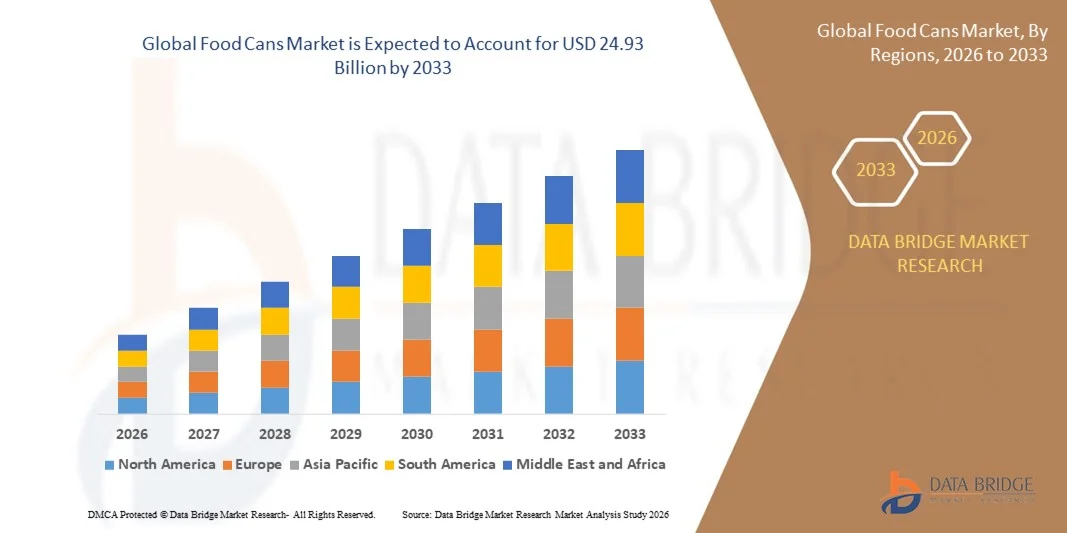
- The global food cans market size was valued at USD 15.06 billion in 2025 and is expected to reach USD 24.93 billion by 2033, at a CAGR of 6.50% during the forecast period
- The market growth is largely fuelled by the increasing demand for packaged and convenience foods driven by busy lifestyles and rising urban population
- The growing preference for long shelf life, safe storage, and easy transportation of food products is further supporting the adoption of food cans
Food Cans Market Analysis
- The market is witnessing steady growth due to the increasing consumption of ready-to-eat meals, processed foods, and preserved products, along with the expansion of the retail and food service sectors
- In addition, the rising focus on sustainable and recyclable packaging solutions and the strong protective properties of metal cans against contamination, light, and oxygen are contributing to market expansion
- North America dominated the food cans market with the largest revenue share in 2025, driven by the high consumption of packaged and processed foods, as well as strong demand for convenient and long shelf life food products
- Asia-Pacific region is expected to witness the highest growth rate in the global food cans market, driven by expanding population, growing middle-class consumption, and increasing demand for convenient food products. Rising investments in food processing and packaging infrastructure are also supporting regional expansion
- The Steel/Tin Cans segment held the largest market revenue share in 2025 driven by their high strength, durability, and superior protection against external contaminants. Steel and tin cans are widely used for packaging vegetables, meat, seafood, and processed food due to their ability to withstand high temperatures during sterilization and ensure longer shelf life, making them a preferred choice for food manufacturers
Report Scope and Food Cans Market Segmentation
|
Attributes |
Food Cans Key Market Insights |
|
Segments Covered |
|
|
Countries Covered |
North America
Europe
Asia-Pacific
Middle East and Africa
South America
|
|
Key Market Players |
|
|
Market Opportunities |
|
|
Value Added Data Infosets |
In addition to the insights on market scenarios such as market value, growth rate, segmentation, geographical coverage, and major players, the market reports curated by the Data Bridge Market Research also include import export analysis, production capacity overview, production consumption analysis, price trend analysis, climate change scenario, supply chain analysis, value chain analysis, raw material/consumables overview, vendor selection criteria, PESTLE Analysis, Porter Analysis, and regulatory framework. |
Food Cans Market Trends
Rising Demand For Convenient And Long Shelf Life Food Packaging
- The growing demand for convenient and ready-to-eat food products is significantly shaping the food cans market, as consumers increasingly prefer packaging solutions that offer extended shelf life, safety, and ease of storage. Food cans are gaining traction due to their strong barrier properties against light, air, and contaminants, which help preserve food quality and freshness. This trend strengthens their adoption across packaged food, ready meals, seafood, and vegetable products, encouraging manufacturers to expand production capacity and introduce innovative can formats
- Increasing urbanization and busy lifestyles have accelerated the demand for packaged and processed food products that offer convenience and reliability. Consumers are actively seeking packaged foods that require minimal preparation and provide long-term storage benefits, prompting food manufacturers to rely on metal cans for efficient packaging. This has also led to partnerships between food producers and packaging companies to enhance packaging performance and product safety
- Sustainability and recyclability trends are influencing purchasing decisions, with manufacturers emphasizing eco-friendly metal packaging solutions. Metal cans are widely recognized for their high recycling rates and circular economy benefits, helping brands meet environmental goals and consumer expectations. Companies are increasingly promoting recyclable packaging and investing in lightweight and resource-efficient can production to strengthen brand positioning and sustainability credentials
- For instance, in 2024, Ball Corporation in the U.S. and Crown Holdings expanded their food can production and introduced sustainable metal packaging solutions for packaged food manufacturers. These initiatives were launched in response to rising demand for recyclable and durable packaging, with distribution across retail and foodservice sectors. The products were also positioned as environmentally responsible packaging solutions, strengthening customer adoption and long-term partnerships
- While demand for food cans is increasing, sustained market expansion depends on continuous innovation, cost efficiency, and maintaining compatibility with evolving food processing technologies. Manufacturers are also focusing on improving material efficiency, enhancing production scalability, and developing advanced coatings to ensure product safety and sustainability
Food Cans Market Dynamics
Driver
Growing Consumption Of Packaged And Processed Food Products
- Rising global consumption of packaged and processed foods is a major driver for the food cans market. Food manufacturers are increasingly using metal cans to ensure product safety, extend shelf life, and maintain nutritional value. This trend is also encouraging innovation in can design, coatings, and sealing technologies to improve packaging performance and consumer convenience
- Expanding demand for canned vegetables, fruits, meat, seafood, and ready meals is influencing market growth. Food cans help protect products from contamination and spoilage while enabling efficient storage and transportation. The increasing demand for convenience foods and emergency food storage solutions further supports the adoption of canned food packaging
- Food manufacturers and packaging companies are actively promoting metal cans through product innovation, sustainability initiatives, and branding strategies. These efforts are supported by the growing consumer preference for reliable and recyclable packaging, and they also encourage collaborations between packaging providers and food companies to improve efficiency and environmental performance
- For instance, in 2023, Ardagh Metal Packaging expanded its food can manufacturing capabilities to support increasing demand from processed food producers. This expansion followed rising consumption of shelf-stable food products, driving higher adoption of metal cans. The company also emphasized recyclable packaging solutions to strengthen sustainability and customer engagement
- Although increasing packaged food consumption supports growth, wider adoption depends on cost management, raw material availability, and technological advancements. Investment in sustainable production, recycling infrastructure, and packaging innovation will be critical for meeting global demand and maintaining competitive advantage
Restraint/Challenge
Fluctuating Raw Material Prices And Competition From Alternative Packaging
- Fluctuating prices of raw materials such as aluminum and steel remain a key challenge, affecting production costs and pricing stability for food can manufacturers. Rising material costs can reduce profit margins and increase overall packaging expenses for food producers. In addition, supply chain disruptions can further affect production and availability
- Competition from alternative packaging formats such as flexible packaging and plastic containers remains a significant challenge. These alternatives often offer lightweight and cost advantages, attracting certain food manufacturers. This can limit the adoption of metal cans in some product categories where cost and convenience are prioritized
- Production and operational challenges also impact market growth, as food cans require specialized manufacturing processes, coatings, and quality control systems. Maintaining product safety, preventing corrosion, and ensuring regulatory compliance increase operational complexity. Companies must invest in advanced technology and infrastructure to maintain performance and quality standards
- For instance, in 2024, food manufacturers in Southeast Asia and Europe reported shifting some product lines to flexible packaging due to rising metal costs and supply chain uncertainties. These changes affected demand for traditional metal cans in selected applications. Cost sensitivity and material price fluctuations were additional barriers for packaging companies
- Overcoming these challenges will require cost-efficient manufacturing, improved recycling systems, and continuous product innovation. Collaboration between packaging companies, food manufacturers, and recycling organizations can help unlock long-term growth potential. Furthermore, strengthening sustainability benefits and improving material efficiency will be essential for maintaining competitiveness in the global food cans market
Food Cans Market Scope
The market is segmented on the basis of material and application.
- By Material
On the basis of material, the food cans market is segmented into Aluminum Cans and Steel/Tin Cans. The Steel/Tin Cans segment held the largest market revenue share in 2025 driven by their high strength, durability, and superior protection against external contaminants. Steel and tin cans are widely used for packaging vegetables, meat, seafood, and processed food due to their ability to withstand high temperatures during sterilization and ensure longer shelf life, making them a preferred choice for food manufacturers.
The Aluminum Cans segment is expected to witness the fastest growth rate from 2026 to 2033, driven by their lightweight properties, high recyclability, and corrosion resistance. Aluminum cans are increasingly used for ready meals, pet food, and specialty food products due to their ease of handling and sustainability benefits. Their growing adoption is also supported by rising environmental concerns and the increasing focus on recyclable packaging solutions.
- By Application
On the basis of application, the food cans market is segmented into Ready Meals, Powder Products, Fish and Seafood, Fruits and Vegetables, Processed Food, Pet Food, and Other Applications. The Processed Food segment held the largest market revenue share in 2025 driven by the rising demand for packaged and shelf-stable food products across global markets. Food cans are extensively used in processed food packaging to maintain product quality, extend shelf life, and ensure safe storage and transportation.
The Pet Food segment is expected to witness the fastest growth rate from 2026 to 2033, driven by the increasing pet ownership and rising demand for convenient and nutritious pet food products. Food cans are widely preferred in pet food packaging due to their ability to preserve freshness, prevent contamination, and maintain nutritional value. The growing trend of premium pet food and increasing consumer spending on pet care are further supporting segment growth.
Food Cans Market Regional Analysis
- North America dominated the food cans market with the largest revenue share in 2025, driven by the high consumption of packaged and processed foods, as well as strong demand for convenient and long shelf life food products
- Consumers in the region highly value the safety, durability, and recyclability offered by metal food cans, making them a preferred packaging solution for vegetables, meat, seafood, and ready meals
- This widespread adoption is further supported by advanced food processing infrastructure, high consumer awareness regarding food safety, and the strong presence of major packaged food manufacturers, establishing food cans as a key packaging format across retail and foodservice sectors
U.S. Food Cans Market Insight
The U.S. food cans market captured the largest revenue share in 2025 within North America, fueled by the strong demand for ready-to-eat meals and shelf-stable packaged foods. Consumers are increasingly prioritizing convenience, food safety, and long-term storage, encouraging food manufacturers to adopt metal can packaging. The growing consumption of canned soups, vegetables, seafood, and pet food further propels the market. Moreover, the presence of leading packaging manufacturers and increasing focus on sustainable and recyclable packaging solutions is significantly contributing to the market's expansion.
Europe Food Cans Market Insight
The Europe food cans market is expected to witness the fastest growth rate from 2026 to 2033, primarily driven by the rising demand for sustainable and recyclable food packaging solutions. The increase in consumption of packaged and preserved foods, coupled with strict environmental regulations promoting recyclable materials, is fostering market growth. European consumers are also attracted to the long shelf life and safety offered by canned food products. The region is experiencing strong demand across ready meals, seafood, and processed food applications, with manufacturers emphasizing eco-friendly packaging
U.K. Food Cans Market Insight
The U.K. food cans market is expected to witness the fastest growth rate from 2026 to 2033, driven by the increasing demand for convenience foods and ready-to-eat meals. In addition, rising consumer preference for sustainable and recyclable packaging solutions is encouraging food producers to adopt metal cans. The country’s well-established retail sector, along with growing consumption of canned food products, is expected to continue supporting market growth.
Germany Food Cans Market Insight
The Germany food cans market is expected to witness the fastest growth rate from 2026 to 2033, fueled by increasing demand for environmentally friendly and durable packaging solutions. Germany’s strong focus on recycling and sustainability promotes the use of metal cans in food packaging. The integration of advanced packaging technologies and the presence of a well-developed food processing industry are also contributing to market expansion, particularly in processed food and ready meal applications.
Asia-Pacific Food Cans Market Insight
The Asia-Pacific food cans market is expected to witness the fastest growth rate from 2026 to 2033, driven by rapid urbanization, rising disposable incomes, and increasing consumption of packaged foods in countries such as China, Japan, and India. The region's growing working population and changing lifestyles are encouraging demand for convenient and long shelf life food products. Furthermore, the expansion of the food processing industry and increasing investment in packaging infrastructure are accelerating market growth.
Japan Food Cans Market Insight
The Japan food cans market is expected to witness the fastest growth rate from 2026 to 2033 due to the country’s strong demand for convenient and high-quality packaged foods. The Japanese market places significant emphasis on food safety, product quality, and packaging efficiency, supporting the adoption of metal cans. The increasing consumption of ready meals, seafood, and processed food products, along with advanced packaging technologies, is fueling market growth. Moreover, the country’s focus on recyclable and sustainable packaging solutions is further supporting expansion.
China Food Cans Market Insight
The China food cans market accounted for the largest market revenue share in Asia Pacific in 2025, attributed to the country's large population, expanding food processing sector, and rising demand for packaged food products. China stands as one of the largest consumers of canned vegetables, seafood, and ready meals, driven by urbanization and changing dietary habits. The strong presence of domestic food manufacturers and increasing demand for durable and cost-effective packaging solutions are key factors propelling the market in China.
Food Cans Market Share
The Food Cans industry is primarily led by well-established companies, including:
- Ball Corporation (U.S.)
- Tecnocap S.p.A. (Italy)
- CPMC Holdings Limited (China)
- Amcor plc (Switzerland)
- Shengxing Group (China)
- Toyo Seikan Co., Ltd. (Japan)
- Crown Holdings (U.S.)
- Exal Corporation (U.S.)
- Silgan Containers (U.S.)
- SKS Bottle & Packaging, Inc. (U.S.)
- Vetropack (Switzerland)
- Ardagh Group S.A. (Luxembourg)
- Kian Joo Can Factory Berhad (Malaysia)
- COFCO (China)
- HUBER Packaging Group GmbH (Germany)
- CCL Container (Canada)
- Universal Can Corporation (Japan)
- Independent Can Company (U.S.)
- Visy (Australia)
- Lageen Food Packaging (Israel)
- P. Wilkinson Containers Ltd. (U.K.)
- BWAY Corporation (U.S.)
- Gerresheimer AG (Germany)
- Kaira Can Company Limited (India)
- Berlin Packaging (U.S.)
- Silgan Containers (U.S.)
Latest Developments in Global Food Cans Market
- In January 2026, The U.A.E. implemented Phase 2 of its single-use plastic ban, a regulatory development aimed at prohibiting items such as cups, lids, cutlery, and expanded polystyrene food containers. This policy is driving foodservice providers and institutional caterers to shift toward metal food cans as a compliant alternative. The move is expected to accelerate demand for canned soups and ready meals. It benefits can manufacturers by expanding institutional sales channels. This regulation strengthens the role of metal cans as a sustainable packaging solution. It also supports long-term market growth through regulatory-driven adoption
- In November 2025, Ball Corporation announced an investment development of USD 60 million to expand its two-piece food can production capacity at its Sri City facility in India. The expansion is intended to meet the projected 10% annual growth in regional demand. This initiative enhances the company’s manufacturing capabilities and supply reliability. It benefits customers through improved availability and reduced supply constraints. The development strengthens Ball’s presence in Asia-Pacific. It also supports overall market expansion by increasing global production capacity
- In October 2025, Ardagh Group introduced a digital transformation development by launching an AI-enabled supply chain platform. This platform is designed to optimize production planning, logistics, and demand forecasting. The initiative improves operational efficiency and responsiveness to customer needs. It benefits the company by reducing inefficiencies and enhancing decision-making capabilities. The move supports technological advancement in the food cans industry. It also positions Ardagh as an innovation leader in digital packaging operations
- In September 2025, Crown Holdings announced a capacity expansion development through the construction of a new manufacturing facility in Mexico. This facility is intended to increase production of advanced can designs and improve regional supply efficiency. The expansion reduces logistics costs and delivery times for North American customers. It benefits the company by improving operational efficiency and responsiveness. The move strengthens Crown’s competitive positioning. It also supports regional market growth through localized manufacturing
- In August 2025, Ball Corporation announced a strategic partnership development with a major beverage manufacturer to introduce recyclable and low-carbon cans. This collaboration focuses on enhancing sustainable packaging solutions. The initiative supports environmental goals and aligns with increasing consumer demand for eco-friendly packaging. It benefits both partners by strengthening sustainability credentials and product differentiation. The partnership enhances Ball’s market competitiveness. It also accelerates the transition toward sustainable metal packaging in the global market
- In March 2025, Reliance Consumer Products entered into an infrastructure development agreement with the Government of India to build canned-food complexes under the World Food India initiative. This project involves large-scale investment to expand processed and canned food production. The initiative is designed to enhance domestic food processing and export capabilities. It benefits the market by increasing supply chain integration and production scale. The development supports growth in canned food consumption in India. It also strengthens the country’s position in the global food can ecosystem
SKU-
Get online access to the report on the World's First Market Intelligence Cloud

- Interactive Data Analysis Dashboard
- Company Analysis Dashboard for high growth potential opportunities
- Research Analyst Access for customization & queries
- Competitor Analysis with Interactive dashboard
- Latest News, Updates & Trend analysis
- Harness the Power of Benchmark Analysis for Comprehensive Competitor Tracking
Global Food Cans Market, Supply Chain Analysis and Ecosystem Framework
To support market growth and help clients navigate the impact of geopolitical shifts, DBMR has integrated in-depth supply chain analysis into its Global Food Cans Market research reports. This addition empowers clients to respond effectively to global changes affecting their industries. The supply chain analysis section includes detailed insights such as Global Food Cans Market consumption and production by country, price trend analysis, the impact of tariffs and geopolitical developments, and import and export trends by country and HSN code. It also highlights major suppliers with data on production capacity and company profiles, as well as key importers and exporters. In addition to research, DBMR offers specialized supply chain consulting services backed by over a decade of experience, providing solutions like supplier discovery, supplier risk assessment, price trend analysis, impact evaluation of inflation and trade route changes, and comprehensive market trend analysis.
Research Methodology
Data collection and base year analysis are done using data collection modules with large sample sizes. The stage includes obtaining market information or related data through various sources and strategies. It includes examining and planning all the data acquired from the past in advance. It likewise envelops the examination of information inconsistencies seen across different information sources. The market data is analysed and estimated using market statistical and coherent models. Also, market share analysis and key trend analysis are the major success factors in the market report. To know more, please request an analyst call or drop down your inquiry.
The key research methodology used by DBMR research team is data triangulation which involves data mining, analysis of the impact of data variables on the market and primary (industry expert) validation. Data models include Vendor Positioning Grid, Market Time Line Analysis, Market Overview and Guide, Company Positioning Grid, Patent Analysis, Pricing Analysis, Company Market Share Analysis, Standards of Measurement, Global versus Regional and Vendor Share Analysis. To know more about the research methodology, drop in an inquiry to speak to our industry experts.
Customization Available
Data Bridge Market Research is a leader in advanced formative research. We take pride in servicing our existing and new customers with data and analysis that match and suits their goal. The report can be customized to include price trend analysis of target brands understanding the market for additional countries (ask for the list of countries), clinical trial results data, literature review, refurbished market and product base analysis. Market analysis of target competitors can be analyzed from technology-based analysis to market portfolio strategies. We can add as many competitors that you require data about in the format and data style you are looking for. Our team of analysts can also provide you data in crude raw excel files pivot tables (Fact book) or can assist you in creating presentations from the data sets available in the report.