


Food Color Encapsulation Market Size
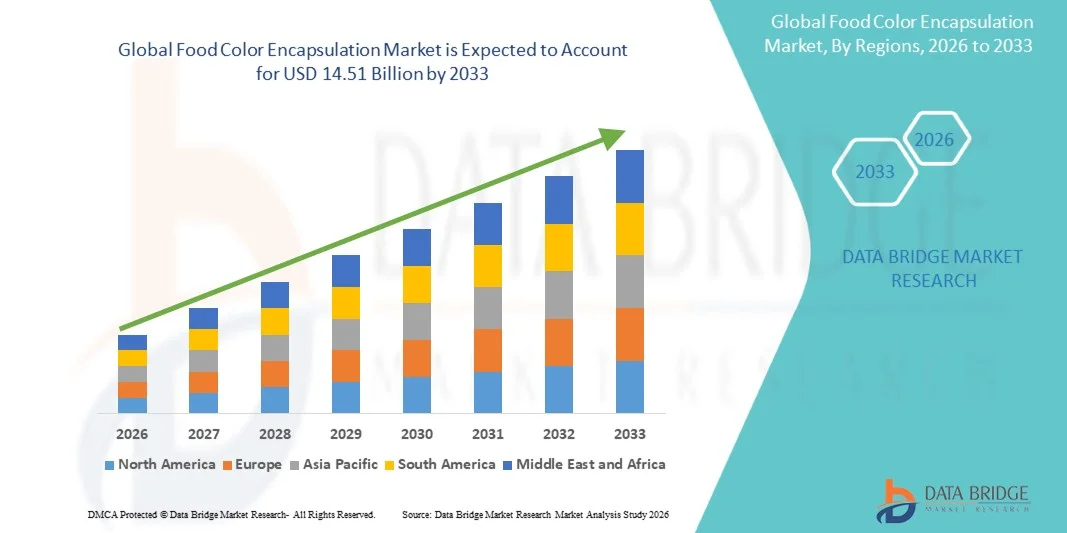
- The global food color encapsulation market size was valued at USD 7.56 billion in 2025 and is expected to reach USD 14.51 billion by 2033, at a CAGR of 8.50% during the forecast period
- The market growth is largely fueled by the increasing demand for natural food additives and technological advancements in encapsulation techniques, leading to improved stability, shelf life, and functionality of food color ingredients across processed food and beverage applications
- Furthermore, rising consumer preference for clean-label, plant-based, and visually appealing food products is establishing encapsulated food colors as an essential ingredient solution within the modern food processing industry. These converging factors are accelerating the adoption of food color encapsulation technologies, thereby significantly boosting the industry’s growth
Food Color Encapsulation Market Analysis
- Food color encapsulation, offering protection and controlled release of natural and artificial pigments through advanced coating and delivery systems, is increasingly becoming a vital technology within the food and beverage industry due to its ability to improve color stability, heat resistance, oxidation protection, and processing performance
- The escalating demand for food color encapsulation is primarily fueled by the growing consumption of functional foods, beverages, bakery products, and dietary supplements, alongside increasing consumer demand for clean-label ingredients, natural colorants, and high-quality processed food products
- North America dominated the food color encapsulation market with a share of 37.5% in 2025, due to the rising demand for natural food additives, clean-label products, and functional food formulations across the food and beverage industry
- Asia-Pacific is expected to be the fastest growing region in the food color encapsulation market during the forecast period due to rapid urbanization, increasing disposable incomes, and expanding consumption of packaged and convenience foods across countries such as China, Japan, and India
- Natural segment dominated the market with a market share of 63.3% in 2025, due to the increasing consumer preference for naturally derived food ingredients and clean-label food products. Food manufacturers are rapidly replacing synthetic colors with plant-based and fruit-derived pigments to align with evolving regulatory standards and consumer health awareness
Report Scope and Food Color Encapsulation Market Segmentation
|
Attributes |
Food Color Encapsulation Key Market Insights |
|
Segments Covered |
|
|
Countries Covered |
North America · U.S. · Canada · Mexico Europe · Germany · France · U.K. · Netherlands · Switzerland · Belgium · Russia · Italy · Spain · Turkey · Rest of Europe Asia-Pacific · China · Japan · India · South Korea · Singapore · Malaysia · Australia · Thailand · Indonesia · Philippines · Rest of Asia-Pacific Middle East and Africa · Saudi Arabia · U.A.E. · South Africa · Egypt · Israel · Rest of Middle East and Africa South America · Brazil · Argentina · Rest of South America |
|
Key Market Players |
· DSM (Netherlands) · Ingredion Incorporated (U.S.) · Kerry Group plc (Ireland) · Cargill, Incorporated (U.S.) · Lycored (Israel) · Balchem Inc. (U.S.) · Firmenich SA (Switzerland) · International Flavors & Fragrances Inc (India) · Symrise (Germany) · Sensient Technologies Corporation (U.S.) · Sphera Encapsulation (Itlay) |
|
Market Opportunities |
· Growing Application of Encapsulated Colors in Functional Foods and Nutraceuticals · Expansion of Plant-Based and Organic Food Product Industries |
|
Value Added Data Infosets |
In addition to the insights on market scenarios such as market value, growth rate, segmentation, geographical coverage, and major players, the market reports curated by the Data Bridge Market Research also include in-depth expert analysis, pricing analysis, brand share analysis, consumer survey, demography analysis, supply chain analysis, value chain analysis, raw material/consumables overview, vendor selection criteria, PESTLE Analysis, Porter Analysis, and regulatory framework. |
Food Color Encapsulation Market Trends
“Rising Adoption of Natural and Clean-Label Encapsulated Food Colors”
- A significant trend in the food color encapsulation market is the increasing adoption of natural and clean-label encapsulated food colors, driven by growing consumer preference for plant-based ingredients and healthier food formulations across global food and beverage industries. This trend is strengthening the role of encapsulation technologies in improving the stability, shelf life, and processing performance of natural pigments in diverse food applications
- For instance, Givaudan and DDW, The Color House develop natural encapsulated food color solutions derived from fruits, vegetables, and botanical sources for use in beverages, confectionery, and dairy products. These solutions help manufacturers maintain color consistency and product stability while supporting clean-label product positioning and regulatory compliance
- The beverage industry is increasingly utilizing encapsulated natural colors to protect sensitive pigments from degradation caused by heat, light, and acidic processing conditions. This is increasing the importance of encapsulation technologies in ready-to-drink beverages, functional drinks, and flavored water applications that require long-lasting visual appeal and ingredient stability
- Food manufacturers are expanding the use of encapsulated colors in bakery and confectionery products where stable color performance is essential during baking, freezing, and extended storage periods. This trend is encouraging greater adoption of advanced microencapsulation and nano encapsulation technologies capable of maintaining pigment quality under complex production conditions
- The growing popularity of organic and plant-based food products is further accelerating demand for naturally sourced encapsulated food colors that align with evolving consumer health and sustainability expectations. Encapsulation technologies are helping manufacturers improve the commercial usability of sensitive natural pigments while reducing formulation limitations associated with traditional food coloring methods
- The market is witnessing increasing investments in biotechnology and ingredient innovation focused on developing highly stable and sustainable natural food color systems for large-scale industrial use. This rising transition toward clean-label and naturally derived food formulations is reinforcing the importance of food color encapsulation technologies across modern food processing industries globally
Food Color Encapsulation Market Dynamics
Driver
“Increasing Demand for Stable Food Color Solutions in Processed Foods and Beverages”
- The increasing demand for stable food color solutions in processed foods and beverages is driving the growth of the food color encapsulation market as manufacturers focus on improving product appearance, shelf life, and resistance to environmental conditions during processing and storage. Encapsulation technologies enable food colors to maintain stability against heat, moisture, oxidation, and light exposure, improving overall product quality and consistency across multiple food applications
- For instance, Sensient Technologies develops encapsulated natural food color solutions designed to improve pigment stability and processing performance in confectionery, dairy products, beverages, and bakery applications. These encapsulation systems help food manufacturers maintain vibrant product appearance while reducing color degradation during transportation and long-term storage
- The growing consumption of packaged foods and ready-to-drink beverages is increasing the need for encapsulated food colors capable of delivering long-lasting visual appeal under varying production and distribution environments. Food manufacturers are prioritizing encapsulation technologies that support controlled release and improved compatibility with complex food matrices
- The functional food and nutraceutical industries are also expanding their use of encapsulated food colors to improve ingredient protection and product differentiation in dietary supplements, gummies, and fortified food products. These technologies enhance formulation flexibility while supporting clean-label and naturally derived ingredient requirements across health-focused product categories
- The increasing requirement for visually appealing and shelf-stable processed food products across global food industries continues to strengthen this driver. The growing focus on ingredient quality, product consistency, and clean-label innovation is positioning food color encapsulation as a critical technology within modern food manufacturing processes
Restraint/Challenge
“High Production Costs and Technical Complexity in Encapsulation Processes”
- The food color encapsulation market faces challenges due to the high production costs and technical complexity associated with advanced encapsulation technologies, which require specialized equipment, controlled processing environments, and precise formulation techniques. These factors increase manufacturing expenses and create operational difficulties for food ingredient producers aiming to scale encapsulated color production efficiently
- For instance, DSM utilizes advanced encapsulation technologies and precision processing systems to develop stable food color ingredients for processed food and beverage applications. These sophisticated manufacturing procedures require significant investment in research, production infrastructure, and quality control systems, increasing overall production costs for encapsulated food color solutions
- Producing high-performance encapsulated food colors involves maintaining strict control over particle size, release behavior, coating efficiency, and stability characteristics to ensure consistent product performance under varying processing and storage conditions. These technical requirements increase formulation complexity and extend development timelines across commercial food manufacturing operations
- The market also faces challenges related to the cost and availability of high-quality natural pigments, shell materials, and specialized encapsulation agents used in advanced food color formulations. Manufacturers must balance product performance, regulatory compliance, and commercial affordability while maintaining consistent quality standards across large-scale production environments
- The market continues to encounter constraints associated with optimizing encapsulation performance, reducing manufacturing costs, and improving commercial scalability for naturally derived food color systems. These challenges collectively influence production economics and create barriers for wider adoption of advanced encapsulated food color technologies across global food industries
Food Color Encapsulation Market Scope
The market is segmented on the basis of shell material, core phase, technology, method, and application.
- By Shell Material
On the basis of shell material, the food color encapsulation market is segmented into polysaccharides, proteins, lipids, and emulsifiers. The polysaccharides segment dominated the market with the largest market revenue share in 2025, driven by its strong compatibility with natural food colorants and excellent film-forming and stabilization properties. Manufacturers widely utilize polysaccharides such as starch, maltodextrin, and gum arabic due to their ability to improve color stability against heat, oxygen, and moisture exposure during food processing and storage. The growing preference for clean-label and plant-based ingredients has further strengthened the adoption of polysaccharide-based encapsulation systems across food and beverage applications. In addition, these materials offer cost-effectiveness and easy scalability for large-scale industrial production, supporting their extensive usage in commercial food manufacturing. Their ability to maintain color uniformity and extend shelf life continues to position polysaccharides as a preferred shell material in encapsulated food color formulations.
The proteins segment is anticipated to witness the fastest growth rate from 2026 to 2033, fueled by rising demand for high-performance encapsulation systems with enhanced emulsification and controlled release capabilities. Protein-based shell materials such as whey protein and gelatin provide superior protection for sensitive natural pigments against oxidation and environmental degradation. Food manufacturers are increasingly adopting protein encapsulation technologies in premium beverages, dairy products, and functional foods to improve color retention and product quality. The increasing focus on nutrient-rich and protein-enriched food formulations is also supporting the expansion of this segment. In addition, advancements in protein modification technologies are improving encapsulation efficiency and processing flexibility for diverse food applications.
- By Core Phase
On the basis of core phase, the food color encapsulation market is segmented into natural and artificial. The natural segment dominated the market with the largest market revenue share of 63.3% in 2025, driven by the increasing consumer preference for naturally derived food ingredients and clean-label food products. Food manufacturers are rapidly replacing synthetic colors with plant-based and fruit-derived pigments to align with evolving regulatory standards and consumer health awareness. Encapsulation technologies are widely used to improve the stability, shelf life, and heat resistance of natural food colors, which are often sensitive to environmental conditions. The growing demand for organic beverages, confectionery products, and functional foods has further accelerated the adoption of natural encapsulated colors across the global food industry. In addition, rising investments in botanical extraction and natural pigment innovation continue to strengthen the market presence of naturally sourced encapsulated colors.
The artificial segment is expected to witness the fastest CAGR from 2026 to 2033, driven by its strong color consistency, high stability, and cost-efficient production advantages in large-scale food manufacturing. Artificial encapsulated colors are increasingly utilized in processed foods, bakery products, and confectionery applications where vibrant and long-lasting color performance is essential. Manufacturers prefer artificial colors for their superior resistance to light, pH fluctuations, and thermal processing conditions. The growing expansion of packaged and convenience food industries in developing economies is further supporting the demand for artificial food color encapsulation solutions. In addition, advancements in encapsulation techniques are improving the safety profile and controlled release functionality of artificial color systems in food applications.
- By Technology
On the basis of technology, the food color encapsulation market is segmented into microencapsulation and nano encapsulation. The microencapsulation segment dominated the market with the largest market revenue share in 2025, driven by its widespread commercial adoption and cost-effective processing capabilities in the food industry. Microencapsulation technology is extensively utilized to protect sensitive food colors from oxidation, moisture, and temperature variations while improving product stability and shelf life. Food manufacturers favor this technology due to its compatibility with multiple shell materials and its ability to support controlled release and color retention in processed foods and beverages. The increasing production of functional foods, bakery products, and dairy items has further contributed to the large-scale utilization of microencapsulation systems. In addition, the technology offers operational flexibility and easy integration into existing food processing infrastructure, supporting its dominant market position.
The nano encapsulation segment is anticipated to witness the fastest growth rate from 2026 to 2033, fueled by rising demand for advanced delivery systems with improved bioavailability and enhanced color protection efficiency. Nano encapsulation technology enables superior dispersion and stability of food pigments while providing better absorption and controlled release characteristics. Food manufacturers are increasingly investing in nano-scale encapsulation solutions for premium functional beverages, nutraceuticals, and fortified food products. The growing focus on innovation in food nanotechnology and high-performance ingredient delivery systems is accelerating the adoption of nano encapsulation methods. In addition, increasing research activities aimed at improving encapsulation precision and product functionality are expected to support rapid segment expansion during the forecast period.
- By Method
On the basis of method, the food color encapsulation market is segmented into physical method, chemical method, and physico-chemical method. The physico-chemical method segment dominated the market with the largest market revenue share in 2025, driven by its ability to provide high encapsulation efficiency and improved stability for sensitive food color compounds. Techniques such as coacervation and solvent evaporation are widely utilized due to their effectiveness in producing uniform and controlled encapsulated particles. Food manufacturers prefer physico-chemical methods for applications requiring precise release characteristics and enhanced protection against environmental degradation. The increasing demand for premium food products with stable appearance and extended shelf life has further strengthened the adoption of these methods across multiple food processing industries. In addition, ongoing technological improvements in particle engineering and formulation optimization continue to support the dominance of physico-chemical encapsulation approaches.
The physical method segment is expected to witness the fastest CAGR from 2026 to 2033, driven by growing industry preference for simple, scalable, and solvent-free processing technologies. Physical encapsulation methods such as spray drying and freeze drying are gaining significant traction due to their cost-efficiency and suitability for heat-sensitive natural food colors. Manufacturers are increasingly adopting these methods to meet rising clean-label and sustainability requirements in food production. The expanding demand for encapsulated ingredients in beverages, dairy products, and dietary supplements is also contributing to the rapid growth of physical encapsulation technologies. In addition, advancements in drying equipment and process automation are improving production efficiency and encapsulation quality across industrial applications.
- By Application
On the basis of application, the food color encapsulation market is segmented into dietary supplements, functional food products, bakery products, confectionery products, beverages, frozen products, and dairy products. The beverages segment dominated the market with the largest market revenue share in 2025, driven by the increasing demand for visually appealing and naturally colored ready-to-drink beverages and health drinks. Encapsulated food colors are widely utilized in beverage formulations to improve pigment stability against light exposure, temperature fluctuations, and acidic conditions during storage and transportation. Beverage manufacturers are increasingly incorporating encapsulated natural colors to meet consumer demand for clean-label and preservative-free products. The rapid expansion of energy drinks, flavored water, plant-based beverages, and fortified drinks has further accelerated segment growth globally. In addition, encapsulation technologies help maintain consistent appearance and flavor quality, supporting their widespread adoption across beverage manufacturing industries.
The dietary supplements segment is anticipated to witness the fastest growth rate from 2026 to 2033, fueled by rising consumer focus on preventive healthcare and nutritionally enriched products. Encapsulated food colors are increasingly utilized in gummies, capsules, powders, and chewable supplements to enhance visual appeal and maintain ingredient stability. Supplement manufacturers are adopting advanced encapsulation technologies to improve shelf life and protect sensitive natural pigments from degradation during processing and storage. The growing popularity of personalized nutrition and plant-based supplements is further supporting demand for encapsulated color solutions in the nutraceutical industry. In addition, increasing investments in functional ingredient innovation and health-focused product development are expected to accelerate the expansion of this segment during the forecast period
Food Color Encapsulation Market Regional Analysis
- North America dominated the food color encapsulation market with the largest revenue share of 37.5% in 2025, driven by the rising demand for natural food additives, clean-label products, and functional food formulations across the food and beverage industry
- Food manufacturers in the region highly prioritize advanced encapsulation technologies to improve color stability, shelf life, and resistance against heat, moisture, and oxidation during food processing and storage
- This widespread adoption is further supported by strong investments in food innovation, increasing consumer preference for plant-based ingredients, and the growing consumption of processed and convenience foods, establishing encapsulated food colors as an essential ingredient solution across multiple food applications
U.S. Food Color Encapsulation Market Insight
The U.S. food color encapsulation market captured the largest revenue share in 2025 within North America, fueled by increasing demand for naturally sourced food colors and rapid expansion of the functional food and beverage sector. Food manufacturers are increasingly adopting encapsulation technologies to maintain color consistency and product quality in beverages, bakery products, dairy items, and nutraceuticals. The growing consumer focus on health-conscious and clean-label food products, combined with strong research activities in food ingredient innovation, further propels the market growth. Moreover, the presence of major food processing companies and advanced food technology infrastructure significantly contributes to the expansion of the industry.
Europe Food Color Encapsulation Market Insight
The Europe food color encapsulation market is projected to expand at a substantial CAGR throughout the forecast period, primarily driven by stringent food safety regulations and increasing demand for natural and sustainable food ingredients. The rising popularity of organic foods and premium confectionery products is fostering the adoption of encapsulated food color solutions across the region. European food manufacturers are also emphasizing product quality, stability, and visual appeal, encouraging the integration of advanced encapsulation technologies into food production processes. The region is witnessing strong growth in bakery, dairy, beverage, and functional food applications supported by increasing investments in clean-label food innovation.
U.K. Food Color Encapsulation Market Insight
The U.K. food color encapsulation market is anticipated to grow at a noteworthy CAGR during the forecast period, driven by increasing consumer preference for natural food ingredients and rising demand for visually appealing packaged food products. In addition, the expansion of the functional beverage and dietary supplement industries is accelerating the adoption of encapsulated food colors across multiple applications. The country’s strong retail and foodservice sectors, combined with growing awareness regarding product stability and shelf-life enhancement, continue to support market growth. Furthermore, increasing innovation in plant-based and fortified food products is expected to strengthen industry expansion in the coming years.
Germany Food Color Encapsulation Market Insight
The Germany food color encapsulation market is expected to expand at a considerable CAGR during the forecast period, fueled by rising demand for technologically advanced food processing solutions and increasing focus on sustainable food production. Germany’s strong food manufacturing infrastructure and emphasis on product quality are promoting the adoption of encapsulated natural and artificial food colors in processed foods and beverages. The growing preference for clean-label formulations and high-performance food ingredients is also supporting market expansion. In addition, increasing research and development activities in food ingredient stabilization technologies are contributing to the growth of the market across industrial applications.
Asia-Pacific Food Color Encapsulation Market Insight
The Asia-Pacific food color encapsulation market is poised to grow at the fastest CAGR during the forecast period of 2026 to 2033, driven by rapid urbanization, increasing disposable incomes, and expanding consumption of packaged and convenience foods across countries such as China, Japan, and India. The region’s growing food processing industry, supported by rising demand for natural food additives and functional food products, is accelerating the adoption of food color encapsulation technologies. Furthermore, increasing investments in food manufacturing infrastructure and the presence of large consumer populations are improving the accessibility and commercial adoption of encapsulated food color solutions across regional markets.
Japan Food Color Encapsulation Market Insight
The Japan food color encapsulation market is gaining momentum due to the country’s advanced food processing industry, strong preference for premium-quality food products, and increasing demand for innovative functional foods. Japanese food manufacturers place significant emphasis on product appearance, stability, and ingredient safety, encouraging the use of encapsulated food colors in beverages, confectionery, and dairy applications. The integration of advanced encapsulation technologies with high-quality natural pigments is supporting product innovation across the market. Moreover, the growing aging population and increasing demand for nutritionally enriched food products are expected to further stimulate market growth.
China Food Color Encapsulation Market Insight
The China food color encapsulation market accounted for the largest market revenue share in Asia Pacific in 2025, attributed to the country’s expanding processed food industry, rising middle-class population, and rapid adoption of advanced food technologies. China represents one of the largest markets for functional beverages, confectionery products, and packaged foods, increasing the demand for stable and visually appealing food color solutions. The growing focus on clean-label food ingredients and government support for food quality improvement initiatives are key factors propelling market growth. In addition, the presence of large-scale domestic food manufacturers and increasing investments in food ingredient innovation continue to strengthen the market in China.
Food Color Encapsulation Market Share
The food color encapsulation industry is primarily led by well-established companies, including:
- DSM (Netherlands)
- Ingredion Incorporated (U.S.)
- Kerry Group plc (Ireland)
- Cargill, Incorporated (U.S.)
- Lycored (Israel)
- Balchem Inc. (U.S.)
- Firmenich SA (Switzerland)
- International Flavors & Fragrances Inc (India)
- Symrise (Germany)
- Sensient Technologies Corporation (U.S.)
- Sphera Encapsulation (Itlay)
Latest Developments in Global Food Color Encapsulation Market
- In April 2025, Phytolon and Ginkgo Bioworks completed the second development milestone of their partnership focused on fermentation-based natural food colors, achieving nearly three times higher production efficiency for beetroot red and prickly pear yellow pigments through advanced biotechnology and strain optimization processes. This development is expected to strengthen the food color encapsulation market by improving the commercial scalability, production consistency, and cost-efficiency of naturally derived encapsulated food color solutions. The achievement also supports growing industry demand for stable clean-label color ingredients with enhanced resistance to heat, oxidation, and processing conditions across beverages, confectionery, bakery, and functional food applications
- In May 2025, the U.S. Food and Drug Administration approved three new natural food color additives, including galdieria extract blue and butterfly pea flower extract, expanding regulatory acceptance of plant-based color ingredients within the food and beverage industry. This approval is anticipated to accelerate demand for advanced food color encapsulation technologies capable of protecting sensitive natural pigments from degradation caused by light, temperature, and pH fluctuations. The development is also expected to encourage food manufacturers to increase the use of naturally sourced encapsulated colors in beverages, dairy products, frozen foods, confectionery products, and dietary supplements to meet rising clean-label consumer preferences
- In November 2024, Phytolon secured a strategic investment from Rich Products Ventures to accelerate commercialization of its precision fermentation-based natural food colors designed for bakery, dessert, and processed food applications. The investment is expected to support research, product innovation, and industrial-scale manufacturing of encapsulated natural food colors with improved stability and shelf-life performance. This development is further anticipated to strengthen the adoption of sustainable encapsulation technologies across the food processing industry while supporting the transition away from synthetic food dyes toward environmentally friendly and naturally sourced alternatives
- In May 2024, Chromologics partnered with Olon Group to scale the industrial production of fermentation-based natural food colors by utilizing Olon’s advanced biomanufacturing infrastructure and fermentation expertise in Italy. This partnership is projected to strengthen the food color encapsulation market by increasing large-scale production capacity and improving the availability of stable and sustainable encapsulated color ingredients for food manufacturers globally. The collaboration is also expected to support innovation in clean-label food formulations and enhance the performance of natural pigments used in beverages, confectionery, dairy products, and processed foods under varying storage and processing conditions
- In January 2024, Phytolon and Ginkgo Bioworks achieved the first milestone in their collaboration by successfully developing a complete yellow-to-purple spectrum of natural betalain food colors using yeast fermentation technology and advanced bioengineering capabilities. This advancement is expected to create significant opportunities in the food color encapsulation market by enabling the production of highly stable, vibrant, and naturally sourced color formulations suitable for a wide range of food and beverage applications. The development also supports the growing demand for sustainable and scalable natural color alternatives while encouraging further innovation in encapsulation systems designed to improve pigment stability, shelf life, and processing efficiency

- Interactive Data Analysis Dashboard
- Company Analysis Dashboard for high growth potential opportunities
- Research Analyst Access for customization & queries
- Competitor Analysis with Interactive dashboard
- Latest News, Updates & Trend analysis
- Harness the Power of Benchmark Analysis for Comprehensive Competitor Tracking
Global Food Color Encapsulation Market, Supply Chain Analysis and Ecosystem Framework
To support market growth and help clients navigate the impact of geopolitical shifts, DBMR has integrated in-depth supply chain analysis into its Global Food Color Encapsulation Market research reports. This addition empowers clients to respond effectively to global changes affecting their industries. The supply chain analysis section includes detailed insights such as Global Food Color Encapsulation Market consumption and production by country, price trend analysis, the impact of tariffs and geopolitical developments, and import and export trends by country and HSN code. It also highlights major suppliers with data on production capacity and company profiles, as well as key importers and exporters. In addition to research, DBMR offers specialized supply chain consulting services backed by over a decade of experience, providing solutions like supplier discovery, supplier risk assessment, price trend analysis, impact evaluation of inflation and trade route changes, and comprehensive market trend analysis.
Data collection and base year analysis are done using data collection modules with large sample sizes. The stage includes obtaining market information or related data through various sources and strategies. It includes examining and planning all the data acquired from the past in advance. It likewise envelops the examination of information inconsistencies seen across different information sources. The market data is analysed and estimated using market statistical and coherent models. Also, market share analysis and key trend analysis are the major success factors in the market report. To know more, please request an analyst call or drop down your inquiry.
The key research methodology used by DBMR research team is data triangulation which involves data mining, analysis of the impact of data variables on the market and primary (industry expert) validation. Data models include Vendor Positioning Grid, Market Time Line Analysis, Market Overview and Guide, Company Positioning Grid, Patent Analysis, Pricing Analysis, Company Market Share Analysis, Standards of Measurement, Global versus Regional and Vendor Share Analysis. To know more about the research methodology, drop in an inquiry to speak to our industry experts.
Data Bridge Market Research is a leader in advanced formative research. We take pride in servicing our existing and new customers with data and analysis that match and suits their goal. The report can be customized to include price trend analysis of target brands understanding the market for additional countries (ask for the list of countries), clinical trial results data, literature review, refurbished market and product base analysis. Market analysis of target competitors can be analyzed from technology-based analysis to market portfolio strategies. We can add as many competitors that you require data about in the format and data style you are looking for. Our team of analysts can also provide you data in crude raw excel files pivot tables (Fact book) or can assist you in creating presentations from the data sets available in the report.













