




Global Food Grade Nitrogen Gas Market
Market Size in USD Billion
CAGR :
% 
 USD
6.37 Billion
USD
10.94 Billion
2025
2033
USD
6.37 Billion
USD
10.94 Billion
2025
2033
 Forecast Period Forecast Period |
2026 - 2033 |
 Market Size (Base Year) Market Size (Base Year) |
USD 6.37 Billion |
 Market Size (Forecast Year) Market Size (Forecast Year) |
USD 10.94 Billion |
 CAGR CAGR |
% |
| Major Markets Players |
|
Food Grade Nitrogen Gas Market Overview
The Food Grade Nitrogen Gas Market was valued at USD 6.37 Billion in 2025 and is projected to reach USD 10.94 Billion by 2033, growing at a CAGR of 7.00% from 2026 to 2033. The market is experiencing consistent growth driven by rising demand for packaged and frozen food products, increasing adoption of modified atmosphere packaging technologies, and expanding use of nitrogen in food preservation and processing applications. Growing investments in cold chain infrastructure and advancements in cryogenic freezing systems are further supporting market expansion across developed and emerging economies.
The increasing global emphasis on food safety, shelf-life extension, and reduction of food wastage, combined with stringent regulatory standards for food quality, is accelerating the adoption of food grade nitrogen gas across the food and beverage industry. Manufacturers are increasingly shifting toward high-purity nitrogen solutions for packaging, chilling, and freezing applications to maintain product freshness and nutritional value. Rising consumption of convenience foods and expansion of large-scale food processing industries are further strengthening market growth worldwide.
Key Market Trends & Insights
- North America dominated the Food Grade Nitrogen Gas Market with the largest revenue share of 38.3% in 2025, supported by highly developed food processing infrastructure, strong penetration of packaged and frozen food consumption, and widespread adoption of modified atmosphere packaging technologies
- The high purity segment led the market with a 62% share in 2025, driven by strict food safety regulations and increasing demand for contamination-free processing environments
- Asia-Pacific is expected to be the fastest-growing region at a CAGR of 8% from 2026 to 2033, fueled by rapid urbanization, expanding food processing industries, and rising consumption of packaged and frozen foods
- Freezing and chilling are the fastest-growing application type, projected to register a CAGR of 14% from 2026 to 2033, supported by increasing demand for high-quality frozen food products and rapid cryogenic freezing techniques
- The compressed gas segment dominated the form category with a 58% revenue share in 2025, led by its extensive use across food processing, packaging, and storage applications due to easier handling and widespread cylinder-based distribution systems
- Bulk segment accounted for 50% of the market in 2025, preferred by large-scale supply requirements from industrial food processing units and centralized manufacturing facilities
- The tonnage/pipeline segment is the fastest-growing transportation category, with a CAGR of 14% from 2026 to 2033, driven by rising investments in integrated industrial gas supply systems
Market Size & Forecast
- Global Market Value (2025): USD 6.37 Billion
- Expected Market Value (2033): USD 10.94 Billion
- Forecast CAGR (2026–2033): 7.00%
- Leading Region in 2025: North America
- Fastest Growing Region: Asia-Pacific
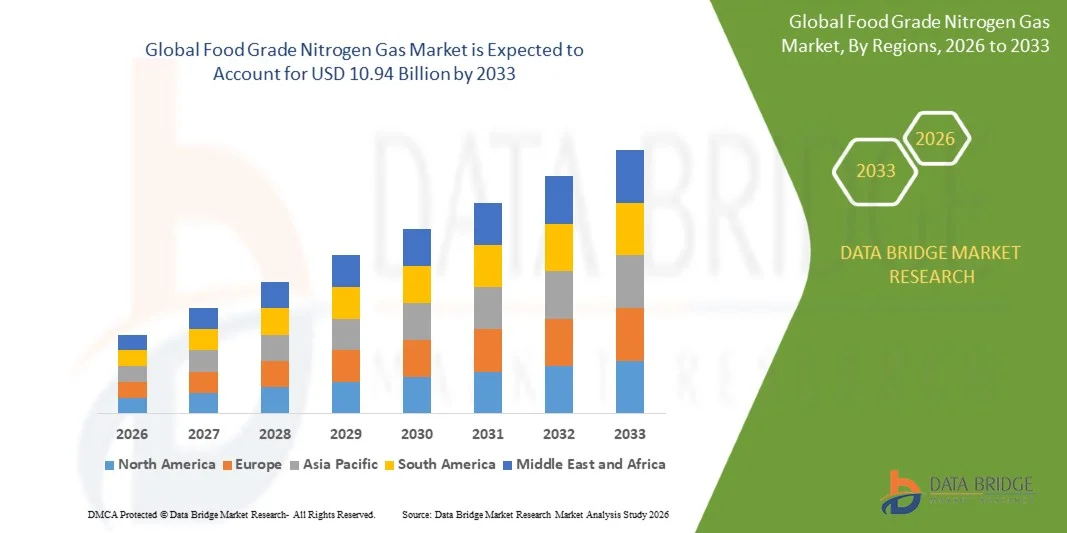
Report Scope and Food Grade Nitrogen Gas Market Segmentation
|
Attributes |
Food Grade Nitrogen Gas Key Market Insights |
|
Segments Covered |
|
|
Countries Covered |
North America · U.S. · Canada · Mexico Europe · Germany · France · U.K. · Netherlands · Switzerland · Belgium · Russia · Italy · Spain · Turkey · Rest of Europe Asia-Pacific · China · Japan · India · South Korea · Singapore · Malaysia · Australia · Thailand · Indonesia · Philippines · Rest of Asia-Pacific Middle East and Africa · Saudi Arabia · U.A.E. · South Africa · Egypt · Israel · Rest of Middle East and Africa South America · Brazil · Argentina · Rest of South America |
|
Key Market Players |
· Air Products Inc. (U.S.) · Messer SE & Co. KGaA (Germany) · Praxair Technology, Inc. (U.S.) · Massy Group, Inc. (Trinidad and Tobago) · PT Aneka Gas Industri Tbk. (Indonesia) · TAIYO NIPPON SANSO CORPORATION (Japan) · SOL SpA (Italy) · Gulf Cryo (Kuwait) · AIR WATER INC. (Japan) · South-Tek Systems (U.S.) · Air Liquide (France) · WESFARMERS LIMITED (Australia) · Linde plc (Ireland) · National Gases Ltd. (India) · Cryogenic Gases (U.S.) · Les Gaz Industriels Ltd (LGI) (Mauritius) · Sidewinder Dry Ice & Gas (U.S.) · Axcel Gases (India) · Yingde Gases Group (China) · American Welding & Gas (U.S.) · IJsfabriek Strombeek (Belgium) |
|
Market Opportunities |
· Expansion of Packaged Food Markets in Emerging Economies · Growth of Online Food Delivery and Frozen Food Supply Chains · Rising Investment in Industrial Gas Infrastructure for Food Sector |
|
Value Added Data Infosets |
In addition to the insights on market scenarios such as market value, growth rate, segmentation, geographical coverage, and major players, the market reports curated by the Data Bridge Market Research also include in-depth expert analysis, pricing analysis, brand share analysis, consumer survey, demography analysis, supply chain analysis, value chain analysis, raw material/consumables overview, vendor selection criteria, PESTLE Analysis, Porter Analysis, and regulatory framework. |
Food Grade Nitrogen Gas Market Trends
Trend: Rising Use of Modified Atmosphere Packaging in Food Industry
Food manufacturers are increasingly adopting modified atmosphere packaging (MAP) using food grade nitrogen gas to extend shelf life, reduce oxidation, and maintain product quality across perishable food categories. Nitrogen flushing is widely used in meat, dairy, bakery, and ready-to-eat food segments, supporting higher demand for high-purity nitrogen in packaging lines. Growth in global packaged food consumption and retail-ready products is further accelerating MAP adoption across processing facilities.
Companies such as Air Liquide are supplying food grade nitrogen solutions for MAP applications, supporting large-scale food packaging operations across Europe and North America.
Food Grade Nitrogen Gas Market Dynamics
Key Market Driver: Growing Demand for Cold Chain and Cryogenic Freezing
Rising consumption of frozen and processed food products is significantly increasing demand for cold chain infrastructure and cryogenic freezing systems that use liquid nitrogen. Food processors are adopting rapid freezing technologies to preserve texture, flavor, and nutritional value, especially in meat, seafood, and bakery products. Expansion of global refrigerated logistics networks and export-oriented food industries is further strengthening nitrogen usage in preservation processes.
Companies such as Linde plc and Air Products Inc. are expanding cryogenic gas supply capabilities to support growing demand from industrial food freezing and storage applications.
Key Restraint/Challenge: High Cost of Cryogenic Systems and Distribution Infrastructure
A major challenge in the Food Grade Nitrogen Gas market is the high capital cost associated with cryogenic freezing systems, air separation units, and distribution infrastructure required for large-scale nitrogen supply. Installation and maintenance of liquid nitrogen storage tanks, insulated pipelines, and on-site generation systems significantly increase operational expenditure for food manufacturers. Smaller and mid-sized food processors face cost barriers in adopting advanced nitrogen-based preservation technologies.
Industrial gas providers such as Messer SE & Co. KGaA continue investing in distributed supply and on-site generation models to reduce logistics dependency and improve cost efficiency for end users.
Key Market Opportunity: Growth of Online Food Delivery and Frozen Food Supply Chains
Rapid expansion of online food delivery platforms and frozen food retail channels is creating strong opportunities for nitrogen-based preservation and packaging solutions. Increasing demand for ready-to-eat meals, frozen snacks, and pre-packaged food products is driving higher reliance on nitrogen flushing and cryogenic freezing to maintain product integrity during transportation and storage. Growth in e-commerce grocery platforms and cold chain logistics networks is further supporting large-scale adoption of food grade nitrogen systems.
Companies such as TAIYO NIPPON SANSO CORPORATION are strengthening supply capabilities for food preservation applications to support expanding frozen food distribution ecosystems across Asia-Pacific and global markets.
Food Grade Nitrogen Gas Market Scope
The food grade nitrogen gas market is segmented on the basis of form, grade, application, transportation, and end user.
- By Form
On the basis of form, the Food Grade Nitrogen Gas Market is segmented into Compressed Gas and Liquid Nitrogen. The Compressed Gas segment dominated the market with a share of 58% in 2025, driven by its extensive use across food processing, packaging, and storage applications due to easier handling and widespread cylinder-based distribution systems. It offers cost efficiency and operational flexibility for small to medium-scale food manufacturers, which strengthens its adoption across multiple end-use facilities. Strong availability through industrial gas supply networks further supports its leading position. Rising demand from packaged food preservation and modified atmosphere packaging systems reinforces segment dominance.
The Liquid Nitrogen segment is projected to register the fastest growth at a CAGR of 13% from 2026 to 2033, driven by increasing adoption in cryogenic freezing and advanced food preservation applications. It enables rapid freezing that preserves texture, flavor, and nutritional value, which is highly preferred in premium frozen food categories. Expanding cold chain infrastructure and industrial-scale food processing units are further accelerating its deployment. Growing demand for high-efficiency preservation methods in meat, seafood, and bakery products continues to support strong expansion.
- By Grade
On the basis of grade, the market is segmented into High Purity and Low Purity nitrogen gas. The High Purity segment dominated the market with a share of 62% in 2025, driven by strict food safety regulations and increasing demand for contamination-free processing environments. It is widely used in sensitive applications such as packaging, freezing, and beverage processing where product integrity is critical. Food manufacturers increasingly prefer high purity gas to ensure compliance with international quality standards and extend product shelf life. Strong adoption in export-oriented food industries further reinforces its dominance.
The High Purity segment is also projected to register the fastest growth at a CAGR of 12.5% from 2026 to 2033, supported by rising demand for premium packaged foods and clean-label production processes. Increasing regulatory scrutiny on food hygiene and processing standards is pushing manufacturers toward higher purity grades. Expansion of processed food exports and modernization of food manufacturing facilities are accelerating adoption. Continuous technological improvements in gas purification systems are further strengthening segment growth.
- By Application
On the basis of application, the market is segmented into Freezing and Chilling, Packaging, and Carbonation. The Packaging segment dominated the market with a share of 40% in 2025, driven by widespread use of modified atmosphere packaging in meat, dairy, and ready-to-eat food products. Nitrogen gas helps in displacing oxygen, thereby reducing oxidation and extending shelf life of packaged foods. Strong demand from retail-ready and convenience food segments further supports adoption. Large-scale integration in food processing and packaging facilities reinforces its leading position.
The Freezing and Chilling segment is projected to register the fastest growth at a CAGR of 14% from 2026 to 2033, driven by increasing demand for high-quality frozen food products and rapid cryogenic freezing techniques. Liquid nitrogen-based freezing systems help preserve food structure and nutritional value, making them highly preferred in premium food processing. Expansion of cold chain logistics and frozen food retail networks is further accelerating adoption. Rising consumption of meat, seafood, and bakery frozen products continues to support strong segment growth.
- By Transportation
On the basis of transportation, the market is segmented into Bulk, Cylinder and Packed Gas, and Tonnage/Pipeline. The Bulk segment dominated the market with a share of 50% in 2025, driven by large-scale supply requirements from industrial food processing units and centralized manufacturing facilities. Bulk delivery systems ensure cost efficiency and continuous gas availability for high-volume operations. Strong infrastructure of tanker-based distribution networks supports its widespread adoption across developed and emerging regions. Increasing demand from large food manufacturers further strengthens segment dominance.
The Tonnage/Pipeline segment is projected to register the fastest growth at a CAGR of 14% from 2026 to 2033, driven by rising investments in integrated industrial gas supply systems. Pipeline-based delivery ensures uninterrupted nitrogen supply, which is critical for continuous food processing operations. Expansion of large-scale food manufacturing hubs and automation in production facilities is accelerating adoption. Growing focus on operational efficiency and reduced logistical costs further supports segment expansion.
- By End User
On the basis of end user, the market is segmented into Dairy and Frozen Products, Beverages, Meat, Poultry and Seafood, Bakery and Confectionery Products, and Others. The Meat, Poultry and Seafood segment dominated the market with a share of 38% in 2025, driven by high consumption of nitrogen in preservation, packaging, and freezing applications. Nitrogen gas helps maintain freshness, reduce microbial growth, and extend shelf life of protein-rich products. Strong demand from global meat processing industries further reinforces adoption. Increasing export of frozen seafood and processed meat products continues to support segment leadership.
The Beverages segment is projected to register the fastest growth at a CAGR of 13% from 2026 to 2033, driven by rising use of nitrogen in carbonation, packaging, and inerting applications. It helps maintain product quality and prevents oxidation in beer, soft drinks, and ready-to-drink beverages. Expansion of craft beverage production and packaged drink consumption is accelerating adoption. Growing demand for premium and shelf-stable beverage products further supports strong segment growth.
Food Grade Nitrogen Gas Market Regional Analysis
North America dominated the food grade nitrogen gas market and accounted for the largest revenue share of 38.3% in 2025, driven by highly developed food processing infrastructure, strong penetration of packaged and frozen food consumption, and widespread adoption of modified atmosphere packaging technologies. The region benefits from advanced industrial gas distribution networks, high compliance with food safety regulations, and strong integration of nitrogen-based preservation across meat, dairy, and beverage industries. Large-scale investments in cold chain logistics and automated food manufacturing systems further strengthen regional demand. In addition, the presence of leading industrial gas suppliers and continuous innovation in cryogenic and food preservation technologies reinforce North America’s leadership position in the global market.
U.S. Food Grade Nitrogen Gas Market Insight
The U.S. Food Grade Nitrogen Gas market is experiencing strong growth driven by rising demand for processed and convenience foods, expansion of large-scale meat and seafood processing industries, and increasing adoption of cryogenic freezing technologies. Food manufacturers are increasingly deploying nitrogen-based packaging and preservation systems to extend shelf life and maintain product quality across domestic and export markets. Strong cold chain infrastructure and advanced food safety compliance standards are further accelerating adoption. In addition, continuous investments in automated food production facilities and high-purity industrial gas systems are supporting sustained market expansion across the U.S.
Canada Food Grade Nitrogen Gas Market Insight
The Canada Food Grade Nitrogen Gas market is witnessing steady growth supported by expanding frozen food consumption, rising demand for packaged dairy and bakery products, and increasing investments in modern food processing facilities. Food producers are increasingly using nitrogen gas for chilling, freezing, and packaging applications to maintain freshness and reduce spoilage. The country’s strong export-oriented seafood and meat industries are further driving demand for high-quality preservation solutions. In addition, growing adoption of advanced cold chain logistics and sustainable food processing practices is contributing to market growth in Canada.
Europe Food Grade Nitrogen Gas Market Insight
The Europe Food Grade Nitrogen Gas market is expanding steadily due to strong regulatory focus on food safety, increasing demand for packaged and convenience foods, and growing adoption of advanced preservation technologies. The region benefits from a highly structured food manufacturing ecosystem and widespread use of modified atmosphere packaging across retail supply chains. Food processors across dairy, meat, bakery, and beverage industries are increasingly integrating nitrogen-based systems to enhance product shelf life and reduce waste. In addition, rising investments in energy-efficient food processing technologies and sustainable cold chain infrastructure continue to support regional market growth.
U.K. Food Grade Nitrogen Gas Market Insight
The U.K. Food Grade Nitrogen Gas market is growing steadily, driven by high consumption of packaged foods, strong retail and supermarket penetration, and increasing demand for extended shelf-life products. Food manufacturers are increasingly adopting nitrogen-based packaging and freezing solutions to improve product stability and reduce food waste. The country’s well-developed cold chain logistics and strong presence of processed food producers further support market adoption. In addition, rising focus on sustainable food preservation methods and automation in food manufacturing is strengthening demand in the U.K.
Germany Food Grade Nitrogen Gas Market Insight
The Germany Food Grade Nitrogen Gas market is expanding due to strong industrial food processing capabilities, high demand for premium packaged foods, and increasing emphasis on food quality and safety standards. Manufacturers across meat, dairy, and bakery sectors are widely using nitrogen gas for controlled atmosphere packaging and cryogenic freezing applications. The country’s advanced engineering capabilities and strong regulatory compliance framework support adoption of high-purity gas systems. In addition, growing investments in automation and energy-efficient food production technologies are further accelerating market development in Germany.
Asia-Pacific Food Grade Nitrogen Gas Market Insight
The Asia-Pacific Food Grade Nitrogen Gas market is expected to register the fastest growth with a CAGR of 8% from 2026 to 2033, driven by rapid urbanization, expanding food processing industries, and rising consumption of packaged and frozen foods. Increasing investments in cold chain infrastructure and food preservation technologies are significantly boosting demand across emerging economies. Countries such as China, India, Japan, and South Korea are witnessing strong adoption of nitrogen-based packaging and cryogenic freezing systems. In addition, growing e-commerce food delivery networks and rising disposable incomes are further accelerating regional market expansion.
Japan Food Grade Nitrogen Gas Market Insight
The Japan Food Grade Nitrogen Gas market is witnessing steady growth supported by high demand for premium packaged foods, strong technological adoption in food processing, and increasing use of advanced preservation techniques. Food manufacturers are increasingly relying on nitrogen gas for freezing, packaging, and beverage applications to maintain product quality and freshness. The country’s advanced cold chain infrastructure and strong emphasis on food safety standards are further supporting market expansion. In addition, rising demand for ready-to-eat meals and convenience food products is strengthening adoption in Japan.
China Food Grade Nitrogen Gas Market Insight
The China Food Grade Nitrogen Gas market is growing rapidly due to large-scale food processing expansion, rising consumption of packaged and frozen foods, and strong growth in e-commerce-driven food distribution networks. Manufacturers are increasingly adopting nitrogen-based modified atmosphere packaging and cryogenic freezing systems to improve product shelf life and quality. The country’s rapidly developing cold chain infrastructure and strong presence of industrial gas suppliers are further accelerating adoption. In addition, increasing focus on food safety modernization and automation in food manufacturing is driving sustained market growth in China.
Food Grade Nitrogen Gas Market Share
The food grade nitrogen gas industry is primarily led by well-established companies, including:
- Air Products Inc. (U.S.)
- Messer SE & Co. KGaA (Germany)
- Praxair Technology, Inc. (U.S.)
- Massy Group, Inc. (Trinidad and Tobago)
- PT Aneka Gas Industri Tbk. (Indonesia)
- TAIYO NIPPON SANSO CORPORATION (Japan)
- SOL SpA (Italy)
- Gulf Cryo (Kuwait)
- AIR WATER INC. (Japan)
- South-Tek Systems (U.S.)
- Air Liquide (France)
- WESFARMERS LIMITED (Australia)
- Linde plc (Ireland)
- National Gases Ltd. (India)
- Cryogenic Gases (U.S.)
- Les Gaz Industriels Ltd (LGI) (Mauritius)
- Sidewinder Dry Ice & Gas (U.S.)
- Axcel Gases (India)
- Yingde Gases Group (China)
- American Welding & Gas (U.S.)
- IJsfabriek Strombeek (Belgium)
Latest Developments in Food Grade Nitrogen Gas Market
- In 2025, Nippon Sanso Holdings expanded its cryogenic and industrial gas supply capabilities across Asia to support rising food grade nitrogen demand from food processing and preservation industries. This development improves regional availability of high-purity nitrogen used in freezing and modified atmosphere packaging, strengthening cold chain reliability across fast-growing packaged food markets. It enhances supply chain responsiveness in Asia-Pacific where food manufacturing and exports are expanding rapidly. The expansion also intensifies competition in industrial gas distribution by improving localized production and delivery efficiency for food manufacturers
- In 2025, Messer Group expanded its industrial gas infrastructure across Europe and emerging markets to strengthen supply of food grade nitrogen for processing and packaging applications. This initiative improves production proximity and on-site generation capabilities, reducing logistics dependency for food manufacturers. It enhances operational continuity for meat, bakery, and dairy processors requiring uninterrupted nitrogen supply for preservation processes. The development strengthens regional industrial gas availability and supports growing demand for efficient food preservation systems
- In 2024, Air Products increased its industrial gas production capacity with a focus on nitrogen supply for food processing and cryogenic freezing applications. This expansion strengthens supply reliability for large-scale food manufacturers requiring continuous nitrogen for packaging and preservation operations. It supports rising global demand for processed and frozen food products by improving scalability of high-purity gas supply. The investment also reinforces competitive positioning in the food grade industrial gas market through enhanced production efficiency
- In 2024, Linde expanded its industrial gas production and distribution infrastructure across Asia-Pacific and North America to meet growing demand for food grade nitrogen. This development improves access to nitrogen for freezing, chilling, packaging, and modified atmosphere applications across large food manufacturing hubs. It enhances cold chain efficiency and supports continuous operations in high-volume food processing facilities. The expansion strengthens Linde’s global supply network alignment with increasing consumption of packaged and frozen foods
- In 2024, Air Liquide expanded its air separation capacity across key global regions to support rising demand for high-purity nitrogen in food applications. This development strengthens supply for modified atmosphere packaging and cryogenic freezing processes used in food preservation. It improves supply reliability for food manufacturers focused on shelf-life extension and product quality retention. The initiative reinforces Air Liquide’s leadership position in industrial gases by scaling infrastructure to match growing food processing demand
SKU-
Get online access to the report on the World's First Market Intelligence Cloud

- Interactive Data Analysis Dashboard
- Company Analysis Dashboard for high growth potential opportunities
- Research Analyst Access for customization & queries
- Competitor Analysis with Interactive dashboard
- Latest News, Updates & Trend analysis
- Harness the Power of Benchmark Analysis for Comprehensive Competitor Tracking
Global Food Grade Nitrogen Gas Market, Supply Chain Analysis and Ecosystem Framework
To support market growth and help clients navigate the impact of geopolitical shifts, DBMR has integrated in-depth supply chain analysis into its Global Food Grade Nitrogen Gas Market research reports. This addition empowers clients to respond effectively to global changes affecting their industries. The supply chain analysis section includes detailed insights such as Global Food Grade Nitrogen Gas Market consumption and production by country, price trend analysis, the impact of tariffs and geopolitical developments, and import and export trends by country and HSN code. It also highlights major suppliers with data on production capacity and company profiles, as well as key importers and exporters. In addition to research, DBMR offers specialized supply chain consulting services backed by over a decade of experience, providing solutions like supplier discovery, supplier risk assessment, price trend analysis, impact evaluation of inflation and trade route changes, and comprehensive market trend analysis.
Research Methodology
Data collection and base year analysis are done using data collection modules with large sample sizes. The stage includes obtaining market information or related data through various sources and strategies. It includes examining and planning all the data acquired from the past in advance. It likewise envelops the examination of information inconsistencies seen across different information sources. The market data is analysed and estimated using market statistical and coherent models. Also, market share analysis and key trend analysis are the major success factors in the market report. To know more, please request an analyst call or drop down your inquiry.
The key research methodology used by DBMR research team is data triangulation which involves data mining, analysis of the impact of data variables on the market and primary (industry expert) validation. Data models include Vendor Positioning Grid, Market Time Line Analysis, Market Overview and Guide, Company Positioning Grid, Patent Analysis, Pricing Analysis, Company Market Share Analysis, Standards of Measurement, Global versus Regional and Vendor Share Analysis. To know more about the research methodology, drop in an inquiry to speak to our industry experts.
Customization Available
Data Bridge Market Research is a leader in advanced formative research. We take pride in servicing our existing and new customers with data and analysis that match and suits their goal. The report can be customized to include price trend analysis of target brands understanding the market for additional countries (ask for the list of countries), clinical trial results data, literature review, refurbished market and product base analysis. Market analysis of target competitors can be analyzed from technology-based analysis to market portfolio strategies. We can add as many competitors that you require data about in the format and data style you are looking for. Our team of analysts can also provide you data in crude raw excel files pivot tables (Fact book) or can assist you in creating presentations from the data sets available in the report.












