




Global Forensic Imaging Market
Market Size in USD Billion
CAGR :
% 
 USD
116.04 Billion
USD
275.81 Billion
2025
2033
USD
116.04 Billion
USD
275.81 Billion
2025
2033
 Forecast Period Forecast Period |
2026 –2033 |
 Market Size (Base Year) Market Size (Base Year) |
USD 116.04 Billion |
 Market Size (Forecast Year) Market Size (Forecast Year) |
USD 275.81 Billion |
 CAGR CAGR |
% |
| Major Markets Players |
|
Forensic Imaging Market Size
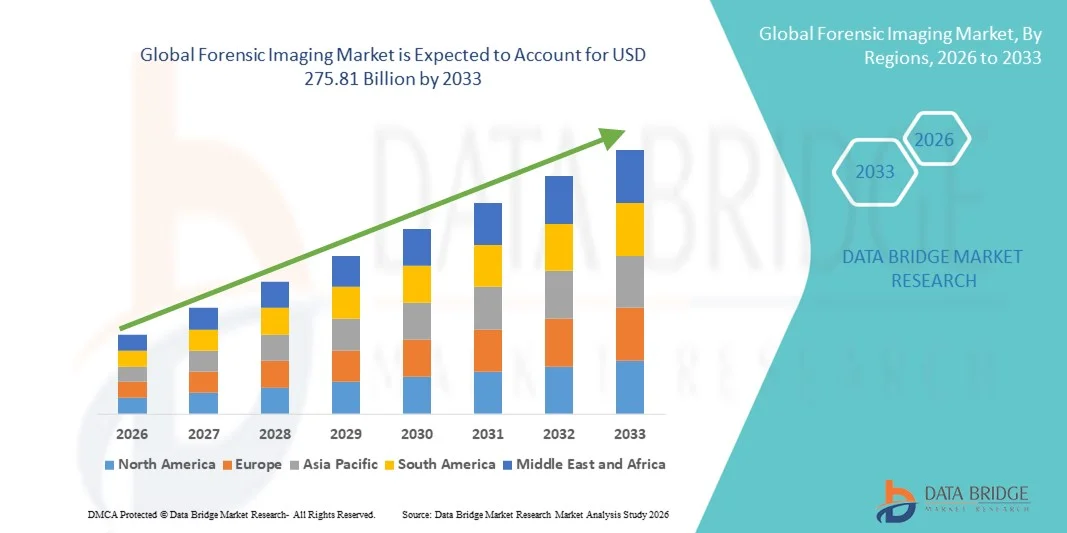
- The global forensic imaging market size was valued at USD 116.04 billion in 2025 and is expected to reach USD 275.81 billion by 2033, at a CAGR of 11.43% during the forecast period
- The market growth is largely fueled by the increasing adoption of advanced forensic technologies and continuous technological progress in digital imaging systems, leading to enhanced evidence documentation and investigation efficiency across law enforcement agencies, forensic laboratories, and healthcare institutions
- Furthermore, rising demand for accurate, high-resolution, and non-invasive imaging solutions for crime scene analysis, post-mortem investigations, and legal documentation is establishing forensic imaging systems as essential tools in modern forensic science. These converging factors are accelerating the uptake of Forensic Imaging solutions, thereby significantly boosting the industry's growth
Forensic Imaging Market Analysis
- Forensic imaging, encompassing advanced digital photography, 3D imaging, CT, MRI, and post-mortem imaging technologies, plays a critical role in modern forensic investigations across law enforcement agencies, forensic laboratories, and medical examiner offices due to its ability to provide accurate, non-invasive, and legally admissible visual evidence
- The escalating demand for forensic imaging is primarily driven by rising crime investigation complexity, growing adoption of digital forensics, increasing preference for non-destructive autopsy techniques, and continuous advancements in high-resolution imaging and AI-assisted image analysis
- North America dominated the forensic imaging market with an estimated revenue share of 37.8% in 2025, supported by a well-established forensic infrastructure, high adoption of advanced imaging technologies, strong government funding for public safety and criminal justice systems, and the presence of leading forensic imaging solution providers, with the U.S. witnessing widespread deployment across law enforcement and forensic pathology departments
- Asia-Pacific is expected to be the fastest-growing region in the Forensic Imaging market during the forecast period, driven by increasing investments in law enforcement modernization, expansion of forensic laboratories, rising crime rates in urban areas, and growing adoption of advanced medical and forensic imaging technologies across countries such as China and India
- The death investigations segment accounted for the largest revenue share of 64.3% in 2025, driven by the growing reliance on imaging-based virtual autopsy techniques in medico-legal examinations
Report Scope and Forensic Imaging Market Segmentation
|
Attributes |
Forensic Imaging Key Market Insights |
|
Segments Covered |
|
|
Countries Covered |
North America
Europe
Asia-Pacific
Middle East and Africa
South America
|
|
Key Market Players |
|
|
Market Opportunities |
|
|
Value Added Data Infosets |
In addition to the insights on market scenarios such as market value, growth rate, segmentation, geographical coverage, and major players, the market reports curated by the Data Bridge Market Research also include in-depth expert analysis, patient epidemiology, pipeline analysis, pricing analysis, and regulatory framework. |
Forensic Imaging Market Trends
Increasing Integration of Advanced Digital Imaging and AI-Assisted Analysis
- A significant and accelerating trend in the global Forensic Imaging market is the growing integration of high-resolution digital imaging technologies with advanced analytical software, enabling faster, more accurate, and standardized evidence documentation across forensic laboratories and law enforcement agencies
- These technologies support detailed visualization, automated image enhancement, and precise measurement capabilities, significantly improving investigative workflows and evidentiary reliability
- For instance, modern forensic imaging platforms equipped with multi-spectral and 3D imaging capabilities are increasingly used to capture detailed impressions of fingerprints, bite marks, tool marks, and ballistic evidence, enabling investigators to analyze trace evidence that may not be visible under conventional lighting conditions. The adoption of digital autopsy imaging systems and forensic radiology solutions in medical examiner offices is further strengthening imaging-based forensic investigations
- The integration of artificial intelligence-assisted image processing tools is enabling automated pattern recognition, facial reconstruction, and comparative evidence analysis, reducing manual workload and improving investigation turnaround times. Advanced image enhancement technologies are also improving the clarity of surveillance footage, helping investigators identify suspects and reconstruct crime scenes more effectively
- In addition, the increasing use of portable forensic imaging devices is enabling on-site evidence documentation at crime scenes, minimizing contamination risks and preserving evidentiary integrity. These mobile systems allow investigators to immediately capture high-quality digital records that can be securely transmitted to centralized forensic laboratories for further analysis
- The growing transition toward digital forensic workflows, supported by integrated evidence management platforms and secure data storage systems, is transforming the way forensic investigations are conducted, enabling seamless collaboration between law enforcement agencies, forensic laboratories, and judicial systems
- As governments and law enforcement agencies continue to modernize forensic infrastructure, the demand for advanced imaging solutions capable of delivering high-precision documentation, automated analysis, and secure digital archiving is expected to increase significantly
Forensic Imaging Market Dynamics
Driver
Rising Criminal Investigations and Demand for Accurate Evidence Documentation
- The increasing number of criminal investigations worldwide, coupled with the growing emphasis on scientifically validated evidence in judicial processes, is a major driver for the adoption of forensic imaging technologies. Law enforcement agencies are increasingly relying on high-resolution imaging systems to document crime scenes, injuries, and physical evidence in a standardized and legally admissible manner
- For instance, several national forensic laboratories across North America and Europe are expanding the deployment of digital forensic radiography and 3D crime-scene reconstruction technologies to improve investigative accuracy and accelerate case processing timelines. Such infrastructure modernization initiatives are expected to significantly drive the growth of the forensic imaging market during the forecast period
- The rising adoption of advanced forensic technologies in counterterrorism operations, disaster victim identification (DVI), and mass casualty investigations is further increasing demand for high-precision imaging solutions capable of handling complex forensic scenarios
- In addition, the growing need for accurate medical-legal documentation of injuries, including trauma imaging and post-mortem examinations, is encouraging hospitals and forensic pathology centers to adopt specialized forensic imaging systems, strengthening cross-sector demand
- The expansion of government funding for forensic modernization programs, combined with the increasing establishment of dedicated forensic laboratories in developing countries, is further accelerating market growth
Restraint/Challenge
High Equipment Costs and Shortage of Skilled Forensic Professionals
- The high initial cost associated with advanced forensic imaging equipment, including multi-spectral imaging systems, 3D reconstruction platforms, and forensic radiology technologies, remains a key challenge for widespread adoption, particularly in resource-constrained regions. Budget limitations in public forensic laboratories can delay modernization initiatives and restrict the deployment of advanced imaging systems
- For instance, several forensic departments in developing regions continue to rely on conventional photographic documentation methods due to funding constraints, limiting their ability to adopt advanced digital imaging platforms and automated evidence analysis technologies
- In addition, the shortage of trained forensic imaging specialists and technical personnel capable of operating sophisticated imaging systems and interpreting complex digital evidence presents an operational challenge for many forensic institutions
- The need for regular equipment calibration, software upgrades, and compliance with stringent legal and evidentiary standards also increases operational costs, creating additional barriers for smaller laboratories
- Addressing these challenges through government funding support, specialized forensic training programs, and the development of cost-efficient imaging technologies will be essential for sustaining long-term growth in the forensic imaging market
Forensic Imaging Market Scope
The market is segmented on the basis of modality, application, and end-user.
- By Modality
On the basis of modality, the Forensic Imaging market is segmented into X-ray, CT, MRI, and Ultrasound. The CT segment dominated the largest market revenue share of 41.6% in 2025, driven by its superior capability to provide high-resolution, cross-sectional anatomical visualization essential for forensic investigations. CT imaging allows non-invasive examination of skeletal trauma, internal hemorrhage, foreign objects, and cause-of-death assessment, making it a preferred modality in forensic institutes and advanced hospitals. Increasing use of post-mortem CT (PMCT) in medico-legal investigations further strengthens adoption. Governments and forensic departments are investing in dedicated forensic CT facilities to enhance investigation accuracy and reduce autopsy time. The modality also supports 3D reconstruction, enabling improved courtroom presentation of evidence. Integration with AI-based reconstruction software improves diagnostic precision. Growth in criminal investigation cases and disaster victim identification programs continues to drive demand. Expansion of digital forensic laboratories globally further supports adoption. Technological advancements in multi-slice CT scanners increase scanning speed and resolution. Increasing collaboration between healthcare institutions and law enforcement agencies also contributes to strong segment leadership.
The MRI segment is expected to witness the fastest CAGR of 9.4% from 2026 to 2033, driven by its superior soft-tissue visualization capabilities and non-radiative imaging advantages. MRI is increasingly utilized in forensic neuropathology and detailed tissue injury analysis, particularly in complex medico-legal investigations. Rising adoption of advanced imaging for virtual autopsy procedures supports rapid segment expansion. Improved availability of high-field MRI systems enhances image clarity and diagnostic capability. Growing research initiatives in forensic radiology further promote MRI usage. Hospitals are expanding forensic imaging capabilities, including MRI integration, to support clinical forensic investigations. Increasing awareness regarding minimally invasive forensic procedures is accelerating adoption. MRI also enables improved detection of subtle tissue injuries and vascular abnormalities. Expansion of academic forensic research programs contributes to growing installation rates. Continuous technological innovation and declining equipment costs in emerging markets further support segment growth.
- By Application
On the basis of application, the Forensic Imaging market is segmented into Death Investigations and Clinical Studies. The death investigations segment accounted for the largest revenue share of 64.3% in 2025, driven by the growing reliance on imaging-based virtual autopsy techniques in medico-legal examinations. Forensic imaging enables rapid identification of trauma, fractures, foreign bodies, and internal injuries without invasive procedures, significantly improving investigation efficiency. Law enforcement agencies increasingly depend on imaging data for criminal case analysis and court evidence presentation. Rising adoption of post-mortem imaging in disaster victim identification programs also strengthens demand. Government investments in forensic modernization programs further support the segment’s leadership. Increasing number of suspicious death investigations globally continues to drive utilization. Advanced imaging helps reduce autopsy time and improves documentation accuracy. Integration of 3D visualization tools enhances evidentiary value in legal proceedings. Collaboration between forensic institutes and hospitals supports infrastructure expansion. Continuous development of standardized forensic imaging protocols also contributes to strong dominance.
The clinical studies segment is expected to register the fastest CAGR of 8.9% from 2026 to 2033, driven by the growing use of forensic imaging techniques in trauma research, abuse detection, and medico-legal clinical evaluations. Hospitals increasingly utilize forensic imaging for documenting injury patterns associated with violence, accidents, and abuse cases. Rising clinical research activities focused on injury biomechanics and forensic pathology support segment growth. Integration of imaging evidence in medico-legal reporting enhances clinical adoption. Increasing demand for standardized injury documentation methods across healthcare institutions further accelerates expansion. Technological advancements improving imaging speed and diagnostic accuracy also contribute to adoption. Growing training programs in forensic radiology among healthcare professionals expand utilization. Research collaborations between academic institutions and forensic agencies further drive innovation. Increasing use of imaging in child abuse investigations and trauma documentation supports long-term demand. These factors collectively position the clinical studies segment as the fastest-growing application area.
- By End-User
On the basis of end-user, the Forensic Imaging market is segmented into Forensic Institutes, Hospitals, and Others. The forensic institutes segment dominated the market with a revenue share of 52.8% in 2025, supported by the growing establishment of dedicated forensic imaging laboratories worldwide. These institutes serve as primary centers for medico-legal investigations, criminal case examinations, and disaster victim identification operations. Government funding for modernization of forensic infrastructure significantly contributes to segment leadership. Increasing integration of CT and MRI facilities within forensic laboratories enhances investigative efficiency. High volume of criminal investigations requiring imaging-based evidence further drives demand. Adoption of digital forensic archiving systems improves data management capabilities. Growing need for non-invasive autopsy techniques supports strong installation of advanced imaging equipment. Training programs in forensic radiology conducted within these institutes also boost utilization. Collaboration with law enforcement agencies enhances operational demand. Expansion of national forensic networks across developed and emerging countries further strengthens the segment’s dominance.
The hospitals segment is projected to witness the fastest CAGR of 8.7% from 2026 to 2033, driven by increasing adoption of clinical forensic imaging services within trauma centers and emergency departments. Hospitals are increasingly supporting medico-legal cases requiring injury documentation and forensic analysis. Rising investments in advanced diagnostic imaging infrastructure enable hospitals to participate actively in forensic investigations. Growth in trauma cases and violence-related injuries requiring medico-legal reporting further supports expansion. Integration of forensic radiology units within large tertiary hospitals is accelerating. Increasing collaboration between hospitals and forensic departments enhances service utilization. Training of radiologists in forensic imaging techniques also promotes adoption. Expansion of hospital-based research initiatives in forensic medicine contributes to growth. Government healthcare policies encouraging medico-legal documentation in hospitals further strengthen demand. These factors collectively position hospitals as the fastest-growing end-user segment during the forecast period.
Forensic Imaging Market Regional Analysis
- North America dominated the forensic imaging market with an estimated revenue share of 37.8% in 2025, supported by a well-established forensic infrastructure, strong government funding for criminal justice systems, and widespread adoption of advanced imaging technologies such as post-mortem CT (PMCT), forensic radiography, and 3D crime-scene reconstruction tools across law-enforcement agencies and forensic pathology departments
- Agencies such as the U.S. Federal Bureau of Investigation (FBI) and major state forensic laboratories increasingly deploy advanced CT scanners, digital autopsy platforms, and 3D imaging systems to enhance evidence visualization, improve case documentation accuracy, and accelerate investigation timeline
- This regional leadership is further strengthened by the presence of leading forensic imaging technology providers, continuous R&D investments, and the integration of artificial intelligence-assisted imaging analytics, enabling faster identification of injuries, trauma patterns, and concealed evidence
U.S. Forensic Imaging Market Insight
The U.S. forensic imaging market captured the largest revenue share within North America in 2025, driven by extensive deployment of digital forensic radiology systems across medical examiner offices, hospitals, and law-enforcement agencies. Increasing reliance on virtual autopsy techniques, advanced crime-scene scanning technologies, and federal funding for forensic modernization programs is significantly accelerating market expansion. Moreover, collaborations between universities, forensic laboratories, and technology providers are fostering innovation in AI-enabled imaging analysis and automated evidence reconstruction.
Europe Forensic Imaging Market Insight
The Europe forensic imaging market is projected to expand at a substantial CAGR throughout the forecast period, supported by strong regulatory frameworks, standardized forensic investigation protocols, and increasing adoption of minimally invasive autopsy technologies. Several European countries are integrating post-mortem CT and MRI imaging into routine forensic examinations to enhance diagnostic accuracy while reducing the need for traditional autopsies. Growing investments in cross-border forensic collaboration programs are also strengthening the region’s technological adoption.
U.K. Forensic Imaging Market Insight
The U.K. forensic imaging market is anticipated to grow at a noteworthy CAGR during the forecast period, driven by the expansion of digital forensic services, modernization of forensic laboratories, and increasing utilization of 3D crime-scene scanning technologies by police departments. Government initiatives focused on improving evidence reliability and reducing investigation turnaround times are further encouraging the adoption of advanced forensic imaging platforms across public safety agencies.
Germany Forensic Imaging Market Insight
The Germany forensic imaging market is expected to expand at a considerable CAGR, fueled by the country’s advanced healthcare infrastructure, strong research ecosystem, and growing emphasis on precision forensic diagnostics. German forensic institutes are increasingly adopting high-resolution CT imaging, automated skeletal analysis software, and advanced digital documentation systems to improve medico-legal investigations and forensic reporting accuracy.
Asia-Pacific Forensic Imaging Market Insight
The Asia-Pacific forensic imaging market is expected to witness the fastest CAGR during the forecast period, driven by rising investments in law-enforcement modernization, expansion of forensic laboratories, and growing awareness regarding advanced forensic technologies across emerging economies. Rapid urbanization, increasing crime investigation requirements, and government initiatives to strengthen forensic capabilities in countries such as China and India are significantly accelerating the adoption of forensic CT scanners, digital radiography systems, and 3D forensic reconstruction platforms.
Japan Forensic Imaging Market Insight
The Japan forensic imaging market is gaining momentum due to the country’s strong technological capabilities, advanced medical imaging infrastructure, and increasing adoption of minimally invasive forensic examination techniques. The use of high-precision CT and MRI imaging for post-mortem investigations is expanding, supported by academic research programs and collaborations between hospitals and forensic departments focused on improving diagnostic efficiency.
China Forensic Imaging Market Insight
The China forensic imaging market accounted for the largest revenue share within Asia-Pacific in 2025, attributed to rapid expansion of forensic institutions, strong government support for public security modernization, and increasing deployment of advanced digital forensic imaging equipment across provincial forensic laboratories. The country’s growing investments in smart policing technologies, AI-enabled evidence analysis systems, and large-scale forensic infrastructure development continue to drive significant market growth.
Forensic Imaging Market Share
The Forensic Imaging industry is primarily led by well-established companies, including:
- GE HealthCare (U.S.)
- Siemens Healthineers (Germany)
- Koninklijke Philips N.V. (Netherlands)
- Canon Medical Systems Corporation (Japan)
- Fujifilm Holdings Corporation (Japan)
- Agfa-Gevaert Group (Belgium)
- Shimadzu Corporation (Japan)
- Carestream Health (U.S.)
- Hitachi Medical Systems (Japan)
- Esaote S.p.A. (Italy)
- Hologic, Inc. (U.S.)
- Planmed Oy (Finland)
- Samsung Medison (South Korea)
- Mindray Medical International Limited (China)
- United Imaging Healthcare (China)
- Analogic Corporation (U.S.)
- Neusoft Medical Systems (China)
- Ziehm Imaging (Germany)
- CurveBeam AI (U.S.)
- Mediso Ltd. (Hungary)
Latest Developments in Global Forensic Imaging Market
- In March 2025, GE HealthCare announced the expansion of its advanced CT imaging solutions portfolio with upgraded digital CT platforms designed to enhance precision imaging capabilities, including applications in forensic pathology and post-mortem imaging. The upgraded systems incorporate AI-enabled reconstruction, improved detector sensitivity, and faster scanning speeds, enabling forensic investigators and medical examiners to perform high-resolution non-invasive autopsy imaging with improved workflow efficiency and diagnostic accuracy
- In October 2024, Fujifilm Healthcare introduced next-generation digital radiography and CT imaging systems optimized for advanced clinical and forensic imaging environments. These systems provide enhanced image clarity, AI-assisted workflow tools, and improved data management integration, supporting growing adoption of radiological imaging technologies in forensic laboratories and medico-legal institutes worldwide
- In June 2023, Canon Medical Systems launched its advanced Aquilion CT imaging platform featuring deep-learning-based reconstruction technology aimed at delivering ultra-high-resolution imaging with reduced radiation exposure. The system supports complex diagnostic and forensic imaging applications, enabling improved visualization of skeletal trauma, internal injuries, and foreign objects during forensic investigations
- In September 2022, Siemens Healthineers introduced enhancements to its SOMATOM CT scanner portfolio, integrating AI-based image reconstruction and workflow automation designed to improve imaging accuracy and throughput. These advancements are widely adopted in forensic radiology settings for detailed post-mortem imaging and virtual autopsy procedures
- In April 2021, Philips Healthcare expanded its portfolio of digital radiography and CT imaging solutions with upgraded imaging platforms focused on high-precision diagnostics and improved imaging efficiency. The new systems support broader utilization of radiological imaging technologies in forensic medicine by enabling high-resolution internal examinations without invasive autopsy procedures
SKU-
Get online access to the report on the World's First Market Intelligence Cloud

- Interactive Data Analysis Dashboard
- Company Analysis Dashboard for high growth potential opportunities
- Research Analyst Access for customization & queries
- Competitor Analysis with Interactive dashboard
- Latest News, Updates & Trend analysis
- Harness the Power of Benchmark Analysis for Comprehensive Competitor Tracking
Research Methodology
Data collection and base year analysis are done using data collection modules with large sample sizes. The stage includes obtaining market information or related data through various sources and strategies. It includes examining and planning all the data acquired from the past in advance. It likewise envelops the examination of information inconsistencies seen across different information sources. The market data is analysed and estimated using market statistical and coherent models. Also, market share analysis and key trend analysis are the major success factors in the market report. To know more, please request an analyst call or drop down your inquiry.
The key research methodology used by DBMR research team is data triangulation which involves data mining, analysis of the impact of data variables on the market and primary (industry expert) validation. Data models include Vendor Positioning Grid, Market Time Line Analysis, Market Overview and Guide, Company Positioning Grid, Patent Analysis, Pricing Analysis, Company Market Share Analysis, Standards of Measurement, Global versus Regional and Vendor Share Analysis. To know more about the research methodology, drop in an inquiry to speak to our industry experts.
Customization Available
Data Bridge Market Research is a leader in advanced formative research. We take pride in servicing our existing and new customers with data and analysis that match and suits their goal. The report can be customized to include price trend analysis of target brands understanding the market for additional countries (ask for the list of countries), clinical trial results data, literature review, refurbished market and product base analysis. Market analysis of target competitors can be analyzed from technology-based analysis to market portfolio strategies. We can add as many competitors that you require data about in the format and data style you are looking for. Our team of analysts can also provide you data in crude raw excel files pivot tables (Fact book) or can assist you in creating presentations from the data sets available in the report.












