




Global Forestry Software Market
Market Size in USD Billion
CAGR :
% 
 USD
2.80 Billion
USD
14.10 Billion
2025
2033
USD
2.80 Billion
USD
14.10 Billion
2025
2033
 Forecast Period Forecast Period |
2026 - 2033 |
 Market Size (Base Year) Market Size (Base Year) |
USD 2.80 Billion |
 Market Size (Forecast Year) Market Size (Forecast Year) |
USD 14.10 Billion |
 CAGR CAGR |
% |
| Major Markets Players |
|
Forestry Software Market Overview
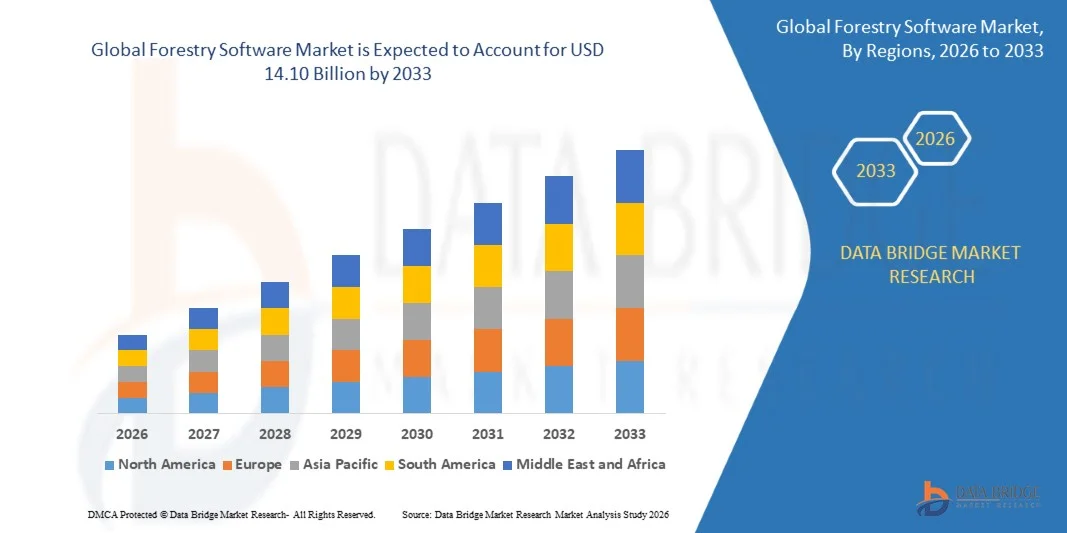
The Forestry Software Market was valued at USD 2.80 Billion in 2025 and is projected to reach USD 14.10 Billion by 2033, growing at a CAGR of 22.4% from 2026 to 2033. The market is experiencing consistent growth driven by increasing adoption of precision forestry practices, rising demand for digital resource management solutions, and growing emphasis on sustainable forest operations. Expanding use of cloud-based platforms, GIS technologies, remote sensing systems, and AI-enabled analytics is further supporting market expansion across commercial forestry and land management applications.
The increasing global focus on sustainable forest management and efficient utilization of natural resources, combined with stringent environmental regulations and carbon reduction initiatives, is encouraging forestry companies and government agencies to invest in advanced software solutions. Forestry software platforms are increasingly being utilized to optimize harvesting operations, improve inventory tracking, enhance supply chain visibility, and support compliance with environmental standards. Growing integration of satellite imagery, IoT devices, and real-time monitoring technologies is further strengthening the adoption of digital forestry management systems worldwide.
Key Market Trends & Insights
- North America dominated the Forestry Software Market with the largest revenue share of 35.5% in 2025, supported by early adoption of precision forestry technologies, increasing digitalization of timber operations, and strong demand for sustainable forest management solutions
- The cloud-based forestry software segment led the market with a 61.8% share in 2025, driven by increasing adoption of digital forest management platforms that enable real-time data access and centralized operational control
- Asia-Pacific is expected to be the fastest-growing region at a CAGR of 22.9% from 2026 to 2033, fueled by rapid modernization of forestry operations, increasing government initiatives for forest conservation, and expanding adoption of digital resource management technologies
- Fire detection is the fastest-growing technology type, projected to register a CAGR of 14.3% from 2026 to 2033, supported by increasing frequency of wildfires and growing concerns regarding forest conservation and climate resilience
- The geospatial segment dominated the technology category with a 47.2% revenue share in 2025, led by extensive use of GIS, satellite imaging, and remote sensing technologies for forest monitoring and planning
- Forest management accounted for 39.6% of the market in 2025, preferred by increasing emphasis on sustainable resource utilization and efficient planning of forestry operations
- The inventory & logistics management segment is the fastest-growing application category, with a CAGR of 13.5% from 2026 to 2033, driven by rising need for efficient timber transportation, warehouse management, and supply chain visibility
Market Size & Forecast
- Global Market Value (2025): USD 2.80 Billion
- Expected Market Value (2033): USD 14.10 Billion
- Forecast CAGR (2026–2033): 22.4%
- Leading Region in 2025: North America
- Fastest Growing Region: Asia-Pacific
Report Scope and Forestry Software Market Segmentation
|
Attributes |
Forestry Software Key Market Insights |
|
Segments Covered |
|
|
Countries Covered |
North America · U.S. · Canada · Mexico Europe · Germany · France · U.K. · Netherlands · Switzerland · Belgium · Russia · Italy · Spain · Turkey · Rest of Europe Asia-Pacific · China · Japan · India · South Korea · Singapore · Malaysia · Australia · Thailand · Indonesia · Philippines · Rest of Asia-Pacific Middle East and Africa · Saudi Arabia · U.A.E. · South Africa · Egypt · Israel · Rest of Middle East and Africa South America · Brazil · Argentina · Rest of South America |
|
Key Market Players |
· A.G. Leader Technology Inc. (U.S.) · AGCO Corporation (U.S.) · AgJunction Inc. (Canada) · AgEagle Aerial Systems, Inc. (U.S.) · Valmont Industries Inc. (U.S.) · Agsmart Pty Ltd (Australia) · BouMatic (U.S.) · CROPMETRICS (U.S.) · CropX Inc. (Israel) · Deere & Company (U.S.) · Farmers Edge Inc. (Canada) · GEA Group Aktiengesellschaft (Germany) · Monsanto Company (U.S.) · Taranis (U.S.) · Precision Planting LLC (U.S.) · Raven Industries Inc. (U.S.) · Topcon (Japan) · Tetra Laval International S.A. (Switzerland) · Trimble Inc. (U.S.) |
|
Market Opportunities |
· Expansion of GIS and Remote Sensing Applications in Forestry Operations · Rising Demand for Real-Time Wildfire Monitoring and Risk Management Solutions · Increasing Digital Transformation Initiatives Across Emerging Forestry Markets |
|
Value Added Data Infosets |
In addition to the market insights such as market value, growth rate, market segments, geographical coverage, market players, and market scenario, the market report curated by the Data Bridge Market Research team includes in-depth expert analysis, import/export analysis, pricing analysis, production consumption analysis, and pestle analysis. |
Forestry Software Market Trends
Trend: Rising Adoption of Cloud-Based Forestry Solutions
Forestry organizations are increasingly adopting cloud-based software platforms to improve operational efficiency, enhance data accessibility, and support precision forestry practices. Cloud solutions enable real-time monitoring of timber resources, harvesting activities, inventory levels, and logistics operations across geographically dispersed forest assets. Integration with GIS, IoT sensors, and remote sensing technologies is further strengthening digital forest management capabilities. According to the Food and Agriculture Organization (FAO), forests cover approximately 4.06 billion hectares globally, highlighting the growing need for advanced digital tools to manage resources efficiently.
Companies such as Trimble are expanding cloud-enabled offerings, and in May 2025 the company launched Forestry One to streamline forestry operations and strengthen connected forest management systems.
Forestry Software Market Dynamics
Key Market Driver: Growing Focus on Sustainable Forest Management
Increasing emphasis on sustainable forestry practices and responsible resource utilization is significantly driving demand for forestry software solutions. Governments and forestry enterprises are adopting digital platforms to improve forest inventory management, optimize harvesting activities, and ensure compliance with environmental regulations. The United Nations Food and Agriculture Organization estimates that more than 420 million hectares of forest have been lost since 1990, increasing the importance of efficient monitoring and conservation measures. Advanced software integrated with satellite imagery and analytics is enabling better decision-making and reducing operational inefficiencies.
Organizations such as Holmen are actively investing in digital forestry solutions, and in April 2024 the company adopted Trimble's CONNECTED FOREST platform to enhance data-driven forest management.
Key Restraint/Challenge: High Implementation Costs
A major challenge in the Forestry Software market is the high initial investment associated with deploying advanced digital solutions and integrating them with existing forestry operations. Implementation often requires expenditure on software licenses, cloud infrastructure, GIS systems, sensors, and employee training programs. Smaller forestry operators and landowners frequently face difficulties in adopting sophisticated technologies due to limited financial resources and technical expertise.
In addition, integration with legacy systems and the need for continuous software updates further increase operational costs. The complexity involved in deploying comprehensive digital ecosystems continues to limit adoption, particularly across developing forestry regions and small-scale timber enterprises.
Key Market Opportunity: Growing Demand for Wildfire Monitoring Solutions
Increasing frequency and severity of wildfires are creating significant growth opportunities for the Forestry Software market. Governments and forestry agencies are increasingly adopting digital platforms integrated with geospatial analytics, satellite imaging, and AI technologies to improve early fire detection and risk assessment. According to the European Commission's Joint Research Centre, wildfires burned more than 500,000 hectares across Europe in 2023, highlighting the need for advanced monitoring systems. Real-time data analysis and predictive capabilities are improving emergency response and forest protection efforts.
Organizations such as the Food and Agriculture Organization introduced an upgraded Open Foris platform in July 2025 to strengthen forest monitoring capabilities and support wildfire management initiatives worldwide.
Forestry Software Market Scope
The forestry software market is segmented on the basis of product type, application, and technology.
- By Product Type
On the basis of product type, the Forestry Software Market is segmented into on-premises forestry software and cloud-based forestry software. The Cloud-Based Forestry Software segment dominated the market with the largest share of 61.8% in 2025, driven by increasing adoption of digital forest management platforms that enable real-time data access and centralized operational control. Cloud-based solutions provide seamless connectivity across harvesting, planning, inventory tracking, and compliance management activities. Their ability to support remote operations and integration with GIS and IoT technologies enhances operational efficiency for forestry companies. Lower infrastructure costs and flexible subscription models are encouraging widespread deployment among both large enterprises and small operators. Growing emphasis on data-driven forestry practices further strengthens the segment’s leading position.
The Cloud-Based Forestry Software segment is projected to register the fastest growth at a CAGR of 12.8% from 2026 to 2033, driven by rising demand for scalable and remotely accessible software solutions across the forestry value chain. Increasing use of mobile devices and connected sensors is enabling efficient monitoring of forest assets and field activities. Advancements in cloud computing and analytics capabilities are improving decision-making and resource optimization. Expanding investments in digital transformation initiatives are accelerating migration away from traditional software systems. Growing focus on sustainable forest management and regulatory reporting requirements is further supporting rapid adoption worldwide.
- By Application
On the basis of application, the Forestry Software Market is segmented into forest management, logging management, mapwork harvester, inventory and logistics management, and other. The Forest Management segment dominated the market with the largest share of 39.6% in 2025, driven by increasing emphasis on sustainable resource utilization and efficient planning of forestry operations. Forestry companies are utilizing software platforms to monitor timber resources, optimize harvesting schedules, and ensure regulatory compliance. Integration of satellite imagery and geospatial tools is improving visibility and decision-making capabilities. Growing demand for accurate forest inventory and environmental monitoring is enhancing the importance of digital forest management solutions. Continuous adoption of precision forestry practices further reinforces the segment’s dominant position.
The Inventory & Logistics Management segment is projected to register the fastest growth at a CAGR of 13.5% from 2026 to 2033, driven by rising need for efficient timber transportation, warehouse management, and supply chain visibility. Increasing complexity of global wood product trade is encouraging deployment of advanced logistics software solutions. Real-time tracking technologies and automated inventory systems are improving operational efficiency and reducing losses. Growing demand for optimized resource allocation and cost reduction is supporting segment expansion. Rising adoption of digital supply chain management platforms across forestry enterprises is further accelerating growth.
- By Technology
On the basis of technology, the Forestry Software Market is segmented into cut-to-length, geospatial, and fire detection. The Geospatial segment dominated the market with a share of 47.2% in 2025, supported by extensive use of GIS, satellite imaging, and remote sensing technologies for forest monitoring and planning. Geospatial solutions enable accurate mapping, land assessment, and resource management across large forest areas. Their ability to provide real-time insights enhances productivity and supports sustainable forestry practices. Increasing integration with drones and IoT-enabled devices is improving data accuracy and operational efficiency. Strong demand for environmental compliance and precision forestry applications further strengthens the segment’s market leadership.
The Fire Detection segment is projected to register the fastest growth at a CAGR of 14.3% from 2026 to 2033, driven by increasing frequency of wildfires and growing concerns regarding forest conservation and climate resilience. Advanced fire detection technologies are enabling early identification of fire risks through satellite monitoring and AI-based analytics. Governments and forestry agencies are increasing investments in disaster prevention and emergency response systems. Integration of thermal imaging, sensor networks, and predictive analytics is improving detection capabilities and reducing response times. Rising focus on protecting forest ecosystems and minimizing economic losses is significantly accelerating segment growth.
Forestry Software Market Regional Analysis
North America dominated the forestry software market and accounted for the largest revenue share of 35.5% in 2025, driven by early adoption of precision forestry technologies, increasing digitalization of timber operations, and strong demand for sustainable forest management solutions. The region benefits from extensive commercial forestry activities, advanced GIS infrastructure, and widespread use of cloud-based software platforms for resource planning and inventory monitoring. Forestry companies are increasingly investing in data-driven tools to optimize harvesting operations, improve regulatory compliance, and enhance supply chain visibility. In addition, the presence of major software vendors and growing adoption of IoT and remote sensing technologies continue to reinforce North America’s leadership position in the global market.
U.S. Forestry Software Market Insight
The U.S. Forestry Software market is experiencing strong growth driven by rising adoption of precision forestry practices, increasing demand for real-time forest monitoring, and expanding investments in digital resource management solutions. Forestry enterprises are utilizing advanced software platforms to optimize timber harvesting, improve asset tracking, and support sustainability objectives. The country's highly developed technological ecosystem and widespread implementation of cloud computing are enabling efficient deployment of forestry management systems. In addition, growing emphasis on wildfire prevention and regulatory reporting requirements is further accelerating market expansion across the U.S.
Canada Forestry Software Market Insight
The Canada Forestry Software market is witnessing steady growth supported by extensive forest resources, rising investments in sustainable forestry practices, and increasing use of digital technologies across timber operations. Companies are adopting forestry software solutions to improve inventory management, optimize logistics, and enhance operational efficiency. The country's strong focus on environmental conservation and resource monitoring is encouraging implementation of geospatial and remote sensing technologies. In addition, increasing government initiatives aimed at promoting responsible forest management are further contributing to market growth in Canada.
Europe Forestry Software Market Insight
The Europe Forestry Software market is expanding steadily due to increasing focus on sustainable forest utilization, growing adoption of precision forestry technologies, and rising demand for efficient resource management solutions. The region benefits from strong environmental regulations and widespread implementation of digital tools to improve forest monitoring and operational planning. Forestry organizations are increasingly utilizing software platforms to support biodiversity conservation and optimize harvesting activities. Rising investments in geospatial analytics and remote sensing capabilities continue to support regional market growth.
U.K. Forestry Software Market Insight
The U.K. Forestry Software market is growing steadily, driven by increasing emphasis on sustainable land management, rising use of digital mapping technologies, and expanding adoption of cloud-based forestry solutions. Forestry operators are focusing on software-driven approaches to improve inventory tracking and streamline operational processes. The country's growing commitment to carbon reduction and environmental conservation is encouraging deployment of advanced forest monitoring tools. In addition, rising integration of GIS and analytics technologies is strengthening market expansion in the U.K.
Germany Forestry Software Market Insight
The Germany Forestry Software market is expanding due to increasing digitalization of forestry operations, strong focus on sustainable resource utilization, and growing adoption of geospatial technologies. Forestry enterprises are increasingly implementing software solutions to enhance planning efficiency, optimize timber production, and improve regulatory compliance. The country's emphasis on environmental protection and technological innovation is driving demand for advanced forest management systems. In addition, rising investments in remote sensing and automated data analysis are further accelerating market development in Germany.
Asia-Pacific Forestry Software Market Insight
The Asia-Pacific Forestry Software market is expected to register the fastest growth with a CAGR of 22.9% from 2026 to 2033, driven by rapid modernization of forestry operations, increasing government initiatives for forest conservation, and expanding adoption of digital resource management technologies. Rising demand for sustainable timber production and efficient land-use planning is significantly boosting software deployment across the region. Countries such as China, India, Japan, and Australia are witnessing growing investments in GIS-based solutions, cloud platforms, and remote sensing technologies. In addition, increasing awareness regarding wildfire management and biodiversity protection is further accelerating regional market expansion.
Japan Forestry Software Market Insight
The Japan Forestry Software market is witnessing steady growth supported by increasing adoption of smart forestry technologies, rising labor shortages, and growing emphasis on efficient forest resource management. Companies are utilizing digital solutions to improve harvesting efficiency and optimize timber supply chains. The country's advanced technological infrastructure and strong focus on automation are supporting widespread implementation of software-driven forestry systems. In addition, increasing investments in geospatial analytics and environmental monitoring are strengthening demand in Japan.
China Forestry Software Market Insight
The China Forestry Software market is growing rapidly due to increasing investments in forest conservation programs, expanding adoption of digital technologies, and rising demand for efficient resource management solutions. Forestry organizations are actively implementing software platforms to enhance inventory control, optimize harvesting operations, and improve environmental monitoring capabilities. The country's large-scale afforestation initiatives and strong focus on ecological sustainability are supporting rapid deployment of advanced forestry management systems. In addition, increasing integration of AI, satellite imaging, and cloud technologies is further driving market growth in China.
Forestry Software Market Share
The forestry software industry is primarily led by well-established companies, including:
- G. Leader Technology Inc. (U.S.)
- AGCO Corporation (U.S.)
- AgJunction Inc. (Canada)
- AgEagle Aerial Systems, Inc. (U.S.)
- Valmont Industries Inc. (U.S.)
- Agsmart Pty Ltd (Australia)
- BouMatic (U.S.)
- CROPMETRICS (U.S.)
- CropX Inc. (Israel)
- Deere & Company (U.S.)
- Farmers Edge Inc. (Canada)
- GEA Group Aktiengesellschaft (Germany)
- Monsanto Company (U.S.)
- Taranis (U.S.)
- Precision Planting LLC (U.S.)
- Raven Industries Inc. (U.S.)
- Topcon (Japan)
- Tetra Laval International S.A. (Switzerland)
- Trimble Inc. (U.S.)
Latest Developments in Forestry Software Market
- In October 2025, Remsoft acquired Australian forestry technology company LOGR to strengthen its forest intelligence platform and expand digital capabilities across planning, operations, and sustainability management. The acquisition enhanced real-time data capture, logistics visibility, and chain-of-custody tracking, supporting the growing shift toward integrated cloud-based forestry software ecosystems and improving supply chain efficiency across global forestry operations
- In July 2025, the Food and Agriculture Organization (FAO) introduced a redesigned version of its Open Foris platform to provide enhanced open-source tools for forest data collection, analysis, and monitoring. The upgrade strengthened digital forest management capabilities and expanded accessibility for governments and organizations, supporting wider adoption of software-based forest monitoring and sustainability initiatives across global markets
- In May 2025, Trimble launched the Forestry One platform to connect and streamline forestry operations through a unified data environment integrated with its Connected Forest solutions. The introduction of the platform improved inventory management, harvest planning, supply chain traceability, and regulatory compliance capabilities, accelerating digital transformation and increasing demand for advanced forestry software solutions worldwide
- In April 2024, Sweden-based renewable forest products company Holmen selected Trimble’s CONNECTED FOREST system to support data-driven decision-making across its forestry operations. The implementation enhanced digital management capabilities, improved operational efficiency, and accelerated the adoption of advanced forest monitoring technologies, contributing to the expansion of the forestry software market
- In September 2023, Trimble Inc. introduced an upgraded version of its cloud-based forestry and log inventory software, LIMS PRO, to improve visibility across sawmill and supply chain operations. The solution strengthened workflow digitalization and inventory management capabilities, supporting increased demand for cloud-enabled forestry software and driving greater operational transparency throughout the timber value chain
SKU-
Get online access to the report on the World's First Market Intelligence Cloud

- Interactive Data Analysis Dashboard
- Company Analysis Dashboard for high growth potential opportunities
- Research Analyst Access for customization & queries
- Competitor Analysis with Interactive dashboard
- Latest News, Updates & Trend analysis
- Harness the Power of Benchmark Analysis for Comprehensive Competitor Tracking
Research Methodology
Data collection and base year analysis are done using data collection modules with large sample sizes. The stage includes obtaining market information or related data through various sources and strategies. It includes examining and planning all the data acquired from the past in advance. It likewise envelops the examination of information inconsistencies seen across different information sources. The market data is analysed and estimated using market statistical and coherent models. Also, market share analysis and key trend analysis are the major success factors in the market report. To know more, please request an analyst call or drop down your inquiry.
The key research methodology used by DBMR research team is data triangulation which involves data mining, analysis of the impact of data variables on the market and primary (industry expert) validation. Data models include Vendor Positioning Grid, Market Time Line Analysis, Market Overview and Guide, Company Positioning Grid, Patent Analysis, Pricing Analysis, Company Market Share Analysis, Standards of Measurement, Global versus Regional and Vendor Share Analysis. To know more about the research methodology, drop in an inquiry to speak to our industry experts.
Customization Available
Data Bridge Market Research is a leader in advanced formative research. We take pride in servicing our existing and new customers with data and analysis that match and suits their goal. The report can be customized to include price trend analysis of target brands understanding the market for additional countries (ask for the list of countries), clinical trial results data, literature review, refurbished market and product base analysis. Market analysis of target competitors can be analyzed from technology-based analysis to market portfolio strategies. We can add as many competitors that you require data about in the format and data style you are looking for. Our team of analysts can also provide you data in crude raw excel files pivot tables (Fact book) or can assist you in creating presentations from the data sets available in the report.












