


What is the Free From Food Market Size and Growth Rate?
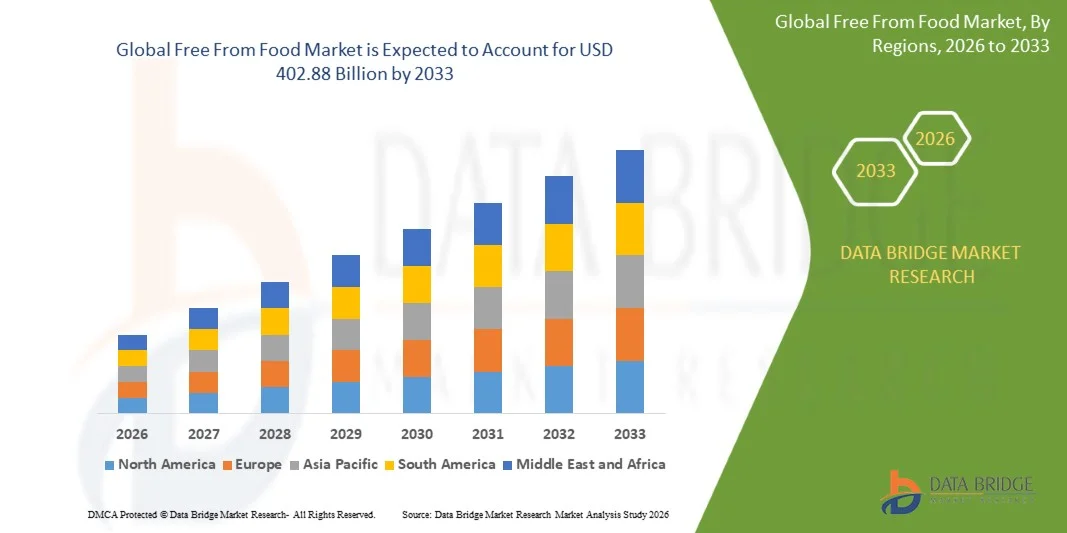
- As per Data Bridge Market Research analysis, the Free From Food market was valued at USD 181.25 billion in 2025 and is projected to reach USD 402.88 billion by 2033, growing at a CAGR of 10.50% from 2026 to 2033.
- The market is experiencing robust growth driven by rising consumer awareness regarding food allergies and intolerances, increasing prevalence of celiac disease and lactose intolerance, and growing demand for clean-label and allergen-free food products across the globe.
- The increasing incidence of food-related health issues globally, combined with stricter government regulations on food labeling and allergen declaration, is compelling food manufacturers, retailers, and consumers to adopt free-from food products. Gluten-free, lactose-free, and sugar-free products are replacing conventional food items in many markets, offering safe, healthy, and inclusive alternatives for consumers with dietary restrictions and lifestyle preferences.
Market Size & Forecast
- Global Market Value (2025): USD 181.25 Billion
- Expected Market Value (2033): USD 402.88 Billion
- Forecast CAGR (2026 to 2033): 10.50%
- Leading Region in 2025: North America
- Fastest Growing Region: Asia Pacific
What are the Major Takeaways of the Free From Food Market?
- North America dominated the global free from food market with the largest revenue share in 2025, supported by high consumer awareness regarding food allergies and intolerances, stringent food safety regulations enforced by the U.S. Food and Drug Administration (FDA), and a well-established retail infrastructure across the region. The U.S. free from food market was valued at approximately USD 30.41 billion in 2025.
- Asia Pacific is expected to be the fastest-growing region, fueled by rapid urbanization, rising disposable incomes, expanding middle-class population, and increasing prevalence of lactose intolerance and other food sensitivities in countries such as China, India, and Japan. The Asia-Pacific free from food market was valued at USD 34.11 billion in 2025 and is projected to grow at a CAGR of 9.7% from 2026 to 2033.
- The gluten-free segment led the product type category with a 40.27% share in 2025, driven by rising prevalence of celiac disease, increasing consumer preference for gluten-free diets, and growing availability of gluten-free alternatives across retail channels.
- The sugar-free segment is the fastest-growing product type, projected to register a CAGR of 11.60%, reflecting the surge in demand for low-calorie and diabetic-friendly food products amid rising obesity and diabetes prevalence worldwide.
- The bakery products segment dominated the application category with a 24.81% revenue share in 2025, supported by increasing availability of gluten-free, lactose-free, and sugar-free bakery items and growing consumer demand for healthier baked goods.
- The beverages segment is expected to witness the fastest growth at a CAGR of 11.20% from 2026 to 2033, driven by rising demand for plant-based milk alternatives, sugar-free beverages, and functional drinks catering to health-conscious consumers.
- The online retail segment is the fastest-growing distribution channel, with a CAGR of 13.20%, driven by the expansion of e-commerce platforms and direct-to-consumer models that enhance product accessibility and consumer convenience.
Report Scope and Free From Food Market Segmentation
|
Attributes |
Free From Food Key Market Insights |
|
Segments Covered |
|
|
Countries Covered |
North America
Europe
Asia-Pacific
Middle East and Africa
South America
|
|
Key Market Players |
|
|
Market Opportunities |
|
|
Value Added Data Infosets |
In addition to the insights on market scenarios such as market value, growth rate, segmentation, geographical coverage, and major players, the market reports curated by the Data Bridge Market Research also include in-depth expert analysis, pricing analysis, brand share analysis, consumer survey, demography analysis, supply chain analysis, value chain analysis, raw material/consumables overview, vendor selection criteria, PESTLE Analysis, Porter Analysis, and regulatory framework. |
What is the Key Trend in the Free From Food Market?
- The free-from food market has transitioned from a niche, medically-driven category to a mainstream consumer choice, with health-conscious shoppers seeking perceived wellness and sustainability advantages. The market was valued at over USD 100 billion in 2025 and is forecast to more than double by 2033, with sugar-free claims now accounting for approximately 40% of total revenues.
- Major food companies are investing heavily in acquisitions and reformulations to keep iconic brands relevant in the free-from era.
- For instance, in 2024, PepsiCo announced a $1.2 billion acquisition of Siete Foods, a Texas-based maker of grain-free tortillas and chips, expanding its multicultural portfolio with better-for-you products rooted in heritage.
- Mondelez International is remaking its own classics by leveraging its Enjoy Life Foods subsidiary for allergen-friendly innovation.
- For instance, after launching gluten-free Oreo in 2021, the company followed with gluten-free Chips Ahoy in 2024, marking the first-ever gluten-free version of America's number one chocolate chip cookie.
- General Mills and Nestlé are committing to cleaner formulations. In June 2025, General Mills announced it will remove synthetic food dyes from cereals and food sold in schools by summer 2026 and from its entire U.S. retail portfolio by the end of 2027. Nestlé USA also plans to eliminate FD&C synthetic colors from its entire U.S. portfolio by 2026.
- As major food manufacturers continue to prioritize health-conscious formulations and allergen-friendly product development, the adoption of free-from food products is expected to accelerate, reinforcing free-from offerings as a core component of the modern food and beverage industry.
What are the Key Drivers of the Free From Food Market?
- Rising health consciousness and increasing awareness of food intolerances are powerful drivers. The free-from food market is witnessing significant growth driven by increasing awareness of lifestyle disorders, inflammation, and the importance of maintaining good gut health.
- For instance, according to Food Allergy Research & Education, approximately 33 million Americans were affected by food allergies in 2024. Celiac diagnoses, lactose intolerance, nut allergies, and diabetes are all pushing consumers toward alternatives.
- The market has grown from medically necessary products to a mass-market wellness phenomenon. Harvard Health noted in 2024 that "interest and enthusiasm around gluten-free diets continues to grow dramatically" – far beyond those with medical necessity.
- Millennials and Gen Z are specifically more inclined toward clean-label, natural, and free-from products. According to a study, 83% of U.S. consumers read food labels before buying, with 64% of Gen Z consumers looking for clean-label claims such as "natural."
- With the rise of e-commerce businesses, access to free-from products has become more convenient, supported by improved distribution channels that reach global consumers efficiently. Supermarkets are increasingly integrating gluten-free, dairy-free, and vegan options into their mainstream aisles.
- With the food industry increasingly relying on clean-label innovation and allergen-friendly product development to drive growth, free-from foods will remain indispensable for meeting evolving consumer preferences and dietary needs.
Which Factors are Challenging the Growth of the Free From Food Market?
- Most free-from food products come at a higher price than their standard counterparts, and this gap appears to be widening amid inflationary pressures. The high cost of production is due to the use of alternative ingredients, limited availability of certain products in certain regions, and the potential for cross-contamination during processing.
- These high costs limit adoption among price-sensitive consumers, particularly in emerging economies.
- For instance, record-high cocoa prices have threatened to force allergen-free chocolate suppliers out of production, with one founder warning that some businesses are looking at whether they could "replicate the taste of chocolate."
- Regulatory complexity across different regions poses challenges for manufacturers seeking global expansion. There is a lack of standardized regulations and labelling requirements across different countries, leading to confusion among consumers.
- For instance, in May 2025, Mondelez International updated its "Free From" labelling manual to ensure compliance with evolving allergen control and management standards. The patchwork of state and federal mandates banning ingredients, coupled with tariffs, is challenging brands.
- The perception of free-from foods being less tasty or inferior in quality compared to conventional products poses a challenge in attracting a wider consumer base. Reformulating products with simple ingredient lists while protecting taste, texture, and shelf life requires substantial R&D investment.
- The high capital investment and recurring operational costs associated with free-from food production continue to restrict adoption, particularly among small and medium-sized manufacturers. This cost barrier slows market penetration in price-sensitive and emerging regions, limiting the widespread deployment of allergen-friendly and clean-label products despite growing demand.
How is the Free From Food Market Segmented?
The free from food market is segmented on the basis of type, distribution channel, and application.
- By Type
On the basis of type, the global free from food market is segmented into gluten-free, lactose-free, sugar-free, and others. The gluten-free segment dominated the market with a 40.27% share in 2025, driven by rising prevalence of celiac disease, increasing consumer preference for gluten-free diets, and growing availability of gluten-free alternatives across retail channels. Widespread product innovation, improved taste profiles, and expanding distribution networks are further reinforcing the leading position of this segment.
The sugar-free segment is projected to register the fastest growth at a CAGR of 11.60% from 2026 to 2033, driven by rising prevalence of diabetes and obesity, increasing consumer demand for low-calorie and diabetic-friendly food products, and growing health consciousness among consumers. Advances in natural sweetener technologies and clean-label formulations are accelerating segment expansion.
- By Distribution Channel
On the basis of distribution channel, the global free from food market is segmented into supermarkets/hypermarkets, specialty stores, online retail, and others. The supermarkets/hypermarkets segment dominated the market with a 45.05% share in 2025, preferred by consumers for wide product variety, competitive pricing, and convenient one-stop shopping experiences. Strong retail presence, attractive in-store promotions, and established supply chains are reinforcing the leading position of this segment.
The online retail segment is expected to witness the fastest growth at a CAGR of 13.20% from 2026 to 2033, driven by the rapid expansion of e-commerce platforms, direct-to-consumer models, and increasing consumer preference for convenient home delivery and digital shopping experiences. Enhanced product accessibility, personalized recommendations, subscription-based models, and seamless digital payment options are accelerating the adoption of online distribution channels.
- By Application
On the basis of application, the global free from food market is segmented into bakery products, beverages, snacks & savouries, dairy products, and others. The bakery products segment dominated the market with a 24.81% share in 2025, supported by increasing availability of gluten-free, lactose-free, and sugar-free bakery items and growing consumer demand for healthier baked goods. Product innovation, improved texture and taste profiles, and expanding product portfolios are reinforcing the leading position of this segment.
The beverages segment is expected to witness the fastest growth at a CAGR of 11.20% from 2026 to 2033, driven by rising demand for plant-based milk alternatives, sugar-free beverages, and functional drinks catering to health-conscious consumers. Increasing product launches, growing availability across retail and online channels, and consumer preference for convenient health-focused beverages are accelerating market expansion.
Which Region Holds the Largest Share of the Free From Food Market?
- North America dominated the global free from food market with the largest revenue share of 35.2% in 2025, accounting for USD 63.8 billion of the total market value. This regional dominance is supported by high consumer awareness regarding food allergies and intolerances, stringent food safety regulations enforced by the U.S. Food and Drug Administration (FDA), and a well-established retail infrastructure across the region. The U.S. free from food market was valued at approximately USD 30.41 billion in 2025 and is projected to reach USD 74.33 billion by 2034, growing at a CAGR of 10.44%.
- The region also benefits from the high prevalence of food allergies and celiac disease. According to Food Allergy Research & Education, approximately 33 million Americans, including many children with multiple food allergies, were affected by food allergies in 2024. The FDA's 2025 allergen labelling requirements, which mandate clearer identification and expand recognized allergen definitions, have reduced cross-contamination incidents and increased consumer confidence in free-from products.
U.S. Free From Food Market Insight
The U.S. free from food market is experiencing steady growth, supported by rising consumer focus on health and wellness, increasing prevalence of food allergies and intolerances, and growing adoption of gluten-free, lactose-free, and sugar-free food products. Increasing investments in product innovation and growing demand for clean-label, organic, and non-GMO free-from food products are contributing to market growth. Furthermore, integration of advanced food processing technologies and transparent labeling practices is improving product quality and consumer trust, positioning the U.S. as a key innovation hub in the free from food industry.
Canada Free From Food Market Insight
The Canada free from food market is expanding steadily due to the country's high health consciousness, advanced food processing infrastructure, and increasing adoption of allergen-free and specialty food products. Health-conscious consumers, individuals with dietary restrictions, and aging populations are increasingly utilizing free-from food products for preventive healthcare and overall wellness. Continuous advancements in food formulation technologies, sustainable sourcing, and clean-label product development, along with strong government support for food safety and labelling regulations, are further driving market growth in Canada.
Asia-Pacific Free From Food Market Insight
The Asia-Pacific free from food market is expected to witness rapid growth, driven by increasing urbanization, rising disposable incomes, and growing health awareness across countries such as China, India, and Australia. Growing prevalence of food allergies and intolerances, rising adoption of gluten-free and lactose-free diets, and increasing demand for clean-label and organic products are supporting regional market expansion. Additionally, the growing presence of domestic free-from food manufacturers and expanding retail and e-commerce platforms is accelerating market penetration across commercial and consumer sectors.
Japan Free From Food Market Insight
The Japan free from food market is witnessing consistent growth due to rising investments in functional food innovation, healthy aging initiatives, and clean-label product development. Food manufacturers, specialty retailers, and research institutes are increasingly developing high-quality free-from products targeting specific health concerns such as digestive health, food allergies, and lifestyle-related diseases. Moreover, increasing integration of plant-based ingredients and functional formulations, along with the country's focus on food safety and quality, are further contributing to market growth.
China Free From Food Market Insight
The China free from food market is growing rapidly, driven by increasing urbanization, expanding middle-class population, and rising government focus on food safety, public health education, and clean-label initiatives. Growing adoption of gluten-free, lactose-free, and sugar-free products across commercial, retail, and online sectors is significantly boosting market demand. In addition, rising investments in product innovation, increasing awareness regarding food allergies and intolerances, and rapid e-commerce expansion are positioning China as one of the fastest-growing markets for free-from food products globally.
India Free From Food Market Insight
The India free from food market is experiencing robust growth, supported by increasing health consciousness, rising incidence of lactose intolerance and diabetes, and growing demand for affordable and accessible free-from food solutions. The country's diverse dietary preferences and increasing adoption of gluten-free and sugar-free products, combined with expanding retail penetration and e-commerce growth, are driving market expansion. Additionally, rising consumer awareness regarding food allergies, government initiatives promoting food safety, and growing availability of certified free-from products are further accelerating market adoption across urban and semi-urban populations.
Which are the Top Companies in Free From Food Market?
The free from food industry is primarily led by well-established companies, including:
- Nestlé S.A. (Switzerland)
- Danone S.A. (France)
- Unilever Plc (U.K.)
- General Mills Inc. (U.S.)
- Conagra Brands Inc. (U.S.)
- Mondelez International (U.S.)
- The Hain Celestial Group Inc. (U.S.)
- Campbell Soup Company (U.S.)
- Abbott Laboratories (U.S.)
- Beyond Meat Inc. (U.S.)
- Dr. Schär AG/SpA (Italy)
- Oatly Group AB (Sweden)
- Blue Diamond Growers (U.S.)
- Kellogg Company (U.S.)
- Alpro UK Limited (U.K.)
- Doves Farm Foods Ltd. (U.K.)
- Amy's Kitchen Inc. (U.S.)
- Enjoy Life Foods (U.S.)
- Pacific Foods (U.S.)
What are Latest Developments in Free From Food Market?
- In August 2026, Ferrero Group announced it had signed an agreement to acquire Purely Elizabeth, a U.S.-based health food brand, with the transaction expected to close in the coming months. This follows Ferrero's acquisition of U.S. cereal company WK Kellogg Co in 2025.
- In January 2026, Mars officially launched Cheez-It original gluten-free crackers, following the acquisition of Kellanova by Mars, Inc. in July 2025. Mars called the launch "one of the most highly requested innovations in the brand's history." The company also expanded the Cheez-It portfolio with several new products including Cheez-It Ultimate Snack Mix, Cheez-It Crunch, Cheez-It Snap'd honey BBQ, and Cheez-It Grooves loaded nachos.
- In December 2025, Ripple Foods, a leader in high-protein, allergen-free plant-based milks, announced USD 17 million in new funding from investors including Material Impact and Rich Products Ventures. The company also appointed Becky O'Grady as Chief Executive Officer. The funding will support the introduction of a new line of organic plant-based milks in Q1 2026 and expanded retail distribution across major partners including Target, Whole Foods, and Walmart.
- In September 2025, Food Navigator reported that the global Free From market surpassed USD 100 billion in 2025 and is forecast to more than double by 2033. Sugar-free claims now account for approximately 40 percent of revenues, with 54 percent of consumers actively seeking reduced sugar, salt, gluten, or fat products according to Euromonitor.
- In May 2024, Nestlé launched Vital Pursuit, a new frozen food brand aimed at weight-conscious consumers and GLP-1 weight-loss medication users. The product line features portion-aligned meals including gluten-free flatbreads, high-protein bowls, and portion-controlled pizzas, all priced at USD 4.99 or less.

- Interactive Data Analysis Dashboard
- Company Analysis Dashboard for high growth potential opportunities
- Research Analyst Access for customization & queries
- Competitor Analysis with Interactive dashboard
- Latest News, Updates & Trend analysis
- Harness the Power of Benchmark Analysis for Comprehensive Competitor Tracking
Global Free From Food Market, Supply Chain Analysis and Ecosystem Framework
To support market growth and help clients navigate the impact of geopolitical shifts, DBMR has integrated in-depth supply chain analysis into its Global Free From Food Market research reports. This addition empowers clients to respond effectively to global changes affecting their industries. The supply chain analysis section includes detailed insights such as Global Free From Food Market consumption and production by country, price trend analysis, the impact of tariffs and geopolitical developments, and import and export trends by country and HSN code. It also highlights major suppliers with data on production capacity and company profiles, as well as key importers and exporters. In addition to research, DBMR offers specialized supply chain consulting services backed by over a decade of experience, providing solutions like supplier discovery, supplier risk assessment, price trend analysis, impact evaluation of inflation and trade route changes, and comprehensive market trend analysis.
Data collection and base year analysis are done using data collection modules with large sample sizes. The stage includes obtaining market information or related data through various sources and strategies. It includes examining and planning all the data acquired from the past in advance. It likewise envelops the examination of information inconsistencies seen across different information sources. The market data is analysed and estimated using market statistical and coherent models. Also, market share analysis and key trend analysis are the major success factors in the market report. To know more, please request an analyst call or drop down your inquiry.
The key research methodology used by DBMR research team is data triangulation which involves data mining, analysis of the impact of data variables on the market and primary (industry expert) validation. Data models include Vendor Positioning Grid, Market Time Line Analysis, Market Overview and Guide, Company Positioning Grid, Patent Analysis, Pricing Analysis, Company Market Share Analysis, Standards of Measurement, Global versus Regional and Vendor Share Analysis. To know more about the research methodology, drop in an inquiry to speak to our industry experts.
Data Bridge Market Research is a leader in advanced formative research. We take pride in servicing our existing and new customers with data and analysis that match and suits their goal. The report can be customized to include price trend analysis of target brands understanding the market for additional countries (ask for the list of countries), clinical trial results data, literature review, refurbished market and product base analysis. Market analysis of target competitors can be analyzed from technology-based analysis to market portfolio strategies. We can add as many competitors that you require data about in the format and data style you are looking for. Our team of analysts can also provide you data in crude raw excel files pivot tables (Fact book) or can assist you in creating presentations from the data sets available in the report.













