




Global Free To Air Fta Service Market
Market Size in USD Billion
CAGR :
% 
 USD
144.01 Billion
USD
335.25 Billion
2025
2033
USD
144.01 Billion
USD
335.25 Billion
2025
2033
 Forecast Period Forecast Period |
2026 –2033 |
 Market Size (Base Year) Market Size (Base Year) |
USD 144.01 Billion |
 Market Size (Forecast Year) Market Size (Forecast Year) |
USD 335.25 Billion |
 CAGR CAGR |
% |
| Major Markets Players |
|
Free-to-Air (FTA) Service Market Size
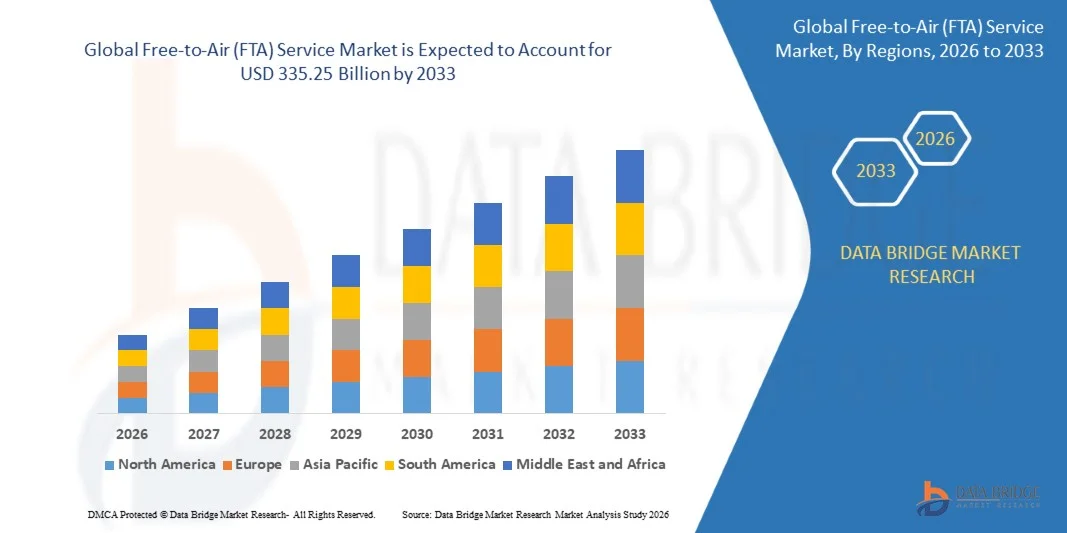
- The global Free-to-Air (FTA) Service market size was valued at USD 144.01 billion in 2025 and is expected to reach USD 335.25 billion by 2033, at a CAGR of 11.14% during the forecast period
- The market growth is largely fueled by the increasing demand for cost-effective and subscription-free content consumption, enabling users to access television and radio services without recurring charges, which is particularly significant in price-sensitive and developing regions
- Furthermore, rising expansion of digital broadcasting infrastructure and government initiatives promoting free access to information and public service content are strengthening the adoption of Free-to-Air platforms. These factors collectively enhance accessibility, improve content reach, and significantly drive the overall growth of the market
Free-to-Air (FTA) Service Market Analysis
- Free-to-Air (FTA) services refer to television and radio broadcasting systems that transmit unencrypted signals, allowing users to access content without any subscription fees through compatible receivers or devices. These services are widely utilized for delivering news, entertainment, education, and public information across residential and commercial applications
- The growing demand for FTA services is primarily driven by increasing television penetration, rising preference for affordable entertainment options, and continuous advancements in digital and satellite broadcasting technologies, which enhance signal quality, coverage, and accessibility across diverse geographic regions
- North America dominated the Free-to-Air (FTA) Service market with a share of over 40% in 2025, due to the widespread availability of advanced broadcasting infrastructure and high penetration of digital television services
- Asia-Pacific is expected to be the fastest growing region in the Free-to-Air (FTA) Service market during the forecast period due to expanding population, rising television penetration, and increasing demand for affordable entertainment
- Public segment dominated the market with a market share of 61.8% in 2025, due to strong government support and the objective of providing free and accessible information to the masses. Public broadcasters play a critical role in delivering educational, cultural, and news content, particularly in underserved regions. Their wide reach and trustworthiness among viewers contribute significantly to sustained viewership
Report Scope and Free-to-Air (FTA) Service Market Segmentation
|
Attributes |
Free-to-Air (FTA) Service Key Market Insights |
|
Segments Covered |
|
|
Countries Covered |
North America
Europe
Asia-Pacific
Middle East and Africa
South America
|
|
Key Market Players |
|
|
Market Opportunities |
|
|
Value Added Data Infosets |
In addition to the market insights such as market value, growth rate, market segments, geographical coverage, market players, and market scenario, the market report curated by the Data Bridge Market Research team includes in-depth expert analysis, import/export analysis, pricing analysis, production consumption analysis, and pestle analysis. |
Free-to-Air (FTA) Service Market Trends
“Rising Adoption of Digital and Mobile-Based Free-to-Air Services”
- A significant trend in the Free-to-Air (FTA) Service market is the increasing shift toward digital and mobile-based broadcasting platforms, driven by the growing demand for on-the-go content consumption and enhanced accessibility across diverse user groups. This transition is reshaping traditional broadcasting by enabling viewers to access FTA content through smartphones, tablets, and connected devices without dependency on conventional television setups
- For instance, Samsung Electronics offers Samsung TV Plus, an ad-supported Free-to-Air streaming service integrated into smart TVs and mobile devices, allowing users to access a wide range of live channels and on-demand content. This approach enhances user engagement and expands FTA reach beyond traditional broadcast infrastructure
- The adoption of mobile-based FTA services is growing rapidly as improved internet connectivity and affordable smartphones enable seamless streaming of television content. This is strengthening audience reach in both urban and rural areas while supporting flexible viewing preferences
- Broadcasters are increasingly integrating hybrid delivery models that combine terrestrial, satellite, and internet-based streaming to improve content distribution efficiency. This integration is enabling higher-quality transmission and uninterrupted viewing experiences across multiple platforms
- The demand for personalized and regional content is encouraging FTA providers to expand their digital offerings with targeted programming. This is increasing viewer retention and supporting the growth of localized content ecosystems within the FTA framework
- The market is witnessing a transformation toward digital-first broadcasting where mobile accessibility and connected TV integration are becoming essential. This trend is reinforcing the evolution of FTA services into more flexible, scalable, and user-centric platforms that align with changing consumer consumption patterns
Free-to-Air (FTA) Service Market Dynamics
Driver
“Increasing Demand for Cost-Effective and Subscription-Free Content”
- The increasing preference for cost-effective entertainment and information services is a major driver of the Free-to-Air (FTA) Service market, as consumers seek alternatives to expensive subscription-based platforms. FTA services provide unrestricted access to a variety of channels without recurring fees, making them highly attractive in both developed and emerging economies
- For instance, Doordarshan delivers a wide range of free television channels across India, ensuring accessibility to news, education, and entertainment content for millions of viewers without subscription costs. This widespread availability significantly strengthens FTA adoption, particularly in price-sensitive regions
- The rising cost of cable and OTT subscriptions is encouraging users to shift toward free broadcasting options that offer essential and diverse content. This transition is driving consistent demand for FTA services across households and public institutions
- Governments and public broadcasters are actively promoting free access to information as part of digital inclusion strategies. These initiatives are expanding broadcasting infrastructure and increasing the availability of FTA channels across underserved regions
- The sustained demand for accessible and economical content solutions continues to reinforce this driver. The ability of FTA services to deliver wide-reaching, reliable, and cost-efficient broadcasting is positioning them as a critical component of the global media landscape
Restraint/Challenge
“Limitations in Content Monetization and Revenue Generation”
- The Free-to-Air (FTA) Service market faces challenges related to limited monetization opportunities, as the absence of subscription fees restricts revenue generation primarily to advertising and sponsorship models. This dependency creates financial constraints for broadcasters in maintaining and expanding high-quality content offerings
- For instance, Channel Four Television Corporation relies heavily on advertising revenue to fund its Free-to-Air services, making it vulnerable to fluctuations in advertising spending and market conditions. This reliance highlights the financial challenges associated with sustaining FTA operations without diversified income streams
- The increasing competition from subscription-based and OTT platforms offering premium and exclusive content is impacting the attractiveness of FTA services. This competition makes it difficult for FTA broadcasters to retain viewership and attract advertisers
- The need to continuously invest in content production, digital infrastructure, and technology upgrades adds financial pressure on FTA providers. These investments are essential to remain competitive but are challenging to sustain with limited revenue sources
- The ongoing challenge of balancing cost structures with revenue limitations continues to constrain market growth. Addressing monetization gaps while maintaining content quality and accessibility remains a critical concern for stakeholders in the FTA service market
Free-to-Air (FTA) Service Market Scope
The market is segmented on the basis of device, broadcaster type, and application.
• By Device
On the basis of device, the Free-to-Air (FTA) Service market is segmented into satellite television, mobile TV, cable television, and radio. The satellite television segment dominated the largest market revenue share in 2025, driven by its extensive coverage capabilities, especially in remote and rural areas where wired infrastructure remains limited. Satellite-based FTA services enable uninterrupted broadcasting across vast geographies, making them a preferred choice in developing regions. The affordability of satellite receivers and the absence of subscription fees further strengthen adoption among cost-sensitive consumers. In addition, continuous improvements in signal quality and high-definition broadcasting enhance viewer experience and sustain demand. Government-backed initiatives to expand digital access also support the widespread penetration of satellite television services.
The mobile TV segment is anticipated to witness the fastest growth rate from 2026 to 2033, fueled by increasing smartphone penetration and rising consumption of on-the-go content. Consumers are shifting toward mobile-based viewing due to convenience, flexibility, and personalized content access. Advancements in mobile network infrastructure, including 4G and 5G, enable smoother streaming of FTA channels without significant latency. The growing preference for digital platforms among younger audiences further accelerates adoption. In addition, integration of FTA services with mobile applications enhances accessibility and user engagement. The expansion of affordable data plans also contributes to the rapid growth of mobile TV consumption.
• By Broadcaster Type
On the basis of broadcaster type, the Free-to-Air (FTA) Service market is segmented into public and commercial. The public broadcaster segment dominated the largest market revenue share of 61.8% in 2025, driven by strong government support and the objective of providing free and accessible information to the masses. Public broadcasters play a critical role in delivering educational, cultural, and news content, particularly in underserved regions. Their wide reach and trustworthiness among viewers contribute significantly to sustained viewership. In addition, government funding ensures continuous operation and expansion of services without reliance on advertising revenue. The emphasis on public welfare and national communication strategies further strengthens the position of public broadcasters.
The commercial broadcaster segment is expected to witness the fastest growth rate from 2026 to 2033, driven by increasing advertising opportunities and content diversification strategies. Commercial broadcasters focus on entertainment-driven programming, attracting larger audiences and higher engagement levels. The rising demand for regional and niche content encourages private players to expand their offerings. In addition, advancements in digital broadcasting technologies enable cost-effective content distribution. Partnerships with advertisers and content creators enhance revenue generation potential. The shift toward competitive programming and innovative formats further supports the growth of commercial broadcasters in the FTA ecosystem.
• By Application
On the basis of application, the Free-to-Air (FTA) Service market is segmented into industrial, household, and others. The household segment dominated the largest market revenue share in 2025, driven by the widespread demand for free entertainment and information services among residential users. FTA services provide an economical alternative to paid subscriptions, making them highly attractive in price-sensitive markets. The increasing penetration of television sets and digital receivers in homes further supports growth. In addition, households rely on FTA channels for news, education, and regional content, enhancing daily engagement. The simplicity of installation and minimal maintenance requirements also contribute to widespread adoption.
The industrial segment is anticipated to witness the fastest growth rate from 2026 to 2033, fueled by increasing use of FTA services in sectors such as hospitality, transportation, and public facilities. Businesses utilize FTA broadcasting to provide entertainment and information to customers without incurring recurring subscription costs. The growing emphasis on enhancing customer experience in hotels, airports, and waiting areas drives demand. In addition, FTA services are used for internal communication and informational displays in industrial environments. The expansion of commercial infrastructure and public spaces further accelerates adoption. Integration with digital signage and centralized broadcasting systems also supports the rapid growth of industrial applications.
Free-to-Air (FTA) Service Market Regional Analysis
- North America dominated the Free-to-Air (FTA) Service market with the largest revenue share of over 40% in 2025, driven by the widespread availability of advanced broadcasting infrastructure and high penetration of digital television services
- Consumers in the region benefit from access to a diverse range of high-quality content, including news, entertainment, and educational programming without subscription costs
- This strong adoption is further supported by technological advancements in transmission systems, increasing demand for cost-effective viewing options, and the presence of established broadcasters, strengthening the role of FTA services across residential and commercial users
U.S. Free-to-Air (FTA) Service Market Insight
The U.S. Free-to-Air (FTA) Service market captured the largest revenue share in 2025 within North America, driven by the high adoption of digital broadcasting and strong demand for free access to local and national channels. Consumers are increasingly utilizing FTA services as a complementary solution to subscription-based platforms, ensuring access to essential information and entertainment. The presence of well-established public and commercial broadcasters, along with continuous investments in high-definition and next-generation broadcasting technologies, is supporting sustained market growth.
Europe Free-to-Air (FTA) Service Market Insight
The Europe Free-to-Air (FTA) Service market is expected to expand at a significant CAGR during the forecast period, driven by strong public broadcasting systems and regulatory support for free access to information. The increasing demand for regional and multilingual content is encouraging broadcasters to expand their FTA offerings across various countries. Growth is further supported by digital switchover initiatives and rising consumer preference for cost-efficient media consumption across households and public institutions.
U.K. Free-to-Air (FTA) Service Market Insight
The U.K. Free-to-Air (FTA) Service market is anticipated to grow at a notable CAGR during the forecast period, driven by high reliance on public broadcasting and increasing demand for free digital television services. Consumers are increasingly seeking accessible and diverse content without subscription commitments, strengthening adoption rates. The strong presence of national broadcasters and continuous innovation in digital terrestrial television services are expected to further drive market expansion.
Germany Free-to-Air (FTA) Service Market Insight
The Germany Free-to-Air (FTA) Service market is projected to grow at a considerable CAGR during the forecast period, supported by a well-established broadcasting ecosystem and high consumer preference for free media access. The country’s focus on high-quality content delivery and technological advancement in transmission infrastructure is fostering adoption. Increasing integration of digital broadcasting technologies and emphasis on public information dissemination are contributing to sustained growth.
Asia-Pacific Free-to-Air (FTA) Service Market Insight
The Asia-Pacific Free-to-Air (FTA) Service market is expected to grow at the fastest CAGR during the forecast period of 2026 to 2033, driven by expanding population, rising television penetration, and increasing demand for affordable entertainment. The region’s growing focus on digitalization and government initiatives promoting free access to information are accelerating market expansion. Rapid infrastructure development and the presence of large rural populations are further supporting the adoption of FTA services across emerging economies.
Japan Free-to-Air (FTA) Service Market Insight
The Japan Free-to-Air (FTA) Service market is witnessing steady growth due to advanced broadcasting technologies and high consumer demand for quality content. The country’s strong focus on innovation and digital infrastructure supports seamless delivery of FTA services across multiple devices. Increasing consumption of high-definition and mobile-based broadcasting is contributing to the expansion of the market in Japan.
China Free-to-Air (FTA) Service Market Insight
The China Free-to-Air (FTA) Service market accounted for the largest market revenue share in Asia Pacific in 2025, driven by rapid urbanization and strong government support for public broadcasting services. The growing demand for accessible information and entertainment among a large population base is accelerating adoption. Continuous expansion of digital broadcasting infrastructure and increasing availability of affordable receiving devices are key factors propelling the market in China.
Free-to-Air (FTA) Service Market Share
The Free-to-Air (FTA) Service industry is primarily led by well-established companies, including:
- ProSiebenSat.1 Media SE (Germany)
- Rai Pubblicità S.p.A. (Italy)
- RTL Group S.A. (Luxembourg)
- Sky Plc (U.K.)
- A&E Television Networks, LLC (U.S.)
- AT&T, Inc. (U.S.)
- Channel Four Television Corporation (U.K.)
- 21st Century Fox (U.S.)
- Canadian Broadcasting Corporation (Canada)
- TiVo Corporation (U.S.)
- Mediengruppe RTL Deutschland GmbH (Germany)
- Viewsat (U.S.)
- SES S.A. (Luxembourg)
- Sony Pictures Television Networks (U.S.)
- Viacom International, Inc. (U.S.)
Latest Developments in Global Free-to-Air (FTA) Service Market
- In February 2025, BBC expanded its Free-to-Air digital broadcasting services by introducing additional HD and region-specific channels across the U.K., aimed at enhancing localized content delivery and improving overall viewing quality. This development strengthens the market by increasing audience engagement through high-definition experiences and tailored programming, while also reinforcing the role of public broadcasters in delivering diverse and accessible content, ultimately driving higher adoption of FTA platforms across both urban and regional audiences
- In January 2025, Doordarshan upgraded its terrestrial Free-to-Air network infrastructure with advanced digital transmitters and expanded its channel portfolio, particularly targeting rural and semi-urban regions. This initiative significantly accelerates market growth by improving signal reliability and accessibility in underserved areas, enabling wider reach among populations with limited access to paid services, and supporting government-led digital inclusion efforts that enhance overall FTA service penetration
- In November 2024, Samsung Electronics expanded its Samsung TV Plus Free-to-Air streaming platform into additional international markets while increasing its portfolio of ad-supported channels and on-demand content. This move contributes to market expansion by merging traditional FTA broadcasting with digital streaming capabilities, attracting a broader and younger audience base, increasing content consumption across connected devices, and opening new revenue streams through targeted advertising models
- In June 2024, Nexstar Media Group launched Nexstar News Network, a Free-to-Air platform designed to deliver localized news coverage across more than 200 markets in the U.S., including previously underserved regions. This development enhances the market by expanding the availability of hyper-local content, strengthening viewer trust and engagement, and leveraging digital integration for live streaming and on-demand access, thereby increasing the overall reach and relevance of FTA news services
- In May 2024, PBS introduced PBS Sports, a dedicated Free-to-Air channel focused on broadcasting live sports events including college athletics, community-level competitions, and select international events. This initiative drives market growth by broadening content diversity within FTA offerings, attracting sports audiences who prefer free viewing options, and increasing overall platform engagement while reducing dependency on subscription-based sports broadcasting services
SKU-
Get online access to the report on the World's First Market Intelligence Cloud

- Interactive Data Analysis Dashboard
- Company Analysis Dashboard for high growth potential opportunities
- Research Analyst Access for customization & queries
- Competitor Analysis with Interactive dashboard
- Latest News, Updates & Trend analysis
- Harness the Power of Benchmark Analysis for Comprehensive Competitor Tracking
Research Methodology
Data collection and base year analysis are done using data collection modules with large sample sizes. The stage includes obtaining market information or related data through various sources and strategies. It includes examining and planning all the data acquired from the past in advance. It likewise envelops the examination of information inconsistencies seen across different information sources. The market data is analysed and estimated using market statistical and coherent models. Also, market share analysis and key trend analysis are the major success factors in the market report. To know more, please request an analyst call or drop down your inquiry.
The key research methodology used by DBMR research team is data triangulation which involves data mining, analysis of the impact of data variables on the market and primary (industry expert) validation. Data models include Vendor Positioning Grid, Market Time Line Analysis, Market Overview and Guide, Company Positioning Grid, Patent Analysis, Pricing Analysis, Company Market Share Analysis, Standards of Measurement, Global versus Regional and Vendor Share Analysis. To know more about the research methodology, drop in an inquiry to speak to our industry experts.
Customization Available
Data Bridge Market Research is a leader in advanced formative research. We take pride in servicing our existing and new customers with data and analysis that match and suits their goal. The report can be customized to include price trend analysis of target brands understanding the market for additional countries (ask for the list of countries), clinical trial results data, literature review, refurbished market and product base analysis. Market analysis of target competitors can be analyzed from technology-based analysis to market portfolio strategies. We can add as many competitors that you require data about in the format and data style you are looking for. Our team of analysts can also provide you data in crude raw excel files pivot tables (Fact book) or can assist you in creating presentations from the data sets available in the report.












