What Is The Fruit Flavour Bubble Tea Market Size And Growth Rate?
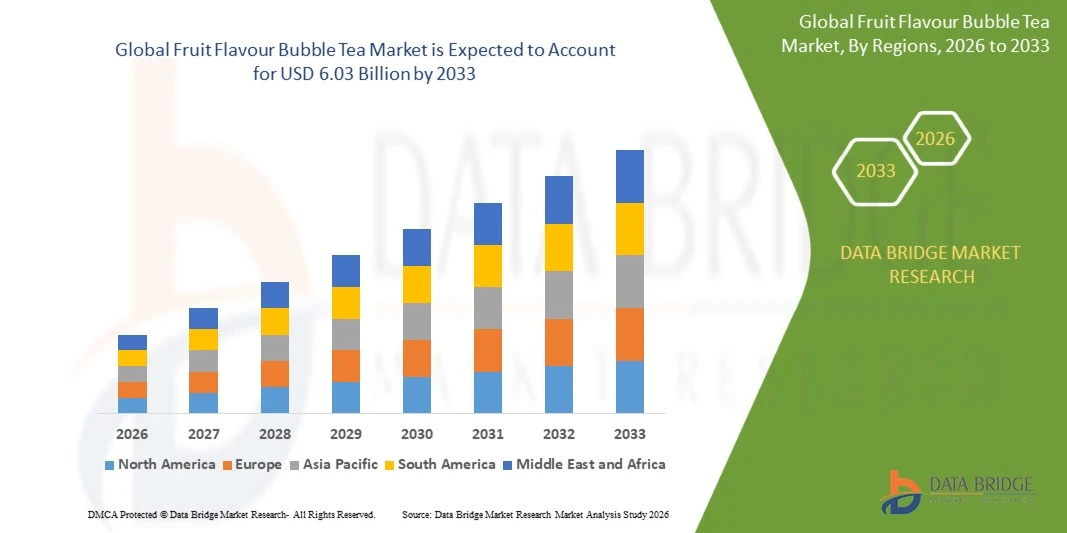
- As per Data Bridge Market Research analysis, the fruit flavour bubble tea market was valued at USD 2.87 billion in 2025 and is projected to reach USD 6.03 billion by 2033, growing at a CAGR of 9.72% from 2026 to 2033.
- The market is expanding due to rising consumer preference for fruit-based and refreshing beverages, growing popularity of customizable and experiential drinks, rapid expansion of bubble tea chains and franchise networks, increasing demand for natural and reduced-sugar ingredients, strong social media influence, and the growing availability of ready-to-drink bubble tea through supermarkets, convenience stores, and online platforms.
- Fruit flavour bubble tea is increasingly being adopted across cafés, quick-service outlets, and packaged beverage formats, supported by growing demand for fresh fruit teas, mango, strawberry, and passion fruit flavours, innovative toppings such as popping boba and fruit jelly, premium and clean-label formulations, and wider availability through bubble tea shops, retail stores, and food delivery platforms.
Market Size & Forecast
- Global Market Value (2025): USD 2.87 billion
- Expected Market Value (2033): USD 6.03 billion
- Forecast CAGR (2026–2033): 9.72%
- Leading Region in 2025: Asia-Pacific
- Fastest Growing Region: Europe
What Are The Major Takeaways Of The Fruit Flavour Bubble Tea Market?
- Asia-Pacific dominated the global fruit flavour bubble tea market with a share of 46.00% in 2025, supported by the cultural origins of bubble tea, a dense network of bubble tea chains, high everyday consumption, and the strong presence of leading brands in China, Taiwan, and Southeast Asia.
- Europe is expected to be the fastest-growing regional market at a CAGR of 10.40% from 2026 to 2033, driven by growing interest in Asian beverage culture, expansion of international bubble tea brands, rising local production, and increasing availability through retail and online channels.
- The mango segment dominated the market by flavour with a share of 30.00% in 2025, supported by its popularity, natural sweetness, tropical appeal, and wide use across fresh fruit teas and ready-to-drink formats.
- The strawberry segment is expected to register the fastest growth, at a CAGR of 10.80% from 2026 to 2033, driven by its strong appeal among younger consumers, visual attractiveness, and growing use in seasonal and limited-edition products.
- The black tea segment dominated the base type category with a share of 43.60% in 2025, supported by its strong flavour, versatility, and compatibility with fruit flavours and milk-based preparations.
- The bottles segment dominated the packaging type category with a share of 30.00% in 2025, supported by portability, product visibility, convenience, and strong availability across supermarkets and convenience stores.
- Online retail is expected to be the fastest-growing distribution channel at a CAGR of 11.20% from 2026 to 2033, supported by food delivery platforms, brand-owned apps, subscription models, and the rising popularity of ready-to-drink bubble tea kits.
Report Scope And Fruit Flavour Bubble Tea Market Segmentation
|
Attributes |
Fruit Flavour Bubble Tea Key Market Insights |
|
Segments Covered |
|
|
Countries Covered |
North America
Europe
Asia-Pacific
Middle East and Africa
South America
|
|
Key Market Players |
|
|
Market Opportunities |
|
|
Value Added Data Infosets |
In addition to the insights on market scenarios such as market value, growth rate, segmentation, geographical coverage, and major players, the market reports curated by the Data Bridge Market Research also include in-depth expert analysis, pricing analysis, brand share analysis, consumer survey, demography analysis, supply chain analysis, value chain analysis, raw material/consumables overview, vendor selection criteria, PESTLE Analysis, Porter Analysis, and regulatory framework. |
What Is The Key Trend In The Fruit Flavour Bubble Tea Market?
- Increasing shift toward fresh fruit tea and healthier formulations is becoming a major trend in the global fruit flavour bubble tea market, as consumers increasingly seek drinks made with real fruit, brewed tea, natural ingredients, and reduced sugar. Brands are moving away from powdered mixes toward fresh fruit preparations, organic fruit-flavoured lines, and lighter recipes, supported by growing health awareness and visible sugar-labeling requirements in some markets.
- Integration of premium experiences, new toppings, and ready-to-drink formats is gaining importance as consumers look for differentiated and shareable products. Companies are introducing seasonal and limited-edition fruit flavours, popping boba, fruit jelly, and cheese-foam toppings, while shelf-stable bottled and packaged formats extend consumption beyond bubble tea shops into supermarkets and convenience stores.
- For instance, in September 2026, HeyTea opened its first Philadelphia store after a New York opening, with long queues for its chilled fruit teas made from brewed whole-leaf tea and fresh fruit instead of powdered mixes, demonstrating the growing international appeal of fresh fruit tea formats.
- Overall, the fruit flavour bubble tea market is increasingly shaped by fresh fruit formulations, reduced-sugar and natural ingredients, premium and limited-edition flavours, innovative toppings, ready-to-drink formats, and rapid international franchise expansion. Bubble tea companies are therefore moving toward consumer-centric product development that combines fruit-forward flavours with healthier positioning, convenience, and strong digital and delivery capabilities.
What Are The Key Drivers Of The Fruit Flavour Bubble Tea Market?
- Rising demand for refreshing, fruit-based, and customizable beverages is becoming a major growth driver in the global fruit flavour bubble tea market, as consumers, particularly younger and urban populations, seek flavourful drinks that offer variety, personalization, and a perceived natural or lighter profile compared with carbonated beverages. Strong social media influence, visually appealing products, and cultural globalization are further supporting trial and repeat consumption.
- Expansion of bubble tea chains, franchise networks, and delivery platforms is gaining importance as brands extend into new cities and countries with affordable price points and digital ordering. Growth of ready-to-drink bubble tea in retail channels, along with regional flavour localization and the use of seasonal fruit, is also widening the consumer base.
- For instance, in December 2025, Mixue opened its first U.S. store in Los Angeles, with bubble teas priced from USD 3.99, as part of a plan to expand across the Americas. The company operates more than 53,000 stores worldwide, illustrating the scale and international reach of low-priced, fruit-forward tea chains.
- Overall, the fruit flavour bubble tea market is increasingly shaped by flavour innovation, health and wellness preferences, social media influence, franchise and delivery expansion, and the growth of packaged formats. Bubble tea companies are therefore moving toward broader geographic expansion, differentiated flavours, and omnichannel distribution.
What Factors Are Challenging The Growth Of The Fruit Flavour Bubble Tea Market?
- Volatility in tea, fruit, milk, tapioca, and packaging costs is becoming a major challenge in the global fruit flavour bubble tea market, as manufacturers and chains are exposed to agricultural supply fluctuations, weather conditions, and trade measures. Tapioca pearl supply is concentrated in Southeast Asia, and tariffs on imports of Taiwanese goods into the U.S. have increased cost pressure for some operators.
- Increasing scrutiny of sugar content, ingredient safety, and product quality is also restraining growth, as sugar-labeling rules, health concerns, and intense price competition in markets such as China pressure margins. Manufacturers are required to reduce sugar, use cleaner ingredients, and maintain taste, texture, and affordability.
- For instance, in September 2025, Consumer Reports published test results raising concerns about lead in some products containing tapioca pearls, increasing attention on ingredient sourcing and safety testing among bubble tea brands and suppliers.
- Overall, the global fruit flavour bubble tea market is increasingly shaped by input-cost volatility, trade and regulatory pressures, health and safety scrutiny, and price competition. Bubble tea companies are therefore moving toward diversified sourcing, lower-sugar formulations, stronger quality assurance, and efficient franchise and supply-chain models.
How Is The Fruit Flavour Bubble Tea Market Segmented?
The global fruit flavour bubble tea market is segmented on the basis of flavour, base type, component, packaging type, and distribution channel.
- By Flavour
On the basis of flavour, the global fruit flavour bubble tea market is segmented into mango, strawberry, peach, passion fruit, lychee, and others. The mango segment dominated the market with a share of 30.00% in 2025, supported by its popularity, natural sweetness, tropical appeal, and wide use across fresh fruit teas and ready-to-drink formats.
The strawberry segment is projected to grow at a CAGR of 10.80% from 2026 to 2033, driven by its strong appeal among younger consumers, visual attractiveness, and growing use in seasonal and limited-edition products.
- By Base Type
On the basis of base type, the global fruit flavour bubble tea market is segmented into black tea, green tea, oolong tea, fruit juice, and others. The black tea segment dominated the market with a share of 43.60% in 2025, supported by its strong flavour, versatility, and compatibility with fruit flavours.
The fruit juice segment is projected to grow at a CAGR of 10.90% from 2026 to 2033, driven by increasing demand for lighter, caffeine-free, and naturally fruity beverages.
- By Component
On the basis of component, the global fruit flavour bubble tea market is segmented into tapioca pearls, popping boba, fruit jelly, and others. The tapioca pearls segment dominated the market with a share of 29.80% in 2025, supported by its signature texture, strong consumer recognition, and wide availability.
The popping boba segment is projected to grow at a CAGR of 10.40% from 2026 to 2033, supported by its fruit-burst appeal, visual novelty, and growing use in fruit-flavoured drinks.
- By Packaging Type
On the basis of packaging type, the global fruit flavour bubble tea market is segmented into bottles, cups, tetra pack, cans, and pouches. The bottles segment dominated the market with a share of 30.00% in 2025, supported by portability, product visibility, and strong availability across retail channels.
The tetra pack segment is projected to grow at a CAGR of 10.60% from 2026 to 2033, driven by longer shelf life, lightweight construction, and efficient transportation and storage.
- By Distribution Channel
On the basis of distribution channel, the global fruit flavour bubble tea market is segmented into supermarkets/hypermarkets, convenience stores, specialty stores, and online retail. The supermarkets/hypermarkets segment dominated the market with a share of 30.00% in 2025, supported by wide product assortment, strong promotional activity, and high consumer footfall.
The online retail segment is projected to grow at a CAGR of 11.20% from 2026 to 2033, supported by food delivery platforms, brand-owned apps, subscription models, and the rising popularity of ready-to-drink bubble tea kits.
Which Region Holds The Largest Share Of The Fruit Flavour Bubble Tea Market?
- Asia-Pacific accounted for the largest share of the global hypotonic drinks market 46.00% in 2025, supported by rising health consciousness, increasing participation in sports and fitness activities, growing demand for rapid hydration solutions, and expanding availability of functional beverages.
- The region benefits from a large consumer base, rising disposable incomes, and the growing popularity of active lifestyles. Countries such as China, Japan, India, South Korea, and Australia contribute to regional demand through increasing consumption of sports and hydration drinks, expanding retail distribution networks, and growing availability of ready-to-drink beverages across supermarkets, convenience stores, and online platforms.
Asia-Pacific Fruit Flavour Bubble Tea Market Insight
Asia-Pacific is the largest region in the global fruit flavour bubble tea market. The regional market is supported by the cultural origins of bubble tea, rapid urbanization, large young populations, extensive chain networks, affordable price points, and highly developed food delivery platforms. Rising demand for fresh fruit teas, reduced-sugar options, and premium formulations, along with continued franchise expansion, is expected to further support regional growth.
China Fruit Flavour Bubble Tea Market Insight
The China fruit flavour bubble tea market is supported by a large base of domestic chains such as Mixue, HEYTEA, Nayuki, and Chagee, strong demand for fresh fruit tea, and extensive delivery penetration. The market is highly competitive, with price competition and saturation encouraging brands to focus on product innovation, premiumization, and international expansion.
Japan Fruit Flavour Bubble Tea Market Insight
The Japan fruit flavour bubble tea market is supported by strong consumer interest in trendy beverages, seasonal and visually appealing flavours, and a well-developed convenience retail network. International chains continue to enter the market, while demand for fruit-forward and lighter beverages is expected to support product innovation and new store formats.
U.S. Fruit Flavour Bubble Tea Market Insight
The U.S. fruit flavour bubble tea market is supported by growing interest in Asian beverages, rapid expansion of international chains, and strong demand among younger and urban consumers. Companies such as Mixue, HeyTea, and Chagee have expanded or announced U.S. openings, while established brands such as Gong Cha and Kung Fu Tea face increasing competition. Fresh fruit tea, reduced-sugar options, and delivery-led ordering are expected to remain important growth areas.
Europe Fruit Flavour Bubble Tea Market Insight
Europe is projected to be the fastest-growing region in the global fruit flavour bubble tea market. Growth is supported by rising interest in Asian beverage culture, expansion of international chains, increasing demand for fruit-based and natural drinks, and growing local production of bubble tea ingredients and ready-to-drink products. European producers such as OMG Bubble Tea export natural bubble tea products across the region, supporting market development.
Germany Fruit Flavour Bubble Tea Market Insight
The Germany fruit flavour bubble tea market is supported by strong consumer interest in Asian-inspired beverages, a growing network of bubble tea shops in major cities, and the availability of ready-to-drink products through supermarkets and discount retailers. Demand for natural, reduced-sugar, and fruit-based drinks is expected to shape product development, while younger consumers continue to drive trial of new flavours and toppings.
U.K. Fruit Flavour Bubble Tea Market Insight
The U.K. fruit flavour bubble tea market is supported by a well-established bubble tea shop culture, strong demand among students and younger consumers, and the growing presence of ready-to-drink products in supermarkets and convenience stores. Increasing consumer interest in fruit-based, lower-sugar, and plant-based options is expected to support market expansion.
Which Are The Top Companies In The Fruit Flavour Bubble Tea Market?
The fruit flavour bubble tea industry is primarily led by well-established companies, including:
- Chatime Group (Taiwan)
- Gong Cha (Taiwan)
- Koi Thé (Singapore)
- Boba Guys (U.S.)
- Tiger Sugar (Taiwan)
- The Alley (Taiwan)
- CoCo Fresh Tea & Juice (Taiwan)
- Happy Lemon (Taiwan)
- Kung Fu Tea (U.S.)
- Sharetea Holdings (Taiwan)
- Mixue Group (China)
- HEYTEA (China)
- Nayuki Holdings (China)
- Chagee Holdings Limited (China)
- Yifang Taiwan Fruit Tea (Taiwan)
What Are Latest Developments In Fruit Flavour Bubble Tea Market?
- In December 2025, Mixue opened its first U.S. store on Hollywood Boulevard in Los Angeles, with bubble teas starting at USD 3.99. The company operates more than 53,000 stores worldwide and plans to expand across the Americas while strengthening its supply chain and investing in production capacity and R&D.
- In August 2026, Bain Capital announced that it would acquire Gong Cha from TA Associates. Gong Cha operates about 2,200 locations globally, including 289 in the U.S. and Canada, and the transaction is expected to close toward the end of 2026.
- In September 2026, HeyTea opened its first Philadelphia store following a New York opening, offering fresh fruit teas made with brewed whole-leaf tea and real fruit. The brand operates more than 4,000 stores worldwide and is scouting additional Northeast sites.
- In September 2026, Chagee Modern Teahouse announced plans to open its first San Francisco Bay Area shops, with the San Francisco location expected between January and March 2027, following openings in the Los Angeles area.
- In October 2026, AB Akola Group increased its stake in OMG Bubble Tea to 51% and took control of the Lithuanian natural bubble tea producer, which exports about 97% of its output to European countries, with the aim of accelerating its international expansion.
- Interactive Data Analysis Dashboard
- Company Analysis Dashboard for high growth potential opportunities
- Research Analyst Access for customization & queries
- Competitor Analysis with Interactive dashboard
- Latest News, Updates & Trend analysis
- Harness the Power of Benchmark Analysis for Comprehensive Competitor Tracking
Global Fruit Flavour Bubble Tea Market, Supply Chain Analysis and Ecosystem Framework
To support market growth and help clients navigate the impact of geopolitical shifts, DBMR has integrated in-depth supply chain analysis into its Global Fruit Flavour Bubble Tea Market research reports. This addition empowers clients to respond effectively to global changes affecting their industries. The supply chain analysis section includes detailed insights such as Global Fruit Flavour Bubble Tea Market consumption and production by country, price trend analysis, the impact of tariffs and geopolitical developments, and import and export trends by country and HSN code. It also highlights major suppliers with data on production capacity and company profiles, as well as key importers and exporters. In addition to research, DBMR offers specialized supply chain consulting services backed by over a decade of experience, providing solutions like supplier discovery, supplier risk assessment, price trend analysis, impact evaluation of inflation and trade route changes, and comprehensive market trend analysis.
Data collection and base year analysis are done using data collection modules with large sample sizes. The stage includes obtaining market information or related data through various sources and strategies. It includes examining and planning all the data acquired from the past in advance. It likewise envelops the examination of information inconsistencies seen across different information sources. The market data is analysed and estimated using market statistical and coherent models. Also, market share analysis and key trend analysis are the major success factors in the market report. To know more, please request an analyst call or drop down your inquiry.
The key research methodology used by DBMR research team is data triangulation which involves data mining, analysis of the impact of data variables on the market and primary (industry expert) validation. Data models include Vendor Positioning Grid, Market Time Line Analysis, Market Overview and Guide, Company Positioning Grid, Patent Analysis, Pricing Analysis, Company Market Share Analysis, Standards of Measurement, Global versus Regional and Vendor Share Analysis. To know more about the research methodology, drop in an inquiry to speak to our industry experts.
Data Bridge Market Research is a leader in advanced formative research. We take pride in servicing our existing and new customers with data and analysis that match and suits their goal. The report can be customized to include price trend analysis of target brands understanding the market for additional countries (ask for the list of countries), clinical trial results data, literature review, refurbished market and product base analysis. Market analysis of target competitors can be analyzed from technology-based analysis to market portfolio strategies. We can add as many competitors that you require data about in the format and data style you are looking for. Our team of analysts can also provide you data in crude raw excel files pivot tables (Fact book) or can assist you in creating presentations from the data sets available in the report.