




Global Fruit Vegetable Processing Market
Market Size in USD Billion
CAGR :
% 
 USD
10.92 Billion
USD
20.13 Billion
2025
2033
USD
10.92 Billion
USD
20.13 Billion
2025
2033
 Forecast Period Forecast Period |
2026 –2033 |
 Market Size (Base Year) Market Size (Base Year) |
USD 10.92 Billion |
 Market Size (Forecast Year) Market Size (Forecast Year) |
USD 20.13 Billion |
 CAGR CAGR |
% |
| Major Markets Players |
|
Fruit - Vegetable Processing Market Size
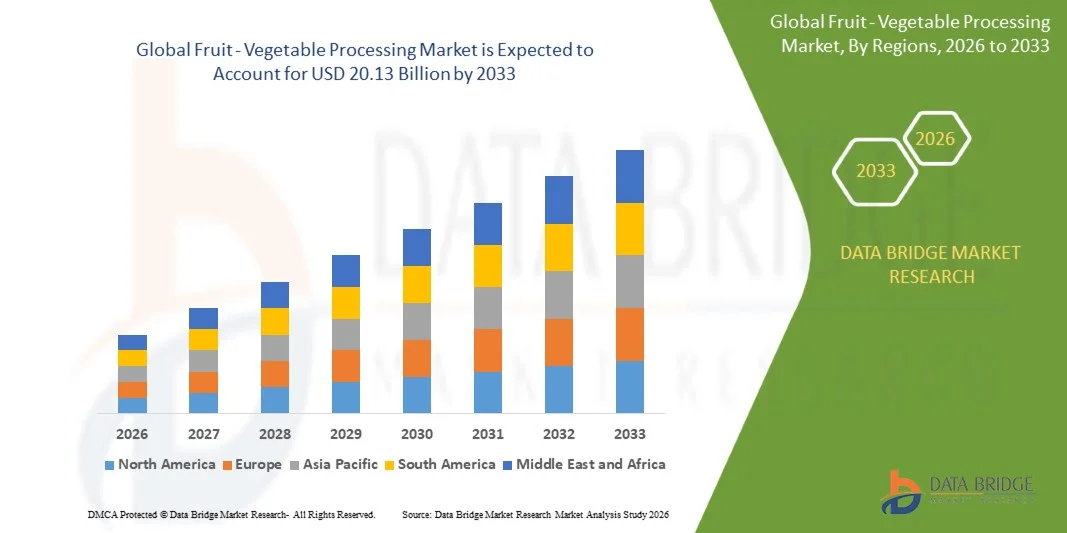
- The global fruit - vegetable processing market size was valued at USD 10.92 billion in 2025 and is expected to reach USD 20.13 billion by 2033, at a CAGR of 7.95% during the forecast period
- The market growth is largely fueled by the increasing demand for processed and convenience food products, driven by changing consumer lifestyles and rising urbanization, leading to higher consumption of ready-to-eat and easy-to-prepare fruit and vegetable products across both residential and foodservice sectors
- Furthermore, growing awareness regarding food safety, extended shelf life, and nutritional retention is establishing advanced fruit and vegetable processing technologies as essential solutions in the food industry. These converging factors are accelerating the adoption of efficient processing equipment, thereby significantly boosting the market growth
Fruit - Vegetable Processing Market Analysis
- Fruit and vegetable processing involves a range of mechanical and technological operations such as washing, sorting, peeling, cutting, freezing, drying, and packaging to enhance shelf life and maintain product quality. These processes enable large-scale production and distribution of food products while preserving taste, texture, and nutritional value
- The escalating demand for fruit and vegetable processing is primarily fueled by increasing consumption of packaged food, expansion of the food processing industry, and rising preference for hygienic and long-lasting food products across global markets
- North America dominated the fruit - vegetable processing market with a share of over 40% in 2025, due to the strong presence of advanced food processing infrastructure and high demand for packaged and convenience food products
- Asia-Pacific is expected to be the fastest growing region in the fruit - vegetable processing market during the forecast period due to rapid urbanization, rising disposable incomes, and increasing demand for convenience food products
- Washing & dewatering segment dominated the market with a market share of 33.3% in 2025, due to the critical need to maintain hygiene and remove contaminants before further processing. Food safety regulations and rising consumer awareness regarding clean-label products have significantly increased the demand for efficient washing systems. These systems ensure removal of dirt, pesticides, and microbial contaminants, enhancing product quality and shelf life
Report Scope and Fruit - Vegetable Processing Market Segmentation
|
Attributes |
Fruit - Vegetable Processing Key Market Insights |
|
Segments Covered |
|
|
Countries Covered |
North America
Europe
Asia-Pacific
Middle East and Africa
South America
|
|
Key Market Players |
|
|
Market Opportunities |
|
|
Value Added Data Infosets |
In addition to the insights on market scenarios such as market value, growth rate, segmentation, geographical coverage, and major players, the market reports curated by the Data Bridge Market Research also include in-depth expert analysis, pricing analysis, brand share analysis, consumer survey, demography analysis, supply chain analysis, value chain analysis, raw material/consumables overview, vendor selection criteria, PESTLE Analysis, Porter Analysis, and regulatory framework. |
Fruit - Vegetable Processing Market Trends
“Growing Use of Automated Fruit & Vegetable Processing”
- A significant trend in the fruit - vegetable processing market is the rising adoption of automated processing technologies, driven by the increasing need for operational efficiency, consistency, and product quality in large-scale production. Automation is enabling faster sorting, peeling, cutting, and packaging processes, reducing human labor dependence and minimizing contamination risks
- For instance, TOMRA Sorting Solutions provides advanced optical sorting machines widely used in fruit and vegetable processing facilities to enhance yield, reduce waste, and ensure uniform product quality. Such technologies are transforming traditional processing lines into high-throughput, precision-driven operations
- The integration of robotics and machine vision systems is expanding across the industry, supporting tasks such as grading, defect detection, and portioning with high accuracy. This trend is positioning automated equipment as a critical factor for processors aiming to meet strict quality standards while optimizing production capacity
- The market is witnessing increased use of high-capacity peeling and cutting machines that maintain nutritional integrity and reduce manual handling. Processors are leveraging these systems to improve throughput, maintain hygiene standards, and satisfy growing consumer demand for pre-processed fresh produce
- Companies are also adopting automated washing and drying systems to streamline post-harvest handling while preserving shelf life and freshness. These solutions contribute to reduced operational bottlenecks and enhance overall process sustainability
- The rising deployment of automated packaging lines ensures precise portioning, labeling, and sealing of ready-to-eat fruits and vegetables. This development is reinforcing the role of automation as a key enabler of supply chain efficiency and market competitiveness across global processing facilities
Fruit - Vegetable Processing Market Dynamics
Driver
“Rising Demand for Ready-to-Eat Products”
- The growing consumer preference for convenient, ready-to-eat fruit and vegetable products is driving demand across retail and foodservice channels. This shift is encouraging processors to adopt faster and more efficient processing lines capable of meeting quality and safety standards at scale
- For instance, Bonduelle Group has expanded its automated vegetable processing capabilities to cater to the rising demand for fresh-cut and ready-to-eat products in supermarkets and quick-service restaurants. Such investments support faster production cycles, consistent quality, and reduced labor dependency
- Increasing urbanization and busier lifestyles are further fueling demand for packaged salads, pre-cut fruits, and meal kits, prompting manufacturers to enhance their processing and packaging capacities
- The rising focus on food safety and traceability is encouraging processors to implement automated systems that minimize human contact and contamination risks. This ensures compliance with regulatory standards while meeting consumer expectations for hygiene and freshness
- Health-conscious consumer trends are also influencing the market, with a preference for minimally processed, nutrient-preserving products. This is motivating processors to deploy technologies that maintain nutritional content while offering convenience
Restraint/Challenge
“High Equipment Investment and Maintenance Costs”
- The fruit - vegetable processing market faces challenges due to the high capital investment required for automated machinery and the ongoing maintenance costs needed to ensure operational reliability. Advanced equipment such as optical sorters, robotic cutters, and automated packaging systems require significant upfront expenditure
- For instance, Key Technology’s automated sorting and processing solutions involve considerable procurement and installation costs, which can limit adoption among small and mid-sized processors. Such financial barriers slow market penetration despite clear efficiency gains
- Maintenance and spare parts for complex automated systems add to operational expenditure, especially when dealing with specialized components and high-tech sensors
- The market also encounters challenges related to system integration, as processors must adapt existing lines to accommodate new automation while ensuring minimal disruption to production
- Economic constraints and cost sensitivity among smaller processors can limit investments in automation, thereby affecting the overall growth rate of advanced fruit - vegetable processing solutions
Fruit - Vegetable Processing Market Scope
The market is segmented on the basis of type, operation type, material, and product type.
• By Type
On the basis of type, the fruit and vegetable processing market is segmented into pre-processing, peeling/inspection/slicing, washing & dewatering, fillers, packaging & handling, seasoning systems, and others. The washing & dewatering segment dominated the largest market revenue share of 33.3% in 2025, driven by the critical need to maintain hygiene and remove contaminants before further processing. Food safety regulations and rising consumer awareness regarding clean-label products have significantly increased the demand for efficient washing systems. These systems ensure removal of dirt, pesticides, and microbial contaminants, enhancing product quality and shelf life. In addition, technological advancements in automated washing equipment have improved operational efficiency and reduced water consumption. The growing scale of industrial food processing facilities further supports the widespread adoption of washing and dewatering equipment.
The packaging & handling segment is anticipated to witness the fastest growth rate from 2026 to 2033, fueled by increasing demand for processed and ready-to-eat food products. Efficient packaging solutions are essential for preserving freshness, extending shelf life, and ensuring safe transportation of processed fruits and vegetables. The rising adoption of automation in packaging lines enhances speed, accuracy, and cost efficiency for manufacturers. In addition, innovations in sustainable and eco-friendly packaging materials are driving investments in advanced handling systems. The expansion of retail and e-commerce channels for food products further accelerates demand for advanced packaging and handling solutions.
• By Operation Type
On the basis of operation type, the fruit and vegetable processing market is segmented into automatic and semi-automatic. The automatic segment dominated the largest market revenue share in 2025, driven by increasing demand for high-efficiency processing and reduced human intervention in large-scale operations. Automated systems enable consistent quality, higher throughput, and reduced labor costs, which are essential for industrial food processing units. The integration of advanced technologies such as sensors and control systems improves precision and minimizes wastage during processing. In addition, stringent food safety standards encourage manufacturers to adopt automated solutions to maintain hygiene and traceability. The growing need for scalable production capabilities further supports the dominance of automatic processing systems.
The semi-automatic segment is expected to witness the fastest growth rate from 2026 to 2033, driven by its affordability and suitability for small and medium-sized enterprises. These systems offer flexibility and require lower initial investment compared to fully automated solutions, making them attractive for emerging market players. Semi-automatic equipment allows partial manual control, enabling customization in processing operations based on product type. In addition, the growing number of local food processing units in developing regions supports demand for such solutions. The gradual transition of small-scale processors toward mechanization further contributes to segment growth.
• By Material
On the basis of material, the fruit and vegetable processing market is segmented into fruits, vegetables, and others. The vegetables segment dominated the largest market revenue share in 2025, driven by the high consumption volume and wide application of processed vegetables across food industries. Vegetables are extensively used in frozen, canned, and ready-to-cook products, leading to strong demand for processing solutions. The increasing preference for convenience foods and ready meals further accelerates the processing of vegetables. In addition, advancements in preservation techniques help maintain nutritional value and extend shelf life. The rising global demand for plant-based diets also supports the dominance of vegetable processing.
The fruits segment is anticipated to witness the fastest growth rate from 2026 to 2033, fueled by increasing demand for fruit-based beverages, snacks, and health-oriented products. Consumers are increasingly shifting toward natural and nutrient-rich food options, driving the processing of fruits into juices, purees, and dried products. Technological advancements in processing equipment ensure better retention of flavor, color, and nutrients. In addition, the expansion of export markets for processed fruit products contributes to segment growth. The rising popularity of functional foods and organic fruit products further boosts demand.
• By Product Type
On the basis of product type, the fruit and vegetable processing market is segmented into fresh, freshly cut, canned, frozen, dried & dehydrated, and convenience. The frozen segment dominated the largest market revenue share in 2025, driven by its ability to preserve nutritional content while offering extended shelf life. Frozen fruits and vegetables are widely used in households and foodservice industries due to their convenience and year-round availability. The growth of cold chain infrastructure has significantly supported the expansion of frozen food distribution. In addition, advancements in freezing technologies ensure minimal quality degradation and improved texture retention. The increasing demand for ready-to-cook products further strengthens the segment’s dominance.
The convenience segment is expected to witness the fastest growth rate from 2026 to 2033, driven by changing consumer lifestyles and rising demand for ready-to-eat and easy-to-prepare food products. Urbanization and busy schedules have increased the preference for processed food that requires minimal preparation time. Manufacturers are focusing on innovative product offerings with enhanced taste and nutritional value to attract consumers. In addition, the expansion of modern retail and online food delivery platforms supports the growth of convenience products. The rising adoption of packaged healthy snacks and meal solutions further accelerates segment demand.
Fruit - Vegetable Processing Market Regional Analysis
- North America dominated the fruit - vegetable processing market with the largest revenue share of over 40% in 2025, driven by the strong presence of advanced food processing infrastructure and high demand for packaged and convenience food products
- Consumers in the region prioritize food safety, quality, and extended shelf life, encouraging the adoption of advanced processing technologies across fruits and vegetables
- This widespread adoption is further supported by high consumption of frozen and ready-to-eat products, well-established cold chain logistics, and continuous technological advancements, establishing processed fruits and vegetables as a key component in both retail and foodservice sectors
U.S. Fruit - Vegetable Processing Market Insight
The U.S. fruit - vegetable processing market captured the largest revenue share in 2025 within North America, fueled by strong demand for convenience foods and high consumption of frozen and canned products. Consumers are increasingly shifting toward ready-to-cook and packaged food options due to busy lifestyles and urbanization. The presence of major food processing companies and continuous investment in automation technologies further strengthens the market. Moreover, the expansion of retail chains and online grocery platforms is significantly contributing to the growth of processed fruit and vegetable products across the country.
Europe Fruit - Vegetable Processing Market Insight
The Europe fruit - vegetable processing market is projected to expand at a substantial CAGR throughout the forecast period, primarily driven by stringent food safety regulations and increasing demand for organic and high-quality processed products. The rise in health-conscious consumers and preference for clean-label food products is fostering market growth. European countries are witnessing strong demand for frozen, canned, and minimally processed fruits and vegetables across households and foodservice sectors. The integration of sustainable processing techniques and eco-friendly packaging solutions further supports market expansion in the region.
U.K. Fruit - Vegetable Processing Market Insight
The U.K. fruit - vegetable processing market is anticipated to grow at a noteworthy CAGR during the forecast period, driven by rising demand for convenience food and ready-to-eat meals. Increasing urban population and changing dietary patterns are encouraging consumers to opt for processed fruits and vegetables. The country’s well-developed retail infrastructure and strong presence of supermarkets support product availability. In addition, the growing trend of healthy snacking and plant-based diets is further boosting demand for processed fruit and vegetable products.
Germany Fruit - Vegetable Processing Market Insight
The Germany fruit - vegetable processing market is expected to expand at a considerable CAGR during the forecast period, fueled by strong demand for high-quality and sustainably processed food products. Germany’s advanced food processing industry and focus on technological innovation support efficient production and distribution. Consumers in the country show a strong preference for organic and minimally processed food items. The integration of automation and energy-efficient processing technologies further enhances market growth, particularly in frozen and canned product segments.
Asia-Pacific Fruit - Vegetable Processing Market Insight
The Asia-Pacific fruit - vegetable processing market is poised to grow at the fastest CAGR during the forecast period of 2026 to 2033, driven by rapid urbanization, rising disposable incomes, and increasing demand for convenience food products. The region is witnessing strong growth in consumption of processed fruits and vegetables due to changing lifestyles and expanding middle-class population, with India emerging as the fastest growing country. Furthermore, the expansion of food processing industries, government support for agricultural value addition, and improvements in cold storage infrastructure are accelerating market growth across the region.
Japan Fruit - Vegetable Processing Market Insight
The Japan fruit - vegetable processing market is gaining momentum due to the country’s demand for high-quality, convenient, and long shelf-life food products. Consumers prefer neatly packaged and ready-to-eat fruit and vegetable items that align with busy urban lifestyles. The country’s strong focus on food safety and advanced processing technologies supports market expansion. In addition, the aging population is encouraging demand for easy-to-consume and nutritionally balanced processed food products.
China Fruit - Vegetable Processing Market Insight
The China fruit - vegetable processing market accounted for the largest market revenue share in Asia Pacific in 2025, attributed to rapid urbanization, expanding middle-class population, and increasing demand for packaged food products. China is one of the largest producers and consumers of processed fruits and vegetables. The growing adoption of modern retail channels and e-commerce platforms is boosting product accessibility. In addition, strong domestic production capabilities and government initiatives supporting food processing industries are key factors driving market growth in the country.
Fruit - Vegetable Processing Market Share
The fruit - vegetable processing industry is primarily led by well-established companies, including:
- GEA Group Aktiengesellschaft (Germany)
- SPX FLOW (U.S.)
- Krones AG (Germany)
- Tetra Pak International S.A. (Switzerland)
- Alfa Laval (Sweden)
- JBT Corporation (U.S.)
- I.M.A. Industria Macchine Automatiche S.p.A (Italy)
- Feldmeier Equipment, Inc. (U.S.)
- Coperion GmbH (Germany)
- GEMAK (Turkey)
- Sealtech Engineers Private Limited (India)
- Inoxpa S.A. (Spain)
- Stephan Machinery (Germany)
- SSP Pvt. Ltd (India)
- Mahanagar Engineering Pvt. Ltd (India)
- Dairy Tech India (India)
- ABL Technologies Ltd (India)
- Varsha Engineers (India)
Latest Developments in Global Fruit - Vegetable Processing Market
- In February 2024, Nestlé S.A. expanded its fruit and vegetable processing capabilities through investments in plant-based and ready-to-eat product lines, which strengthened its ability to cater to evolving consumer demand for convenient and health-focused food products. This development enhanced its innovation pipeline and enabled the company to introduce value-added processed offerings with improved nutritional profiles. It also supported capacity expansion and reinforced its competitive positioning across both developed and emerging markets
- In September 2021, The Kraft Heinz Company acquired Hemmer, which allowed the company to localize its product portfolio by introducing region-specific sauces and condiments tailored to Brazilian consumer preferences. This move strengthened its distribution network and brand presence across Latin America. The acquisition also enabled cross-leveraging of supply chains and improved market penetration in the fast-growing processed food segment
- In June 2021, AGRANA Beteiligungs-AG acquired Taiyo Kagaku Co. along with its Yokkaichi plant in southern Japan, which significantly enhanced its footprint in the Asia-Pacific region. This development improved its fruit preparation and ingredient processing capabilities while increasing production efficiency and output capacity. It also enabled Agrana to better serve regional customers and strengthen its position in high-growth Asian markets
- In August 2020, ADM (Archer Daniels Midland Company) expanded its fruit and vegetable ingredient processing operations through capacity enhancements and product innovation, enabling the company to address growing demand from food manufacturers for high-quality processed ingredients. This initiative supported the development of customized solutions and improved supply reliability across global markets. It also strengthened ADM’s role as a key supplier in the value-added food processing ecosystem
- In July 2020, Olam International strengthened its food processing segment through strategic restructuring and investments in sustainable sourcing and processing operations, which enhanced overall supply chain efficiency. This move supported the company’s focus on delivering natural and minimally processed food products aligned with evolving consumer preferences. It also improved operational scalability and reinforced its market presence in the global fruit and vegetable processing industry
SKU-
Get online access to the report on the World's First Market Intelligence Cloud

- Interactive Data Analysis Dashboard
- Company Analysis Dashboard for high growth potential opportunities
- Research Analyst Access for customization & queries
- Competitor Analysis with Interactive dashboard
- Latest News, Updates & Trend analysis
- Harness the Power of Benchmark Analysis for Comprehensive Competitor Tracking
Global Fruit Vegetable Processing Market, Supply Chain Analysis and Ecosystem Framework
To support market growth and help clients navigate the impact of geopolitical shifts, DBMR has integrated in-depth supply chain analysis into its Global Fruit Vegetable Processing Market research reports. This addition empowers clients to respond effectively to global changes affecting their industries. The supply chain analysis section includes detailed insights such as Global Fruit Vegetable Processing Market consumption and production by country, price trend analysis, the impact of tariffs and geopolitical developments, and import and export trends by country and HSN code. It also highlights major suppliers with data on production capacity and company profiles, as well as key importers and exporters. In addition to research, DBMR offers specialized supply chain consulting services backed by over a decade of experience, providing solutions like supplier discovery, supplier risk assessment, price trend analysis, impact evaluation of inflation and trade route changes, and comprehensive market trend analysis.
Research Methodology
Data collection and base year analysis are done using data collection modules with large sample sizes. The stage includes obtaining market information or related data through various sources and strategies. It includes examining and planning all the data acquired from the past in advance. It likewise envelops the examination of information inconsistencies seen across different information sources. The market data is analysed and estimated using market statistical and coherent models. Also, market share analysis and key trend analysis are the major success factors in the market report. To know more, please request an analyst call or drop down your inquiry.
The key research methodology used by DBMR research team is data triangulation which involves data mining, analysis of the impact of data variables on the market and primary (industry expert) validation. Data models include Vendor Positioning Grid, Market Time Line Analysis, Market Overview and Guide, Company Positioning Grid, Patent Analysis, Pricing Analysis, Company Market Share Analysis, Standards of Measurement, Global versus Regional and Vendor Share Analysis. To know more about the research methodology, drop in an inquiry to speak to our industry experts.
Customization Available
Data Bridge Market Research is a leader in advanced formative research. We take pride in servicing our existing and new customers with data and analysis that match and suits their goal. The report can be customized to include price trend analysis of target brands understanding the market for additional countries (ask for the list of countries), clinical trial results data, literature review, refurbished market and product base analysis. Market analysis of target competitors can be analyzed from technology-based analysis to market portfolio strategies. We can add as many competitors that you require data about in the format and data style you are looking for. Our team of analysts can also provide you data in crude raw excel files pivot tables (Fact book) or can assist you in creating presentations from the data sets available in the report.












