What is the Fumigants Market Size and Growth Rate?
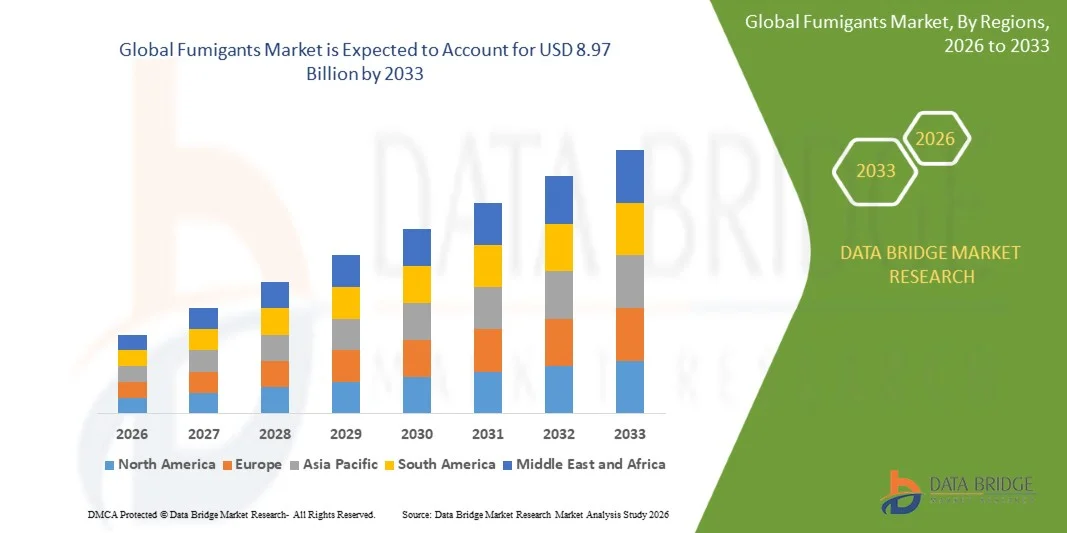
- As per market analysis, the global Fumigants Market was valued at approximately USD 5.48 billion in 2025 and is projected to reach USD 8.97 billion by 2033, growing at a CAGR of 5.68% from 2026 to 2033.
- The market is witnessing growth driven by increasing global food demand, rising crop-pest pressure, growing requirements for effective pest management, and increasing emphasis on protecting agricultural products during storage and transportation. Fumigants are widely used for controlling insects, nematodes, and other pests affecting crops, stored grains, warehouses, shipping containers, and food-processing facilities, supporting their continued adoption across agricultural and commercial applications.
- Increasing adoption of technology-enabled pest control services, improved fumigation techniques, and advanced application technologies is creating further growth opportunities. The expansion of commercial agriculture, rising post-harvest loss prevention requirements, and increasing demand for effective crop protection solutions are supporting market development across agriculture, commercial and industrial facilities, and residential applications.
Market Size & Forecast
- Market Value (2025): USD 5.48 billion
- Expected Market Value (2033): USD 8.97 Million
- Forecast CAGR (2026–2033): 5.68%
- Leading Region in 2025: Asia-Pacific
- Fastest Growing Region: Asia-Pacific
What are the Major Takeaways of the Fumigants Market ?
- Asia Pacific dominated the global Fumigants Market with a market share of 45.36% in 2025, supported by high agricultural production, large grain-storage infrastructure, dense population centers, and increasing pest-control requirements across agricultural, residential, and commercial applications. Strong demand for fumigation in China, India, and Japan, along with expanding food-processing, warehousing, and commodity-storage facilities, is further supporting regional market development.
- Asia Pacific is expected to witness strong growth in the global Fumigants Market during the forecast period, supported by expanding agricultural production, increasing demand for stored-grain protection, rising pest infestation, and growing adoption of fumigation across residential and industrial applications. Increasing investments in grain-storage facilities, food-processing infrastructure, warehouses, and commodity transportation across China, India, Japan, and other Asian economies are further contributing to regional expansion.
- Phosphine represented the leading type segment of the global Fumigants Market in 2025, supported by its extensive application in stored-grain and commodity protection. Its use across wheat, rice, maize, pulses, oilseeds, animal feed, processed foods, tobacco, and other stored commodities is supporting segment dominance. The sulfuryl fluoride segment is expected to witness strong growth during the forecast period, supported by increasing use in food-processing plants, warehouses, mills, transportation equipment, commodity chambers, and structural pest-control applications.
- Solid represented the largest form segment of the global Fumigants Market in 2025, supported by established use of aluminum-phosphide and magnesium-phosphide formulations in grain-storage and commodity-protection applications. Their suitability for silos, warehouses, bag stacks, railcars, containers, and ship holds is supporting widespread adoption. The gas segment is expected to witness strong growth during the forecast period, supported by precise dosage control, rapid distribution, recirculation capability, and compatibility with automated concentration-monitoring systems.
- Agriculture represented the leading application segment of the global Fumigants Market in 2025, supported by extensive fumigation requirements for soil, stored grains, seeds, animal feed, nursery products, and post-harvest agricultural commodities. The growing need to control nematodes, insects, weeds, fungi, bacteria, and other soil- and storage-related pests is supporting fumigant adoption across agricultural supply chains. The Commercial & Industrial segment is expected to witness strong growth during the forecast period, driven by fumigation requirements across warehouses, ship holds, railcars, containers, silos, food-processing facilities, and transportation vehicles.
- The global Fumigants Market is expected to grow at a CAGR of 6.17% from 2026 to 2034, driven by increasing pest infestation across agricultural, commercial, industrial, and residential applications, rising demand for crop and stored-commodity protection, expansion of grain-storage infrastructure, and changing pest pressures. Increasing adoption of technology-enabled pest-control services and the development of advanced fumigation products and application methods are further creating opportunities for market expansion.
Report Scope Fumigants Market Segmentation
|
Attributes |
Fumigants Key Market Insights |
|
Segments Covered |
|
|
Countries Covered |
North America
Europe
Asia-Pacific
Middle East and Africa
South America
|
|
Key Market Players |
|
|
Market Opportunities |
|
|
Value Added Data Infosets |
In addition to the insights on market scenarios such as market value, growth rate, segmentation, geographical coverage, and major players, the market reports curated by the Data Bridge Market Research also include import export analysis, production capacity overview, production consumption analysis, price trend analysis, climate change scenario, supply chain analysis, value chain analysis, raw material/consumables overview, vendor selection criteria, PESTLE Analysis, Porter Analysis, and regulatory framework. |
What is the Key Trend in the Fumigants Market ?
- Fumigant manufacturers are increasingly focusing on developing safer and more effective fumigation chemistries in response to environmental regulations, operator-safety requirements, and the phase-out of methyl bromide. The development of alternative fumigants such as phosphine, sulfuryl fluoride, and newer chemistries is supporting the transition toward fumigation solutions with improved application characteristics and regulatory compliance. The continued search for alternatives that provide broad-spectrum pest control while reducing environmental and safety concerns is becoming an important trend in the market.
- The adoption of digital monitoring and automated fumigation technologies is gaining traction, as users seek greater control over fumigant concentration, treatment duration, exposure conditions, and documentation. Integration of atmospheric monitoring, automated gas-delivery systems, sensors, and digital treatment records is supporting more consistent fumigation processes across grain-storage facilities, warehouses, food-processing plants, shipping containers, and other enclosed environments. Recent industry developments indicate increasing use of digital tools for monitoring, planning, service support, and operational decision-making.
- For instance, on August 26, 2025, the U.S. EPA registered eFUME as a labeled fumigant for selected produce imports, following extensive development and testing as an alternative to methyl bromide. The registration represents an important development in fumigation chemistry and supports the industry's transition toward alternative products for quarantine and stored-product pest-control applications. Western Fumigation stated that eFUME was the first new fumigant approved by the EPA since 1961.
- The integration of automated gas monitoring with fumigation equipment is also supporting improved treatment accuracy and compliance. Advanced systems can monitor fumigant concentrations and atmospheric conditions during treatment, helping fumigation operators maintain required exposure levels and document treatment activities. This trend is particularly relevant to grain silos, warehouses, food-processing facilities, shipping containers, and quarantine applications where accurate treatment and traceability are important. In phosphine fumigation, the increasing use of controlled-release and monitoring technologies is supporting more precise treatment practices.
- The adoption of integrated and non-chemical pest-control approaches is further emerging as an important trend, as increasing regulatory scrutiny and resistance concerns encourage users to combine conventional fumigants with controlled-atmosphere treatment, heat treatment, monitoring, sealing, and other pest-management methods. Research indicates that resistance management, safety requirements, infrastructure limitations, and regulatory fragmentation are influencing the development and commercial adoption of next-generation fumigation technologies. These factors are encouraging suppliers to develop integrated solutions that improve pest-control effectiveness while reducing dependence on individual fumigant chemistries.
What are the Key Drivers of the Fumigants Market ?
- Fumigant providers are increasingly focusing on technology-enabled pest-control solutions that combine fumigation products with digital monitoring, real-time pest detection, automated alerts, and data-based treatment management. The integration of connected sensors and digital pest-control platforms is enabling pest management professionals and facility operators to monitor infestation activity continuously, identify emerging pest problems, and implement fumigation treatments more efficiently. These capabilities are supporting the transition from conventional product-based fumigation toward integrated monitoring and treatment services.
- The rising pressure from crop pests and changes in pest distribution are driving demand for fumigants across agricultural and post-harvest applications. Changes in temperature, rainfall, humidity, cropping cycles, and commodity movement can influence pest survival, reproduction, and geographical distribution, increasing the requirement for effective pest-control measures. Fumigants are widely used to control insects, nematodes, and other pests affecting agricultural soil, stored grains, seeds, and commodities, thereby supporting crop protection and reducing post-harvest losses.
- For instance, in May 2026, digital pest-control systems are increasingly incorporating wireless sensors and real-time monitoring capabilities to provide automated alerts regarding pest activity. These systems can transmit infestation information to users through connected devices, enabling faster identification of pest emergence and supporting preventive treatment decisions. The increasing use of digital surveillance platforms for monitoring agricultural pests is further encouraging fumigant manufacturers and pest-control service providers to develop integrated solutions combining treatment, monitoring, data analytics, and compliance documentation.
- The expansion of grain production, commercial storage capacity, and post-harvest protection requirements is further supporting fumigant adoption. Fumigation is extensively used across grain elevators, warehouses, silos, food-processing facilities, mills, transportation equipment, shipping containers, and vessels to protect stored commodities from insects and other pests. Increasing international trade in agricultural commodities is also creating demand for quarantine fumigation and pre-shipment treatment of containers, vessels, railcars, wooden packaging, and export commodities.
- Product innovation and the development of alternative fumigation technologies are emerging as important growth drivers. Manufacturers are focusing on alternative fumigants, improved formulations, cylinderized phosphine, sulfuryl fluoride, advanced soil fumigants, recirculation systems, and digitally monitored application technologies. These developments are supporting more controlled treatment, improved application efficiency, and broader fumigation applications across agriculture, stored commodities, food-processing facilities, warehouses, and structural pest-control environments.
Which Factors are Challenging the Growth of the Fumigants Market ?
- Stringent health, environmental, and regulatory requirements are challenging the growth of the Global Fumigants Market , as fumigants are toxic substances that require controlled application, appropriate sealing, gas monitoring, aeration, clearance testing, and restricted re-entry procedures. Increasing regulatory scrutiny related to worker exposure, pesticide residues, toxic emissions, and environmental impact is increasing the complexity and compliance costs associated with fumigation operations.
- Restrictions on methyl bromide and the gradual transition toward alternative fumigation solutions are creating challenges for market participants. Methyl bromide has faced substantial restrictions because of its ozone-depleting properties, while regulatory requirements continue to influence its use in quarantine and pre-shipment applications. The development and commercial adoption of alternative fumigants are also affected by regulatory approval requirements, product efficacy, infrastructure needs, and differences in regulations across countries.
- Increasing resistance of stored-product pests to phosphine is emerging as a major challenge for the Global Fumigants Market , particularly because phosphine remains widely used for stored-grain and commodity protection. Repeated application, inadequate sealing, insufficient gas concentration, and shortened exposure periods can contribute to resistance development, potentially reducing treatment effectiveness and increasing the need for improved application protocols, monitoring, and resistance-management strategies.
- High application and compliance costs are also restricting fumigant adoption, particularly among smaller operators and users in cost-sensitive markets. Effective fumigation can require certified personnel, protective equipment, gas-monitoring instruments, specialized sealing systems, treatment planning, aeration, and clearance testing. These requirements increase operational expenditure and can make fumigation more difficult to implement across smaller agricultural storage facilities and commercial operations.
- The availability of alternative pest-control technologies is creating additional competitive pressure on conventional fumigants. Hermetic storage, controlled-atmosphere systems, heat treatment, biological pest control, improved storage technologies, and integrated pest-management approaches are increasingly being considered alongside chemical fumigation.
How is the Fumigants Market Segmented?
The market is segmented on the basis of type, form, and application.
- By Component
On the basis of type, the Fumigants Market is segmented into Methyl Bromide, Phosphine, Sulfuryl Fluoride, and Others. The Phosphine segment dominated the market with a share of 43.13% in 2025, supported by its extensive use for stored-grain and commodity protection across wheat, rice, maize, pulses, oilseeds, animal feed, processed foods, tobacco, and other commodities. Its availability in aluminum-phosphide and magnesium-phosphide formulations and suitability for silos, warehouses, ships, railcars, containers, and other enclosed storage environments are further supporting its leading position.
The Sulfuryl Fluoride segment is expected to witness the fastest growth during the forecast period at a CAGR of 6.63%, supported by increasing adoption across food-processing plants, warehouses, mills, transportation equipment, commodity chambers, and structural pest-control applications. Its growing use in commercial and industrial fumigation is further supporting segment expansion.
- By Form
On the basis of form, the Fumigants Market is segmented into Solid, Liquid, and Gas. The Solid segment dominated the market with a share of 34.23% in 2025, supported by the established use of aluminum-phosphide and magnesium-phosphide tablets, pellets, sachets, plates, strips, and bag formulations. Their suitability for grain-storage facilities, silos, warehouses, containers, railcars, ship holds, and bag stacks, along with convenient transportation and storage characteristics, is supporting the widespread adoption of solid fumigants.
The Gas segment is expected to witness the fastest growth during the forecast period at a CAGR of 6.30%, supported by precise dosage control, rapid distribution, recirculation capabilities, and compatibility with automated concentration-monitoring systems. Increasing adoption of cylinderized phosphine, sulfuryl fluoride, methyl bromide, and other gaseous fumigation solutions across enclosed commercial and industrial environments is further supporting segment growth.
- By Application
On the basis of application, the Fumigants Market is segmented into Commercial & Industrial, Agriculture, and Residential. The Agriculture segment dominated the market with a share of 23.12% in 2025, supported by extensive fumigation requirements for pre-plant soil treatment, stored-grain protection, seed and feed protection, orchard and nursery treatment, greenhouse applications, and post-harvest protection of agricultural commodities. Increasing requirements to control nematodes, weeds, fungi, bacteria, insects, and other soil- and storage-related pests are further supporting segment dominance.
The Commercial & Industrial segment is expected to witness the fastest growth during the forecast period at a CAGR of 6.39%, supported by increasing fumigation requirements across ship holds, railcars, sea containers, silos, warehouses, chambers, transportation vehicles, and other commercial and industrial facilities. Growing demand for effective pest control across storage, logistics, food processing, and commodity transportation environments is further contributing to segment expansion.
Which Region Holds the Largest Share of the Fumigants Market ?
- Asia Pacific dominated the global Fumigants Market with a market share of 39.05% in 2025, supported by large grain-production and consumption volumes, extensive use of phosphine, and a broad base of small and industrial storage facilities. Warm and humid climatic conditions and expanding trade in rice, wheat, maize, pulses, oilseeds, spices, fresh produce, and timber are further supporting the region's leading position. China and India represent significant markets within the region due to their extensive grain-storage, food-processing, warehousing, and commodity-distribution infrastructure.
- Asia Pacific is expected to witness the fastest growth in the Global Fumigants Market at a CAGR of 6.68% from 2026 to 2034, supported by increasing agricultural production, growing demand for stored-commodity protection, expansion of grain-storage infrastructure, and rising movement of agricultural commodities across domestic and international supply chains. Increasing fumigation requirements across warehouses, food-processing facilities, ports, containers, and other storage and transportation facilities in China, India, Japan, Australia, and other Asian economies are further supporting regional market expansion.
U.S. Fumigants Market Insight
The U.S. Fumigants Market is supported by extensive agricultural production, large-scale grain storage, and the need to protect commodities throughout storage, processing, and transportation. Fumigation is widely used to control insects and other pests in stored grains, warehouses, food-processing facilities, shipping containers, and commercial structures. Increasing emphasis on food safety, post-harvest loss prevention, and effective pest management is supporting demand for fumigation products. Regulatory requirements governing pesticide application, worker safety, and environmental protection are also influencing product selection and encouraging the adoption of controlled and professionally managed fumigation practices.
Europe Fumigants Market Insight
The Europe Fumigants Market is supported by increasing demand for effective pest management across agriculture, food storage, warehousing, and commercial facilities. The region’s well-developed agricultural and food-processing industries are generating demand for fumigation solutions to protect stored grains, commodities, and processed food products from insects and other pests. Stringent food safety, pesticide-use, and environmental regulations are also encouraging the adoption of controlled and compliant fumigation practices. Increasing investments in modern storage infrastructure, post-harvest protection, and technology-enabled pest-control services are further supporting market development across countries such as Germany, France, Italy, Spain, and the United Kingdom.
U.K. Fumigants Market Insight
The U.K. Fumigants Market is supported by demand for effective pest management across agriculture, food storage, warehousing, logistics, and commercial facilities. The country’s substantial food-import and commodity-storage activities create requirements for fumigation to protect stored grains, food products, and other commodities from insects and pests. Increasing emphasis on food safety, quarantine compliance, and prevention of post-harvest losses is supporting the adoption of fumigation solutions. At the same time, stringent environmental and worker-safety regulations are encouraging market participants to adopt controlled application practices, safer alternatives, and improved fumigation technologies.
Germany Fumigants Market Insight
Germany’s Fumigants Market is supported by the country’s well-developed agricultural sector, extensive food-processing industry, and advanced storage and logistics infrastructure. Increasing requirements for effective protection of grains, stored commodities, food products, warehouses, and transportation facilities are supporting the use of fumigation solutions. Growing emphasis on food safety, pest management, and prevention of post-harvest losses is further contributing to market demand. Stringent regulatory and environmental requirements are encouraging market participants to adopt controlled application practices and develop safer, effective fumigation technologies for agricultural, commercial, and industrial applications.
Asia-Pacific Fumigants Market Insight
The Asia-Pacific Fumigants Market is supported by the region’s extensive agricultural production, expanding grain-storage infrastructure, and increasing demand for effective pest-control solutions across agricultural and commercial applications. Growing food consumption and international trade in grains, cereals, spices, and other agricultural commodities are increasing the need for post-harvest protection and storage fumigation. China and India represent important markets due to their large agricultural bases and expanding warehousing and food-processing facilities. Increasing adoption of fumigation across warehouses, silos, shipping containers, and food-processing facilities is further supporting market expansion across the region.
Japan Fumigants Market Insight
Japan's Fumigants Market is supported by the country's well-developed agricultural, food-processing, storage, and logistics infrastructure, creating consistent demand for effective pest-control solutions. Increasing requirements for protecting stored grains, food commodities, warehouses, shipping containers, and other enclosed facilities are supporting fumigant adoption. Stringent food-safety and pest-control standards are encouraging the use of controlled and professionally managed fumigation practices. In addition, Japan's extensive international trade in agricultural and processed commodities is contributing to demand for quarantine and pre-shipment fumigation solutions. Technological advancements in monitoring and application methods are further supporting market development.
China Fumigants Market Insight
China's Fumigants Market is supported by the country's large agricultural production base, extensive grain-storage infrastructure, and increasing need for effective pest management across agricultural and commercial facilities. Growing production and movement of rice, wheat, maize, oilseeds, and other commodities are increasing demand for fumigation to protect stored products from insects and other pests. Expansion of food-processing facilities, warehouses, logistics networks, and commodity-trading activities is further supporting market development. Increasing focus on post-harvest loss reduction, food security, storage hygiene, and efficient pest-control practices is also creating opportunities for fumigant products in China.
Which are the Top Companies in Fumigants Market ?
The Fumigants Market industry is primarily led by well-established companies, including:
- UPL Limited (India)
- Detia Degesch GmbH (Germany)
- Draslovka Holding a.s. (Czech Republic)
- AMVAC Chemical Corporation (U.S.)
- Douglas Products and Packaging Company LLC (U.S.)
- BASF SE (Germany)
- Corteva Agriscience, Inc. (U.S.)
- Syngenta AG (Switzerland)
- FMC Corporation (U.S.)
- ADAMA Agricultural Solutions Ltd. (Israel)
- Solvay S.A. (Belgium)
- Arkema S.A. (France)
- LANXESS AG (Germany)
- Nufarm Limited (Australia)
- Nippon Soda Co., Ltd. (Japan)
What are Latest Developments in Fumigants Market ?
- In September 2025, Detia Degesch Group expanded its fumigation-services footprint in Europe through the acquisition of Fumico Holding B.V. (Netherlands) and DDD, d.o.o. Koper (Slovenia) from INTRESO Group BV. The transaction strengthened Detia Degesch's presence at important European ports, including Rotterdam, Amsterdam, and Koper, and expanded its fumigation-service capabilities.
- In February 2025, Detia Degesch Group participated in the Infestation Control Conference (ICC 2025) in Chiang Mai, Thailand, where the company shared expertise related to phosphine fumigation, controlled-atmosphere treatments, heat treatment, freezing, sanitation, and pest-management practices. The event highlighted increasing industry focus on integrated and alternative approaches to stored-product pest control.
- In January 2025, Detia Degesch introduced the U-Phos® cylinderized phosphine fumigant through Degesch America, providing a cylinder-based phosphine solution for stored-grain and commodity fumigation. The product is designed to release phosphine gas through dispensing equipment, supporting professional fumigation applications.
- In May 2025, Research continued to focus on improving the safety and effectiveness of phosphine fumigation. A study published in 2025 evaluated phosphane exposure during good-practice fumigation using metal-phosphide formulations, including a Detia Degesch magnesium-phosphide product. The research assessed gas concentrations and sealing effectiveness during post-harvest fumigation, highlighting the importance of controlled application and monitoring.
- In September 2026, Phosphine fumigation research continued to address exposure management and application practices. A 2026 study examined phosphane exposure levels during good-practice fumigation and evaluated conditions associated with metal-phosphide formulations used for post-harvest treatments. Such research supports the development of safer fumigation procedures and improved operational controls.

- Interactive Data Analysis Dashboard
- Company Analysis Dashboard for high growth potential opportunities
- Research Analyst Access for customization & queries
- Competitor Analysis with Interactive dashboard
- Latest News, Updates & Trend analysis
- Harness the Power of Benchmark Analysis for Comprehensive Competitor Tracking
Data collection and base year analysis are done using data collection modules with large sample sizes. The stage includes obtaining market information or related data through various sources and strategies. It includes examining and planning all the data acquired from the past in advance. It likewise envelops the examination of information inconsistencies seen across different information sources. The market data is analysed and estimated using market statistical and coherent models. Also, market share analysis and key trend analysis are the major success factors in the market report. To know more, please request an analyst call or drop down your inquiry.
The key research methodology used by DBMR research team is data triangulation which involves data mining, analysis of the impact of data variables on the market and primary (industry expert) validation. Data models include Vendor Positioning Grid, Market Time Line Analysis, Market Overview and Guide, Company Positioning Grid, Patent Analysis, Pricing Analysis, Company Market Share Analysis, Standards of Measurement, Global versus Regional and Vendor Share Analysis. To know more about the research methodology, drop in an inquiry to speak to our industry experts.
Data Bridge Market Research is a leader in advanced formative research. We take pride in servicing our existing and new customers with data and analysis that match and suits their goal. The report can be customized to include price trend analysis of target brands understanding the market for additional countries (ask for the list of countries), clinical trial results data, literature review, refurbished market and product base analysis. Market analysis of target competitors can be analyzed from technology-based analysis to market portfolio strategies. We can add as many competitors that you require data about in the format and data style you are looking for. Our team of analysts can also provide you data in crude raw excel files pivot tables (Fact book) or can assist you in creating presentations from the data sets available in the report.