What is the Gel Hand Sanitizer Market Size and Growth Rate?
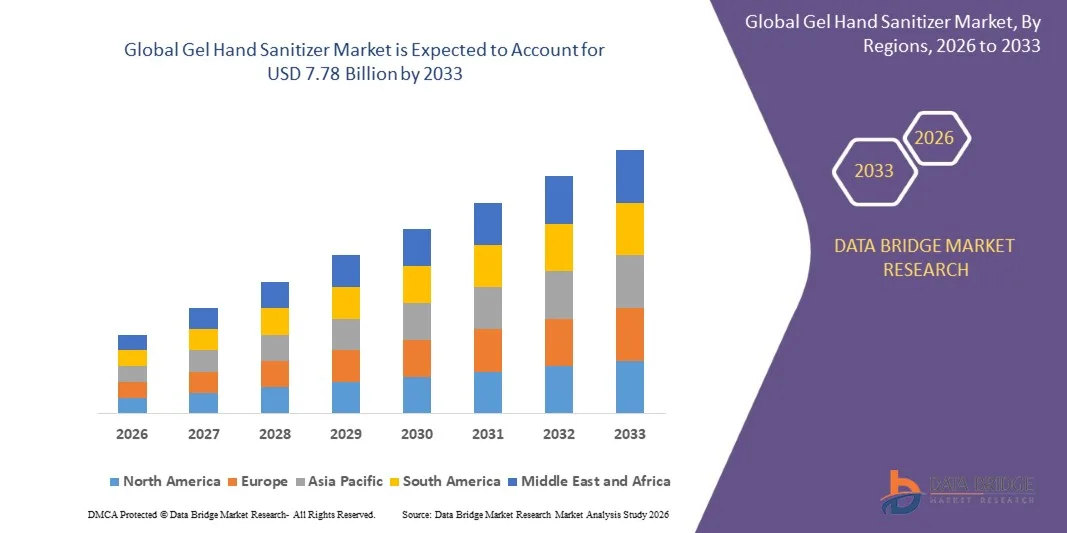
- As per Data Bridge Market Research analysis, the gel hand sanitizer market was valued at USD 3.85 billion in 2025 and is projected to reach USD 7.78 billion by 2033, growing at a CAGR of 9.20% from 2026 to 2033.
- The market is experiencing consistent growth driven by rising awareness of hand hygiene, increasing demand for convenient and effective sanitizing products, and expanding applications across healthcare facilities, educational institutions, commercial establishments, and households.
- The growing emphasis on infection prevention, combined with heightened hygiene standards in public spaces and workplaces, is encouraging consumers, healthcare providers, and businesses to adopt gel-based hand sanitizers. Alcohol-based formulations and convenient portable packaging are supporting product adoption by offering quick-drying, easy-to-use solutions for everyday hygiene and protection against germs.
Market Size & Forecast
- Global Market Value (2025): USD 3.85 Billion
- Expected Market Value (2033): USD 7.78 Billion
- Forecast CAGR (2026–2033): 9.20%
- Leading Region in 2025: North America
- Fastest Growing Region: Asia Pacific
What are the Major Takeaways of the Gel Hand Sanitizer Market?
- North America dominated the gel hand sanitizer market with the largest revenue share of 36.0% in 2025, supported by high hygiene awareness, established healthcare infrastructure, and strong demand for sanitizing products across hospitals, workplaces, and households.
- Asia-Pacific is expected to be the fastest-growing region at a CAGR of 6.6% from 2026 to 2033, fueled by rising hygiene awareness, expanding healthcare infrastructure, and increasing demand across China, India, and Japan.
- The alcohol-based segment led the market with a 82.6% share in 2025, driven by its established effectiveness against many bacteria and viruses when appropriately formulated and used.
- Non-alcohol-based are the fastest-growing content type, projected to register a CAGR of 5.5%, reflecting the surge in demand for alternative formulations among consumers seeking different ingredient profiles.
- The pump bottles segment dominated the packaging type category with a 44.9% revenue share in 2025, led by convenient dispensing, ease of use, and suitability for repeated applications.
- Hypermarkets and supermarkets accounted for 37.5% of the market share in 2025, preferred by broad product availability, convenient shopping experiences, and established retail networks.
- The dispensing packets segment is the fastest-growing packaging type category, with a CAGR of 6.0%, driven by rising demand for portable and single-use packaging, and commuters, convenient on-the-go application, and growing adoption across restaurants, healthcare facilities, and hospitality establishments.
Report Scope and Gel Hand Sanitizer Market Segmentation
|
Attributes |
Gel Hand Sanitizer Key Market Insights |
|
Segments Covered |
|
|
Countries Covered |
North America
Europe
Asia-Pacific
Middle East and Africa
South America
|
|
Key Market Players |
|
|
Market Opportunities |
|
|
Value Added Data Infosets |
In addition to the insights on market scenarios such as market value, growth rate, segmentation, geographical coverage, and major players, the market reports curated by the Data Bridge Market Research also include in-depth expert analysis, pricing analysis, brand share analysis, consumer survey, demography analysis, supply chain analysis, value chain analysis, raw material/consumables overview, vendor selection criteria, PESTLE Analysis, Porter Analysis, and regulatory framework. |
What is the Key Trend in the Gel Hand Sanitizer Market?
- Manufacturers are increasingly developing moisturizing gel hand sanitizers that combine effective germ protection with skin-conditioning ingredients to meet consumer demand for frequent sanitization without excessive skin dryness.
- For instance, in April 2024, a study published in Cosmetics on an alcohol-free hand sanitizer nanoemulgel formulated with lemon peel extract. The formulations demonstrated antimicrobial activity, highlighting innovation toward alternative, skin-conscious sanitizing products.
- Product innovation is increasingly focused on portable packaging, convenient dispensing formats, and skin-friendly formulations that support everyday hygiene at home, work, and while traveling.
- Manufacturers are also emphasizing moisturizing ingredients, including aloe vera, glycerin, and vitamin E, to improve skin comfort and encourage continued product use among consumers who sanitize their hands frequently.
- For instance, in August 2025, researchers at the University of Georgia announced the development of NORel, a nitric oxide-releasing hand sanitizer gel designed to provide longer-lasting antimicrobial activity than conventional alcohol-based sanitizers. The research reported activity against more than 97% of tested bacteria and fungi, including antibiotic-resistant strains
- As consumers and institutions prioritize convenient, skin-conscious hygiene solutions, manufacturers are expected to continue investing in improved gel formulations, portable product formats, and packaging innovations that support regular hand sanitization.
What are the Key Drivers of the Gel Hand Sanitizer Market?
- The rising awareness of infection prevention and the importance of hand hygiene is significantly increasing demand for gel hand sanitizers across healthcare facilities, educational institutions, workplaces, and residential settings.
- For instance, in October 2025, the World Health Organization (WHO) and UNICEF released the first global guidelines on hand hygiene in community settings, emphasizing access to effective hygiene products in homes, schools, public spaces, and institutions. The guidelines recognize alcohol-based hand rub containing at least 60% alcohol as an effective alternative when hands are not visibly dirty, supporting demand for convenient sanitizing products.
- Growing demand for convenient, portable hygiene products is encouraging consumers and businesses to adopt gel hand sanitizers that can be used without soap, water, or dedicated washing facilities in many everyday situations.
- For instance, in May 2025, the WHO promoted its World Hand Hygiene Day campaign, emphasizing proper hand hygiene practices in healthcare settings and the importance of ensuring access to hand hygiene products at the point of care. This initiative reinforces the need for sanitizers in hospitals and healthcare facilities to support infection prevention.
- With continued emphasis on infection control, consumer convenience, and hygiene practices across public and private settings, gel hand sanitizers are expected to remain important products in everyday hygiene routines.
What Factors are Challenging the Growth of the Gel Hand Sanitizer Market?
- Gel hand sanitizer manufacturers face challenges related to product safety, regulatory compliance, and quality control, particularly when maintaining appropriate alcohol concentrations and ensuring that formulations meet applicable safety requirements.
- For instance, in April 2024, Aruba Aloe Balm N.V. announced a voluntary nationwide recall of 40 lots of its Aruba Aloe Hand Sanitizer Gel Alcohol 80% after the products were found to contain alcohol denatured with methanol. This incident highlights the quality-control risks, product safety requirements, and potential financial and reputational costs associated with manufacturing gel hand sanitizers
- These challenges can increase testing, manufacturing, and compliance costs while creating additional pressure on producers to maintain consistent product quality and consumer confidence.
- The presence of improperly formulated or mislabeled products can undermine consumer trust, increase regulatory scrutiny, and expose manufacturers and distributors to recalls, financial losses, and reputational damage.
- For instance, in February 2024, the U.S. Food and Drug Administration added Shenzhen Shierjie Biological Engineering Co. Ltd. to its import alert after the manufacturer failed to respond to multiple requests for records related to manufacturing practices and product quality.
- As regulatory authorities continue emphasizing product safety, accurate labeling, and formulation quality, manufacturers must strengthen quality assurance and compliance practices to sustain consumer confidence and support long-term market growth.
How is the Gel Hand Sanitizer Market Segmented?
The gel hand sanitizer market is segmented on the basis of content, packaging type, distribution channel, and end-use.
- By Content
On the basis of content, the gel hand sanitizer market is segmented into alcohol-based and non-alcohol-based products. The alcohol-based segment dominated the broader hand sanitizer market with an estimated 82.6% share in 2025. These products are widely used in hospitals, clinics, workplaces, educational institutions, and households. Ethanol- and isopropyl alcohol-based formulations are popular because they dry quickly and are convenient when soap and water are unavailable. Their broad availability across pharmacies, supermarkets, and online retail platforms further supports adoption. Continued emphasis on infection prevention and hygiene compliance is strengthening demand for alcohol-based gel hand sanitizers. However, formulation quality, alcohol concentration, and skin tolerability remain important considerations for manufacturers and consumers.
The non-alcohol-based segment is expected to witness growth at an estimated CAGR of 5.5% from 2026 to 2033, reflecting demand for alternative formulations among consumers seeking different ingredient profiles. These products may use antimicrobial ingredients other than ethanol or isopropyl alcohol, depending on the formulation and applicable regulations. They can appeal to consumers concerned about alcohol exposure, skin dryness, or product compatibility with particular settings. Manufacturers are exploring plant-derived ingredients and other alternative formulations to differentiate their products. However, efficacy varies by active ingredient, and not every formulation provides the same level of protection against all pathogens.
- By Packaging Type
On the basis of packaging type, the gel hand sanitizer market is segmented into pump bottles and dispensing packets. The pump bottles segment dominated the broader sanitizer packaging market with an estimated 44.9% share in 2025, supported by convenient dispensing, ease of use, and suitability for repeated applications. Pump bottles are widely used in hospitals, offices, schools, restaurants, and households because they allow users to dispense gel without pouring it directly from the container. Different bottle sizes serve personal, countertop, and institutional requirements. Larger pump containers are particularly useful in high-traffic environments where frequent hand sanitization is required. Their availability across retail outlets and institutional supply channels further strengthens demand.
The dispensing packets segment is expected to grow at an estimated CAGR of 6.0% from 2026 to 2033, as demand increases for portable, single-use hygiene products. Individual packets are convenient for travelers, commuters, students, restaurant customers, and people who need sanitizers while away from home. Their compact format makes them suitable for pockets, handbags, travel kits, and promotional hygiene packs. Sachets can also support controlled dispensing and reduce the need to carry a full-sized bottle. Businesses may distribute individual packets in hospitality settings, transport facilities, and event venues. However, packaging costs and single-use material waste can limit their appeal.
- By Distribution Channel
On the basis of distribution channel, the gel hand sanitizer market is segmented into hypermarkets, supermarkets, drug stores, and online channels. The hypermarkets and supermarkets segment dominated the broader hand sanitizer market with an estimated 37.5% share in 2025, supported by broad product availability, convenient shopping experiences, and established retail networks. Consumers can purchase gel hand sanitizers alongside groceries, personal care products, and household essentials. Retail outlets also offer multiple brands, pack sizes, fragrances, and formulations to meet different consumer preferences. Promotional campaigns and discounts encourage repeat purchases and bulk buying. Strong foot traffic and widespread geographic coverage further support product accessibility.
The online distribution channel is expected to witness rapid growth at an estimated CAGR of 7.0% from 2026 to 2033, driven by increasing e-commerce adoption and demand for convenient home delivery. Online platforms allow consumers to compare product formulations, prices, pack sizes, and customer reviews before purchasing. Subscription services and multipack offers can support repeat buying among households and institutional customers. Digital channels also enable smaller manufacturers to reach consumers without relying entirely on physical retail networks. Growing smartphone usage and improvements in online payment and delivery infrastructure are further supporting adoption. However, competition, delivery costs, and concerns about product authenticity can affect purchasing decisions.
- By End-Use
On the basis of end-use, the gel hand sanitizer market is segmented into restaurants, schools, hospitals, and others. The hospitals segment is expected to dominate the market with an estimated 45.0% share in 2025, driven by infection prevention practices and the need for frequent hand hygiene among healthcare workers, patients, and visitors. Hospitals use hand sanitizers across patient-care areas, treatment rooms, nursing stations, and other clinical environments. Alcohol-based hand rubs are particularly important when hands are not visibly soiled and handwashing facilities are not immediately required. Healthcare institutions also purchase sanitizing products in bulk to maintain availability across departments. Infection prevention protocols and healthcare quality standards further support demand.
The restaurants segment is expected to experience growth at an estimated CAGR of 6.0% from 2026 to 2033, supported by rising attention to food safety, employee hygiene, and cleanliness in food-service environments. Restaurants use hand sanitizers at entrances, service counters, kitchens, and employee areas as part of broader hygiene practices. Growing consumer expectations for clean dining environments are encouraging establishments to strengthen sanitation procedures. Gel-based products offer convenient dispensing for staff and customers when used in accordance with appropriate hygiene guidance. Demand is also supported by the expansion of quick-service restaurants, cafés, catering businesses, and food-delivery operations. However, hand sanitizer does not replace proper handwashing when handling food or when hands are visibly dirty or greasy.
Which Region Holds the Largest Share of the Gel Hand Sanitizer Market?
- North America dominated the gel hand sanitizer market with the largest revenue share of 36.0% in 2025, supported by high hygiene awareness, established healthcare infrastructure, and strong demand for sanitizing products across hospitals, workplaces, and households.
- The region also benefits from established infection prevention protocols, widespread availability of alcohol-based sanitizers, and strong distribution networks across pharmacies, supermarkets, and online retail channels. Increasing emphasis on healthcare hygiene, convenient personal care products, and workplace sanitation continues to support North America's leading position in the global market.
U.S. Gel Hand Sanitizer Market Insight
The U.S. gel hand sanitizer market is witnessing steady growth due to rising awareness of personal hygiene, increasing emphasis on infection prevention, and sustained demand across healthcare facilities, workplaces, and households. The country’s well-established healthcare infrastructure, strong retail networks, and widespread availability of alcohol-based sanitizing products are supporting market expansion. In addition, growing consumer preference for portable packaging, moisturizing formulations, and convenient hygiene solutions is encouraging product innovation and adoption across commercial and residential applications.
Asia-Pacific Gel Hand Sanitizer Market Insight
The Asia-Pacific gel hand sanitizer market is expected to witness rapid growth, driven by rising hygiene awareness, expanding healthcare infrastructure, and increasing demand for convenient sanitizing products across countries such as China, India, and Japan. Growing urbanization, improvements in healthcare access, and increasing adoption of infection prevention practices are supporting regional market expansion. In addition, the growth of e-commerce platforms, expanding retail distribution networks, and rising demand for affordable and portable hygiene products are accelerating gel hand sanitizer adoption across consumer and institutional markets.
Japan Gel Hand Sanitizer Market Insight
The Japan gel hand sanitizer market is witnessing consistent growth due to strong hygiene awareness, established healthcare infrastructure, and widespread emphasis on cleanliness in public and commercial environments. Healthcare facilities, educational institutions, offices, and households continue to support demand for convenient hand sanitizing products. Moreover, increasing consumer interest in skin-friendly formulations, compact packaging, and premium personal care products is encouraging manufacturers to introduce innovative gel hand sanitizers tailored to evolving hygiene preferences.
China Gel Hand Sanitizer Market Insight
The China gel hand sanitizer market is growing steadily, driven by increasing awareness of personal hygiene, expanding healthcare services, and rising demand for sanitizing products across urban and commercial settings. Growing e-commerce penetration, extensive retail distribution networks, and the availability of products across different price categories are improving consumer access. In addition, domestic manufacturing capabilities, product formulation innovation, and increasing emphasis on hygiene practices in workplaces, schools, and healthcare facilities are supporting market development across the country.
U.K. Gel Hand Sanitizer Market Insight
The U.K. gel hand sanitizer market is experiencing steady growth, supported by continued attention to infection prevention, established healthcare services, and demand for convenient hygiene products across public and commercial settings. Hospitals, schools, offices, hospitality businesses, and households contribute to product adoption through routine hygiene practices. Furthermore, the expansion of online retail, growing preference for portable packaging, and increasing interest in moisturizing and skin-conscious formulations are encouraging product innovation and strengthening the availability of gel hand sanitizers across consumer and institutional channels.
Germany Gel Hand Sanitizer Market Insight
The Germany gel hand sanitizer market is expanding steadily due to strong hygiene awareness, an established healthcare system, and demand for reliable sanitizing products across medical, industrial, and commercial environments. Healthcare providers, workplaces, educational institutions, and households use gel hand sanitizers to support routine hygiene and infection prevention practices. Continuous product innovation, growing demand for skin-compatible formulations, and the availability of sanitizers through pharmacies, supermarkets, and online platforms are further supporting market development in Germany.
Which are the Top Companies in Gel Hand Sanitizer Market?
The gel hand sanitizer industry is primarily led by well-established companies, including:
- Reckitt (U.K.)
- Hindustan Unilever Limited (India)
- Godrej Consumer Products Limited (India)
- Himalaya Wellness Company (India)
- Dabur India Limited (India)
- ITC Limited (India)
- Colgate-Palmolive Company (U.S.)
- 3M (U.S.)
- Ecolab Inc. (U.S.)
- Medline Industries, LP (U.S.)
- B. Braun SE (Germany)
- PAUL HARTMANN AG (Germany)
- Kutol Products Company (U.S.)
- Zep Inc. (U.S.)
- S. C. Johnson & Son, Inc. (U.S.)
- Procter & Gamble (U.S.)
- Beiersdorf AG (Germany)
- Essity AB (Sweden)
- Kimberly-Clark Corporation (U.S.)
- Best Sanitizers, Inc. (U.S.)
What are Latest Developments in Gel Hand Sanitizer Market?
- In July 2025, SC Johnson Professional launched Alcare® Enhanced featuring OPTIDOSE technology, a hand sanitizer solution designed to support proper hand hygiene in healthcare facilities. The technology dispenses a consistent, clinically validated dose with each push and is compatible with the company’s Proline Manual dispenser. The launch highlights continued innovation in sanitizer dispensing systems and efforts to improve hand hygiene compliance in professional healthcare settings.
- In September 2023, Kao Corporation and Kyoto Prefectural University of Medicine announced the development of a novel antimicrobial skin-coating formulation. Designed for use after handwashing, the formulation enhances the skin’s natural antimicrobial barrier and demonstrated activity lasting more than two hours in the reported research. The development represents an alternative approach to hand hygiene, focusing on longer-lasting protection and the potential to complement conventional hand sanitizing products.
- In March 2022, GOJO Industries expanded the PURELL consumer portfolio with new moisturizing and plant-based foam hand sanitizers. The new products included PURELL Advanced Hand Sanitizer Naturals Foam, made with plant-based ethanol, and PURELL Advanced Hand Sanitizer 2in1 Moisturizing Foam, formulated with moisturizing ingredients and vitamins. The announcement also noted that gel versions of these formulas were available, reflecting growing product development focused on skin comfort and ingredient preferences.
- In June 2021, India’s Department of Science and Technology announced the development of an alcohol-free hand sanitizer by Pune-based startup WeinnovateBiosolutions. The formulation used silver nanoparticles to provide sustained antimicrobial activity and was developed to address skin dryness associated with repeated sanitizer use. According to the government announcement, it had completed a clinical trial approved by the Central Drugs Standard Control Organisation and was awaiting regulatory licensing. The development highlighted research into gentler, longer-lasting alternatives to conventional alcohol-based sanitizers.
- In March 2021, Medimix, the flagship brand of AVA Group, launched a natural hand sanitizer gel formulated with skin-nourishing ingredients. The gel incorporated aloe vera, tulasi and natural glycerine, along with natural fragrances and moisturizers, and was offered in 50 ml and 250 ml bottles. The product was made available through retail outlets and e-commerce platforms, reflecting manufacturers’ efforts to combine everyday hand hygiene with skin-conditioning benefits.
- Interactive Data Analysis Dashboard
- Company Analysis Dashboard for high growth potential opportunities
- Research Analyst Access for customization & queries
- Competitor Analysis with Interactive dashboard
- Latest News, Updates & Trend analysis
- Harness the Power of Benchmark Analysis for Comprehensive Competitor Tracking
Data collection and base year analysis are done using data collection modules with large sample sizes. The stage includes obtaining market information or related data through various sources and strategies. It includes examining and planning all the data acquired from the past in advance. It likewise envelops the examination of information inconsistencies seen across different information sources. The market data is analysed and estimated using market statistical and coherent models. Also, market share analysis and key trend analysis are the major success factors in the market report. To know more, please request an analyst call or drop down your inquiry.
The key research methodology used by DBMR research team is data triangulation which involves data mining, analysis of the impact of data variables on the market and primary (industry expert) validation. Data models include Vendor Positioning Grid, Market Time Line Analysis, Market Overview and Guide, Company Positioning Grid, Patent Analysis, Pricing Analysis, Company Market Share Analysis, Standards of Measurement, Global versus Regional and Vendor Share Analysis. To know more about the research methodology, drop in an inquiry to speak to our industry experts.
Data Bridge Market Research is a leader in advanced formative research. We take pride in servicing our existing and new customers with data and analysis that match and suits their goal. The report can be customized to include price trend analysis of target brands understanding the market for additional countries (ask for the list of countries), clinical trial results data, literature review, refurbished market and product base analysis. Market analysis of target competitors can be analyzed from technology-based analysis to market portfolio strategies. We can add as many competitors that you require data about in the format and data style you are looking for. Our team of analysts can also provide you data in crude raw excel files pivot tables (Fact book) or can assist you in creating presentations from the data sets available in the report.