




Global Gesture Recognition Market
Market Size in USD Billion
CAGR :
% 
 USD
48.54 Billion
USD
282.38 Billion
2025
2033
USD
48.54 Billion
USD
282.38 Billion
2025
2033
 Forecast Period Forecast Period |
2026 –2033 |
 Market Size (Base Year) Market Size (Base Year) |
USD 48.54 Billion |
 Market Size (Forecast Year) Market Size (Forecast Year) |
USD 282.38 Billion |
 CAGR CAGR |
% |
| Major Markets Players |
|
Gesture Recognition Market Size
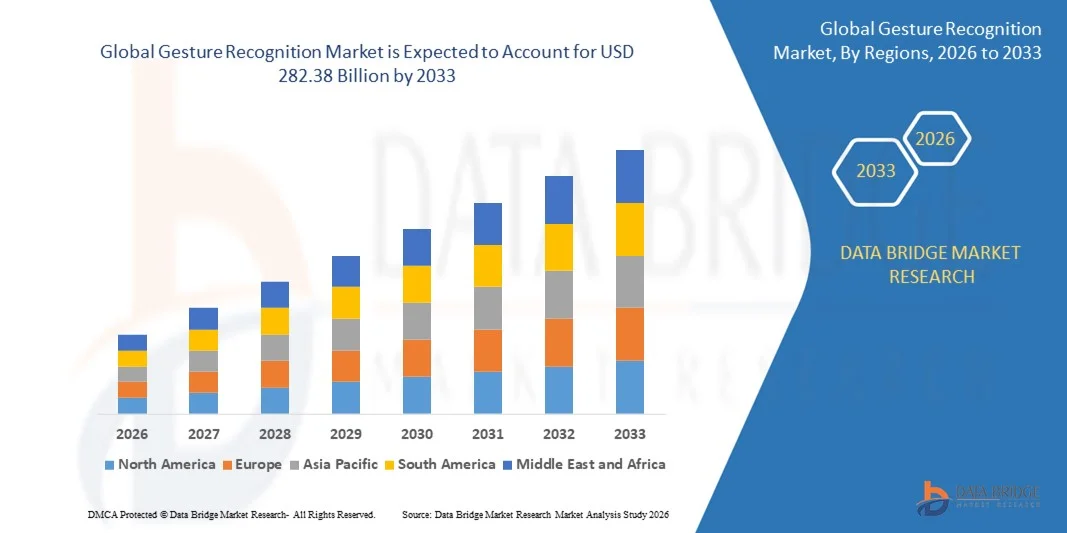
- The global gesture recognition market size was valued at USD 48.54 billion in 2025 and is expected to reach USD 282.38 billion by 2033, at a CAGR of 24.62% during the forecast period
- The market growth is largely fuelled by the rising adoption of touchless interfaces in consumer electronics, healthcare, automotive, and gaming applications
- Increasing integration of artificial intelligence and machine learning for accurate gesture interpretation
Gesture Recognition Market Analysis
- The market is witnessing rapid technological advancements, including 3D sensing and computer vision improvements
- Companies are focusing on developing low-cost, high-accuracy gesture recognition solutions to expand adoption
- North America dominated the gesture recognition market with the largest revenue share of 38.75% in 2025, driven by rapid adoption of smart devices, gaming consoles, and AR/VR applications, as well as increasing awareness of touchless interfaces and advanced human–machine interaction technologies
- Asia-Pacific region is expected to witness the highest growth rate in the global gesture recognition market, driven by rapid urbanization, increasing disposable incomes, government initiatives promoting smart cities and digital transformation, and expanding manufacturing capabilities for sensors and electronic components
- The Camera-Based Technology segment held the largest market revenue share in 2025, driven by its ability to capture high-resolution images, support AI-powered motion detection, and enable real-time interaction across consumer electronics, gaming, and automotive applications. Camera-based systems are also preferred for AR/VR devices, interactive kiosks, and security solutions, providing seamless integration with software algorithms and enhanced user experience
Report Scope and Gesture Recognition Market Segmentation
|
Attributes |
Gesture Recognition Key Market Insights |
|
Segments Covered |
|
|
Countries Covered |
North America
Europe
Asia-Pacific
Middle East and Africa
South America
|
|
Key Market Players |
|
|
Market Opportunities |
|
|
Value Added Data Infosets |
In addition to the market insights such as market value, growth rate, market segments, geographical coverage, market players, and market scenario, the market report curated by the Data Bridge Market Research team includes in-depth expert analysis, import/export analysis, pricing analysis, production consumption analysis, and pestle analysis. |
Gesture Recognition Market Trends
Rising Demand For Touchless Interfaces And Human–Machine Interaction
- The growing focus on contactless and intuitive interaction systems is significantly shaping the gesture recognition market, as consumers and enterprises increasingly prefer solutions that enable seamless control without physical input. Gesture recognition technologies are gaining traction due to their ability to enhance user experience, improve accessibility, and provide immersive interaction in consumer electronics, gaming, automotive, and industrial applications
- Increasing integration of artificial intelligence, computer vision, and deep learning algorithms has accelerated the adoption of gesture recognition in smartphones, AR/VR devices, smart TVs, and automotive interfaces. Businesses and consumers are actively seeking systems capable of precise motion detection and real-time response, prompting technology providers to continuously innovate and refine hardware and software solutions
- Growing awareness of hygiene, convenience, and futuristic experiences is influencing purchasing decisions, with manufacturers emphasizing touchless and adaptive interfaces. These factors are helping brands differentiate products in a competitive market and build consumer trust, while also driving innovation in wearable devices, interactive kiosks, and smart home solutions
- For instance, in 2024, Microsoft in the U.S. and Sony in Japan expanded their product portfolios by incorporating advanced gesture recognition in gaming consoles and AR/VR devices. These launches were introduced in response to rising consumer preference for intuitive, contactless interaction, with distribution across retail, e-commerce, and experiential technology channels. The products were also marketed as next-generation solutions, enhancing brand positioning and customer engagement
- While demand for gesture recognition is growing, sustained market expansion depends on continuous R&D, cost-effective sensor technology, and high-accuracy detection comparable to traditional input devices. Companies are also focusing on improving scalability, cross-platform compatibility, and innovative algorithms that balance performance, affordability, and user experience for broader adoption
Gesture Recognition Market Dynamics
Driver
Rising Adoption Of Touchless Interfaces And AI-Powered Interaction
- Increasing consumer and enterprise demand for contactless, intuitive control systems is a major driver for the gesture recognition market. Technology providers are developing solutions that allow seamless human–machine interaction, enhance user experience, and support accessibility requirements, pushing advancements in AI, sensor, and computer vision technologies
- Expanding applications in consumer electronics, automotive, gaming, healthcare, and industrial automation are influencing market growth. Gesture recognition systems enable improved user engagement, real-time response, and immersive experiences, supporting the growing adoption of AR/VR, smart devices, and industrial robotics
- Companies are actively promoting gesture recognition-based solutions through product innovation, marketing campaigns, and strategic partnerships. These efforts are supported by the rising need for touchless and immersive interaction, encouraging collaborations among technology providers, device manufacturers, and software developers to improve performance and reliability
- For instance, in 2023, Google in the U.S. and Samsung in South Korea reported increased incorporation of gesture recognition in smartphones, smart TVs, and automotive infotainment systems. This expansion followed higher consumer preference for touchless interfaces and next-generation user experiences, driving repeat usage and product differentiation. Both companies also highlighted AI-based detection and responsiveness in marketing campaigns to strengthen consumer trust and engagement
- Although rising touchless interaction and AI adoption support growth, wider adoption depends on sensor affordability, computational requirements, and integration challenges. Investment in advanced algorithms, cost-efficient hardware, and scalable solutions will be critical for meeting global demand and maintaining competitive advantage
Restraint/Challenge
High Implementation Costs And Technological Complexity
- The relatively higher cost of gesture recognition solutions compared to conventional input devices remains a key challenge, limiting adoption among price-sensitive consumers and small enterprises. Advanced sensor technology, AI algorithms, and integration requirements contribute to elevated costs. In addition, compatibility and calibration issues can affect system performance and reliability
- Consumer and enterprise awareness remains uneven, particularly in emerging markets where smart device penetration is still growing. Limited understanding of functional benefits and usability restricts adoption across certain industries. This also leads to slower uptake in regions where educational initiatives on gesture recognition are minimal
- Technical and operational challenges also impact market growth, as gesture recognition requires precise sensor calibration, optimized software, and reliable hardware. Variations in lighting, movement speed, and environmental conditions can affect accuracy. Companies must invest in robust design, testing, and continuous software updates to maintain system performance
- For instance, in 2024, automotive manufacturers in India and Brazil integrating gesture-based infotainment systems reported slower adoption due to higher costs, calibration challenges, and limited consumer familiarity. Technical complexity and integration requirements were additional barriers, prompting some enterprises to limit deployment in pilot or high-end models only
- Overcoming these challenges will require cost-efficient sensor technology, user-friendly interfaces, and targeted educational initiatives for consumers and enterprises. Collaboration among device manufacturers, software developers, and technology providers can help unlock the long-term growth potential of the global gesture recognition market. Furthermore, developing affordable, high-performance solutions and strengthening marketing strategies around usability and innovation will be essential for widespread adoption
Gesture Recognition Market Scope
The market is segmented on the basis of component type, authentication type, touch type, and industry vertical
- By Component Type
On the basis of component type, the gesture recognition market is segmented into Touch-Based Gesture Recognition, Touchless Gesture Recognition, RFID Technology, Camera-Based Technology, Sensors, Voice Assistance, and Others. The Camera-Based Technology segment held the largest market revenue share in 2025, driven by its ability to capture high-resolution images, support AI-powered motion detection, and enable real-time interaction across consumer electronics, gaming, and automotive applications. Camera-based systems are also preferred for AR/VR devices, interactive kiosks, and security solutions, providing seamless integration with software algorithms and enhanced user experience.
The Touchless Gesture Recognition segment is expected to witness the fastest growth rate from 2026 to 2033, fueled by rising demand for contactless interaction in healthcare, automotive, and industrial environments. Touchless systems offer hygienic, intuitive, and adaptive control, eliminating the need for physical contact while enabling efficient interaction. These systems are increasingly deployed in public spaces, smart devices, and industrial automation to enhance convenience, safety, and operational efficiency.
- By Authentication Type
On the basis of authentication type, the market is segmented into Fingerprint Recognition, Face Recognition, Vision and IRIS Recognition, and Hand and Leg Recognition. The Face Recognition segment held the largest revenue share in 2025 due to its adoption in smartphones, security systems, and automotive infotainment interfaces. Face recognition is valued for its accuracy, quick verification process, and integration with AI algorithms, supporting personalized user experiences and secure access in both consumer and enterprise applications.
The Fingerprint Recognition segment is expected to grow at a significant rate from 2026 to 2033, driven by increasing use in smartphones, smart locks, and access control systems. Fingerprint recognition offers convenience, cost-effectiveness, and reliability for secure authentication, making it popular among enterprises and individual consumers. Continuous advancements in sensor technology and integration with mobile devices are further accelerating adoption.
- By Touch Type
On the basis of touch type, the market is segmented into Single Touch-Based Systems and Multi Touch-Based Systems. Multi Touch-Based Systems dominated the market in 2025, owing to their ability to detect and process multiple points of contact simultaneously, enhancing user interaction and enabling gestures such as pinch, swipe, and zoom. These systems are widely used in smartphones, tablets, interactive displays, and kiosks, providing immersive and responsive user experiences.
Single Touch-Based Systems are expected to witness strong growth from 2026 to 2033, supported by their low cost, simple implementation, and suitability for basic gesture control in devices such as kiosks, point-of-sale terminals, and industrial equipment. Their ease of integration and minimal processing requirements make them ideal for applications where complex multi-touch gestures are not needed.
- By Industry Vertical
On the basis of industry vertical, the market is segmented into Automotive, Consumer Electronics, Healthcare, Advertisement and Communication, Defense, Finance and Banking, Government, and Others. The Consumer Electronics segment held the largest market share in 2025 due to the widespread adoption of smartphones, smart TVs, gaming consoles, and AR/VR devices equipped with gesture recognition technologies. These devices leverage gesture control to enhance user experience, simplify navigation, and provide interactive entertainment.
The Automotive segment is projected to witness the fastest growth from 2026 to 2033, driven by increasing incorporation of gesture-based infotainment, navigation, and safety systems in connected and smart vehicles. Gesture recognition allows drivers to control in-car functions without distraction, improving safety and convenience. Rising consumer demand for advanced driver-assistance systems (ADAS) and touchless interaction features is further accelerating adoption in the automotive sector.
Gesture Recognition Market Regional Analysis
- North America dominated the gesture recognition market with the largest revenue share of 38.75% in 2025, driven by rapid adoption of smart devices, gaming consoles, and AR/VR applications, as well as increasing awareness of touchless interfaces and advanced human–machine interaction technologies
- Consumers in the region highly value convenience, intuitive control, and immersive experiences offered by gesture recognition in consumer electronics, automotive infotainment, and industrial applications
- This widespread adoption is further supported by high disposable incomes, a tech-savvy population, and growing integration of AI and computer vision in devices, establishing gesture recognition as a preferred solution for both enterprise and consumer applications
U.S. Gesture Recognition Market Insight
The U.S. gesture recognition market captured the largest revenue share in 2025 within North America, fueled by the increasing penetration of smart devices, AR/VR systems, and automotive gesture-based controls. Consumers are prioritizing enhanced interactivity and seamless touchless experiences in both gaming and home automation. The rapid uptake of AI-powered systems, coupled with demand for mobile and voice-controlled interfaces, is driving growth. In addition, integration with platforms such as Apple ARKit, Google ARCore, and smart vehicle infotainment systems is significantly contributing to market expansion.
Europe Gesture Recognition Market Insight
The Europe gesture recognition market is expected to witness the fastest growth rate from 2026 to 2033, primarily driven by strong investments in AR/VR technologies, industrial automation, and connected automotive solutions. Increasing urbanization and the growing adoption of smart devices are fostering market growth. European consumers are drawn to convenience, safety, and energy-efficient gesture-controlled systems. The market is expanding across consumer electronics, healthcare, and industrial applications, with gesture recognition integrated into both new technologies and retrofitted systems.
U.K. Gesture Recognition Market Insight
The U.K. gesture recognition market is expected to witness rapid growth from 2026 to 2033, driven by growing adoption of smart home automation, gaming, and automotive infotainment systems. Rising demand for intuitive, touchless interfaces in residential and commercial applications is encouraging market uptake. The U.K.’s strong e-commerce infrastructure and high awareness of emerging technologies are expected to further stimulate growth. Enterprises are increasingly investing in AI-based gesture solutions to enhance user experience and operational efficiency.
Germany Gesture Recognition Market Insight
The Germany gesture recognition market is expected to witness strong growth from 2026 to 2033, fueled by awareness of advanced digital technologies and demand for smart industrial and automotive solutions. Germany’s emphasis on innovation, quality, and sustainability supports the adoption of gesture recognition in manufacturing, smart vehicles, and consumer devices. Integration with AR/VR systems, AI-driven motion detection, and human–machine interfaces is becoming prevalent, aligning with local consumer expectations for accuracy and reliability.
Asia-Pacific Gesture Recognition Market Insight
The Asia-Pacific gesture recognition market is expected to witness the fastest growth from 2026 to 2033, driven by rapid urbanization, rising disposable incomes, and technological advancements in countries such as China, Japan, India, and South Korea. The growing preference for smart homes, connected devices, and industrial automation is accelerating adoption. Furthermore, government initiatives promoting digitalization and smart cities are expanding accessibility. APAC’s emergence as a manufacturing hub for gesture recognition sensors and devices is improving affordability and availability for a wider consumer base.
Japan Gesture Recognition Market Insight
The Japan gesture recognition market is expected to witness rapid growth from 2026 to 2033 due to high technological adoption, urbanization, and demand for seamless interaction. The Japanese market emphasizes security, convenience, and advanced user experience, with gesture recognition increasingly integrated into AR/VR, smart homes, and automotive systems. The aging population is also expected to drive demand for easier-to-use, touchless interfaces in residential and commercial applications, supporting market expansion.
China Gesture Recognition Market Insight
The China gesture recognition market accounted for the largest revenue share in Asia-Pacific in 2025, attributed to rapid technological adoption, smart city initiatives, and an expanding middle class. Gesture recognition is becoming widespread in consumer electronics, automotive systems, and industrial automation. Availability of cost-effective devices, domestic manufacturers, and government support for digitalization are key factors propelling the market. The rising focus on AR/VR, AI integration, and touchless human–machine interaction further strengthens market growth.
Gesture Recognition Market Share
The Gesture Recognition industry is primarily led by well-established companies, including:
- ESPROS Photonics AG (Switzerland)
- Microsoft Corporation (U.S.)
- Eyesight Technologies Ltd. (Israel)
- Cognivue Corporation (U.S.)
- Gestsure Technologies Ltd. (U.K.)
- Elliptic Laboratories A/S (Norway)
- Cognitec Systems GmbH (Germany)
- Apple Inc. (U.S.)
- Intel Corporation (U.S.)
- Microchip Technology Inc. (U.S.)
- Qualcomm Technologies, Inc. (U.S.)
- XYZ Interactive Technologies Inc. (U.S.)
- pmdtechnologies ag (Germany)
- OBLONG INDUSTRIES, INC. (U.S.)
- MetaSensor Inc. (U.S.)
- Gesture Research (U.S.)
- PointGrab Inc. (Israel)
- OmniVision Technologies, Inc. (U.S.)
- Google LLC (U.S.)
- Sony Corporation (Japan)
- Infineon Technologies AG (Germany)
Latest Developments in Global Gesture Recognition Market
- In March, 2025, Apple Inc., Patent Filing, filed a patent for vision-based hand gesture customization powered by advanced machine learning, enabling users to personalize and define custom hand gestures using few-shot and meta-learning techniques for seamless device control. This innovation enhances accessibility, improves user experience across virtual reality, gaming, and smart home applications, and strengthens Apple’s position in AI-driven gesture recognition technologies.
- In November, 2023, NXP Semiconductors N.V., Product Launch, unveiled the Trimension NCJ29D6 automotive ultra-wideband single-chip solution integrating secure ranging and short-range radar capabilities for applications such as secure car access, child presence detection, intrusion alerts, and gesture recognition. The development helps automakers reduce system complexity and costs while supporting software-defined vehicles and compliance with evolving safety regulations, thereby accelerating adoption in automotive gesture applications.
- In April, 2024, Sony Corporation, Partnership, entered into collaboration with AMERIA AG to design and integrate touchless gesture-based control solutions across Sony’s professional display models. This partnership expands Sony’s portfolio of interactive display systems, enhances user engagement in commercial environments, and supports broader deployment of contactless technologies.
- In February, 2024, Apple Inc., Product Launch, launched the Vision Pro VR headset in the U.S., featuring advanced gesture recognition capabilities and immersive virtual environments priced at USD 3,500. The release marked a major product expansion, strengthened Apple’s presence in spatial computing, and increased consumer awareness of gesture-based interaction in premium devices.
- In September, 2023, Meta Platforms, Inc., Product Launch, partnered with EssilorLuxottica to introduce Ray-Ban Meta smart glasses equipped with enhanced cameras, audio features, AI voice commands, and hand gesture interaction. The launch expanded wearable gesture-enabled devices, improved user engagement on social media platforms, and intensified competition in the smart glasses segment.
SKU-
Get online access to the report on the World's First Market Intelligence Cloud

- Interactive Data Analysis Dashboard
- Company Analysis Dashboard for high growth potential opportunities
- Research Analyst Access for customization & queries
- Competitor Analysis with Interactive dashboard
- Latest News, Updates & Trend analysis
- Harness the Power of Benchmark Analysis for Comprehensive Competitor Tracking
Research Methodology
Data collection and base year analysis are done using data collection modules with large sample sizes. The stage includes obtaining market information or related data through various sources and strategies. It includes examining and planning all the data acquired from the past in advance. It likewise envelops the examination of information inconsistencies seen across different information sources. The market data is analysed and estimated using market statistical and coherent models. Also, market share analysis and key trend analysis are the major success factors in the market report. To know more, please request an analyst call or drop down your inquiry.
The key research methodology used by DBMR research team is data triangulation which involves data mining, analysis of the impact of data variables on the market and primary (industry expert) validation. Data models include Vendor Positioning Grid, Market Time Line Analysis, Market Overview and Guide, Company Positioning Grid, Patent Analysis, Pricing Analysis, Company Market Share Analysis, Standards of Measurement, Global versus Regional and Vendor Share Analysis. To know more about the research methodology, drop in an inquiry to speak to our industry experts.
Customization Available
Data Bridge Market Research is a leader in advanced formative research. We take pride in servicing our existing and new customers with data and analysis that match and suits their goal. The report can be customized to include price trend analysis of target brands understanding the market for additional countries (ask for the list of countries), clinical trial results data, literature review, refurbished market and product base analysis. Market analysis of target competitors can be analyzed from technology-based analysis to market portfolio strategies. We can add as many competitors that you require data about in the format and data style you are looking for. Our team of analysts can also provide you data in crude raw excel files pivot tables (Fact book) or can assist you in creating presentations from the data sets available in the report.












