




Global Gourmet Salt Market
Market Size in USD Billion
CAGR :
% 
 USD
1.83 Billion
USD
2.90 Billion
2025
2033
USD
1.83 Billion
USD
2.90 Billion
2025
2033
 Forecast Period Forecast Period |
2026 –2033 |
 Market Size (Base Year) Market Size (Base Year) |
USD 1.83 Billion |
 Market Size (Forecast Year) Market Size (Forecast Year) |
USD 2.90 Billion |
 CAGR CAGR |
% |
| Major Markets Players |
|
Gourmet Salt Market Size
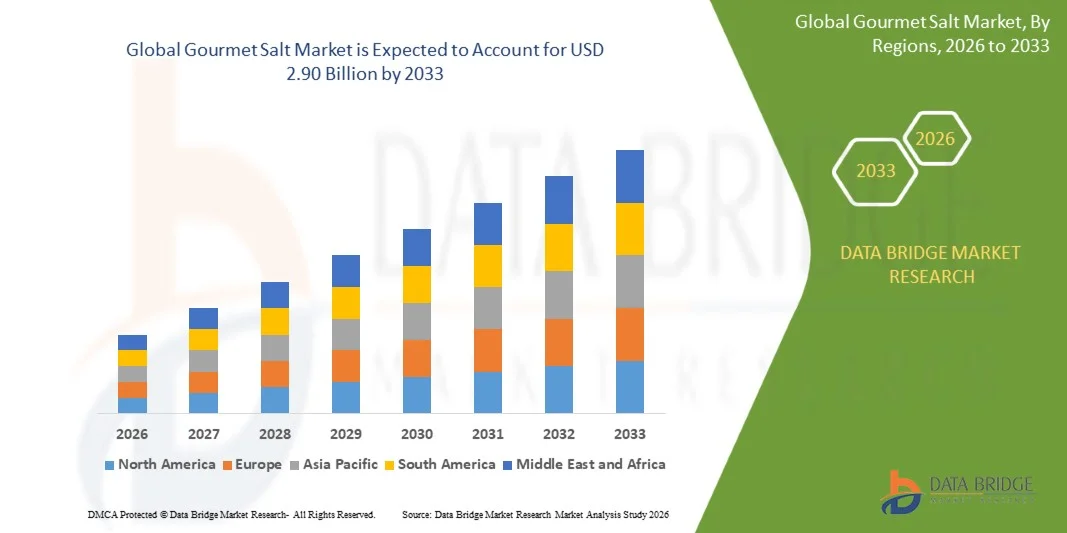
- The global gourmet salt market size was valued at USD 1.83 billion in 2025 and is expected to reach USD 2.90 billion by 2033, at a CAGR of 5.95% during the forecast period
- The market growth is largely fueled by the increasing consumer preference for premium, natural, and artisanal food ingredients, along with the growing popularity of gourmet cooking and specialty culinary products across household and foodservice applications
- Furthermore, rising demand for clean-label seasonings, mineral-rich salts, and authentic flavor-enhancing ingredients is positioning gourmet salts as a preferred choice in premium food preparation. These converging factors are accelerating the adoption of gourmet salt products across retail, hospitality, and packaged food industries, thereby significantly boosting the market growth
Gourmet Salt Market Analysis
- Gourmet salts, offering unique textures, flavors, mineral compositions, and visual appeal, are increasingly becoming essential ingredients in modern culinary applications across households, restaurants, bakeries, confectionery, seafood, and processed food industries due to their premium positioning and versatility in food enhancement
- The escalating demand for gourmet salts is primarily fueled by the growing consumer inclination toward premium dining experiences, increasing awareness regarding natural and minimally processed ingredients, and rising utilization of specialty salts in gourmet cooking, food presentation, and artisanal packaged food products
- North America dominated the gourmet salt market with a share of 37.73% in 2025, due to increasing consumer preference for premium and artisanal food ingredients, along with rising demand for clean-label seasoning products
- Asia-Pacific is expected to be the fastest growing region in the gourmet salt market during the forecast period due to rising urbanization, increasing disposable incomes, and rapidly evolving food consumption patterns in countries such as China, Japan, and India
- Himalayan salts segment dominated the market with a market share of 38.9% in 2025, due to rising consumer preference for natural and mineral-rich salt products in premium food applications. Consumers increasingly associate Himalayan salts with purity, trace mineral content, and health-oriented dietary trends, supporting strong demand across households and foodservice industries
Report Scope and Gourmet Salt Market Segmentation
|
Attributes |
Gourmet Salt Key Market Insights |
|
Segments Covered |
|
|
Countries Covered |
North America
Europe
Asia-Pacific
Middle East and Africa
South America
|
|
Key Market Players |
|
|
Market Opportunities |
|
|
Value Added Data Infosets |
In addition to the insights on market scenarios such as market value, growth rate, segmentation, geographical coverage, and major players, the market reports curated by the Data Bridge Market Research also include in-depth expert analysis, pricing analysis, brand share analysis, consumer survey, demography analysis, supply chain analysis, value chain analysis, raw material/consumables overview, vendor selection criteria, PESTLE Analysis, Porter Analysis, and regulatory framework. |
Gourmet Salt Market Trends
“Rising Demand for Artisanal and Mineral-Rich Gourmet Salts”
- A significant trend in the gourmet salt market is the growing consumer preference for artisanal, naturally harvested, and mineral-rich salt varieties that enhance flavor, texture, and visual appeal across premium food applications. This trend is strengthening the positioning of gourmet salts as high-value culinary ingredients in restaurants, packaged foods, and household cooking
- For instance, Cargill expanded its specialty ingredient portfolio at Expo West 2024 by introducing new Pink Himalayan salt offerings targeted toward premium and health-conscious food manufacturers. These products support increasing demand for natural and visually distinctive gourmet salts used in confectionery, bakery, and gourmet seasoning applications
- The popularity of gourmet cooking and premium dining experiences is increasing the utilization of specialty salts such as fleur de sel, flake salts, and smoked salts in foodservice and hospitality industries. Chefs and food manufacturers are increasingly incorporating gourmet salts to enhance flavor complexity and elevate product presentation across premium cuisines
- Consumers are becoming more conscious regarding ingredient sourcing and product authenticity, which is driving demand for minimally processed and naturally harvested salts with trace mineral content. This preference is encouraging manufacturers to promote sustainability, origin transparency, and artisanal harvesting methods within their product portfolios
- The bakery and confectionery sectors are increasingly utilizing gourmet salts to create sweet and savory flavor contrasts in chocolates, caramel products, pastries, and gourmet snacks. This trend is supporting innovation in premium packaged foods and encouraging wider adoption of specialty salts across processed food categories
- The market is witnessing rising penetration of gourmet salt products through e-commerce platforms and specialty retail channels that improve accessibility to imported and niche artisanal salt brands. This increasing consumer exposure to premium culinary ingredients is reinforcing the long-term growth of gourmet salts across global food and beverage industries
Gourmet Salt Market Dynamics
Driver
“Growing Consumer Preference for Premium and Clean-Label Food Ingredients”
- The growing consumer inclination toward premium, clean-label, and naturally sourced food ingredients is significantly driving the demand for gourmet salts across household, foodservice, and packaged food applications. Consumers increasingly prefer specialty salts that provide enhanced flavor profiles, natural mineral content, and reduced processing compared to conventional table salts
- For instance, True Salt announced operational expansion and sustainability initiatives in 2024 to strengthen the supply of premium sea salt and flake salt products for foodservice and manufacturing industries. This development reflects the increasing market demand for responsibly sourced and high-quality gourmet salt ingredients among food manufacturers and commercial kitchens
- The growing popularity of gourmet and international cuisines is accelerating the incorporation of artisanal salts into seafood, meat, bakery, and confectionery products. Consumers are increasingly willing to pay premium prices for ingredients that improve taste, texture, and culinary authenticity in food preparation
- Food manufacturers are actively introducing specialty seasoning blends and flavored salt products to meet evolving consumer preferences for unique and restaurant-style flavor experiences. The increasing demand for clean-label and minimally processed ingredients is further encouraging the use of naturally harvested gourmet salts in premium packaged foods
- The increasing focus on premiumization within the food and beverage industry continues to strengthen this driver. Rising demand for natural, authentic, and flavor-enhancing ingredients is positioning gourmet salts as an important component of modern culinary and processed food applications
Restraint/Challenge
“High Production and Premium Pricing of Specialty Salts”
- The gourmet salt market faces challenges due to the high production costs associated with artisanal harvesting, limited-scale processing, and specialized packaging requirements for premium salt products. These production complexities increase operational expenses and contribute to higher retail pricing compared to conventional table salt products
- For instance, Maldon Crystal Salt Co. continues to utilize traditional hand-harvesting and slow evaporation techniques for producing its flake salt products. While these methods enhance product quality and texture, they also increase production time and manufacturing costs, limiting price competitiveness in mass-market applications
- The sourcing of gourmet salts from specific geographic regions and natural environments creates supply-side constraints and increases dependency on climate conditions and transportation logistics. These factors can impact product availability and create fluctuations in supply chain efficiency and operational costs
- Premium gourmet salts often target niche consumer groups due to their comparatively higher pricing, which can limit broader market penetration in price-sensitive regions. Manufacturers continue to face challenges in balancing premium product positioning with affordability and large-scale accessibility
- The continued pressure to reduce operational costs while preserving artisanal quality standards remains a significant challenge for gourmet salt manufacturers. These factors collectively influence pricing structures, production scalability, and competitive dynamics across the global gourmet salt market
Gourmet Salt Market Scope
The market is segmented on the basis of type, application, and distribution channel.
•By Type
On the basis of type, the gourmet salt market is segmented into Himalayan salts, fleur de sel, flake salts, sel gris or grey salts, specialty salts, and others. The Himalayan salts segment dominated the market with the largest market revenue share of 38.9% in 2025, driven by rising consumer preference for natural and mineral-rich salt products in premium food applications. Consumers increasingly associate Himalayan salts with purity, trace mineral content, and health-oriented dietary trends, supporting strong demand across households and foodservice industries. The visually appealing pink color and coarse texture of Himalayan salts further enhance their popularity in gourmet cooking, seasoning, and presentation purposes. Food manufacturers and restaurants also favor Himalayan salts for premium positioning and artisanal branding strategies. In addition, the expanding availability of Himalayan salt variants across retail and online platforms continues to strengthen segment growth globally.
The fleur de sel segment is anticipated to witness the fastest growth rate from 2026 to 2033, fueled by increasing demand for high-end finishing salts in gourmet cuisine and fine dining applications. Fleur de sel is highly valued for its delicate crystal structure, subtle flavor profile, and handcrafted harvesting process, making it a preferred ingredient among chefs and culinary professionals. The growing influence of premium cooking trends and rising consumer interest in artisanal food ingredients are further accelerating segment adoption. Luxury restaurants and specialty food brands increasingly incorporate fleur de sel into confectionery, seafood, and baked products to enhance flavor and texture. Moreover, rising awareness regarding authentic culinary experiences and premium food presentation continues to support the rapid expansion of the segment.
•By Application
On the basis of application, the gourmet salt market is segmented into seafood products, bakery and confectionery, sauces and savory, meat and poultry products, and others. The meat and poultry products segment dominated the market with the largest market revenue share in 2025, driven by extensive use of gourmet salts in marination, curing, seasoning, and flavor enhancement applications. Gourmet salts improve texture, moisture retention, and taste profiles in processed and premium meat products, increasing their demand among food manufacturers and restaurants. Consumers increasingly seek premium and restaurant-style meat products with enhanced sensory appeal, further supporting segment expansion. The growing popularity of smoked meats, grilled foods, and specialty poultry dishes also contributes to the strong consumption of gourmet salts in this category. In addition, foodservice providers continue to utilize specialty salts to differentiate menu offerings and improve product presentation.
The bakery and confectionery segment is expected to witness the fastest CAGR from 2026 to 2033, driven by the rising incorporation of gourmet salts in premium chocolates, caramel products, pastries, and artisan baked goods. Consumers increasingly prefer sweet and savory flavor combinations, encouraging manufacturers to utilize specialty salts for taste enhancement and product differentiation. Gourmet salts are widely used to improve texture contrast and intensify flavor profiles in confectionery products, supporting increasing adoption across premium food brands. The growing demand for artisanal bakery products and innovative dessert offerings is further accelerating segment growth. In addition, the expansion of gourmet food culture and premium snacking trends continues to create strong opportunities for gourmet salt applications in bakery and confectionery products.
•By Distribution Channel
On the basis of distribution channel, the gourmet salt market is segmented into supermarkets/hypermarket, convenience stores, online retailing, specialty stores, and other distribution channels. The supermarkets/hypermarket segment dominated the market with the largest market revenue share in 2025, driven by the wide availability of gourmet salt brands, extensive product visibility, and strong consumer footfall. These retail channels offer consumers access to multiple gourmet salt varieties, packaging formats, and premium imported products under a single platform. Consumers often prefer supermarkets and hypermarkets for comparing product quality, pricing, and brand options before purchasing premium food ingredients. Promotional campaigns, organized retail expansion, and increasing shelf space for gourmet and organic food products further support segment dominance. In addition, strong distribution networks and partnerships with international gourmet food brands continue to strengthen product accessibility across developed and emerging markets.
The online retailing segment is anticipated to witness the fastest growth rate from 2026 to 2033, fueled by the increasing popularity of e-commerce platforms and rising consumer preference for convenient shopping experiences. Online channels provide access to a broad range of gourmet salt products, including imported and niche specialty variants that may have limited offline availability. Consumers increasingly utilize digital platforms to explore premium food ingredients, compare reviews, and access subscription-based or bulk purchasing options. The growing influence of food bloggers, culinary influencers, and digital marketing strategies is further accelerating online product sales. In addition, expanding smartphone penetration, secure payment systems, and rapid home delivery services continue to support the rapid growth of the online retailing segment.
Gourmet Salt Market Regional Analysis
- North America dominated the gourmet salt market with the largest revenue share of 37.73% in 2025, driven by increasing consumer preference for premium and artisanal food ingredients, along with rising demand for clean-label seasoning products
- Consumers in the region highly value the unique flavor profiles, mineral content, and natural sourcing associated with gourmet salts used in household cooking and foodservice applications
- This widespread adoption is further supported by strong demand for organic and specialty foods, high disposable incomes, and the growing popularity of gourmet dining experiences, establishing gourmet salts as a preferred ingredient across retail and commercial food sectors
U.S. Gourmet Salt Market Insight
The U.S. gourmet salt market captured the largest revenue share in 2025 within North America, fueled by increasing consumer interest in premium culinary ingredients and the growing adoption of gourmet cooking trends. Consumers are increasingly utilizing specialty salts in home cooking, grilling, baking, and food presentation applications. The strong presence of premium food brands, expanding restaurant culture, and rising awareness regarding natural and minimally processed food ingredients further propel market growth. Moreover, increasing demand for artisanal and organic food products is significantly contributing to the expansion of the gourmet salt industry in the country.
Europe Gourmet Salt Market Insight
The Europe gourmet salt market is projected to expand at a substantial CAGR throughout the forecast period, primarily driven by the region’s strong culinary heritage and rising demand for premium seasoning ingredients across foodservice and household applications. The growing popularity of artisanal food preparation and gourmet dining is fostering the adoption of specialty salts. European consumers are increasingly attracted to authentic and naturally harvested salt varieties with unique textures and flavor profiles. The market is experiencing notable growth across bakery, seafood, meat, and confectionery applications, with gourmet salts increasingly incorporated into premium packaged food products and restaurant menus.
U.K. Gourmet Salt Market Insight
The U.K. gourmet salt market is anticipated to grow at a noteworthy CAGR during the forecast period, driven by increasing consumer preference for premium cooking ingredients and expanding interest in gourmet and international cuisines. In addition, rising awareness regarding clean-label and natural food products is encouraging consumers to shift toward specialty salts. The country’s strong retail and e-commerce infrastructure is further supporting accessibility to imported and artisanal gourmet salt products. Growing demand for premium bakery, confectionery, and restaurant offerings is also expected to stimulate market growth across the U.K.
Germany Gourmet Salt Market Insight
The Germany gourmet salt market is expected to expand at a considerable CAGR during the forecast period, fueled by rising demand for organic, natural, and sustainably sourced food ingredients. Germany’s strong food processing industry and emphasis on premium culinary standards continue to support the adoption of gourmet salts across packaged foods and foodservice sectors. Consumers increasingly prefer specialty salts for flavor enhancement and premium meal preparation. The growing popularity of gourmet cooking at home, combined with expanding availability of artisanal food products, is further contributing to market expansion in the country.
Asia-Pacific Gourmet Salt Market Insight
The Asia-Pacific gourmet salt market is poised to grow at the fastest CAGR during the forecast period of 2026 to 2033, driven by rising urbanization, increasing disposable incomes, and rapidly evolving food consumption patterns in countries such as China, Japan, and India. The region’s expanding middle-class population and growing interest in premium and international cuisines are accelerating demand for gourmet food ingredients. Furthermore, the rapid expansion of online retailing and specialty food stores is improving accessibility to imported and artisanal salt products. Increasing adoption of gourmet salts across hospitality, bakery, seafood, and packaged food industries is further supporting regional market growth.
Japan Gourmet Salt Market Insight
The Japan gourmet salt market is gaining momentum due to the country’s strong culinary culture, rising preference for premium food ingredients, and increasing consumer focus on authentic flavor enhancement. Japanese consumers place significant importance on food quality and presentation, supporting the adoption of specialty salts in household and restaurant applications. The growing incorporation of gourmet salts into seafood dishes, premium confectionery, and fine dining cuisines is fueling market growth. Moreover, increasing interest in artisanal and imported food ingredients is contributing to the expansion of the gourmet salt market in Japan.
China Gourmet Salt Market Insight
The China gourmet salt market accounted for the largest market revenue share in Asia Pacific in 2025, attributed to rapid urbanization, rising disposable incomes, and increasing consumer demand for premium and imported food products. China represents a major market for gourmet and specialty food ingredients, with gourmet salts becoming increasingly popular across restaurants, hotels, and household cooking applications. The expansion of modern retail infrastructure and e-commerce platforms is significantly improving product accessibility across urban areas. In addition, rising consumer awareness regarding premium culinary experiences and natural food ingredients continues to propel market growth in China.
Gourmet Salt Market Share
The gourmet salt industry is primarily led by well-established companies, including:
- Alaska Salt Co. (U.S.)
- Selina Naturally (U.S.)
- Cargill (U.S.)
- INFOSA (Spain)
- Pyramid Salt (Australia)
- Morton Salt, Inc. (U.S.)
- Murray River Salt (Australia)
- The Marblehead Salt Co. LLC. (U.S.)
- Maldon Crystal Salt Co. (U.K.)
- SAN FRANCISCO SALT CO (U.S.)
- Salty Wahine Gourmet Hawaiian Sea Salts (U.S.)
- SALTOPIA Infused Sea Salts (Canada)
- Südwestdeutsche Salzwerke AG (Germany)
- Caravel Gourmet (Canada)
Latest Developments in Global Gourmet Salt Market
- In March 2024, Club House introduced two new seasoning blends, Tamarind & Pasilla Chile and La Grille Cracked Black Pepper Garlic & Sea Salt, aimed at expanding flavor applications across seafood and broader culinary preparations. The launch reflected the increasing consumer preference for globally inspired and premium seasoning products that enhance convenience and taste in both household and commercial cooking. This development strengthened the gourmet salt market by encouraging product diversification and supporting rising demand for innovative flavor combinations in the foodservice and packaged food industries. The expansion of premium seasoning portfolios by established brands is further expected to intensify competition and stimulate innovation across the gourmet salt industry
- In March 2024, Cargill expanded its ingredient portfolio at Expo West by introducing new Pink Himalayan salt offerings designed for premium and health-conscious food applications. The company showcased multiple crystal sizes, including extra coarse variants specifically developed for confectionery and topping applications, allowing manufacturers greater formulation flexibility. This launch positively impacted the gourmet salt market by strengthening the availability of value-added specialty salts for premium packaged foods and gourmet culinary products. The expansion also aligned with increasing consumer demand for natural, mineral-rich, and visually distinctive salt products across bakery, confectionery, and processed food segments
- In February 2024, True Salt announced plans to strengthen its operations in Southern California to improve production capacity and import capabilities for premium sea salt products, including flake salts. The expansion is expected to ensure a more stable supply of gourmet salts to foodservice operators and food manufacturers while improving distribution efficiency across the region. In addition, the company intensified its sustainability initiatives by implementing eco-friendly operational practices and responsible sourcing strategies to reduce environmental impact. This development supported the gourmet salt market by reinforcing sustainable production trends and increasing the availability of premium sea salt products amid growing consumer preference for ethically sourced food ingredients
- In January 2021, Cargill Salt launched a new purified sea salt flour featuring an ultra-fine powder-like sodium chloride format tailored for blending and dry food applications. The ingredient was specifically designed for products requiring extremely fine particle sizing, including soups, cereals, flour blends, spice mixes, and snack toppings, enabling improved consistency and formulation efficiency. This launch contributed to the gourmet salt market by expanding the range of functional specialty salt ingredients available for food processing applications. The development also highlighted the increasing focus on customized salt solutions that improve texture, blending performance, and flavor delivery across packaged food products
- In April 2020, SaltWorks adopted advanced B2B e-commerce tools in partnership with OroCommerce to strengthen customer experience and streamline large-scale sales operations. The upgraded digital infrastructure enabled the company to better manage diverse customer requirements while supporting scalable and flexible online ordering capabilities for gourmet salt products. This initiative positively impacted the gourmet salt market by accelerating digital transformation within specialty ingredient distribution and improving accessibility for commercial buyers and food manufacturers. The growing adoption of digital commerce platforms by gourmet salt suppliers is further expected to enhance operational efficiency, customer engagement, and global market penetration for premium salt products
SKU-
Get online access to the report on the World's First Market Intelligence Cloud

- Interactive Data Analysis Dashboard
- Company Analysis Dashboard for high growth potential opportunities
- Research Analyst Access for customization & queries
- Competitor Analysis with Interactive dashboard
- Latest News, Updates & Trend analysis
- Harness the Power of Benchmark Analysis for Comprehensive Competitor Tracking
Global Gourmet Salt Market, Supply Chain Analysis and Ecosystem Framework
To support market growth and help clients navigate the impact of geopolitical shifts, DBMR has integrated in-depth supply chain analysis into its Global Gourmet Salt Market research reports. This addition empowers clients to respond effectively to global changes affecting their industries. The supply chain analysis section includes detailed insights such as Global Gourmet Salt Market consumption and production by country, price trend analysis, the impact of tariffs and geopolitical developments, and import and export trends by country and HSN code. It also highlights major suppliers with data on production capacity and company profiles, as well as key importers and exporters. In addition to research, DBMR offers specialized supply chain consulting services backed by over a decade of experience, providing solutions like supplier discovery, supplier risk assessment, price trend analysis, impact evaluation of inflation and trade route changes, and comprehensive market trend analysis.
Research Methodology
Data collection and base year analysis are done using data collection modules with large sample sizes. The stage includes obtaining market information or related data through various sources and strategies. It includes examining and planning all the data acquired from the past in advance. It likewise envelops the examination of information inconsistencies seen across different information sources. The market data is analysed and estimated using market statistical and coherent models. Also, market share analysis and key trend analysis are the major success factors in the market report. To know more, please request an analyst call or drop down your inquiry.
The key research methodology used by DBMR research team is data triangulation which involves data mining, analysis of the impact of data variables on the market and primary (industry expert) validation. Data models include Vendor Positioning Grid, Market Time Line Analysis, Market Overview and Guide, Company Positioning Grid, Patent Analysis, Pricing Analysis, Company Market Share Analysis, Standards of Measurement, Global versus Regional and Vendor Share Analysis. To know more about the research methodology, drop in an inquiry to speak to our industry experts.
Customization Available
Data Bridge Market Research is a leader in advanced formative research. We take pride in servicing our existing and new customers with data and analysis that match and suits their goal. The report can be customized to include price trend analysis of target brands understanding the market for additional countries (ask for the list of countries), clinical trial results data, literature review, refurbished market and product base analysis. Market analysis of target competitors can be analyzed from technology-based analysis to market portfolio strategies. We can add as many competitors that you require data about in the format and data style you are looking for. Our team of analysts can also provide you data in crude raw excel files pivot tables (Fact book) or can assist you in creating presentations from the data sets available in the report.












