


Global Hallux Valgus Treatment Market
Market Size in USD Billion
CAGR :
% 
 USD
25.09 Billion
USD
43.10 Billion
2025
2033
USD
25.09 Billion
USD
43.10 Billion
2025
2033
 Forecast Period Forecast Period |
2026 –2033 |
 Market Size (Base Year) Market Size (Base Year) |
USD 25.09 Billion |
 Market Size (Forecast Year) Market Size (Forecast Year) |
USD 43.10 Billion |
 CAGR CAGR |
% |
| Major Markets Players |
|
Hallux Valgus Treatment Market Size
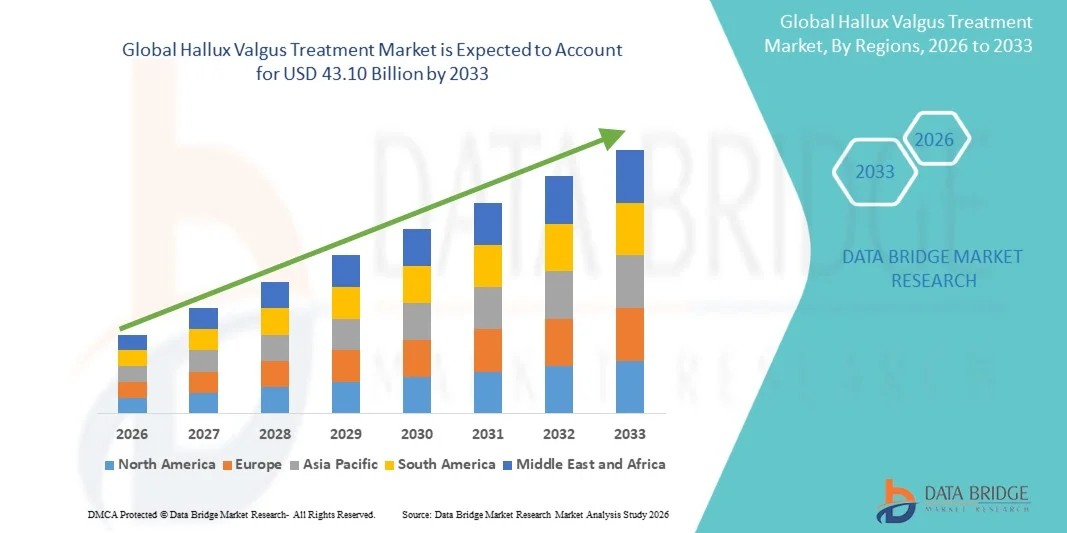
- The global hallux valgus treatment market size was valued at USD 25.09 billion in 2025 and is expected to reach USD 43.10 billion by 2033, at a CAGR of 7.00% during the forecast period
- The market growth is largely fueled by the rising prevalence of foot deformities such as bunions (hallux valgus), driven by aging populations, lifestyle changes, and increased use of restrictive footwear, leading to higher demand for surgical and non-surgical treatment options across orthopedic care settings
- Furthermore, growing awareness regarding early diagnosis, advancements in minimally invasive surgical procedures, and increasing preference for corrective orthopedic interventions are establishing Hallux Valgus Treatment solutions as an important segment of musculoskeletal healthcare. These converging factors are accelerating the uptake of Hallux Valgus Treatment solutions, thereby significantly boosting the industry's growth
Hallux Valgus Treatment Market Analysis
- Hallux Valgus Treatment solutions, including corrective orthotics, physiotherapy, minimally invasive bunion surgery, and advanced orthopedic implants, are increasingly vital components of modern musculoskeletal healthcare systems due to the rising prevalence of foot deformities, aging populations, and increased awareness of corrective treatment options
- The escalating demand for Hallux Valgus Treatment is primarily fueled by increasing incidence of bunions caused by lifestyle and footwear habits, growing preference for minimally invasive surgical procedures, and advancements in orthopedic treatment technologies that improve recovery outcomes and reduce post-operative complications
- North America dominated the hallux valgus treatment market with the largest revenue share of 41.7% in 2025, characterized by advanced healthcare infrastructure, high adoption of orthopedic corrective procedures, strong insurance coverage, and the presence of leading orthopedic device manufacturers and specialty clinics
- Asia-Pacific is expected to be the fastest growing region in the hallux valgus treatment market during the forecast period due to rising healthcare expenditure, increasing awareness of foot deformity treatments, expanding orthopedic care access, and a growing aging population
- The Oral segment dominated the largest market revenue share of 66.5% in 2025, driven by ease of use and high patient compliance
Report Scope and Hallux Valgus Treatment Market Segmentation
|
Attributes |
Hallux Valgus Treatment Key Market Insights |
|
Segments Covered |
|
|
Countries Covered |
North America
Europe
Asia-Pacific
Middle East and Africa
South America
|
|
Key Market Players |
|
|
Market Opportunities |
|
|
Value Added Data Infosets |
In addition to the insights on market scenarios such as market value, growth rate, segmentation, geographical coverage, and major players, the market reports curated by the Data Bridge Market Research also include in-depth expert analysis, patient epidemiology, pipeline analysis, pricing analysis, and regulatory framework. |
Hallux Valgus Treatment Market Trends
“Advancements in Minimally Invasive Procedures, Personalized Orthopedic Care, and 3D-Printed Orthotic Solutions”
- A significant and accelerating trend in the global Hallux Valgus Treatment market is the increasing adoption of minimally invasive surgical techniques and advanced non-surgical correction solutions, aimed at improving patient outcomes, reducing recovery time, and enhancing treatment precision
- For instance, minimally invasive bunion correction procedures using specialized osteotomy techniques are gaining traction due to reduced postoperative pain, smaller incisions, and faster rehabilitation compared to traditional open surgeries
- The integration of 3D imaging and computer-assisted surgical planning is enabling surgeons to achieve higher precision in deformity correction and alignment restoration
- For instance, customized orthotic devices and splints are increasingly being designed using 3D scanning technologies to provide patient-specific support and improved biomechanical correction
- Advances in biomaterials used in implants and fixation devices are further enhancing surgical outcomes by improving durability and reducing complication rates
- The growing use of personalized rehabilitation programs, including physiotherapy and gait correction therapy, is also supporting long-term recovery and recurrence prevention
- This shift toward patient-specific, less invasive, and technology-supported orthopedic care is fundamentally reshaping treatment expectations in hallux valgus management
Hallux Valgus Treatment Market Dynamics
Driver
“Rising Prevalence of Foot Deformities and Increasing Demand for Elective Orthopedic Procedures”
- The increasing prevalence of hallux valgus, particularly among the aging population and individuals wearing improper footwear, is a key driver of the market
- For instance, prolonged use of narrow or high-heeled footwear is strongly associated with the development and progression of bunion deformities, increasing the demand for corrective treatment
- Growing awareness regarding foot health and availability of advanced treatment options is encouraging more patients to opt for early intervention
- For instance, orthopedic clinics are increasingly reporting higher patient volumes for elective bunion correction procedures due to improved safety and recovery outcomes
- Rising healthcare expenditure and better access to orthopedic care services are further supporting market expansion globally
- Increasing adoption of outpatient surgical procedures is also contributing to faster treatment uptake
Restraint/Challenge
“High Surgical Costs, Postoperative Complications, and Limited Awareness in Emerging Regions”
- One of the major challenges in the hallux valgus treatment market is the high cost associated with surgical correction procedures, which limits accessibility for many patients
- For instance, advanced minimally invasive surgeries and customized implants can significantly increase overall treatment expenses
- Postoperative complications such as recurrence of deformity, infection, stiffness, and prolonged rehabilitation can affect patient satisfaction and outcomes
- For instance, some patients may require additional corrective procedures if the deformity returns after initial surgery
- Limited awareness about early-stage non-surgical treatment options in developing regions often leads to delayed diagnosis and progression of the condition
- In addition, lack of access to specialized orthopedic care in rural areas restricts timely intervention
- Addressing these challenges requires improved awareness programs, expansion of orthopedic healthcare infrastructure, and development of cost-effective treatment solutions
Hallux Valgus Treatment Market Scope
The market is segmented on the basis of type, diagnosis, treatment, dosage, route of administration, end-users, and distribution channel.
• By Type
On the basis of type, the Hallux Valgus Treatment market is segmented into Congenital Hallux Valgus, Juvenile or Adolescent Hallux Valgus, and Tailor’s Bunion. The Congenital Hallux Valgus segment dominated the largest market revenue share of 46.8% in 2025, driven by the increasing recognition of hereditary foot deformities and early-onset structural abnormalities. Rising awareness regarding foot health and early orthopedic intervention further supports demand. Growing prevalence of congenital deformities in pediatric populations is boosting diagnosis rates. Advancements in imaging and diagnostic tools enhance early detection. Increasing orthopedic consultations worldwide contribute to segment growth. Rising healthcare access in emerging economies improves treatment uptake. Expanding use of corrective devices and surgical interventions supports management. Physicians increasingly recommend early-stage correction therapies. Growing patient awareness about mobility-related quality of life drives demand. Insurance coverage for corrective procedures strengthens accessibility. Overall, congenital cases dominate due to early diagnosis and long-term treatment needs.
The Juvenile or Adolescent Hallux Valgus segment is expected to witness the fastest CAGR of 7.9% from 2026 to 2033, driven by increasing sports-related foot injuries and lifestyle changes in younger populations. Rising use of improper footwear among adolescents contributes to deformity development. Growing awareness among parents regarding early orthopedic correction supports demand. Expanding pediatric orthopedic care services enhance diagnosis rates. Increasing participation in sports activities raises injury-related cases. Advancements in minimally invasive corrective procedures improve outcomes. Rising availability of specialized clinics boosts treatment access. Early intervention trends are becoming more common in developed regions. Growing healthcare expenditure on pediatric care supports adoption. Awareness campaigns in schools and communities further drive diagnosis. Overall, juvenile hallux valgus is emerging as a fast-growing segment.
• By Diagnosis
On the basis of diagnosis, the Hallux Valgus Treatment market is segmented into X-Rays, Medical History, Physical Examination, Radiography, and Others. The X-Rays segment dominated the largest market revenue share of 52.3% in 2025, driven by its wide availability and high diagnostic accuracy for structural foot deformities. X-rays remain the gold standard for assessing bone alignment and severity of hallux valgus. Increasing orthopedic consultations boost demand for imaging diagnostics. Rising prevalence of foot deformities supports imaging utilization. Technological advancements in digital radiography improve clarity and efficiency. Hospitals and clinics widely rely on X-ray imaging for treatment planning. Growing healthcare infrastructure enhances access to diagnostic facilities. Early detection programs further promote imaging use. Physicians prefer X-rays for pre-surgical evaluation. Insurance coverage for diagnostic imaging supports affordability. Overall, X-rays dominate due to accuracy and clinical reliability.
The Physical Examination segment is expected to witness the fastest CAGR of 6.8% from 2026 to 2033, driven by increasing emphasis on early screening and preventive care. Growing awareness about foot health encourages routine check-ups. Expanding primary healthcare services support early diagnosis. Rising adoption of community health programs boosts screening rates. Physical examination remains a cost-effective diagnostic approach. Increasing access to orthopedic specialists enhances evaluation accuracy. Growing pediatric screening initiatives contribute to demand. Improved training of healthcare professionals supports better detection. Rising awareness campaigns in schools and workplaces drive participation. Early-stage diagnosis trends are strengthening adoption. Overall, physical examination is growing due to preventive healthcare focus.
• By Treatment
On the basis of treatment, the Hallux Valgus Treatment market is segmented into Medications, Self-Care, Devices, Surgery, and Medical Procedures. The Surgery segment dominated the largest market revenue share of 49.6% in 2025, driven by its effectiveness in correcting severe deformities and restoring foot function. Increasing prevalence of advanced hallux valgus cases supports surgical adoption. Rising awareness about long-term corrective solutions boosts demand. Technological advancements in minimally invasive surgeries improve outcomes. Growing orthopedic infrastructure enhances surgical accessibility. Increasing geriatric population contributes to higher surgical need. Insurance coverage for corrective surgeries supports affordability. Physicians prefer surgery in severe and progressive cases. Rising patient preference for permanent correction strengthens adoption. Improved post-operative care reduces complications. Overall, surgery remains dominant due to definitive treatment outcomes.
The Devices segment is expected to witness the fastest CAGR of 8.1% from 2026 to 2033, driven by increasing preference for non-invasive correction methods. Rising awareness of orthopedic braces and orthotic devices supports demand. Growing adoption of early-stage treatment solutions boosts usage. Technological advancements in corrective footwear improve comfort and effectiveness. Increasing pediatric cases favor non-surgical interventions. Expanding availability of orthopedic products enhances accessibility. Rising focus on preventive care supports device adoption. Physicians recommend devices for mild to moderate cases. Growing e-commerce availability boosts distribution. Patient preference for pain-free treatments further drives growth. Overall, devices are emerging as a high-growth segment.
• By Dosage
On the basis of dosage, the Hallux Valgus Treatment market is segmented into Injection, Tablets, and Others. The Tablets segment dominated the largest market revenue share of 61.2% in 2025, driven by ease of administration and widespread use in pain and inflammation management. Oral medications are commonly prescribed for symptomatic relief. Increasing patient preference for non-invasive treatment supports demand. Availability of anti-inflammatory and analgesic drugs boosts usage. Expanding pharmacy networks enhance accessibility. Physicians frequently recommend tablets for conservative treatment. Rising prevalence of mild to moderate cases supports consumption. Cost-effectiveness further strengthens adoption. Growing awareness about early treatment improves usage rates. Insurance coverage enhances affordability. Overall, tablets dominate due to convenience and accessibility.
The Injection segment is expected to witness the fastest CAGR of 7.4% from 2026 to 2033, driven by increasing use in severe pain management and perioperative care. Rising hospital-based treatments support injectable adoption. Advancements in injectable formulations improve effectiveness. Growing surgical procedures increase demand for post-operative pain control. Expanding orthopedic clinics enhance accessibility. Increasing patient preference for rapid pain relief supports growth. Rising healthcare infrastructure in emerging regions boosts usage. Physicians prefer injections in acute cases. Improved drug delivery systems enhance outcomes. Increasing clinical adoption in hospitals supports expansion. Overall, injections are growing due to faster therapeutic action.
• By Route of Administration
On the basis of route of administration, the Hallux Valgus Treatment market is segmented into Oral, Parenteral, and Others. The Oral segment dominated the largest market revenue share of 66.5% in 2025, driven by ease of use and high patient compliance. Oral medications are widely used for pain and inflammation management. Increasing availability of NSAIDs supports adoption. Physicians prefer oral route for non-invasive treatment. Growing outpatient care boosts demand. Rising awareness of conservative treatment supports usage. Expanding retail pharmacy networks improve accessibility. Cost-effectiveness enhances patient preference. Increasing prevalence of mild cases supports long-term use. Improved drug formulations enhance efficacy. Overall, oral administration dominates due to convenience.
The Parenteral segment is expected to witness the fastest CAGR of 7.2% from 2026 to 2033, driven by increasing hospital-based acute care usage. Injectable therapies are used for severe pain and surgical support. Rising orthopedic surgeries support demand. Advancements in injectable drugs improve outcomes. Increasing hospital admissions boost usage. Physicians prefer parenteral route for rapid relief. Growing healthcare infrastructure enhances access. Rising elderly population contributes to demand. Improved clinical protocols support adoption. Increasing focus on post-operative care drives growth. Overall, parenteral route is expanding in clinical settings.
• By End-Users
On the basis of end-users, the Hallux Valgus Treatment market is segmented into Clinic, Hospital, and Others. The Hospital segment dominated the largest market revenue share of 57.9% in 2025, driven by high patient inflow for diagnosis and surgical correction. Hospitals offer advanced orthopedic infrastructure and skilled surgeons. Increasing prevalence of foot deformities boosts hospital visits. Availability of advanced surgical technologies supports treatment outcomes. Rising healthcare expenditure enhances hospital capacity. Insurance coverage improves affordability. Growing geriatric population increases admissions. Hospitals also provide post-operative rehabilitation services. Strong diagnostic capabilities support accurate treatment planning. Government investments strengthen hospital infrastructure. Overall, hospitals remain the dominant end-user segment.
The Clinic segment is expected to witness the fastest CAGR of 8.0% from 2026 to 2033, driven by rising demand for outpatient orthopedic care. Increasing preference for minimally invasive treatments supports clinic visits. Growing number of specialty orthopedic clinics boosts accessibility. Rising awareness of early diagnosis enhances demand. Cost-effective treatment options attract patients. Expanding urban healthcare facilities support growth. Improved availability of orthopedic specialists drives adoption. Increasing focus on preventive care supports clinic utilization. Faster appointment and treatment cycles enhance preference. Growing patient convenience further accelerates demand. Overall, clinics are emerging as a fast-growing segment.
• By Distribution Channel
On the basis of distribution channel, the Hallux Valgus Treatment market is segmented into Hospital Pharmacy, Retail Pharmacy, and Online Pharmacy. The Hospital Pharmacy segment dominated the largest market revenue share of 53.4% in 2025, driven by high dependence on post-surgical medication dispensing. Hospitals are primary treatment centers for orthopedic procedures. Strong supply chain integration ensures drug availability. Increasing surgical cases support demand. Physician-prescribed medications drive hospital pharmacy usage. Insurance coverage improves affordability. Rising hospital admissions boost consumption. Availability of specialized orthopedic drugs supports distribution. Government healthcare programs enhance procurement. Clinical monitoring requirements reinforce hospital dispensing. Overall, hospital pharmacies remain dominant due to structured care systems.
The Online Pharmacy segment is expected to witness the fastest CAGR of 9.3% from 2026 to 2033, driven by increasing digital healthcare adoption. Patients prefer online platforms for convenience and home delivery. Rising smartphone penetration supports access. Growth in e-commerce boosts pharmaceutical sales. Increasing awareness of orthopedic care supports demand. Discounted pricing attracts consumers. Telemedicine integration enhances prescription fulfillment. Expanding logistics networks improve delivery efficiency. Rising preference for privacy in healthcare purchases drives growth. Regulatory support for online drug sales further boosts adoption. Overall, online pharmacies are rapidly expanding as a key channel.
Hallux Valgus Treatment Market Regional Analysis
- North America dominated the hallux valgus treatment market with the largest revenue share of 41.7% in 2025, driven by advanced healthcare infrastructure, high adoption of orthopedic corrective procedures, strong insurance coverage, and the presence of leading orthopedic device manufacturers and specialty orthopedic clinics. The region also benefits from early access to innovative surgical techniques, minimally invasive procedures, and well-established post-operative rehabilitation services
- Patients in the region increasingly opt for corrective bunion surgeries and advanced non-surgical interventions due to strong clinical awareness, favorable reimbursement policies, and improved treatment outcomes supported by modern orthopedic technologies
- This widespread adoption is further supported by high healthcare spending, a well-developed hospital network, and strong availability of specialized orthopedic surgeons, establishing North America as a key revenue-generating region in the global Hallux Valgus Treatment market
U.S. Hallux Valgus Treatment Market Insight
The U.S. hallux valgus treatment market captured the largest revenue share within North America in 2025, driven by a high prevalence of foot deformities, strong adoption of elective orthopedic procedures, and widespread access to advanced surgical care. The country has a highly developed orthopedic healthcare ecosystem with extensive availability of minimally invasive bunion correction procedures and advanced fixation technologies. For instance, U.S.-based orthopedic centers increasingly perform outpatient hallux valgus surgeries using modern techniques that reduce recovery time and improve patient outcomes. In addition, strong insurance coverage and continuous innovation by leading orthopedic device manufacturers are further accelerating market growth.
Europe Hallux Valgus Treatment Market Insight
The Europe hallux valgus treatment market is projected to expand at a substantial CAGR during the forecast period, supported by an aging population, rising awareness of foot health, and increasing availability of advanced orthopedic care. For instance, European healthcare systems are increasingly adopting standardized treatment protocols for foot deformities, including both surgical and conservative management approaches. The region also benefits from strong medical device innovation and expanding access to minimally invasive orthopedic procedures across hospitals and specialty clinics.
U.K. Hallux Valgus Treatment Market Insight
The U.K. hallux valgus treatment market is anticipated to grow at a notable CAGR during the forecast period, driven by rising demand for orthopedic correction procedures and strong public healthcare support through the National Health Service (NHS). For instance, NHS orthopedic departments are increasingly treating hallux valgus cases through both surgical and non-surgical interventions depending on severity. Growing patient awareness and improved access to specialist foot and ankle clinics are further supporting market expansion.
Germany Hallux Valgus Treatment Market Insight
The Germany hallux valgus treatment market is expected to expand at a considerable CAGR during the forecast period, fueled by advanced orthopedic infrastructure, strong clinical expertise, and increasing adoption of minimally invasive surgical techniques. For instance, German hospitals are widely integrating modern osteotomy procedures and advanced fixation devices for bunion correction. The country’s emphasis on precision medicine and high-quality surgical outcomes is further strengthening market growth.
Asia-Pacific Hallux Valgus Treatment Market Insight
The Asia-Pacific hallux valgus treatment market is poised to grow at the fastest CAGR during the forecast period due to rising healthcare expenditure, increasing awareness of foot deformity treatments, expanding orthopedic care access, and a rapidly growing aging population in countries such as China, Japan, and India. For instance, governments across the region are investing in hospital infrastructure and expanding orthopedic specialty services to improve access to corrective procedures. Growing adoption of modern surgical techniques and improving affordability of orthopedic treatments are further accelerating market growth.
Japan Hallux Valgus Treatment Market Insight
The Japan hallux valgus treatment market is gaining momentum due to its aging population, advanced healthcare system, and high focus on orthopedic care quality. For instance, Japanese hospitals are increasingly performing minimally invasive bunion correction surgeries to improve recovery outcomes and reduce hospitalization time. The country’s strong emphasis on mobility preservation and elderly care is further driving demand for both surgical and conservative treatment options.
China Hallux Valgus Treatment Market Insight
The China hallux valgus treatment market accounted for the largest revenue share in Asia Pacific in 2025, driven by rapid urbanization, increasing healthcare access, and a growing burden of musculoskeletal disorders. For instance, major urban hospitals in China are increasingly offering advanced orthopedic surgical procedures for bunion correction, supported by improved medical infrastructure. Strong government investment in healthcare modernization and rising awareness of foot deformity treatments are further supporting market expansion across the country.
Hallux Valgus Treatment Market Share
The Hallux Valgus Treatment industry is primarily led by well-established companies, including:
- Zimmer Biomet (U.S.)
- Stryker Corporation (U.S.)
- Smith & Nephew (U.K.)
- Johnson & Johnson (U.S.)
- Medtronic (Ireland)
- B. Braun SE (Germany)
- Arthrex Inc. (U.S.)
- Össur (Iceland)
- DJO Global (U.S.)
- CONMED Corporation (U.S.)
- Wright Medical Group (U.S.)
- NuVasive (U.S.)
- GE HealthCare (U.S.)
- Siemens Healthineers (Germany)
- Philips Healthcare (Netherlands)
- Hillrom (U.S.)
- Integra LifeSciences (U.S.)
- Orthofix Medical Inc. (U.S.)
- LimaCorporate (Italy)
- Trulife (Ireland)
Latest Developments in Global Hallux Valgus Treatment Market
- In July 2025, Johnson & Johnson announced the launch of the VIRTUGUIDE™ AI-Powered Patient-Matched Lapidus System in the United States, an AI-driven surgical planning and guidance solution designed to support personalized bunion (hallux valgus) corrective procedures, aiming to improve surgical accuracy and outcomes
- In March 2025, researchers published updated concepts on radiographic evaluation and surgical treatment for hallux valgus deformity, highlighting advancements in minimally invasive surgical techniques and improved diagnostic criteria to better guide treatment decisions
- In May 2025, a new Skeleton-Guided Diffusion Model for synthesizing accurate foot X-ray images was introduced in academic research, which can enhance diagnosis and assessment of hallux valgus deformity through improved imaging quality and skeletal landmark evaluation
SKU-
Get online access to the report on the World's First Market Intelligence Cloud

- Interactive Data Analysis Dashboard
- Company Analysis Dashboard for high growth potential opportunities
- Research Analyst Access for customization & queries
- Competitor Analysis with Interactive dashboard
- Latest News, Updates & Trend analysis
- Harness the Power of Benchmark Analysis for Comprehensive Competitor Tracking
Research Methodology
Data collection and base year analysis are done using data collection modules with large sample sizes. The stage includes obtaining market information or related data through various sources and strategies. It includes examining and planning all the data acquired from the past in advance. It likewise envelops the examination of information inconsistencies seen across different information sources. The market data is analysed and estimated using market statistical and coherent models. Also, market share analysis and key trend analysis are the major success factors in the market report. To know more, please request an analyst call or drop down your inquiry.
The key research methodology used by DBMR research team is data triangulation which involves data mining, analysis of the impact of data variables on the market and primary (industry expert) validation. Data models include Vendor Positioning Grid, Market Time Line Analysis, Market Overview and Guide, Company Positioning Grid, Patent Analysis, Pricing Analysis, Company Market Share Analysis, Standards of Measurement, Global versus Regional and Vendor Share Analysis. To know more about the research methodology, drop in an inquiry to speak to our industry experts.
Customization Available
Data Bridge Market Research is a leader in advanced formative research. We take pride in servicing our existing and new customers with data and analysis that match and suits their goal. The report can be customized to include price trend analysis of target brands understanding the market for additional countries (ask for the list of countries), clinical trial results data, literature review, refurbished market and product base analysis. Market analysis of target competitors can be analyzed from technology-based analysis to market portfolio strategies. We can add as many competitors that you require data about in the format and data style you are looking for. Our team of analysts can also provide you data in crude raw excel files pivot tables (Fact book) or can assist you in creating presentations from the data sets available in the report.












