




Global Healthcare Associated Infection Hai Market
Market Size in USD Billion
CAGR :
% 
 USD
31.76 Billion
USD
342.57 Billion
2025
2033
USD
31.76 Billion
USD
342.57 Billion
2025
2033
 Forecast Period Forecast Period |
2026 –2033 |
 Market Size (Base Year) Market Size (Base Year) |
USD 31.76 Billion |
 Market Size (Forecast Year) Market Size (Forecast Year) |
USD 342.57 Billion |
 CAGR CAGR |
% |
| Major Markets Players |
|
Healthcare-Associated Infection (HAI) Market Size
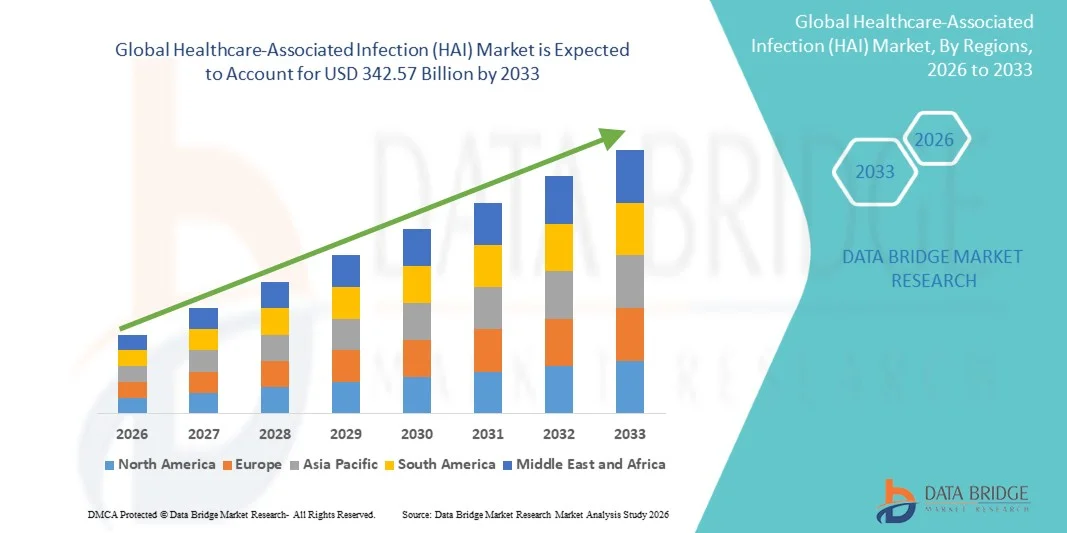
- The global healthcare-associated infection (HAI) market size was valued at USD 31.76 billion in 2025and is expected to reach USD 342.57 billion by 2033, at a CAGR of 34.62% during the forecast period
- The market growth is largely fueled by the increasing prevalence of hospital-acquired infections, rising number of surgical procedures, and growing awareness regarding infection prevention and control measures across healthcare facilities, leading to higher adoption of advanced diagnostic, sterilization, and antimicrobial solutions worldwide
- Furthermore, stringent healthcare regulations, increasing investments in hospital hygiene infrastructure, and growing demand for rapid diagnostic technologies, disinfectants, and antimicrobial products are establishing Healthcare-Associated Infection (HAI) solutions as a critical component of modern healthcare systems. These converging factors are accelerating the uptake of Healthcare-Associated Infection (HAI) solutions, thereby significantly boosting the industry's growth
Healthcare-Associated Infection (HAI) Market Analysis
- Healthcare-Associated Infection (HAI) solutions, which include sterilization products, disinfectants, infection surveillance systems, antimicrobial devices, and rapid diagnostic technologies, are increasingly vital in modern healthcare systems due to their role in reducing hospital-acquired infections, improving patient safety, and lowering healthcare treatment costs
- The escalating demand for Healthcare-Associated Infection (HAI) solutions is primarily fueled by the rising incidence of surgical site infections, catheter-associated urinary tract infections, bloodstream infections, and ventilator-associated pneumonia, along with increasing emphasis on infection prevention protocols and regulatory compliance in hospitals and healthcare facilities
- North America dominated the healthcare-associated infection (HAI) market with the largest revenue share of 38.6% in 2025, driven by advanced healthcare infrastructure, high awareness regarding infection prevention, strong regulatory frameworks, and increasing adoption of infection control technologies, with the U.S. accounting for the majority of hospital infection surveillance and sterilization technology deployments
- Asia-Pacific is expected to be the fastest growing region in the healthcare-associated infection (HAI) market during the forecast period due to expanding healthcare infrastructure, rising hospitalization rates, increasing healthcare expenditure, and growing awareness regarding infection prevention and hospital hygiene standards across countries such as China, India, and Japan
- The consumables segment dominated the largest market revenue share of 58.3% in 2025, driven by the high and recurring usage of gloves, disinfectants, sterilization supplies, testing kits, and protective equipment across healthcare facilities
Report Scope and Healthcare-Associated Infection (HAI) Market Segmentation
|
Attributes |
Healthcare-Associated Infection (HAI) Key Market Insights |
|
Segments Covered |
|
|
Countries Covered |
North America · U.S. · Canada · Mexico Europe · Germany · France · U.K. · Netherlands · Switzerland · Belgium · Russia · Italy · Spain · Turkey · Rest of Europe Asia-Pacific · China · Japan · India · South Korea · Singapore · Malaysia · Australia · Thailand · Indonesia · Philippines · Rest of Asia-Pacific Middle East and Africa · Saudi Arabia · U.A.E. · South Africa · Egypt · Israel · Rest of Middle East and Africa South America · Brazil · Argentina · Rest of South America |
|
Key Market Players |
• 3M Company (U.S.) |
|
Market Opportunities |
· Increasing Adoption of Advanced Infection Surveillance and Rapid Diagnostic Technologies · Rising Investments in Hospital Sterilization and Disinfection Infrastructure |
|
Value Added Data Infosets |
In addition to the insights on market scenarios such as market value, growth rate, segmentation, geographical coverage, and major players, the market reports curated by the Data Bridge Market Research also include in-depth expert analysis, patient epidemiology, pipeline analysis, pricing analysis, and regulatory framework. |
Healthcare-Associated Infection (HAI) Market Trends
“Increasing Adoption of Rapid Diagnostic Technologies and Infection Surveillance Systems”
- A significant and accelerating trend in the global Healthcare-Associated Infection (HAI) market is the growing adoption of rapid diagnostic technologies and advanced infection surveillance systems aimed at improving early pathogen detection and hospital infection control management
- For instance, healthcare facilities are increasingly implementing molecular diagnostics, automated microbial identification systems, and AI-supported infection surveillance platforms to monitor and reduce the incidence of HAIs across clinical settings
- The rising prevalence of antibiotic-resistant pathogens and multidrug-resistant organisms is driving demand for advanced infection prevention technologies and targeted antimicrobial stewardship programs
- Furthermore, hospitals and healthcare systems are increasingly utilizing digital infection tracking tools and electronic health record integration to improve real-time monitoring, outbreak identification, and compliance with infection control protocols
- The growing emphasis on patient safety, healthcare quality improvement, and regulatory compliance is accelerating investments in sterilization technologies, disinfection systems, and hospital-acquired infection prevention solutions
- This trend toward data-driven infection management, rapid pathogen detection, and enhanced hospital hygiene protocols is reshaping modern healthcare infrastructure. Consequently, companies such as Becton Dickinson and STERIS are expanding their infection control technology portfolios and healthcare safety solutions
- The demand for Healthcare-Associated Infection management solutions is increasing steadily across hospitals, ambulatory care centers, and long-term healthcare facilities due to growing awareness regarding patient safety and infection prevention
Healthcare-Associated Infection (HAI) Market Dynamics
Driver
“Rising Incidence of Hospital-Acquired Infections and Growing Focus on Patient Safety”
- The increasing incidence of hospital-acquired infections and growing emphasis on patient safety are major drivers supporting the growth of the global Healthcare-Associated Infection (HAI) market
- For instance, infections such as catheter-associated urinary tract infections, surgical site infections, ventilator-associated pneumonia, and bloodstream infections continue to pose significant clinical and economic burdens on healthcare systems worldwide
- The growing prevalence of antimicrobial-resistant bacteria is further increasing the need for advanced infection prevention, sterilization, and diagnostic solutions across healthcare facilities
- Furthermore, stringent government regulations and healthcare accreditation standards regarding infection control practices are encouraging hospitals to invest in advanced HAI prevention technologies and monitoring systems
- The increasing number of surgical procedures, intensive care unit admissions, and long-term hospitalization cases is also contributing to higher infection risk and greater demand for infection control products and services
- In addition, rising healthcare expenditure, expanding hospital infrastructure, and increasing awareness regarding healthcare hygiene practices are further driving market growth globally
Restraint/Challenge
“High Implementation Costs and Antimicrobial Resistance Challenges”
- The high cost associated with advanced infection prevention technologies and hospital surveillance systems remains a significant challenge affecting broader market adoption
- For instance, implementation of automated sterilization systems, molecular diagnostic platforms, and continuous infection surveillance infrastructure may require substantial capital investment, particularly for smaller healthcare facilities
- In addition, the rapid emergence of antimicrobial-resistant organisms continues to complicate treatment strategies and reduce the effectiveness of conventional antibiotic therapies
- The complexity of maintaining strict infection control compliance and ensuring continuous staff training may also create operational challenges for healthcare institutions
- Furthermore, limited healthcare resources and inadequate infection control infrastructure in certain developing regions can restrict adoption of advanced HAI management solutions
- Overcoming these challenges through stronger antimicrobial stewardship programs, expanded infection prevention funding, technological innovation, and improved healthcare workforce training will be essential for sustaining long-term growth in the global Healthcare-Associated Infection (HAI) market
Healthcare-Associated Infection (HAI) Market Scope
The market is segmented on the basis of product, pathogen, treatment, infections, diagnostic tests, and end use.
- By Product
On the basis of product, the Healthcare-Associated Infection (HAI) market is segmented into consumables and analyzers/instruments. The consumables segment dominated the largest market revenue share of 58.3% in 2025, driven by the high and recurring usage of gloves, disinfectants, sterilization supplies, testing kits, and protective equipment across healthcare facilities. Hospitals and clinics rely heavily on consumables for infection prevention and routine diagnostic procedures. The segment benefits from increasing awareness regarding infection control and patient safety standards. Rising incidence of hospital-acquired infections globally is significantly supporting demand for disposable and single-use products. Government regulations mandating strict hygiene protocols are further driving market growth. Healthcare providers are increasingly investing in high-quality sterilization and diagnostic consumables to minimize cross-contamination risks. Expansion of healthcare infrastructure in emerging economies is also contributing to segment growth. Technological advancements in antimicrobial materials are improving product efficiency and safety. Furthermore, increasing surgical volumes and rising hospitalization rates are expected to sustain segment dominance during the forecast period.
The analyzers/instruments segment is expected to witness the fastest CAGR of 11.8% from 2026 to 2033, driven by increasing adoption of automated diagnostic systems and rapid pathogen detection technologies. Advanced analyzers help healthcare facilities improve infection surveillance, diagnostic accuracy, and treatment efficiency. The segment benefits from rising integration of molecular diagnostic platforms and AI-powered laboratory systems. Hospitals are increasingly adopting automated sterilization monitoring and microbiology analyzers for enhanced infection management. Growing prevalence of antimicrobial-resistant pathogens is significantly supporting demand for advanced diagnostic tools. Technological advancements in portable and high-throughput testing devices are further accelerating adoption. Increasing healthcare digitization and laboratory automation are also contributing to market expansion. Research and development investments in rapid infection diagnostics are strengthening innovation. Furthermore, increasing focus on reducing hospital-acquired infection rates is expected to drive strong segment growth during the forecast period.
- By Pathogen
On the basis of pathogen, the Healthcare-Associated Infection (HAI) market is segmented into viral, bacterial, and fungal. The bacterial segment accounted for the largest market revenue share of 49.6% in 2025, driven by the high prevalence of bacterial infections such as MRSA, Clostridium difficile, and catheter-associated infections in healthcare settings. Bacterial pathogens remain the leading cause of hospital-acquired infections due to their widespread transmission and resistance to antibiotics. The segment benefits from increasing hospitalization rates and rising surgical procedures globally. Healthcare providers are heavily investing in bacterial surveillance and antimicrobial stewardship programs. Growing demand for rapid bacterial diagnostics and sterilization technologies is significantly supporting market growth. Regulatory agencies are implementing stricter infection prevention guidelines in healthcare facilities. Technological advancements in molecular testing and bacterial detection systems are improving diagnostic speed and accuracy. Rising awareness regarding antibiotic resistance is further contributing to market expansion. Furthermore, increasing focus on infection control measures is expected to sustain segment dominance during the forecast period.
The fungal segment is expected to witness the fastest CAGR of 10.9% from 2026 to 2033, driven by increasing incidence of opportunistic fungal infections among immunocompromised and critically ill patients. Rising prevalence of chronic diseases, cancer therapies, and organ transplantation procedures is significantly contributing to fungal infection risks. The segment benefits from growing awareness regarding invasive fungal infections in intensive care units. Healthcare facilities are increasingly adopting advanced fungal diagnostic technologies and antifungal therapies. Expansion of molecular diagnostic testing is improving early detection and treatment outcomes. Rising incidence of drug-resistant fungal strains is further driving demand for innovative infection management solutions. Pharmaceutical companies are investing in advanced antifungal drug development. Increasing ICU admissions and prolonged hospitalization durations are also contributing to segment growth. Continuous advancements in laboratory diagnostics are strengthening clinical detection capabilities. Furthermore, increasing focus on infection prevention in vulnerable patient populations is expected to drive strong segment expansion during the forecast period.
- By Treatment
On the basis of treatment, the Healthcare-Associated Infection (HAI) market is segmented into sterilization, chemical, and radiation. The sterilization segment dominated the largest market revenue share of 46.4% in 2025, driven by increasing emphasis on infection prevention and mandatory sterilization protocols across healthcare institutions. Sterilization methods are widely used to eliminate microorganisms from surgical instruments, medical devices, and hospital environments. The segment benefits from rising surgical volumes and growing adoption of reusable medical equipment. Healthcare providers are increasingly implementing advanced sterilization systems to reduce infection transmission risks. Government regulations and accreditation standards are significantly supporting adoption. Technological advancements in low-temperature and automated sterilization systems are improving operational efficiency. Expansion of healthcare infrastructure globally is further contributing to market growth. Increasing awareness regarding patient safety and hygiene standards is strengthening demand. Furthermore, rising prevalence of multidrug-resistant pathogens is expected to sustain segment dominance during the forecast period.
The radiation segment is expected to witness the fastest CAGR of 11.3% from 2026 to 2033, driven by increasing use of gamma radiation and electron beam sterilization technologies for medical devices and pharmaceutical products. Radiation-based sterilization offers highly effective microbial elimination without damaging sensitive medical materials. The segment benefits from growing demand for sterile single-use medical products and implants. Healthcare manufacturers are increasingly adopting radiation sterilization to meet stringent regulatory requirements. Rising focus on reducing contamination risks in complex medical equipment is significantly supporting growth. Technological advancements in radiation sterilization systems are improving efficiency and scalability. Expansion of biopharmaceutical manufacturing activities is also contributing to market development. Increasing awareness regarding advanced sterilization technologies is further driving adoption. Investments in modern sterilization infrastructure are strengthening market expansion. Furthermore, rising demand for safe and contamination-free healthcare products is expected to drive strong segment growth during the forecast period.
- By Infections
On the basis of infections, the Healthcare-Associated Infection (HAI) market is segmented into urinary tract infections, surgical site infections, hospital-acquired pneumonia, bloodstream infections, gastrointestinal infections, respiratory infections, and other healthcare-associated infections. The surgical site infections segment accounted for the largest market revenue share of 31.8% in 2025, driven by the increasing number of surgical procedures performed globally and the high risk of postoperative infections. Surgical site infections contribute significantly to prolonged hospital stays and healthcare costs, increasing demand for preventive solutions. The segment benefits from rising awareness regarding perioperative infection control practices. Healthcare providers are increasingly adopting antimicrobial sutures, sterilization systems, and advanced wound care technologies. Growing prevalence of chronic diseases requiring surgical intervention is significantly supporting market growth. Regulatory mandates for hospital infection surveillance are further driving adoption of diagnostic and prevention measures. Technological advancements in infection monitoring systems are improving clinical outcomes. Rising focus on patient safety and hospital quality standards is also contributing to market expansion. Furthermore, increasing investments in infection prevention programs are expected to sustain segment dominance during the forecast period.
The bloodstream infections segment is expected to witness the fastest CAGR of 12.1% from 2026 to 2033, driven by increasing use of catheters, central lines, and invasive medical devices in critical care settings. Bloodstream infections are associated with high mortality rates and healthcare costs, increasing demand for rapid diagnostics and preventive interventions. The segment benefits from growing adoption of antimicrobial-coated devices and infection surveillance systems. Hospitals are increasingly implementing central line-associated bloodstream infection prevention protocols. Rising ICU admissions and chronic disease prevalence are significantly contributing to market demand. Technological advancements in molecular blood culture diagnostics are improving early detection and treatment accuracy. Increasing awareness regarding sepsis management is further driving growth. Expansion of critical care infrastructure globally is also supporting segment expansion. Research and development activities in infection control technologies are strengthening innovation. Furthermore, increasing focus on reducing healthcare-associated mortality rates is expected to drive strong segment growth during the forecast period.
- By Diagnostic Tests
On the basis of diagnostic tests, the Healthcare-Associated Infection (HAI) market is segmented into traditional diagnostics and molecular diagnostics. The traditional diagnostics segment dominated the largest market revenue share of 54.1% in 2025, driven by widespread use of culture-based methods and routine microbiological testing in hospitals and laboratories. Traditional diagnostic methods remain cost-effective and highly utilized for identifying bacterial and fungal pathogens. The segment benefits from established laboratory infrastructure and broad accessibility in both developed and emerging economies. Healthcare facilities rely on conventional testing for infection surveillance and antimicrobial susceptibility analysis. Rising hospitalization rates and infection screening requirements are significantly supporting market demand. Continuous improvements in culture media and laboratory automation are enhancing testing efficiency. Government healthcare initiatives promoting infection monitoring are also contributing to growth. Increasing clinical laboratory workloads are further strengthening demand for conventional diagnostics. Furthermore, ongoing dependence on validated diagnostic standards is expected to sustain segment dominance during the forecast period.
The molecular diagnostics segment is expected to witness the fastest CAGR of 13.2% from 2026 to 2033, driven by increasing demand for rapid and highly accurate pathogen detection technologies. Molecular diagnostic platforms enable faster identification of infections and antimicrobial resistance markers compared to conventional methods. The segment benefits from rising adoption of PCR-based testing and next-generation sequencing technologies. Healthcare providers are increasingly utilizing molecular assays for real-time infection management and outbreak monitoring. Growing prevalence of multidrug-resistant organisms is significantly supporting market growth. Technological advancements in point-of-care molecular testing are improving accessibility and turnaround times. Regulatory agencies are encouraging use of advanced diagnostics for infection surveillance programs. Increasing healthcare digitization and laboratory automation are further contributing to market expansion. Investments in precision diagnostics and infectious disease research are accelerating innovation. Furthermore, rising focus on early diagnosis and targeted treatment is expected to drive strong segment growth during the forecast period.
- By End Use
On the basis of end use, the Healthcare-Associated Infection (HAI) market is segmented into hospitals, clinics, ASCs, and others. The hospitals segment accounted for the largest market revenue share of 52.7% in 2025, driven by the high patient influx, large surgical volumes, and extensive use of invasive medical procedures in hospital settings. Hospitals are primary centers for infection diagnosis, treatment, and surveillance activities. The segment benefits from increasing implementation of infection prevention protocols and advanced sterilization systems. Rising prevalence of chronic diseases and growing ICU admissions are significantly supporting demand for HAI management solutions. Healthcare institutions are increasingly investing in automated diagnostic technologies and infection monitoring systems. Government regulations regarding patient safety and hospital accreditation are further driving adoption. Expansion of hospital infrastructure globally is also contributing to segment growth. Increasing awareness regarding antimicrobial resistance is strengthening infection control programs. Furthermore, rising healthcare expenditure and digital transformation initiatives are expected to sustain segment dominance during the forecast period.
The ambulatory surgical centers (ASCs) segment is expected to witness the fastest CAGR of 10.6% from 2026 to 2033, driven by increasing preference for outpatient surgical procedures and cost-effective healthcare services. ASCs are rapidly adopting infection prevention technologies and sterilization protocols to ensure patient safety. The segment benefits from shorter patient stays and reduced risk of prolonged hospital-acquired infections. Rising number of minimally invasive procedures is significantly supporting ASC expansion. Healthcare providers are increasingly implementing advanced disinfection systems and rapid diagnostic tools in outpatient facilities. Growing patient preference for convenient and affordable surgical care is further driving demand. Regulatory standards for infection prevention in outpatient settings are strengthening adoption of HAI management solutions. Expansion of specialty surgical centers globally is also contributing to market growth. Continuous advancements in portable sterilization and diagnostic technologies are improving operational efficiency. Furthermore, increasing investment in outpatient healthcare infrastructure is expected to drive strong segment growth during the forecast period.
Healthcare-Associated Infection (HAI) Market Regional Analysis
- North America dominated the healthcare-associated infection (HAI) market with the largest revenue share of 38.6% in 2025, driven by advanced healthcare infrastructure, high awareness regarding infection prevention, strong regulatory frameworks, and increasing adoption of infection control technologies. The region benefits from extensive implementation of hospital infection surveillance systems, rising focus on patient safety, and increasing use of sterilization and disinfection solutions across healthcare facilities
- Increasing prevalence of hospital-acquired infections, growing surgical procedure volumes, and rising emphasis on reducing healthcare costs associated with prolonged hospital stays are significantly driving demand for infection prevention and control solutions. In addition, growing adoption of antimicrobial products, automated sterilization systems, and advanced diagnostic technologies is supporting market expansion across the region
- Furthermore, strict healthcare regulations, strong government initiatives promoting hospital hygiene standards, and continuous investments in infection control infrastructure are reinforcing North America’s leadership in the global Healthcare-Associated Infection (HAI) market, with the U.S. accounting for the majority of hospital infection surveillance and sterilization technology deployments
U.S. Healthcare-Associated Infection (HAI) Market Insight
The U.S. healthcare-associated infection (HAI) market captured the largest revenue share within North America in 2025, driven by increasing adoption of infection prevention technologies, strong healthcare infrastructure, and rising focus on patient safety initiatives. Growing prevalence of hospital-acquired infections, increasing demand for advanced sterilization and disinfection systems, and expanding use of infection surveillance software are significantly contributing to market growth. In addition, stringent regulatory guidelines and strong investments in healthcare quality improvement programs continue to propel the market expansion in the U.S.
Europe Healthcare-Associated Infection (HAI) Market Insight
The Europe healthcare-associated infection (HAI) market is projected to expand at a substantial CAGR throughout the forecast period, supported by rising awareness regarding hospital hygiene, increasing healthcare-associated infection cases, and growing demand for infection prevention technologies. The region’s strong healthcare systems and stringent infection control regulations are encouraging broader adoption of sterilization equipment and hospital disinfection solutions. Furthermore, increasing investments in healthcare infrastructure and patient safety initiatives are contributing significantly to market growth across Europe.
U.K. Healthcare-Associated Infection (HAI) Market Insight
The U.K. healthcare-associated infection (HAI) market is anticipated to grow at a noteworthy CAGR during the forecast period due to increasing focus on reducing hospital-acquired infections, growing awareness regarding infection control protocols, and rising investments in healthcare hygiene technologies. Expanding implementation of infection surveillance systems and increasing adoption of advanced sterilization methods are further supporting market growth in the country.
Germany Healthcare-Associated Infection (HAI) Market Insight
The Germany healthcare-associated infection (HAI) market is expected to expand at a considerable CAGR during the forecast period, fueled by strong healthcare infrastructure, increasing demand for infection prevention solutions, and rising focus on hospital safety standards. Germany’s emphasis on advanced medical technologies and strict healthcare regulations is accelerating adoption of sterilization and disinfection systems. Moreover, increasing investments in hospital hygiene management and infection monitoring programs are contributing positively to market expansion.
Asia-Pacific Healthcare-Associated Infection (HAI) Market Insight
The Asia-Pacific healthcare-associated infection (HAI) market is expected to witness the fastest CAGR during the forecast period due to expanding healthcare infrastructure, rising hospitalization rates, increasing healthcare expenditure, and growing awareness regarding infection prevention and hospital hygiene standards across countries such as China, India, and Japan. Increasing prevalence of infectious diseases, rapid expansion of healthcare facilities, and rising focus on patient safety are significantly driving market growth in the region. Furthermore, supportive government initiatives and increasing adoption of modern sterilization technologies are accelerating market development across Asia-Pacific.
Japan Healthcare-Associated Infection (HAI) Market Insight
The Japan healthcare-associated infection (HAI) market is gaining momentum due to advanced healthcare infrastructure, increasing aging population, and growing demand for effective infection prevention solutions. Rising adoption of automated sterilization systems, increasing focus on hospital hygiene management, and strong implementation of infection control guidelines are driving market growth. In addition, Japan’s emphasis on patient safety and healthcare quality improvement is contributing to the expansion of the HAI market in the country.
China Healthcare-Associated Infection (HAI) Market Insight
The China Healthcare-Associated Infection (HAI) market accounted for the largest market revenue share in Asia-Pacific in 2025, attributed to expanding healthcare infrastructure, rising hospitalization rates, and increasing awareness regarding infection prevention practices. Growing investments in healthcare modernization, increasing adoption of hospital disinfection and sterilization technologies, and rising focus on reducing hospital-acquired infections are key factors driving market growth. In addition, supportive government healthcare initiatives and rapid expansion of healthcare facilities are significantly contributing to the development of the Healthcare-Associated Infection (HAI) market in China.
Healthcare-Associated Infection (HAI) Market Share
The Healthcare-Associated Infection (HAI) industry is primarily led by well-established companies, including:
• 3M Company (U.S.)
• STERIS plc (Ireland)
• Getinge AB (Sweden)
• Ecolab Inc. (U.S.)
• Cantel Medical Corporation (U.S.)
• Advanced Sterilization Products (U.S.)
• Becton, Dickinson and Company (U.S.)
• Johnson & Johnson (U.S.)
• Cardinal Health (U.S.)
• Kimberly-Clark Corporation (U.S.)
• Matachana Group (Spain)
• Belimed AG (Switzerland)
• Olympus Corporation (Japan)
• Andersen Products Inc. (U.S.)
• MMM Group (Germany)
• Fortive Corporation (U.S.)
• Pal International (U.K.)
• Metrex Research, LLC (U.S.)
• Reckitt Benckiser Group plc (U.K.)
• BioMérieux SA (France)
Latest Developments in Global Healthcare-Associated Infection (HAI) Market
- In June 2021, the U.N. Office on Drugs and Crime and global healthcare authorities reported increasing concern over antimicrobial-resistant healthcare-associated infections (HAIs), prompting hospitals worldwide to strengthen infection prevention protocols, surveillance systems, and sterilization technologies. The development accelerated investment in hospital infection control infrastructure and diagnostic monitoring systems
- In October 2021, Advanced Sterilization Products (ASP) expanded its sterilization monitoring portfolio with new BIOTRACE biological indicators, VERISURE chemical indicators, and SEALSURE steam indicator tape designed to improve sterility assurance and workflow efficiency in healthcare facilities. The launch strengthened hospital infection prevention capabilities against healthcare-associated infections
- In February 2023, market reports from Emergen Research highlighted rapid expansion in the global Hospital Acquired Infection (HAI) Control market driven by rising HAI prevalence, increased awareness regarding infection prevention, and adoption of advanced sterilization and disinfection technologies across healthcare systems worldwide
- In September 2024, Mölnlycke Health Care announced a strategic partnership with Ondine Biomedical to commercialize Steriwave nasal decolonization technology across Europe, the U.K., and the Middle East. The technology was developed to reduce healthcare-associated infections without contributing to antimicrobial resistance, representing a major advancement in non-antibiotic infection prevention
- In March 2024, Getinge launched a new high-performance multi-chamber washer-disinfector designed to improve cleaning efficiency, instrument throughput, and infection control workflows in hospitals and surgical centers. The system was developed to support large-scale sterilization needs in modern healthcare facilities combating HAI
- In February 2025, AbbVie and Pfizer received U.S. FDA approval for Emblaveo for the treatment of complicated intra-abdominal infections caused by drug-resistant Gram-negative bacteria. The approval represented a significant advancement in combating antimicrobial-resistant infections frequently associated with healthcare settings
SKU-
Get online access to the report on the World's First Market Intelligence Cloud

- Interactive Data Analysis Dashboard
- Company Analysis Dashboard for high growth potential opportunities
- Research Analyst Access for customization & queries
- Competitor Analysis with Interactive dashboard
- Latest News, Updates & Trend analysis
- Harness the Power of Benchmark Analysis for Comprehensive Competitor Tracking
Research Methodology
Data collection and base year analysis are done using data collection modules with large sample sizes. The stage includes obtaining market information or related data through various sources and strategies. It includes examining and planning all the data acquired from the past in advance. It likewise envelops the examination of information inconsistencies seen across different information sources. The market data is analysed and estimated using market statistical and coherent models. Also, market share analysis and key trend analysis are the major success factors in the market report. To know more, please request an analyst call or drop down your inquiry.
The key research methodology used by DBMR research team is data triangulation which involves data mining, analysis of the impact of data variables on the market and primary (industry expert) validation. Data models include Vendor Positioning Grid, Market Time Line Analysis, Market Overview and Guide, Company Positioning Grid, Patent Analysis, Pricing Analysis, Company Market Share Analysis, Standards of Measurement, Global versus Regional and Vendor Share Analysis. To know more about the research methodology, drop in an inquiry to speak to our industry experts.
Customization Available
Data Bridge Market Research is a leader in advanced formative research. We take pride in servicing our existing and new customers with data and analysis that match and suits their goal. The report can be customized to include price trend analysis of target brands understanding the market for additional countries (ask for the list of countries), clinical trial results data, literature review, refurbished market and product base analysis. Market analysis of target competitors can be analyzed from technology-based analysis to market portfolio strategies. We can add as many competitors that you require data about in the format and data style you are looking for. Our team of analysts can also provide you data in crude raw excel files pivot tables (Fact book) or can assist you in creating presentations from the data sets available in the report.












