




Global Heart Rate Monitors Market
Market Size in USD Billion
CAGR :
% 
 USD
15.07 Billion
USD
41.64 Billion
2025
2033
USD
15.07 Billion
USD
41.64 Billion
2025
2033
 Forecast Period Forecast Period |
2026 - 2033 |
 Market Size (Base Year) Market Size (Base Year) |
USD 15.07 Billion |
 Market Size (Forecast Year) Market Size (Forecast Year) |
USD 41.64 Billion |
 CAGR CAGR |
% |
| Major Markets Players |
|
Heart Rate Monitors Market Overview
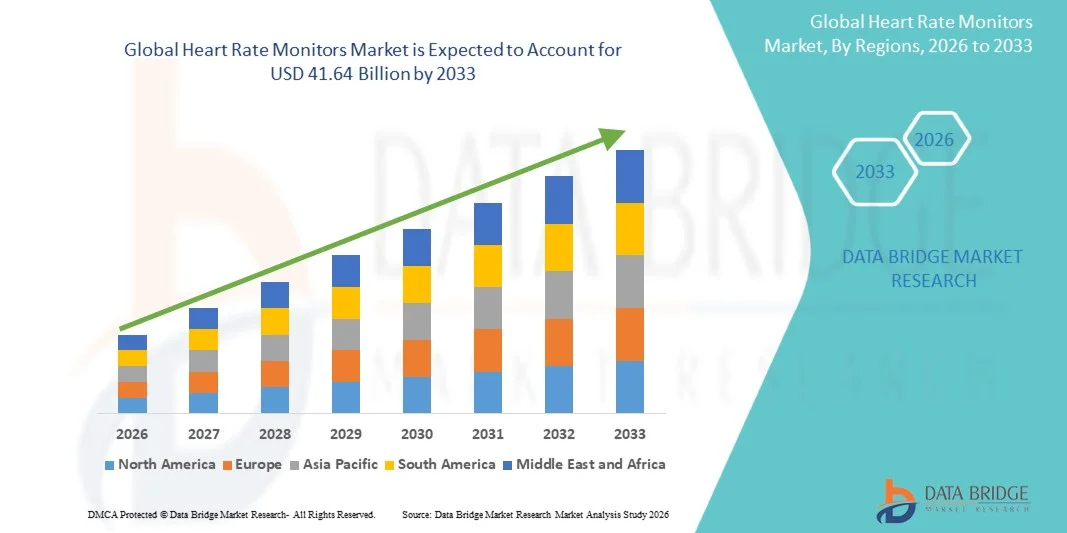
The global heart rate monitors market was valued at USD 15.07 billion in 2025 and is projected to reach USD 41.64 billion by 2033, growing at a CAGR of 13.55% from 2026 to 2033. The market is witnessing steady expansion driven by rising health consciousness, increasing prevalence of cardiovascular diseases, and growing adoption of wearable fitness and remote patient monitoring devices across both developed and emerging economies.
The growing shift toward preventive healthcare, combined with rapid advancements in wearable sensor technologies such as optical (PPG) and ECG-based monitoring, is significantly accelerating market growth. Integration of heart rate monitoring features into smartwatches, fitness bands, and mobile health applications is further boosting consumer adoption. In addition, increasing use in sports performance optimization, clinical monitoring, and home healthcare is strengthening demand for accurate, real-time, and continuous heart rate tracking solutions.
Key Market Trends & Insights
- North America dominated the global heart rate monitors market with the largest revenue share of 38.42% in 2025, supported by high adoption of wearable fitness devices, advanced healthcare infrastructure, and strong penetration of digital health platforms.
- The Wearable segment led the market with a 78.64% share in 2025, driven by rapid adoption of smartwatches, fitness bands, and chest strap monitors for continuous health tracking.
- Asia-Pacific is expected to be the fastest-growing region at a CAGR of 15.2% from 2026 to 2033, fueled by rising health awareness, expanding middle-class population, and rapid adoption of affordable wearable technologies in China and India.
- Non-Wearable is the fastest-growing product type, projected to register a CAGR of 8.9%, reflecting the surge in increasing adoption in hospitals, ICUs, and clinical monitoring environments.
- The Optical segment dominated the technology category with a 66.28% revenue share in 2025, led by widespread integration into wearable devices such as smartwatches and fitness trackers.
- Sports accounted for 54.92% of the market, preferred by strong adoption among athletes, fitness enthusiasts, and professional training institutions. Widely used for endurance tracking, performance optimization, and recovery analysis.
- The Hybrid System segment is the fastest-growing technology category, with a CAGR of 15.8%, driven by integration of optical and electrical sensing technologies for enhanced measurement accuracy.
Market Size & Forecast
- Global Market Value (2025): USD 15.07 Billion
- Expected Market Value (2033): USD 41.64 Billion
- Forecast CAGR (2026–2033): 13.55%
- Leading Region in 2025: North America
- Fastest Growing Region: Asia Pacific
Report Scope and Global Heart Rate Monitors Market Segmentation
|
Attributes |
Heart Rate Monitors Key Market Insights |
|
Segments Covered |
|
|
Countries Covered |
North America · U.S. · Canada · Mexico Europe · Germany · France · U.K. · Netherlands · Switzerland · Belgium · Russia · Italy · Spain · Turkey · Rest of Europe Asia-Pacific · China · Japan · India · South Korea · Singapore · Malaysia · Australia · Thailand · Indonesia · Philippines · Rest of Asia-Pacific Middle East and Africa · Saudi Arabia · U.A.E. · South Africa · Egypt · Israel · Rest of Middle East and Africa South America · Brazil · Argentina · Rest of South America |
|
Key Market Players |
· Apple Inc. (U.S.) · Samsung Electronics Co., Ltd. (South Korea) · Garmin Ltd. (U.S.) · Fitbit LLC (U.S.) · Polar Electro Oy (Finland) · Masimo Corporation (U.S.) · Koninklijke Philips N.V. (Netherlands) · Omron Healthcare Co., Ltd. (Japan) · NIHON KOHDEN CORPORATION (Japan) · Whoop, Inc. (U.S.) · Wahoo Fitness LLC (U.S.) · Suunto Oy (Finland) · Coros Wearables Inc. (U.S.) · Withings S.A.S. (France) · AliveCor, Inc. (U.S.) · BioTelemetry, Inc. (U.S.) · Beurer GmbH (Germany) · Zebra Technologies Corporation (U.S.) · Huawei Technologies Co., Ltd. (China) · Xiaomi Corporation (China) |
|
Market Opportunities |
· Integration of heart rate monitoring with AI-powered predictive health analytics · Expansion of remote patient monitoring (RPM) and telehealth ecosystems · Growing adoption of multi-parameter wearable devices combining heart rate, SpO2, ECG, and stress tracking |
|
Value Added Data Infosets |
In addition to the insights on market scenarios such as market value, growth rate, segmentation, geographical coverage, and major players, the market reports curated by the Data Bridge Market Research also include in-depth expert analysis, patient epidemiology, pipeline analysis, pricing analysis, and regulatory framework. |
Global Heart Rate Monitors Market Trends
Trend: Rising Adoption of Wearable Health & Fitness Monitoring Devices
Consumers are increasingly using smartwatches, fitness bands, and chest strap monitors for continuous heart rate tracking, driven by rising health awareness and preventive healthcare adoption. Integration of heart rate monitoring with mobile apps and digital health ecosystems enables real-time tracking of activity, sleep, and cardiovascular health, improving user engagement and long-term wellness management. The growing demand for personalized fitness insights and subscription-based health platforms is further accelerating adoption of wearable monitoring solutions across global markets. For instance: Apple Watch heart rate and ECG tracking, Fitbit continuous heart rate monitoring ecosystem, Garmin wearable fitness analytics platforms.
Global Heart Rate Monitors Market Dynamics
Key Market Driver: Rising Prevalence of Cardiovascular Diseases and Expansion of Remote Patient Monitoring
The increasing global burden of cardiovascular diseases is driving strong demand for continuous heart rate monitoring for early diagnosis, risk prevention, and long-term disease management. Healthcare systems are increasingly integrating wearable and remote monitoring devices into telehealth frameworks to improve patient outcomes and reduce hospital visits. The shift toward home-based care and preventive healthcare models is significantly strengthening market adoption across both developed and emerging economies. For instance: Philips remote cardiac monitoring solutions, Biotricity cardiac monitoring devices, Apple Health ECG-based atrial fibrillation alerts.
Key Restraint/Challenge: Accuracy Limitations and Variability in Consumer-Grade Devices
Despite rapid technological advancements, consumer wearable heart rate monitors often face limitations in clinical-grade accuracy, particularly during intense physical activity or improper sensor placement. Differences between optical (PPG) and ECG-based readings can lead to inconsistencies, reducing full clinical reliance in critical care applications. This remains a key challenge for broader adoption in hospital-grade monitoring and regulatory approval processes.
For instance: discrepancies between wrist-based smartwatch readings and chest strap ECG devices such as Polar H10 and medical-grade Holter monitors
Key Market Opportunity: Expansion of AI-Enabled Predictive Health and Remote Monitoring Ecosystems
The integration of artificial intelligence and cloud-based analytics with heart rate monitoring devices is creating major opportunities for predictive healthcare and early detection of cardiac abnormalities. These systems enable continuous data analysis, personalized health insights, and proactive intervention strategies, improving patient outcomes and reducing healthcare costs. Expansion of remote patient monitoring programs is further accelerating adoption across hospitals, insurance providers, and homecare settings. For instance: Withings RPM solutions, Biofourmis AI-driven cardiac analytics platform, Google Fitbit Health Connect ecosystem
Global Heart Rate Monitors Market Scope
The heart rate monitors market is segmented on the basis of product, technology, indication, and end users.
- By Product
On the basis of product, the global heart rate monitors market is segmented into wearable and non-wearable devices. The Wearable segment dominated the market with a 78.64% share in 2025, driven by rapid adoption of smartwatches, fitness bands, and chest strap monitors for continuous health tracking. These devices are widely used for real-time fitness monitoring, sleep analysis, and preventive healthcare management across global consumer populations. Strong integration with smartphones, mobile applications, and cloud-based health ecosystems enhances user engagement and data accessibility. Continuous improvements in sensor accuracy, battery life, and device miniaturization are further strengthening adoption. Rising demand for personalized health insights and remote monitoring solutions is reinforcing market dominance. The segment benefits from strong consumer preference for convenient, non-invasive, and always-on health tracking solutions.
The Non-Wearable segment is expected to witness the fastest growth at a CAGR of 8.9% from 2026 to 2033, driven by increasing adoption in hospitals, ICUs, and clinical monitoring environments. These systems are widely used for continuous and high-precision patient monitoring in critical care and surgical applications. Rising prevalence of cardiovascular diseases is significantly boosting demand for reliable medical-grade monitoring systems. Increasing investments in healthcare infrastructure and hospital digitalization are further accelerating adoption. Non-wearable devices offer higher clinical accuracy compared to consumer-grade wearables, making them essential in professional healthcare settings. Growing demand for centralized patient monitoring systems is also supporting segment expansion.
- By Technology
On the basis of technology, the global heart rate monitors market is segmented into optical, electrical, and hybrid systems. The Optical (PPG) segment dominated the market with a 66.28% share in 2025, driven by widespread integration into wearable devices such as smartwatches and fitness trackers. This technology enables continuous, non-invasive heart rate measurement using light-based sensors, making it highly suitable for consumer applications. Advancements in signal processing and AI-based motion correction have significantly improved accuracy and reliability. Rising adoption of fitness and wellness tracking devices is further strengthening demand. Low cost, ease of integration, and energy efficiency make optical systems the preferred choice for manufacturers. The segment continues to expand with the rapid growth of digital health ecosystems.
The Hybrid Systems segment is projected to witness the fastest growth at a CAGR of 15.8% from 2026 to 2033, driven by the integration of optical and electrical sensing technologies for enhanced measurement accuracy. These systems are increasingly used in advanced wearable devices and clinical-grade monitoring equipment. Growing demand for precise cardiovascular monitoring in sports medicine and healthcare is accelerating adoption. Hybrid systems overcome limitations of single-sensor technologies by improving reliability and reducing measurement errors. Rising investment in AI-powered health analytics and smart wearable ecosystems is further boosting growth. Increasing focus on early disease detection and predictive healthcare is strengthening long-term demand.
- By Indication
On the basis of indication, the global heart rate monitors market is segmented into sports and medical applications. The Sports segment dominated the market with a 54.92% share in 2025, driven by strong adoption among athletes, fitness enthusiasts, and professional training institutions. Heart rate monitors are widely used for endurance tracking, performance optimization, and recovery analysis. Integration with sports analytics platforms and coaching applications enhances training efficiency and personalization. Growing popularity of fitness apps and wearable ecosystems is further strengthening demand. Increasing awareness of active lifestyles and preventive fitness management supports continued dominance. Expansion of gyms, fitness centers, and sports academies is also contributing to market growth.
The Medical segment is expected to witness the fastest growth at a CAGR of 14.9% from 2026 to 2033, driven by increasing use in cardiovascular disease monitoring and remote patient care. Healthcare providers are increasingly adopting continuous heart rate monitoring systems for early diagnosis and chronic disease management. Rising penetration of telehealth and home healthcare services is significantly boosting demand. The growing global burden of heart-related disorders is a key growth driver. Advanced monitoring solutions enable real-time alerts and improved patient outcomes. Expansion of digital healthcare infrastructure is further accelerating segment growth.
- By End Users
On the basis of end users, the global heart rate monitors market is segmented into hospitals and clinics, sports medicine centers, professionals, and individuals. The Individuals segment dominated the market with a 48.37% share in 2025, driven by widespread adoption of wearable devices for personal fitness and health tracking. Consumers increasingly rely on smartwatches and fitness bands for daily activity monitoring and preventive healthcare management. Integration with mobile applications and digital health platforms enhances accessibility and user engagement. Rising health awareness and lifestyle changes are major growth drivers. Continuous innovation in affordable and user-friendly wearable devices is strengthening adoption. The segment benefits from strong consumer demand for convenience-based health monitoring solutions.
The Hospitals and Clinics segment is expected to witness the fastest growth at a CAGR of 13.7% from 2026 to 2033, driven by increasing adoption of remote patient monitoring and digital healthcare systems. Healthcare institutions are integrating heart rate monitoring into telemedicine and clinical decision-support platforms. Rising prevalence of cardiovascular diseases is increasing demand for continuous monitoring solutions. Advanced monitoring systems improve patient safety, diagnosis accuracy, and treatment efficiency. Government initiatives supporting healthcare digitalization are further accelerating adoption. Expansion of home-based care and remote monitoring services is also contributing to rapid segment growth.
Global Heart Rate Monitors Market Regional Analysis
North America dominated the global heart rate monitors market with the largest revenue share of 38.42% in 2025, supported by high adoption of wearable fitness devices, advanced healthcare infrastructure, and strong penetration of digital health platforms. The region benefits from increasing consumer focus on preventive healthcare, widespread use of smartwatches and fitness trackers, and strong presence of key wearable technology companies. Rising prevalence of cardiovascular diseases and growing integration of remote patient monitoring solutions across hospitals and homecare settings further support market growth. Continuous innovation in AI-powered health analytics and connected health ecosystems continues to strengthen North America’s leadership position in the global market.
U.S. Heart Rate Monitors Market Insight
The U.S. heart rate monitors market is witnessing strong growth due to high adoption of wearable fitness devices, advanced digital health ecosystems, and increasing prevalence of cardiovascular diseases. The country’s mature healthcare infrastructure, along with strong penetration of smartwatches and remote patient monitoring solutions, is driving demand across consumer and clinical applications. Rising focus on preventive healthcare, fitness tracking, and personalized health analytics is further accelerating market expansion. In addition, continuous innovation by leading wearable technology companies and integration of AI-based health insights are strengthening adoption across hospitals, fitness centers, and homecare settings.
Europe Heart Rate Monitors Market Insight
The Europe heart rate monitors market remains a major contributor to global revenue, driven by strong healthcare systems, rising health awareness, and widespread adoption of digital fitness technologies. The region benefits from increasing use of wearable devices for chronic disease monitoring and preventive healthcare management. Growing government support for digital health initiatives and remote patient monitoring is further supporting market expansion. Rising integration of heart rate tracking in sports science, rehabilitation programs, and telehealth platforms continues to strengthen adoption across the region.
U.K. Heart Rate Monitors Market Insight
The U.K. heart rate monitors market is experiencing steady growth, supported by increasing adoption of wearable health technologies and strong focus on preventive healthcare. Rising demand for fitness tracking devices, combined with expanding telehealth and remote monitoring services, is contributing to market growth. Healthcare providers are increasingly using heart rate monitoring systems for chronic disease management and patient monitoring. In addition, integration of AI-based health analytics and mobile health applications is improving user engagement and expanding adoption across both consumer and clinical segments.
Germany Heart Rate Monitors Market Insight
The Germany heart rate monitors market is expanding steadily due to strong healthcare infrastructure, high fitness awareness, and increasing adoption of advanced medical wearables. Hospitals and clinics are increasingly integrating heart rate monitoring systems for cardiovascular disease management and patient care. The country’s strong focus on precision healthcare and digital transformation is further driving adoption. In addition, growing use of wearable devices in sports science, rehabilitation, and wellness programs is supporting market growth across both clinical and consumer segments.
Asia-Pacific Heart Rate Monitors Market Insight
The Asia-Pacific heart rate monitors market is expected to witness rapid growth, driven by rising health awareness, expanding middle-class population, and increasing adoption of wearable fitness technologies. Growing burden of cardiovascular diseases and improving healthcare infrastructure are supporting demand for continuous monitoring solutions. Countries such as China, India, and Japan are witnessing strong adoption of smartwatches and fitness bands. In addition, increasing penetration of telehealth platforms and affordable wearable devices is accelerating regional market expansion across consumer and clinical applications.
Japan Heart Rate Monitors Market Insight
The Japan heart rate monitors market is witnessing consistent growth due to high adoption of advanced healthcare technologies and strong focus on preventive health management. The aging population is significantly driving demand for continuous cardiovascular monitoring solutions. Japanese consumers are increasingly using wearable devices for fitness tracking, sleep monitoring, and health analytics. Integration of AI-based health systems and strong presence of technology-driven healthcare companies are further supporting market growth across both clinical and consumer applications.
China Heart Rate Monitors Market Insight
The China heart rate monitors market is growing rapidly, driven by increasing urbanization, rising health awareness, and strong adoption of wearable technologies. Expanding middle-class population and growing fitness culture are significantly boosting demand for smartwatches and fitness bands. Government support for digital healthcare transformation and rapid expansion of telehealth services are further accelerating market growth. In addition, strong domestic manufacturing capabilities and continuous innovation in affordable wearable devices are positioning China as one of the fastest-growing markets globally.
Global Heart Rate Monitors Market Share
The Heart Rate Monitors industry is primarily led by well-established companies, including:
- Apple Inc. (U.S.)
- Samsung Electronics Co., Ltd. (South Korea)
- Garmin Ltd. (U.S.)
- Fitbit LLC (U.S.)
- Polar Electro Oy (Finland)
- Masimo Corporation (U.S.)
- Koninklijke Philips N.V. (Netherlands)
- Omron Healthcare Co., Ltd. (Japan)
- NIHON KOHDEN CORPORATION (Japan)
- Whoop, Inc. (U.S.)
- Wahoo Fitness LLC (U.S.)
- Suunto Oy (Finland)
- Coros Wearables Inc. (U.S.)
- Withings S.A.S. (France)
- AliveCor, Inc. (U.S.)
- BioTelemetry, Inc. (U.S.)
- Beurer GmbH (Germany)
- Zebra Technologies Corporation (U.S.)
- Huawei Technologies Co., Ltd. (China)
- Xiaomi Corporation (China)
Latest Developments in Global Heart Rate Monitors Market
- In November 2025, the wearable cardiac monitoring segment saw significant advancements with wider adoption of AI-enabled remote patient monitoring systems that continuously analyze heart rate variability and detect irregular cardiac patterns in real time. These developments are improving early diagnosis capabilities and reducing dependence on hospital-based monitoring. The trend underscores the rapid expansion of digital health and home-based cardiovascular care solutions
- In September 2025, Apple introduced advanced health monitoring upgrades in Apple Watch Series 11, enhancing heart rate tracking with improved optical sensors and machine-learning based cardiovascular insights, including refined ECG interpretation and hypertension risk alerts. The update strengthens real-time health monitoring capabilities and reinforces the device’s role in preventive healthcare and continuous wellness tracking across global consumer markets. It also reflects the growing convergence of wearable electronics and medical-grade monitoring technologies
- In May 2025, Google expanded the Fitbit ecosystem by enhancing AI-driven health analytics and improving continuous heart rate monitoring accuracy across its wearable lineup, focusing on deeper integration between sensor data and personalized wellness insights. The development supports long-term preventive healthcare tracking and strengthens engagement within connected digital health ecosystems. It also highlights the shift toward AI-enabled consumer health platforms
- In June 2023, research and industry adoption accelerated around AI-powered wearable heart monitoring systems capable of detecting atrial fibrillation and other cardiac abnormalities with higher accuracy using continuous PPG-based data analysis. This advancement improved the clinical relevance of consumer wearables and expanded their use in preventive cardiology. It also supported integration of wearable data into telehealth ecosystems.
- In October 2021, Fitbit and clinical researchers validated the effectiveness of wearable heart rate monitoring devices in detecting atrial fibrillation through large-scale clinical studies, demonstrating strong accuracy of continuous wrist-based monitoring systems. This milestone strengthened confidence in consumer wearables as early screening tools for cardiovascular conditions. It also supported broader acceptance of wearable-based cardiac monitoring in healthcare applications
SKU-
Get online access to the report on the World's First Market Intelligence Cloud

- Interactive Data Analysis Dashboard
- Company Analysis Dashboard for high growth potential opportunities
- Research Analyst Access for customization & queries
- Competitor Analysis with Interactive dashboard
- Latest News, Updates & Trend analysis
- Harness the Power of Benchmark Analysis for Comprehensive Competitor Tracking
Research Methodology
Data collection and base year analysis are done using data collection modules with large sample sizes. The stage includes obtaining market information or related data through various sources and strategies. It includes examining and planning all the data acquired from the past in advance. It likewise envelops the examination of information inconsistencies seen across different information sources. The market data is analysed and estimated using market statistical and coherent models. Also, market share analysis and key trend analysis are the major success factors in the market report. To know more, please request an analyst call or drop down your inquiry.
The key research methodology used by DBMR research team is data triangulation which involves data mining, analysis of the impact of data variables on the market and primary (industry expert) validation. Data models include Vendor Positioning Grid, Market Time Line Analysis, Market Overview and Guide, Company Positioning Grid, Patent Analysis, Pricing Analysis, Company Market Share Analysis, Standards of Measurement, Global versus Regional and Vendor Share Analysis. To know more about the research methodology, drop in an inquiry to speak to our industry experts.
Customization Available
Data Bridge Market Research is a leader in advanced formative research. We take pride in servicing our existing and new customers with data and analysis that match and suits their goal. The report can be customized to include price trend analysis of target brands understanding the market for additional countries (ask for the list of countries), clinical trial results data, literature review, refurbished market and product base analysis. Market analysis of target competitors can be analyzed from technology-based analysis to market portfolio strategies. We can add as many competitors that you require data about in the format and data style you are looking for. Our team of analysts can also provide you data in crude raw excel files pivot tables (Fact book) or can assist you in creating presentations from the data sets available in the report.












