


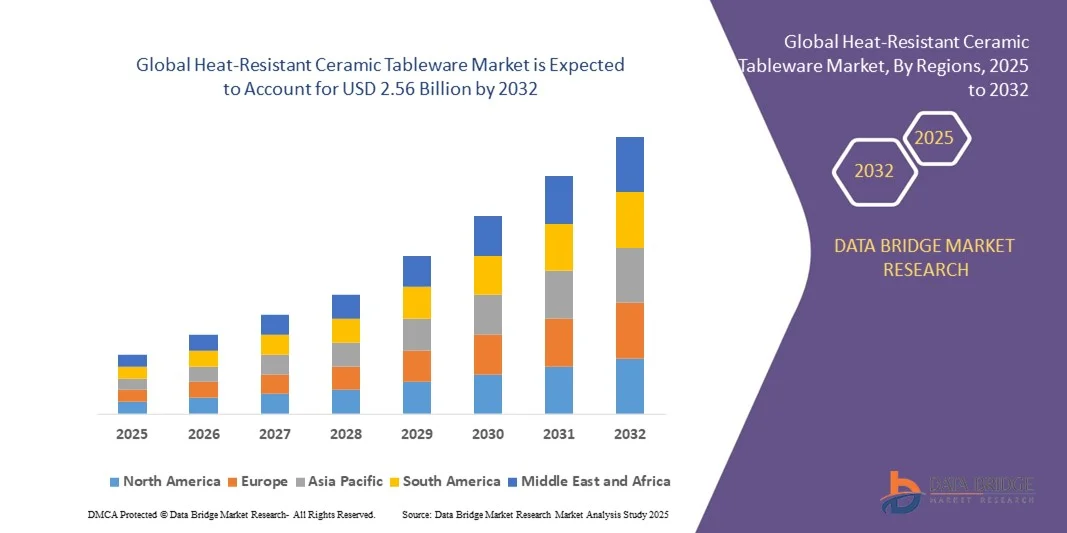
Global Heat-Resistant Ceramic Tableware Market Size
- The global heat-resistant ceramic tableware market size was valued at USD 1.67 billion in 2024 and is projected to reach USD 2.56 billion by 2032, growing at a CAGR of 5.50% during the forecast period.
- Market expansion is driven by increasing consumer preference for durable, aesthetically appealing, and heat-resistant dining solutions, particularly in urban households and hospitality sectors.
- In addition, growing awareness of sustainable and non-toxic materials, coupled with rising disposable incomes and lifestyle upgrades, is fueling demand for high-quality ceramic tableware, thereby propelling the market’s robust growth.
Global Heat-Resistant Ceramic Tableware Market Analysis
- Heat-resistant ceramic tableware, known for its durability, thermal stability, and elegant design, is becoming an essential element in modern kitchens and dining experiences across both residential and commercial sectors due to its ability to withstand high temperatures and frequent U.S.ge without compromising aesthetics.
- The growing demand for heat-resistant ceramic tableware is primarily driven by increasing consumer awareness around sustainable dining solutions, a surge in home cooking and dining trends, and the hospitality industry’s preference for premium, long-lasting serving ware.
- North America dominated the global heat-resistant ceramic tableware market with the largest revenue share of 41.5% in 2024, attributed to high consumer spending, established dining culture, and strong presence of premium tableware brands, with the U.S. showing significant demand across both households and restaurants emphasizing quality and sustainability.
- Asia-Pacific is expected to be the fastest-growing region in the Global Heat-Resistant Ceramic Tableware Market during the forecast period due to rapid urbanization, expanding middle-class populations, and rising lifestyle standards encouraging the adoption of modern, durable tableware.
- Plates segment dominated the Global Heat-Resistant Ceramic Tableware Market with a market share of 38.2% in 2024, driven by their high U.S.ge frequency, diverse applications across meals, and rising consumer interest in aesthetically pleasing and oven-safe dining solutions.
Report Scope and Global Heat-Resistant Ceramic Tableware Market Segmentation
|
Attributes |
Ceramic Tableware Key Market Insights |
|
Segments Covered |
|
|
Countries Covered |
North America
Europe
Asia-Pacific
Middle East and Africa
South America
|
|
Key Market Players |
|
|
Market Opportunities |
|
|
Value Added Data Infosets |
In addition to the insights on market scenarios such as market value, growth rate, segmentation, geographical coverage, and major players, the market reports curated by the Data Bridge Market Research also include in-depth expert analysis, pricing analysis, brand share analysis, consumer survey, demography analysis, supply chain analysis, value chain analysis, raw material/consumables overview, vendor selection criteria, PESTLE Analysis, Porter Analysis, and regulatory framework. |
Global Heat-Resistant Ceramic Tableware Market Trends
Enhanced Aesthetics and Performance Through Material Innovation
- A significant and accelerating trend in the Global Heat-Resistant Ceramic Tableware Market is the continuous advancement in material science and manufacturing techniques, leading to improved heat resistance, enhanced durability, and refined design aesthetics. These innovations are transforming traditional tableware into high-performance, visually appealing products suitable for both daily use and premium dining experiences.
- For instance, manufacturers are increasingly utilizing advanced ceramic blends such as alumina and porcelain composites, which offer superior thermal shock resistance—allowing tableware to move directly from freezer to oven without cracking. Similarly, glazed ceramic coatings are being optimized for scratch resistance and prolonged shine, enhancing both function and form.
- Material innovation also enables the development of thinner, lighter tableware without compromising strength or heat resistance. This not only enhances user comfort and ease of handling but also contributes to reduced energy U.S.ge during production and transport. For example, brands are creating stackable, lightweight designs that are microwave, dishwasher, and oven-safe, catering to modern household needs.
- The integration of digital printing technologies allows for highly detailed, customizable designs on ceramic surfaces, merging artistry with utility. Manufacturers are now offering collections that reflect regional cultures, seasonal themes, and luxury finishes, thereby appealing to a wider consumer base with personalized preferences.
- This focus on aesthetic innovation and performance optimization is reshaping consumer expectations from basic kitchenware to multifunctional lifestyle products. Companies like Villeroy & Boch and Noritake are at the forefront, launching collections with advanced glazing technologies and minimalist, contemporary designs tailored to evolving culinary trends and interior décor preferences.
- The demand for heat-resistant ceramic tableware that combines visual elegance with technical functionality is growing rapidly across residential, hospitality, and commercial sectors, as consumers increasingly value premium, long-lasting, and stylish dining solutions.
Global Heat-Resistant Ceramic Tableware Market Dynamics
Driver
Growing Need Driven by Lifestyle Changes and Hospitality Expansion
- The increasing shift toward modern dining experiences, both at home and in the hospitality sector, coupled with rising consumer awareness around health, sustainability, and aesthetics, is a key driver for the growing demand for heat-resistant ceramic tableware.
- For instance, in March 2024, Royal Doulton launched a new line of eco-friendly, oven-safe ceramic dinnerware targeting urban households and boutique restaurants, combining elegant design with durability. Such innovations by leading brands are expected to further propel market growth in the forecast period.
- As consumers spend more time dining at home due to hybrid work lifestyles and rising food delivery culture, there's growing interest in tableware that is not only functional and heat-resistant but also visually appealing for presentation. Ceramic tableware provides a non-toxic, reU.S.ble, and microwave/oven-safe solution, making it ideal for modern kitchens.
- Furthermore, the rapid expansion of the global hospitality and foodservice industry, particularly in emerging markets, is fueling large-scale demand for durable, high-performance tableware. Hotels, restaurants, and cafés increasingly prefer ceramic products for their resistance to chipping, ease of cleaning, and heat retention during food service.
- The growing appeal of lifestyle dining, minimalistic aesthetics, and eco-conscious living has made ceramic tableware a popular choice in both residential and commercial sectors. The availability of dishwasher-safe, stackable, and multifunctional pieces also supports the rise in adoption. Online retail channels and global design trends further amplify this growth by making premium ceramic tableware more accessible to a wider audience.
Restraint/Challenge
High Fragility and Competitive Pricing Pressure
- Despite their advantages, concerns surrounding the fragility of ceramic tableware continue to pose a significant challenge for broader market penetration. Ceramic items, while heat-resistant and visually appealing, are still prone to cracking or chipping when dropped, which can deter both households with young children and high-traffic commercial users.
- For instance, reports of breakage during transport or regular U.S.ge in fast-paced restaurant environments have led some operators to opt for alternative materials like melamine or tempered glass. This durability concern, especially in cost-sensitive markets, can slow the replacement cycle and limit new purchases.
- In addition, price sensitivity—particularly in emerging economies—can restrict the adoption of premium ceramic products. While affordable ceramic tableware is available, high-end or custom-designed collections often come with a premium price tag, creating barriers for budget-conscious consumers or bulk buyers in the hospitality sector.
- Further complicating the competitive landscape is the growing availability of low-cost alternatives made from stainless steel, bamboo fiber, or plastic composites, which offer higher break resistance and often lower upfront costs.
- To overcome these restraints, manufacturers are focusing on improving product durability through reinforced ceramic blends and protective glazes, while also educating consumers on proper care. At the same time, offering a broader range of price points and sustainable packaging solutions will be essential to address both durability and affordability concerns in the evolving tableware market.
Global Heat-Resistant Ceramic Tableware Market Scope
The market is segmented on the basis application, material type, product type, type, and distribution channel.
- By Application
On the basis of application, the Global Heat-Resistant Ceramic Tableware Market is segmented into household purpose and commercial purpose. The household purpose segment dominated the market with the largest revenue share of 61.3% in 2024, driven by increasing consumer interest in home dining experiences, fueled by lifestyle shifts such as remote working and the popularity of home cooking. Heat-resistant ceramic tableware is preferred in households for its aesthetic appeal, thermal durability, and microwave/oven compatibility. The trend of social dining and gifting high-end dinnerware further supports this segment's dominance.
The commercial purpose segment is expected to register the fastest CAGR of 21.4% from 2025 to 2032. This growth is driven by rising demand from restaurants, hotels, and catering businesses that require durable and heat-resistant ceramic products to maintain food presentation standards while ensuring cost-effective, long-term use in high-traffic environments.
- By Product Type
Based on product type, the Global Heat-Resistant Ceramic Tableware Market is segmented into ceramic dinnerware, ceramic beverage ware, and ceramic flatware. The ceramic dinnerware segment held the largest market share of 52.7% in 2024, due to the high demand for items like plates, serving bowls, and complete dinner sets. Their ability to withstand high temperatures and enhance table presentation makes them ideal for both everyday and formal use.
The ceramic beverage ware segment is projected to witness the fastest CAGR of 20.9% from 2025 to 2032, owing to increasing consumption of hot beverages such as coffee and tea in both residential and commercial settings. Stylish, insulated, and heat-resistant mugs, cups, and tumblers are gaining popularity among younger consumers and office environments, contributing to accelerated growth in this category.
- By Material Type
On the basis of material type, the market is segmented into bone china, stoneware, porcelain, and others. The porcelain segment led the market with a revenue share of 38.5% in 2024, driven by its premium look, high durability, and superior heat resistance. Its widespread use in upscale dining settings and versatility across households and hospitality establishments support its dominance.
The stoneware segment is expected to record the fastest CAGR of 21.2% from 2025 to 2032. Stoneware’s rustic finish, strength, and oven-safe properties make it a preferred choice for casual dining, artisan kitchens, and restaurants seeking robust and aesthetically distinct tableware solutions.
- By Type
By type, the market is segmented into plates, bowls, cups, trays, and cutlery. The plates segment dominated the market with a revenue share of 38.2% in 2024, driven by their core role in meal presentation and frequency of use in both household and foodservice environments. Plates are typically the highest-replaced items due to wear, breakage, and changing consumer preferences, supporting their strong market position.
The cups segment is anticipated to grow at the fastest CAGR of 22.3% from 2025 to 2032, fueled by the rising popularity of specialty beverages and the demand for microwave- and dishwasher-safe cups. The segment also benefits from customization trends in corporate and personal gifting, driving volume growth.
- By Distribution Channel
On the basis of distribution channel, the market is segmented into supermarkets and hypermarkets, specialty stores, wholesalers, online, and others. The supermarkets and hypermarkets segment accounted for the largest revenue share of 34.9% in 2024, supported by wide product availability, consumer trust, and the convenience of in-store inspection before purchase. Retailers often offer discounts and bundles, which attract price-sensitive consumers.
The online segment is projected to witness the fastest CAGR of 23.1% during the forecast period. Increasing internet penetration, ease of product comparison, doorstep delivery, and access to a wide range of global brands are propelling online sales. Consumers also favor online platforms for accessing niche or designer ceramic tableware collections not available in local markets.
Global Heat-Resistant Ceramic Tableware Market Regional Analysis
- North America dominated the global heat-resistant ceramic tableware market with the largest revenue share of 41.5% in 2024, driven by strong consumer demand for premium, durable, and aesthetically appealing dining products across households and the hospitality industry.
- Consumers in the region place high value on quality, design, and functionality, favoring heat-resistant ceramic tableware for its oven safety, microwave compatibility, and visual appeal in both everyday and formal dining settings.
- This widespread adoption is further supported by high disposable incomes, a well-established dining culture, and the growing influence of lifestyle trends promoted through e-commerce and social media. The presence of leading ceramic tableware brands and a mature retail infrastructure further strengthen the market, making North America a key hub for both innovation and consumption in the tableware industry.
U.S. Global Heat-Resistant Ceramic Tableware Market Insight
The U.S. Heat-Resistant Ceramic Tableware Market captured the largest revenue share of 79% in 2024 within North America, driven by a strong domestic demand for high-quality, oven-safe ceramic products in both residential and hospitality sectors. American consumers increasingly prioritize health-conscious, sustainable, and visually appealing tableware for home dining. The growing trend of home cooking, along with rising interest in stylish, Instagram-worthy presentation, fuels demand for premium ceramic dinnerware. Additionally, the country’s large hospitality industry, including hotels, cafés, and restaurants, supports consistent demand for durable, heat-resistant ceramic sets that align with both functional and aesthetic standards.
Europe Global Heat-Resistant Ceramic Tableware Market Insight
The Europe Heat-Resistant Ceramic Tableware Market is projected to expand at a substantial CAGR during the forecast period, propelled by rising demand for sustainable and eco-friendly dining solutions. European consumers show strong preference for stoneware and porcelain, driven by aesthetics, heat retention, and long-lasting quality. Growth is further supported by the continent’s deep-rooted culinary culture, expanding foodservice sector, and lifestyle shifts towards home-based gourmet dining. Moreover, the growing popularity of artisanal and handmade ceramic products, particularly in Western Europe, is creating new growth opportunities, especially through online and specialty retail channels.
U.K. Global Heat-Resistant Ceramic Tableware Market Insight
The U.K. Heat-Resistant Ceramic Tableware Market is anticipated to grow at a noteworthy CAGR during the forecast period, supported by the growing culture of home cooking and dining aesthetics. British consumers are increasingly investing in premium ceramic dinnerware and serveware that reflect modern design trends and functionality. Rising demand for microwave- and dishwasher-safe products and the resurgence of traditional tea culture also contribute to ceramic beverage ware sales. E-commerce platforms and homeware retailers continue to drive visibility and accessibility of new ceramic collections, particularly among young, urban consumers seeking both style and practicality.
Germany Global Heat-Resistant Ceramic Tableware Market Insight
The Germany Heat-Resistant Ceramic Tableware Market is expected to expand at a considerable CAGR during the forecast period, owing to a strong consumer preference for quality craftsmanship and eco-conscious materials. Germany's rich design heritage, coupled with the popularity of minimalist and durable kitchenware, supports steady demand for porcelain and stoneware tableware. Growth in home renovation and kitchen remodeling trends is also boosting purchases of coordinated dining sets. Additionally, German consumers’ increasing focus on sustainability and reU.S.ble products over disposables aligns well with ceramic tableware adoption, especially in environmentally conscious households.
Asia-Pacific Global Heat-Resistant Ceramic Tableware Market Insight
The Asia-Pacific Heat-Resistant Ceramic Tableware Market is poised to grow at the fastest CAGR of 24% during the forecast period (2025–2032), fueled by rapid urbanization, rising disposable incomes, and expanding middle-class populations in countries such as China, India, and Southeast Asia. The region benefits from a strong ceramic production base, making products more affordable and accessible. Cultural dining traditions combined with modern lifestyle changes are driving demand for multifunctional and microwave-safe tableware. Increasing food delivery and home dining trends, especially post-pandemic, are further boosting residential ceramic tableware sales across APAC.
Japan Global Heat-Resistant Ceramic Tableware Market Insight
The Japan Heat-Resistant Ceramic Tableware Market is gaining momentum, driven by the nation’s rich ceramic heritage, increasing demand for minimalist design, and a focus on functional elegance in homeware. Japanese consumers value high-quality, space-saving, and durable ceramic tableware that aligns with traditional dining practices and modern living. The country’s aging population also supports demand for lightweight, easy-to-handle items, while its dense urban environment favors compact, multifunctional tableware sets. Local artisanal products continue to perform well, particularly through specialty stores and cultural retail outlets.
China Global Heat-Resistant Ceramic Tableware Market Insight
The China Heat-Resistant Ceramic Tableware Market accounted for the largest market revenue share in Asia-Pacific in 2024, driven by the country’s expansive ceramic manufacturing industry and a growing domestic appetite for stylish, high-performance tableware. Rising urbanization, increasing disposable income, and a surge in modern kitchen setups are contributing to elevated consumer expectations around durability and heat resistance. Additionally, the growth of domestic e-commerce platforms, home dining culture, and brand-conscious millennial consumers is accelerating demand for both traditional and contemporary ceramic tableware designs. China's export market also remains robust, strengthening its global footprint.
Global Heat-Resistant Ceramic Tableware Market Share
The Major Market Leaders Operating in the Market Are:
- Rosenthal GmbH (Germany)
- Villeroy & Boch (Germany)
- KAHLA/Thüringen Porzellan GmbH (Germany)
- Staatliche Porzellan-Manufaktur Meissen GmbH (Germany)
- Steelite International (U.K.)
- WMF Group (Germany)
- Portmeirion Group PLC (U.K.)
- Degrenne (France)
- Tognana Porcellane (Italy)
- Churchill China (U.K.) Ltd. (U.K.)
- Libbey Inc. (U.S.)
- Apulum S.A. (Romania)
- Kütahya Porselen (Turkey)
- Vista Alegre (Portugal)
- Bernardaud (France)
- Denby Pottery (U.K.)
- Cerasind (Romania)
- GUANGDONG SITONG GROUP CO., LTD (China)
- Richard Ginori s.r.l. (Italy)
- Royal Crown Derby (U.K.)
What are the Recent Developments in Global Heat-Resistant Ceramic Tableware Market?
- In April 2023, Villeroy & Boch, a leading European ceramic tableware manufacturer, launched an initiative in South Africa aimed at introducing a line of heat-resistant porcelain dinnerware tailored to high-temperature cooking and serving practices in local households. This initiative underscores the company's commitment to expanding its product portfolio in emerging markets with durable, high-performance ceramic solutions. By leveraging its design and manufacturing expertise, Villeroy & Boch is both addressing regional consumer preferences for longevity and aesthetics and reinforcing its position in the rapidly growing global Heat‑Resistant Ceramic Tableware Market.
- In March 2023, Corelle Brands introduced a new “Therma‑Guard” range of microwave‑ and oven‑safe dinnerware sets targeting hospitality environments and large households. Designed to resist thermal shock (for example, going from freezer to oven), the range features reinforced glaze and lighter, stackable forms. This advancement highlights Corelle’s focus on blending functional performance with modern design, offering resilient buffet and catering solutions that maintain presentation quality under heavy use.
- In March 2023, Lenox Corporation successfully partnered with a major hotel chain in Bengaluru, India, to supply heat‑resistant stoneware sets for their new properties. This partnership was part of a broader “Safe Kitchen, Elegant Presentation” program aimed at elevating dining experiences in upscale hotel spaces while ensuring durability of tableware under high‑heat serving conditions. The project emphasizes the rising importance of premium ceramic tableware in institutional and commercial sectors in fast‑growing urban regions.
- In February 2023, Wedgwood announced a strategic collaboration with a global e‑commerce platform to offer a curated selection of bone china and porcelain flatware designed for heat resistance and decorative appeal. The collection includes items with thermal‑stable glazes and enhanced edge strength. This collaboration intends to improve accessibility for consumers in remote areas and tap into rising online demand for premium tableware.
- In January 2023, Noritake unveiled its new “OvenSafe Plus” line at the International Home & Kitchen Expo. The line includes trays, plates, and cups made with upgraded porcelain and reinforced rim designs, allowing direct oven use up to higher temperatures without warping. The launch illustrates Noritake’s investment in technical innovation and in meeting growing consumer demands for multifunctional tableware that spans oven, microwave, and dishwasher use, while maintaining visual elegance.

- Interactive Data Analysis Dashboard
- Company Analysis Dashboard for high growth potential opportunities
- Research Analyst Access for customization & queries
- Competitor Analysis with Interactive dashboard
- Latest News, Updates & Trend analysis
- Harness the Power of Benchmark Analysis for Comprehensive Competitor Tracking
Data collection and base year analysis are done using data collection modules with large sample sizes. The stage includes obtaining market information or related data through various sources and strategies. It includes examining and planning all the data acquired from the past in advance. It likewise envelops the examination of information inconsistencies seen across different information sources. The market data is analysed and estimated using market statistical and coherent models. Also, market share analysis and key trend analysis are the major success factors in the market report. To know more, please request an analyst call or drop down your inquiry.
The key research methodology used by DBMR research team is data triangulation which involves data mining, analysis of the impact of data variables on the market and primary (industry expert) validation. Data models include Vendor Positioning Grid, Market Time Line Analysis, Market Overview and Guide, Company Positioning Grid, Patent Analysis, Pricing Analysis, Company Market Share Analysis, Standards of Measurement, Global versus Regional and Vendor Share Analysis. To know more about the research methodology, drop in an inquiry to speak to our industry experts.
Data Bridge Market Research is a leader in advanced formative research. We take pride in servicing our existing and new customers with data and analysis that match and suits their goal. The report can be customized to include price trend analysis of target brands understanding the market for additional countries (ask for the list of countries), clinical trial results data, literature review, refurbished market and product base analysis. Market analysis of target competitors can be analyzed from technology-based analysis to market portfolio strategies. We can add as many competitors that you require data about in the format and data style you are looking for. Our team of analysts can also provide you data in crude raw excel files pivot tables (Fact book) or can assist you in creating presentations from the data sets available in the report.













