


What is Heating Ventilation and Air Conditioning (HVAC) Sensors and Controllers Market Size and Growth Rate ?
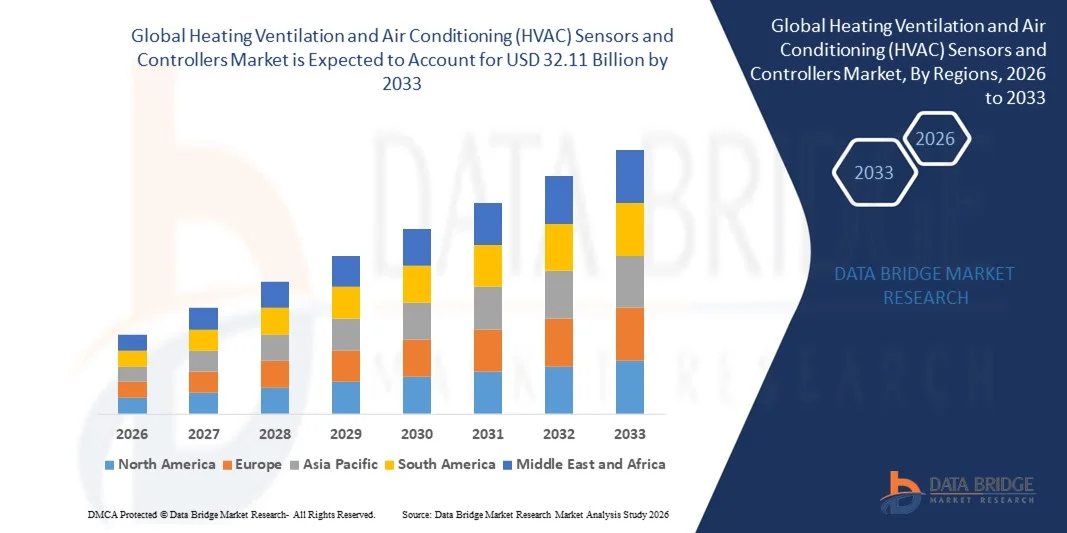
- As per Data Bridge Market Research Analysis the Global Heating Ventilation and Air Conditioning (HVAC) sensors and controllers market size was valued at USD 19.40 billion in 2025 and is expected to reach USD 32.11 billion by 2033, at a CAGR of 6.50% during the forecast period
- The market growth is largely fueled by the increasing emphasis on energy efficiency regulations and carbon reduction targets across residential, commercial, and industrial infrastructure, which is driving the integration of advanced HVAC sensors and intelligent controllers to optimize energy consumption and maintain regulatory compliance
- Furthermore, rising demand for smart buildings, enhanced indoor air quality monitoring, and automated climate control systems is positioning HVAC sensors and controllers as essential components of modern building management systems. These converging factors are accelerating digital transformation in building infrastructure, thereby significantly strengthening the growth trajectory of the Heating Ventilation and Air Conditioning (HVAC) Sensors and Controllers market.
Market Size & Forecast
- Global Market Value (2025): USD 19.40 Billion
- Expected Market Value (2033): USD 32.11 Billion
- Forecast CAGR (2026–2033): 6.50%
Heating Ventilation and Air Conditioning (HVAC) Sensors and Controllers Market Analysis
- Heating Ventilation and Air Conditioning (HVAC) sensors and controllers, designed to monitor and regulate temperature, humidity, pressure, airflow, and air quality parameters, are increasingly becoming critical elements in smart infrastructure as they enable real-time system optimization, predictive maintenance, and centralized building management across diverse end-use sectors
- The escalating demand for Heating Ventilation and Air Conditioning (HVAC) sensors and controllers is primarily driven by rapid urbanization, expansion of commercial construction, increasing awareness of indoor environmental quality, and the growing deployment of IoT-enabled automation platforms that enhance operational efficiency and reduce overall lifecycle energy costs
- Europe dominated the Heating Ventilation and Air Conditioning (HVAC) sensors and controllers market with a share of 34.3% in 2025, due to stringent energy efficiency regulations, strong emphasis on sustainable building infrastructure, and widespread adoption of smart building technologies
- Asia-Pacific is expected to be the fastest growing region in the Heating Ventilation and Air Conditioning (HVAC) sensors and controllers market during the forecast period due to rapid urbanization, expanding construction activities, and increasing awareness of energy conservation
- Temperature sensors segment dominated the market with a market share of 35.3% in 2025, due to their critical role in maintaining thermal comfort, optimizing energy consumption, and ensuring system efficiency across residential and commercial buildings. These sensors form the core of HVAC control loops by continuously monitoring ambient and duct temperatures, enabling precise regulation of heating and cooling cycles
Report Scope and Heating Ventilation and Air Conditioning (HVAC) Sensors and Controllers Market Segmentation
|
Attributes |
Heating Ventilation and Air Conditioning (HVAC) Sensors and Controllers Key Market Insights |
|
Segments Covered |
|
|
Countries Covered |
North America
Europe
Asia-Pacific
Middle East and Africa
South America
|
|
Key Market Players |
|
|
Market Opportunities |
|
|
Value Added Data Infosets |
In addition to the market insights such as market value, growth rate, market segments, geographical coverage, market players, and market scenario, the market report curated by the Data Bridge Market Research team includes in-depth expert analysis, import/export analysis, pricing analysis, production consumption analysis, and pestle analysis. |
Whta is Key Trend in Heating Ventilation and Air Conditioning (HVAC) Sensors and Controllers Market ?
Increasing Integration of IoT-Enabled and Smart Building Automation Systems
- A significant trend in the Heating Ventilation and Air Conditioning (HVAC) Sensors and Controllers market is the increasing integration of IoT-enabled devices within smart building automation systems, driven by the growing demand for real-time monitoring, predictive maintenance, and centralized energy management
- For instance, Honeywell International Inc. and Siemens AG provide IoT-connected HVAC sensors and advanced building management controllers that enable remote diagnostics, automated adjustments, and data-driven performance optimization. These solutions strengthen system responsiveness and support facility managers in reducing energy consumption while maintaining occupant comfort
- The adoption of cloud-based monitoring platforms is expanding as HVAC controllers increasingly integrate with analytics software to provide actionable insights into equipment performance and environmental conditions. This is positioning smart HVAC sensors as essential components in achieving operational transparency and proactive fault detection within modern infrastructures
- Commercial buildings and industrial facilities are deploying advanced temperature, humidity, and occupancy sensors to enable demand-based ventilation and adaptive climate control strategies. This approach improves system efficiency and supports sustainability targets by aligning HVAC output with real-time occupancy and environmental data
- Urban development initiatives focused on smart cities are accelerating the deployment of connected HVAC systems that interact with broader building ecosystems such as lighting and security platforms. This interconnected functionality enhances centralized control and streamlines facility-wide automation processes
- The market is witnessing strong momentum toward digitally integrated climate management solutions where intelligent sensors and programmable controllers form the backbone of automated HVAC operations. This rising incorporation of IoT-enabled HVAC technologies is reinforcing the transition toward energy-efficient, data-driven, and fully interconnected building environments across global markets
Heating Ventilation and Air Conditioning (HVAC) Sensors and Controllers Market Dynamics
Driver
Growing Emphasis on Energy Efficiency and Regulatory Compliance
- The increasing emphasis on reducing energy consumption and meeting stringent environmental regulations is driving demand for advanced Heating Ventilation and Air Conditioning (HVAC) Sensors and Controllers that enable precise climate regulation and energy optimization. These systems support compliance with evolving building efficiency standards while helping organizations lower operational costs and carbon emissions
- For instance, U.S. Department of Energy promotes building energy codes and efficiency programs that encourage adoption of intelligent HVAC control systems to improve overall building performance. Such regulatory frameworks accelerate the implementation of high-accuracy sensors and programmable controllers across new and existing infrastructures
- Rising global focus on sustainability certifications and green building standards is encouraging facility owners to deploy smart HVAC technologies capable of delivering measurable energy savings. Accurate sensing and automated control mechanisms play a critical role in meeting performance benchmarks associated with modern environmental standards
- Industrial and commercial operators are prioritizing energy management strategies that rely on advanced control algorithms to reduce wastage and improve load balancing. This strengthens the need for sensors that continuously monitor airflow, pressure, and temperature to ensure optimized system output
- The sustained regulatory push toward energy-efficient infrastructure continues to reinforce this driver, positioning Heating Ventilation and Air Conditioning (HVAC) Sensors and Controllers as vital technologies for achieving compliance, operational efficiency, and long-term sustainability objectives across diverse building environments
Restraint/Challenge
High Initial Investment and System Integration Complexity
- The Heating Ventilation and Air Conditioning (HVAC) Sensors and Controllers market faces challenges related to the high initial investment required for deploying advanced sensing devices, programmable logic controllers, and integrated building management systems. These upfront costs can be substantial for small and medium-sized facilities seeking modernization of existing HVAC infrastructure
- For instance, Johnson Controls deploys comprehensive building automation platforms that require careful integration with legacy HVAC equipment, resulting in additional engineering, configuration, and commissioning expenses. Such large-scale deployments demand specialized expertise and can extend implementation timelines
- Integrating new-generation sensors with older mechanical systems often involves compatibility adjustments, customized software configurations, and network restructuring. This complexity increases project risk and may deter organizations from undertaking full-scale digital upgrades
- The requirement for skilled technicians to configure, calibrate, and maintain intelligent HVAC control systems further adds to operational expenditure. Limited technical expertise in certain regions can slow adoption and create dependency on specialized service providers
- These financial and technical barriers collectively create adoption constraints, particularly in cost-sensitive markets where return on investment calculations strongly influence purchasing decisions. The complexity of integration and capital expenditure requirements remains a key challenge shaping the pace of market expansion
Heating Ventilation and Air Conditioning (HVAC) Sensors and Controllers Market Scope
The market is segmented on the basis of sensors, controllers, implementation type, and application.
- By Sensors
On the basis of sensors, the Heating Ventilation and Air Conditioning (HVAC) Sensors and Controllers market is segmented into Temperature Sensors, Pressure Sensors, Occupancy Sensors, Humidity Sensors, and Gas & Volatile Organic Compounds Sensors. The Temperature Sensors segment dominated the market with the largest revenue share of 35.3% in 2025, driven by their critical role in maintaining thermal comfort, optimizing energy consumption, and ensuring system efficiency across residential and commercial buildings. These sensors form the core of HVAC control loops by continuously monitoring ambient and duct temperatures, enabling precise regulation of heating and cooling cycles. Increasing emphasis on energy-efficient buildings and regulatory standards for indoor climate control further strengthens demand for temperature sensors across smart building infrastructures.
The Occupancy Sensors segment is anticipated to witness the fastest growth rate from 2026 to 2033, fueled by rising adoption of demand-controlled ventilation systems and smart energy management solutions. Occupancy sensors enable HVAC systems to adjust airflow and temperature based on real-time space utilization, significantly reducing unnecessary energy consumption. Growing investments in green buildings, integration with IoT-based building management systems, and the need for enhanced indoor air quality management are accelerating their deployment across commercial offices, educational institutions, and public facilities.
- By Controllers
On the basis of controllers, the market is segmented into Temperature Controllers, Humidity Controllers, Enthalpy Controllers, and Universal Controllers. The Temperature Controllers segment held the largest market revenue share in 2025 due to their widespread use in regulating heating and cooling equipment across diverse building types. These controllers ensure consistent thermal conditions, improve occupant comfort, and enhance equipment lifespan through automated adjustments. Strong demand from commercial complexes, industrial facilities, and residential smart thermostats contributes significantly to their dominant position in the market.
The Universal Controllers segment is expected to witness the fastest CAGR from 2026 to 2033, driven by increasing demand for integrated and flexible control platforms capable of managing multiple HVAC parameters simultaneously. Universal controllers support interoperability with various sensors and communication protocols, making them suitable for advanced building automation systems. Rising adoption of centralized building management systems and the need for scalable, programmable solutions in large infrastructure projects are accelerating growth in this segment.
- By Implementation Type
On the basis of implementation type, the market is segmented into New Construction and Retrofit. The New Construction segment dominated the market in 2025, supported by rapid urbanization, expansion of commercial infrastructure, and growing investments in smart city projects. Newly constructed buildings increasingly incorporate advanced HVAC sensors and controllers during the design phase to meet energy efficiency standards and sustainability certifications. Integration of intelligent climate control systems at the construction stage reduces long-term operational costs and enhances building performance.
The Retrofit segment is projected to witness the fastest growth rate from 2026 to 2033, driven by the modernization of aging building infrastructure and increasing focus on reducing energy consumption in existing facilities. Retrofitting allows property owners to upgrade legacy HVAC systems with advanced sensors and controllers without complete system replacement. Government incentives for energy-efficient renovations and rising awareness regarding indoor air quality improvements are further supporting segment expansion.
- By Application
On the basis of application, the Heating Ventilation and Air Conditioning (HVAC) sensors and controllers market is segmented into Commercial, Retail, Hospitals, Others, Industrial, Residential, and Transportation & Logistics. The Commercial segment dominated the market with the largest revenue share in 2025, driven by high installation rates in office buildings, corporate campuses, and educational institutions requiring advanced climate management systems. Commercial facilities rely heavily on automated HVAC control to manage large occupancy volumes, reduce operational costs, and comply with energy efficiency regulations. Increasing deployment of smart building technologies further reinforces demand in this segment.
The Hospitals segment is anticipated to witness the fastest growth rate from 2026 to 2033, fueled by stringent requirements for temperature, humidity, and air quality control in healthcare environments. HVAC sensors and controllers play a critical role in maintaining sterile conditions, controlling airborne contaminants, and ensuring patient comfort. Rising healthcare infrastructure development and heightened focus on infection control standards are accelerating adoption across hospitals and specialized medical facilities.
Heating Ventilation and Air Conditioning (HVAC) Sensors and Controllers Market Regional Analysis
- Europe dominated the Heating Ventilation and Air Conditioning (HVAC) sensors and controllers market with the largest revenue share of 34.3% in 2025, driven by stringent energy efficiency regulations, strong emphasis on sustainable building infrastructure, and widespread adoption of smart building technologies
- The region’s focus on reducing carbon emissions and improving indoor air quality has accelerated deployment of advanced HVAC sensors and controllers across commercial and residential buildings
- The market is further supported by robust investments in green construction, modernization of aging infrastructure, and increasing integration of building automation systems. Strong regulatory frameworks related to energy performance of buildings and climate control standards continue to position Europe as a leading region in HVAC system optimization
Germany Heating Ventilation and Air Conditioning (HVAC) Sensors and Controllers Market Insight
The Germany Heating Ventilation and Air Conditioning (HVAC) Sensors and Controllers market captured the largest revenue share within Europe in 2025, supported by the country’s strong manufacturing base and focus on Industry 4.0 initiatives. Growing demand for energy-efficient climate control systems in commercial buildings and industrial facilities is driving the integration of advanced sensors and programmable controllers. Strict building energy codes and increasing adoption of automated building management systems further contribute to market expansion.
U.K. Heating Ventilation and Air Conditioning (HVAC) Sensors and Controllers Market Insight
The U.K. Heating Ventilation and Air Conditioning (HVAC) Sensors and Controllers market is projected to expand at a substantial CAGR during the forecast period, fueled by rising investments in smart infrastructure and energy-efficient residential developments. Government regulations targeting net-zero emissions and improved indoor air quality standards are encouraging the adoption of advanced HVAC monitoring and control solutions. Increasing refurbishment projects across commercial offices and public buildings are further strengthening market demand.
France Heating Ventilation and Air Conditioning (HVAC) Sensors and Controllers Market Insight
The France Heating Ventilation and Air Conditioning (HVAC) Sensors and Controllers market is expected to witness steady growth, driven by national energy transition initiatives and modernization of commercial infrastructure. Demand for connected HVAC systems capable of real-time monitoring and predictive maintenance is increasing across retail, healthcare, and hospitality sectors. The growing adoption of green building certifications and energy performance regulations continues to support the integration of intelligent sensors and controllers.
Asia-Pacific Heating Ventilation and Air Conditioning (HVAC) Sensors and Controllers Market Insight
The Asia-Pacific Heating Ventilation and Air Conditioning (HVAC) Sensors and Controllers market is anticipated to grow at the fastest CAGR during the forecast period, driven by rapid urbanization, expanding construction activities, and increasing awareness of energy conservation. Rising disposable incomes and strong industrial growth in countries such as China, Japan, and India are fostering the adoption of advanced HVAC automation systems. Government initiatives promoting smart cities and energy-efficient buildings are further accelerating regional market expansion.
China Heating Ventilation and Air Conditioning (HVAC) Sensors and Controllers Market Insight
China accounted for the largest market revenue share in Asia-Pacific in 2025, attributed to large-scale infrastructure development and rapid adoption of smart building technologies. The country’s strong manufacturing ecosystem and increasing focus on energy-efficient solutions are driving demand for HVAC sensors and controllers in residential, commercial, and industrial projects. Supportive policies aimed at reducing energy consumption and improving air quality continue to propel market growth.
Japan Heating Ventilation and Air Conditioning (HVAC) Sensors and Controllers Market Insight
The Japan Heating Ventilation and Air Conditioning (HVAC) Sensors and Controllers market is gaining traction due to advanced technological infrastructure and strong emphasis on indoor air quality and energy optimization. Increasing deployment of automated climate control systems in commercial complexes and high-rise residential buildings is supporting demand. The integration of IoT-enabled sensors with centralized building management platforms is further enhancing operational efficiency and driving market expansion.
Heating Ventilation and Air Conditioning (HVAC) Sensors and Controllers Market Share
The Heating Ventilation and Air Conditioning (HVAC) sensors and controllers industry is primarily led by well-established companies, including:
- Keihin Corporation (Japan)
- Sensata Technologies, Inc. (U.S.)
- Robert Bosch GmbH (Germany)
- Continental AG (Germany)
- Panasonic Automotive Systems Europe GmbH (Germany)
- Denso Corporation (Japan)
- Visteon Corporation (U.S.)
- Nippon Seiki Co., Ltd. (Japan)
- Yazaki Corporation (Japan)
- Alps Alpine Co., Ltd. (Japan)
- Renesas Electronics Corporation (Japan)
- Toshiba Electronic Devices & Storage Corporation (Japan)
- Japan Display Inc. (Japan)
- Mitsubishi Electric Corporation (Japan)
- Clarion Co., Ltd. (Japan)
- SANDEN HOLDINGS CORPORATION (Japan)
- Toyota Industries Corporation (Japan)
- Brose Fahrzeugteile SE & Co. KG (Germany)
Latest Developments in Global Heating Ventilation and Air Conditioning (HVAC) Sensors and Controllers Market
- In February 2026, Siemens introduced major upgrades to its Desigo building automation portfolio including enhanced versions of Desigo CC and Desigo Optic, strengthening open-platform HVAC control capabilities and improving interoperability across diverse building systems. The upgraded platform enhances data visualization, remote monitoring, and cybersecurity resilience while enabling seamless integration of advanced HVAC sensors and programmable controllers. This development accelerates digital transformation in commercial and industrial buildings and increases demand for scalable, intelligent HVAC control ecosystems
- In June 2025, Littelfuse expanded its portfolio with the SRP1-CC DC output relay engineered to manage both resistive and inductive loads in heating and HVAC systems. The solid-state relay improves switching reliability under high electrical stress and demanding environmental conditions, reducing failure rates and system downtime. By simplifying integration and enhancing durability, the innovation strengthens the adoption of high-performance controller components in automated HVAC infrastructure
- In March 2025, Siemens partnered with Sensirion to co-develop high-precision differential pressure sensors designed specifically for HVAC airflow and ventilation management. These sensors enhance measurement accuracy, enabling more responsive control of air handling units and optimized indoor air quality management. The collaboration supports energy-efficient building operations and regulatory compliance, reinforcing the importance of advanced sensing technologies in next-generation HVAC control systems
- In March 2025, Johnson Controls launched the NSW8000 Series Wireless Network Sensor integrating temperature, humidity, CO₂, and occupancy sensing within a unified device for building automation platforms. The wireless architecture reduces installation complexity and retrofit costs while improving flexibility in system expansion. Enhanced real-time environmental monitoring improves HVAC responsiveness and energy optimization, driving broader deployment of intelligent sensor-controller networks across smart building projects
- In March 2023, Johnson Controls expanded its smart building solutions portfolio by delivering integrated systems covering heating, ventilation and air conditioning, fire suppression, security, and digital management under a unified control framework. The integrated ecosystem enables centralized analytics, automated decision-making, and improved cross-functional system coordination. This strategic expansion strengthens the market position of comprehensive HVAC sensor and controller solutions by promoting energy efficiency, sustainability goals, and data-driven facility management practices

- Interactive Data Analysis Dashboard
- Company Analysis Dashboard for high growth potential opportunities
- Research Analyst Access for customization & queries
- Competitor Analysis with Interactive dashboard
- Latest News, Updates & Trend analysis
- Harness the Power of Benchmark Analysis for Comprehensive Competitor Tracking
Data collection and base year analysis are done using data collection modules with large sample sizes. The stage includes obtaining market information or related data through various sources and strategies. It includes examining and planning all the data acquired from the past in advance. It likewise envelops the examination of information inconsistencies seen across different information sources. The market data is analysed and estimated using market statistical and coherent models. Also, market share analysis and key trend analysis are the major success factors in the market report. To know more, please request an analyst call or drop down your inquiry.
The key research methodology used by DBMR research team is data triangulation which involves data mining, analysis of the impact of data variables on the market and primary (industry expert) validation. Data models include Vendor Positioning Grid, Market Time Line Analysis, Market Overview and Guide, Company Positioning Grid, Patent Analysis, Pricing Analysis, Company Market Share Analysis, Standards of Measurement, Global versus Regional and Vendor Share Analysis. To know more about the research methodology, drop in an inquiry to speak to our industry experts.
Data Bridge Market Research is a leader in advanced formative research. We take pride in servicing our existing and new customers with data and analysis that match and suits their goal. The report can be customized to include price trend analysis of target brands understanding the market for additional countries (ask for the list of countries), clinical trial results data, literature review, refurbished market and product base analysis. Market analysis of target competitors can be analyzed from technology-based analysis to market portfolio strategies. We can add as many competitors that you require data about in the format and data style you are looking for. Our team of analysts can also provide you data in crude raw excel files pivot tables (Fact book) or can assist you in creating presentations from the data sets available in the report.













