

Global Herbal Supplements Market
Market Size in USD Billion
CAGR :
% 
 USD
56.24 Billion
USD
97.35 Billion
2025
2033
USD
56.24 Billion
USD
97.35 Billion
2025
2033
 Forecast Period Forecast Period |
2026 - 2033 |
 Market Size (Base Year) Market Size (Base Year) |
USD 56.24 Billion |
 Market Size (Forecast Year) Market Size (Forecast Year) |
USD 97.35 Billion |
 CAGR CAGR |
% |
| Major Markets Players |
|
Herbal Supplements Market Overview
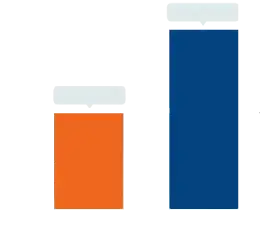
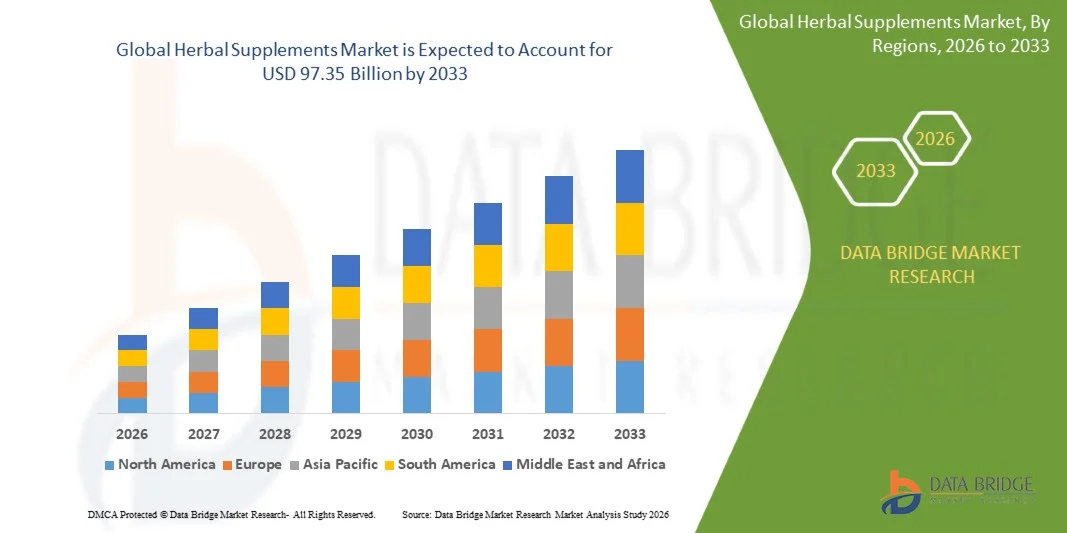
The Herbal Supplements Market was valued at USD 56.24 Billion in 2025 and is projected to reach USD 97.35 Billion by 2033, growing at a CAGR of 7.10% from 2026 to 2033. The market is experiencing consistent growth driven by increasing consumer preference for natural health products, rising awareness regarding preventive healthcare, and growing demand for plant-based nutritional supplements. Expanding adoption of herbal products for immunity enhancement, digestive health, stress management, and overall wellness is further supporting market expansion across developed and emerging economies. Increasing product innovation, wider availability through online retail channels, and growing investments in botanical research are also contributing to market growth.
The rising global focus on preventive healthcare and holistic wellness, combined with growing concerns regarding the side effects associated with synthetic products, is encouraging consumers to adopt herbal supplements as part of their daily health routines. Herbal formulations containing ingredients such as turmeric, ginseng, ginger, moringa, and echinacea are increasingly being utilized to support immunity, cardiovascular health, cognitive function, and healthy aging. In addition, increasing acceptance of traditional medicine systems, expanding clean-label product trends, and growing demand for personalized nutrition solutions are accelerating the adoption of herbal supplements worldwide.
Key Market Trends & Insights
- Asia-Pacific dominated the Herbal Supplements Market with the largest revenue share of 38.5% in 2025, supported by the long-standing use of traditional herbal medicine, strong availability of medicinal plants, and growing consumer preference for natural healthcare solutions
- The medicinal segment led the market with a 68.7% share in 2025, driven by extensive utilization of herbal supplements for disease prevention, immunity enhancement, and therapeutic support
- North America is expected to be the fastest-growing region at a CAGR of 8.1% from 2026 to 2033, fueled by increasing demand for preventive healthcare products, functional nutrition, and natural wellness supplements
- Food & beverages are the fastest-growing application type, projected to register a CAGR of 12.8% from 2026 to 2033, supported by rising demand for functional foods and fortified beverages containing herbal ingredients
- The adult segment dominated the consumer category with a 52.6% revenue share in 2025, led by growing health consciousness and increasing use of herbal supplements for preventive healthcare
- Pharmaceutical accounted for 44.9% of the market in 2025, preferred by increasing integration of herbal ingredients into preventive and therapeutic healthcare products
- The geriatric segment is the fastest-growing consumer category, with a CAGR of 12.3% from 2026 to 2033, driven by the rapidly expanding aging population and increasing focus on healthy aging
Market Size & Forecast
- Global Market Value (2025): USD 56.24 Billion
- Expected Market Value (2033): USD 97.35 Billion
- Forecast CAGR (2026–2033): 7.10%
- Leading Region in 2025: Asia-Pacific
- Fastest Growing Region: North America
Report Scope and Herbal Supplements Market Segmentation
|
Attributes |
Herbal Supplements Key Market Insights |
|
Segments Covered |
|
|
Countries Covered |
North America · U.S. · Canada · Mexico Europe · Germany · France · U.K. · Netherlands · Switzerland · Belgium · Russia · Italy · Spain · Turkey · Rest of Europe Asia-Pacific · China · Japan · India · South Korea · Singapore · Malaysia · Australia · Thailand · Indonesia · Philippines · Rest of Asia-Pacific Middle East and Africa · Saudi Arabia · U.A.E. · South Africa · Egypt · Israel · Rest of Middle East and Africa South America · Brazil · Argentina · Rest of South America |
|
Key Market Players |
· Royal Cosun (Netherlands) · Greenyard (Belgium) · Himalaya Food International Ltd. (India) · J.R. Simplot Company (U.S.) · Lamb Weston Holdings, Inc. (U.K.) · General Mills, Inc. (U.S.) · Mondelez International, Inc. (U.S.) · THE KRAFT HEINZ COMPANY (U.S.) · Royal Ingredients Group (Netherlands) · Pioneer Industries Limited (India) · Cargill, Incorporated (U.S.) · Meelunie B.V. (Netherlands) · Permolex Ltd (Canada) · Amilina AB (Lithuania) · Z&F Sungold Corporation (China) · Tereos SCA (France) · Ardent Mills LLC (U.S.) · Bryan W. Nash & Sons Limited (U.K.) |
|
Market Opportunities |
· Expansion of Herbal Supplements in Functional Foods and Beverages · Increasing Adoption of Herbal Products Among Aging Populations · Growth of E-Commerce and Direct-to-Consumer Herbal Supplement Sales |
|
Value Added Data Infosets |
In addition to the insights on market scenarios such as market value, growth rate, segmentation, geographical coverage, and major players, the market reports curated by the Data Bridge Market Research also include in-depth expert analysis, pricing analysis, brand share analysis, consumer survey, demography analysis, supply chain analysis, value chain analysis, raw material/consumables overview, vendor selection criteria, PESTLE Analysis, Porter Analysis, and regulatory framework. |
Herbal Supplements Market Trends
Trend: Growing Demand for Personalized and Plant-Based Wellness Supplements
Consumers are increasingly seeking personalized nutrition solutions and plant-based wellness products that align with their specific health goals, lifestyle preferences, and preventive healthcare needs. Advances in digital health technologies, health assessments, and customized supplement recommendations are accelerating demand for tailored herbal formulations targeting immunity, cognitive health, digestive wellness, and healthy aging. Growing preference for clean-label, vegan, and naturally sourced products is further supporting adoption across global markets.
Companies such as Herbalife strengthened this trend through its planned acquisition of Bioniq in 2026, aimed at expanding personalized nutrition capabilities and customized supplement offerings. The development highlights the increasing shift toward individualized herbal wellness solutions and data-driven supplementation within the Herbal Supplements Market.
Herbal Supplements Market Dynamics
Key Market Driver: Rising Consumer Preference for Preventive Healthcare and Natural Remedies
The growing focus on preventive healthcare and long-term wellness is significantly driving demand for herbal supplements worldwide. Consumers are increasingly adopting botanical products to support immunity, cardiovascular health, stress management, digestive wellness, and overall health maintenance. Rising concerns regarding potential side effects associated with synthetic products, coupled with increasing awareness of traditional herbal medicine systems, are encouraging greater utilization of natural healthcare solutions across all age groups.
Major companies such as Himalaya Wellness Company, Gaia Herbs, and Nature's Way continue expanding their herbal product portfolios to address growing consumer demand for immunity, metabolic health, and preventive wellness supplements. Increasing product innovation and clinical validation efforts are further strengthening market growth globally.
Key Restraint/Challenge: Lack of Standardization and Regulatory Consistency Across Herbal Products
A major challenge in the Herbal Supplements market is the lack of uniform regulatory frameworks, ingredient standardization, and quality control requirements across different countries and regions. Variations in botanical sourcing, active ingredient concentrations, labeling requirements, and manufacturing standards can create inconsistencies in product quality and efficacy. These challenges may affect consumer confidence and complicate international market expansion for manufacturers operating across multiple regulatory jurisdictions.
The achievement of ISO certification for 24 in-house testing methods by Gaia Herbs in 2022 highlights the industry's increasing emphasis on quality assurance, product verification, and testing standards. However, the broader market continues to face challenges associated with differing regulatory requirements and limited global harmonization of herbal supplement standards.
Key Market Opportunity: Increasing Adoption of Herbal Products Among Aging Populations
The rapidly expanding global elderly population is creating significant growth opportunities for the herbal supplements market. Older consumers are increasingly adopting herbal products to support joint health, cognitive function, cardiovascular wellness, immunity, and healthy aging. Growing interest in natural alternatives for age-related health management is encouraging manufacturers to develop targeted botanical formulations designed specifically for senior consumers.
Companies such as Blackmores and Solgar continue expanding supplement offerings focused on healthy aging, mobility support, and overall wellness. According to estimates from the World Health Organization, the global population aged 60 years and above is expected to increase substantially over the coming decades, creating a large and expanding consumer base for herbal supplements and preventive health products.
Herbal Supplements Market Scope
The herbal supplements market is segmented on the basis of product, formulation, consumer, source, function, application, distribution channel.
- By Product
On the basis of product, the Herbal Supplements Market is segmented into Moringa, Echinacea, Flaxseeds, Turmeric, Ginger, and Ginseng. The Turmeric segment dominated the market with the largest share of 31.8% in 2025, driven by its extensive use in immunity enhancement, anti-inflammatory applications, and preventive healthcare. Growing consumer preference for natural remedies and increasing awareness regarding curcumin’s health benefits have significantly supported product adoption. The segment benefits from widespread availability across dietary supplements, functional foods, and pharmaceutical formulations. Strong demand from Asia-Pacific and North America continues to reinforce market expansion. Continuous product innovation and scientific validation of turmeric-based supplements further strengthen its leading position.
The Ginseng segment is projected to register the fastest growth at a CAGR of 10.9% from 2026 to 2033, driven by increasing consumer demand for energy-boosting and cognitive health supplements. Rising focus on stress management, mental wellness, and physical performance is accelerating product consumption globally. Growing popularity of adaptogenic herbs among younger consumers is creating substantial growth opportunities. Expanding incorporation of ginseng into functional beverages and nutraceutical products is further supporting adoption. Increasing investments in herbal research and premium wellness products are expected to accelerate segment expansion throughout the forecast period.
- By Formulation
On the basis of formulation, the Herbal Supplements Market is segmented into Tablets, Capsules, Liquid, Powder & Granules, Soft Gels, and Others. The Capsules segment dominated the market with a share of 36.4% in 2025, supported by high consumer preference for convenient dosage, portability, and extended shelf life. Capsules provide accurate dosing and improved ingredient protection, making them highly suitable for herbal supplement formulations. Manufacturers increasingly favor capsule-based products due to ease of production and broad consumer acceptance. The segment also benefits from rising demand for plant-based and clean-label supplements. Strong retail availability across pharmacies and health stores further contributes to its market leadership.
The Liquid segment is projected to register the fastest growth at a CAGR of 11.7% from 2026 to 2033, driven by increasing demand for fast-absorbing and easy-to-consume nutritional products. Consumers seeking enhanced bioavailability and quicker nutrient delivery are increasingly shifting toward liquid herbal supplements. Growing adoption among elderly populations and individuals with swallowing difficulties is supporting demand growth. Product innovations involving flavored formulations and functional wellness drinks are further enhancing market penetration. Expanding e-commerce sales and personalized nutrition trends continue to accelerate segment development.
- By Consumer
On the basis of consumer, the Herbal Supplements Market is segmented into Pregnant Women, Adult, Paediatric, and Geriatric. The Adult segment dominated the market with the largest share of 52.6% in 2025, driven by growing health consciousness and increasing use of herbal supplements for preventive healthcare. Adults represent the largest consumer base seeking immunity support, weight management, digestive health, and energy enhancement solutions. Rising prevalence of lifestyle-related disorders has encouraged greater adoption of herbal wellness products. The segment also benefits from higher purchasing power and growing participation in fitness and wellness activities. Continuous expansion of nutraceutical offerings further strengthens market demand among adult consumers.
The Geriatric segment is projected to register the fastest growth at a CAGR of 12.3% from 2026 to 2033, driven by the rapidly expanding aging population and increasing focus on healthy aging. Older consumers are increasingly adopting herbal supplements to support joint health, cardiovascular wellness, cognitive function, and immunity. Rising preference for natural alternatives with fewer side effects than conventional medications is boosting demand. Improvements in healthcare awareness and preventive treatment approaches are supporting market growth. Growing availability of age-specific herbal formulations is expected to further accelerate segment expansion.
- By Source
On the basis of source, the Herbal Supplements Market is segmented into Leaves, Fruits & Vegetable, Barks, Roots, and Others. The Roots segment dominated the market with a share of 39.2% in 2025, supported by the widespread use of herbal ingredients such as ginseng, ginger, turmeric, and ashwagandha. Root-based botanicals are highly valued for their concentrated bioactive compounds and therapeutic properties. Strong demand from pharmaceutical and nutraceutical manufacturers continues to support market growth. The segment benefits from extensive scientific research validating the efficacy of root-derived herbal ingredients. Growing consumer trust in traditional herbal medicine further reinforces its dominant position.
The Fruits & Vegetable segment is projected to register the fastest growth at a CAGR of 11.4% from 2026 to 2033, driven by increasing consumer preference for natural nutrition and plant-based wellness solutions. Rising demand for antioxidant-rich supplements derived from fruits and vegetables is creating significant growth opportunities. Consumers are increasingly seeking products that combine nutritional benefits with preventive healthcare support. Growing awareness regarding clean-label and organic products is further strengthening adoption. Expanding product diversification within functional nutrition is expected to support long-term segment growth.
- By Function
On the basis of function, the Herbal Supplements Market is segmented into Medicinal, Aroma, and Others. The Medicinal segment dominated the market with the largest share of 68.7% in 2025, driven by extensive utilization of herbal supplements for disease prevention, immunity enhancement, and therapeutic support. Consumers increasingly prefer natural health solutions that promote overall wellness while minimizing dependency on synthetic products. Growing prevalence of chronic diseases and lifestyle-related health conditions continues to fuel demand. The segment benefits from expanding clinical research and increasing acceptance of complementary medicine practices. Strong product availability across healthcare and wellness channels further supports market leadership.
The Aroma segment is projected to register the fastest growth at a CAGR of 10.5% from 2026 to 2033, driven by rising interest in stress management, relaxation, and holistic wellness therapies. Consumers are increasingly incorporating aromatic herbal products into daily self-care routines. Growing awareness regarding mental health and emotional well-being is supporting demand growth. Expansion of aromatherapy applications across wellness centers and homecare settings is creating new opportunities. Continuous innovation in herbal aroma-based formulations is expected to accelerate segment adoption.
- By Application
On the basis of application, the Herbal Supplements Market is segmented into Pharmaceutical, Personal Care, Food & Beverages, and Others. The Pharmaceutical segment dominated the market with a share of 44.9% in 2025, driven by increasing integration of herbal ingredients into preventive and therapeutic healthcare products. Pharmaceutical companies are expanding herbal product portfolios to address growing consumer demand for natural treatment alternatives. Rising investments in botanical research and clinical validation are supporting wider market acceptance. The segment benefits from increasing regulatory recognition of herbal medicines across several countries. Strong healthcare spending and expanding nutraceutical adoption further reinforce its dominant position.
The Food & Beverages segment is projected to register the fastest growth at a CAGR of 12.8% from 2026 to 2033, driven by rising demand for functional foods and fortified beverages containing herbal ingredients. Consumers are increasingly seeking convenient nutrition products that support immunity, digestion, and overall wellness. Growing popularity of herbal teas, health drinks, and functional snacks is accelerating market expansion. Manufacturers continue introducing innovative products that combine nutrition with therapeutic benefits. Increasing focus on preventive health and daily wellness consumption is expected to drive substantial segment growth.
- By Distribution Channel
On the basis of distribution channel, the Herbal Supplements Market is segmented into Offline Stores and Online Stores. The Offline Stores segment dominated the market with the largest share of 62.3% in 2025, supported by strong consumer preference for in-person product evaluation and professional guidance. Pharmacies, health stores, supermarkets, and specialty retail outlets continue to serve as major sales channels for herbal supplements. Consumers often rely on direct consultation and product authenticity verification before purchase. Established retail networks and widespread product accessibility contribute significantly to segment dominance. Strong brand visibility within physical stores further supports revenue generation.
The Online Stores segment is projected to register the fastest growth at a CAGR of 14.2% from 2026 to 2033, driven by increasing digitalization and expanding e-commerce penetration worldwide. Consumers are increasingly attracted to the convenience, product variety, and competitive pricing offered by online platforms. Growth in direct-to-consumer sales models and subscription-based wellness services is further accelerating adoption. Enhanced access to product information, customer reviews, and personalized recommendations supports purchasing decisions. Continuous improvements in logistics and digital payment infrastructure are expected to sustain strong segment growth over the forecast period.
Herbal Supplements Market Regional Analysis
Asia-Pacific dominated the herbal supplements market and accounted for the largest revenue share of 38.5% in 2025, supported by the long-standing use of traditional herbal medicine, strong availability of medicinal plants, and growing consumer preference for natural healthcare solutions. The region benefits from extensive herbal cultivation, expanding nutraceutical manufacturing capabilities, and increasing healthcare awareness among consumers. Rising demand for immunity-boosting products, preventive healthcare supplements, and plant-based wellness solutions is accelerating market expansion. Growing government support for traditional medicine systems and increasing investments in herbal product innovation are further strengthening regional growth.
China Herbal Supplements Market Insight
China held the largest share in the Asia-Pacific Herbal Supplements market in 2025, supported by its well-established traditional medicine industry and extensive production of herbal raw materials. The country benefits from strong manufacturing infrastructure and widespread consumer acceptance of botanical health products for preventive and therapeutic applications. Growing demand for herbal supplements targeting immunity, digestive health, and healthy aging is further supporting market growth. In addition, increasing exports of herbal ingredients and finished nutraceutical products are reinforcing China's leadership in the regional market.
India Herbal Supplements Market Insight
India is witnessing the fastest growth in the Asia-Pacific region, driven by rising adoption of Ayurvedic products, increasing health consciousness, and expanding demand for natural nutritional supplements. Growing utilization of herbal formulations for immunity enhancement, stress management, and overall wellness is significantly supporting market expansion. The country is benefiting from strong government initiatives promoting traditional medicine and herbal healthcare practices. In addition, increasing penetration of e-commerce platforms and premium herbal supplement brands is accelerating long-term market growth.
Europe Herbal Supplements Market Insight
The Europe Herbal Supplements market is expanding steadily, supported by increasing demand for natural healthcare products, organic dietary supplements, and preventive wellness solutions. Consumers across the region are increasingly seeking plant-based alternatives to conventional healthcare products, which is strengthening market adoption. Strong demand from nutraceutical, pharmaceutical, and wellness industries is further contributing to growth. In addition, increasing awareness regarding clean-label ingredients and sustainable sourcing practices is supporting regional market development.
Germany Herbal Supplements Market Insight
Germany accounted for the largest share in the Europe Herbal Supplements market in 2025, driven by strong consumer awareness regarding natural health products and extensive utilization of botanical supplements. The country has a well-developed nutraceutical industry that actively incorporates herbal ingredients into wellness and preventive healthcare products. Rising demand for immune health, digestive wellness, and cardiovascular support supplements is further strengthening market growth. In addition, strong retail distribution channels and increasing preference for organic herbal products are reinforcing Germany’s leading position.
U.K. Herbal Supplements Market Insight
The U.K. market is supported by growing consumer preference for natural wellness products, dietary supplements, and plant-based healthcare solutions. Increasing awareness regarding preventive healthcare and healthy lifestyle management is driving demand for herbal supplements across multiple consumer groups. The country is witnessing rising utilization of herbal products for immunity support, stress reduction, and digestive health management. In addition, growing online retail penetration and expanding availability of premium herbal brands are further supporting market expansion.
North America Herbal Supplements Market Insight
North America is projected to grow at the fastest CAGR of 8.1% from 2026 to 2033, driven by increasing demand for preventive healthcare products, functional nutrition, and natural wellness supplements. Rising consumer awareness regarding the benefits of herbal ingredients for immunity, cognitive health, and overall well-being is significantly supporting market growth. Strong adoption of plant-based dietary supplements and expanding investments in nutraceutical innovation are further accelerating regional expansion. In addition, growing preference for clean-label, organic, and scientifically validated herbal products is boosting demand across the region.
U.S. Herbal Supplements Market Insight
The U.S. accounted for the largest share in the North America Herbal Supplements market in 2025, supported by strong demand from nutraceutical, pharmaceutical, and wellness industries. The country benefits from high consumer spending on preventive healthcare and dietary supplementation products. Growing utilization of herbal supplements for immunity enhancement, energy management, healthy aging, and mental wellness is further strengthening market growth. In addition, increasing product availability through pharmacies, specialty health stores, and e-commerce platforms is reinforcing the U.S. leadership position in the regional market.
Herbal Supplements Market Share
The herbal supplements industry is primarily led by well-established companies, including:
- Royal Cosun (Netherlands)
- Greenyard (Belgium)
- Himalaya Food International Ltd. (India)
- R. Simplot Company (U.S.)
- Lamb Weston Holdings, Inc. (U.K.)
- General Mills, Inc. (U.S.)
- Mondelez International, Inc. (U.S.)
- THE KRAFT HEINZ COMPANY (U.S.)
- Royal Ingredients Group (Netherlands)
- Pioneer Industries Limited (India)
- Cargill, Incorporated (U.S.)
- Meelunie B.V. (Netherlands)
- Permolex Ltd (Canada)
- Amilina AB (Lithuania)
- Z&F Sungold Corporation (China)
- Tereos SCA (France)
- Ardent Mills LLC (U.S.)
- Bryan W. Nash & Sons Limited (U.K.)
Latest Developments in Herbal Supplements Market
- In March 2026, Herbalife announced the planned acquisition of personalized nutrition company Bioniq to strengthen its position in the rapidly growing personalized wellness sector. The acquisition is expected to enhance the company’s ability to offer customized herbal supplement solutions based on individual health data and nutritional needs. This development supports the increasing consumer demand for precision nutrition and personalized healthcare, while encouraging broader innovation across the herbal supplements market
- In January 2025, Himalaya Wellness Company launched a new portfolio of standardized botanical extract supplements focused on cardiovascular health, metabolic wellness, and preventive care. The introduction of scientifically formulated herbal products is helping strengthen consumer confidence in evidence-based natural health solutions. This development is contributing to greater acceptance of herbal supplements among mainstream healthcare consumers and expanding market opportunities in the preventive wellness segment
- In September 2024, Gaia Herbs introduced an AI-powered supplement personalization platform designed to recommend customized herbal formulations based on individual wellness goals and lifestyle factors. The initiative reflects the growing convergence of digital health technologies and herbal nutrition products. By improving personalization and customer engagement, the development is expected to drive higher adoption rates and support long-term growth within the herbal supplements industry
- In June 2023, Solgar partnered with the Great Run to promote health, fitness, and nutritional awareness across the U.K., encouraging wider public participation in wellness-focused activities. The collaboration increased visibility for herbal supplements as part of a healthy lifestyle and preventive healthcare approach. This initiative helped strengthen consumer awareness regarding the benefits of nutritional supplementation and supported market growth through broader engagement with health-conscious populations
- In January 2022, Gaia Herbs achieved ISO certification for 24 in-house testing methods, reinforcing its commitment to product quality, ingredient traceability, and sustainable herb production practices. The certification enhanced the company’s reputation for delivering reliable and rigorously tested herbal supplements. This development contributed to stronger consumer trust and encouraged greater adoption of premium herbal products across both domestic and international markets
SKU-
Get online access to the report on the World's First Market Intelligence Cloud

- Interactive Data Analysis Dashboard
- Company Analysis Dashboard for high growth potential opportunities
- Research Analyst Access for customization & queries
- Competitor Analysis with Interactive dashboard
- Latest News, Updates & Trend analysis
- Harness the Power of Benchmark Analysis for Comprehensive Competitor Tracking
Global Herbal Supplements Market, Supply Chain Analysis and Ecosystem Framework
To support market growth and help clients navigate the impact of geopolitical shifts, DBMR has integrated in-depth supply chain analysis into its Global Herbal Supplements Market research reports. This addition empowers clients to respond effectively to global changes affecting their industries. The supply chain analysis section includes detailed insights such as Global Herbal Supplements Market consumption and production by country, price trend analysis, the impact of tariffs and geopolitical developments, and import and export trends by country and HSN code. It also highlights major suppliers with data on production capacity and company profiles, as well as key importers and exporters. In addition to research, DBMR offers specialized supply chain consulting services backed by over a decade of experience, providing solutions like supplier discovery, supplier risk assessment, price trend analysis, impact evaluation of inflation and trade route changes, and comprehensive market trend analysis.
Research Methodology
Data collection and base year analysis are done using data collection modules with large sample sizes. The stage includes obtaining market information or related data through various sources and strategies. It includes examining and planning all the data acquired from the past in advance. It likewise envelops the examination of information inconsistencies seen across different information sources. The market data is analysed and estimated using market statistical and coherent models. Also, market share analysis and key trend analysis are the major success factors in the market report. To know more, please request an analyst call or drop down your inquiry.
The key research methodology used by DBMR research team is data triangulation which involves data mining, analysis of the impact of data variables on the market and primary (industry expert) validation. Data models include Vendor Positioning Grid, Market Time Line Analysis, Market Overview and Guide, Company Positioning Grid, Patent Analysis, Pricing Analysis, Company Market Share Analysis, Standards of Measurement, Global versus Regional and Vendor Share Analysis. To know more about the research methodology, drop in an inquiry to speak to our industry experts.
Customization Available
Data Bridge Market Research is a leader in advanced formative research. We take pride in servicing our existing and new customers with data and analysis that match and suits their goal. The report can be customized to include price trend analysis of target brands understanding the market for additional countries (ask for the list of countries), clinical trial results data, literature review, refurbished market and product base analysis. Market analysis of target competitors can be analyzed from technology-based analysis to market portfolio strategies. We can add as many competitors that you require data about in the format and data style you are looking for. Our team of analysts can also provide you data in crude raw excel files pivot tables (Fact book) or can assist you in creating presentations from the data sets available in the report.