Global Home Networking Device Market
Market Size in USD Billion
CAGR :
% 
 USD
22.08 Billion
USD
35.05 Billion
2025
2033
USD
22.08 Billion
USD
35.05 Billion
2025
2033
 Forecast Period Forecast Period |
2026 –2033 |
 Market Size (Base Year) Market Size (Base Year) |
USD 22.08 Billion |
 Market Size (Forecast Year) Market Size (Forecast Year) |
USD 35.05 Billion |
 CAGR CAGR |
% |
| Major Markets Players |
|
Home Networking Device Market Size
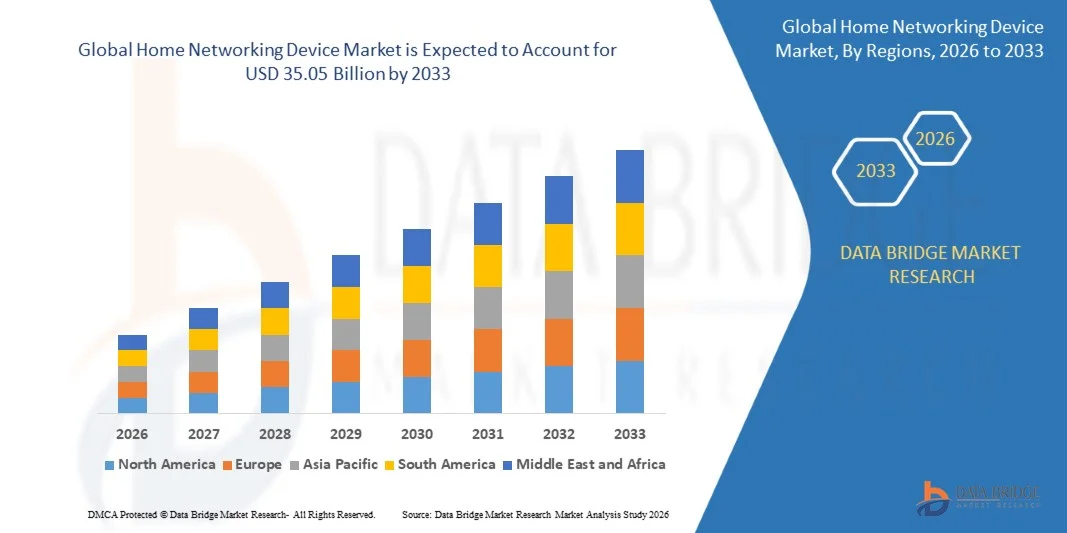
- The global home networking device market size was valued at USD 22.08 billion in 2025 and is expected to reach USD 35.05 billion by 2033, at a CAGR of 5.95% during the forecast period
- The market growth is largely fueled by the increasing adoption of high-speed internet services and the rapid expansion of connected devices within smart homes and digital ecosystems, leading to greater demand for reliable and efficient home networking infrastructure in both residential and commercial environments
- Furthermore, rising consumer demand for seamless connectivity, high data transfer speeds, and uninterrupted access to digital services is positioning home networking devices as essential components of modern living. These converging factors are accelerating the adoption of advanced networking solutions, thereby significantly boosting the industry's growth
Home Networking Device Market Analysis
- Home networking devices are hardware components such as routers, switches, extenders, and access points that enable communication and data exchange between connected devices within a household or enterprise network. These systems support internet access, device integration, and efficient data management across multiple platforms and applications
- The escalating demand for home networking devices is primarily driven by the growing penetration of smart home technologies, increasing consumption of streaming and cloud-based services, and the rising need for high-speed and low-latency connectivity across multiple connected devices
- North America dominated the home networking device market with a share of 35.16% in 2025, due to the high penetration of broadband services and strong adoption of advanced networking technologies across residential and commercial sectors
- Asia-Pacific is expected to be the fastest growing region in the home networking device market during the forecast period due to rapid urbanization, increasing internet penetration, and rising adoption of smart devices in countries such as China, Japan, and India
- Router segment dominated the market with a market share of 39.1% in 2025, due to its central role in managing internet connectivity and network traffic across residential and commercial environments. Routers are essential for enabling communication between devices and ensuring efficient data distribution within a network. Increasing broadband penetration and demand for high-speed internet services continue to drive widespread router adoption
Report Scope and Home Networking Device Market Segmentation
|
Attributes |
Home Networking Device Key Market Insights |
|
Segments Covered |
|
|
Countries Covered |
North America
Europe
Asia-Pacific
Middle East and Africa
South America
|
|
Key Market Players |
|
|
Market Opportunities |
|
|
Value Added Data Infosets |
In addition to the market insights such as market value, growth rate, market segments, geographical coverage, market players, and market scenario, the market report curated by the Data Bridge Market Research team includes in-depth expert analysis, import/export analysis, pricing analysis, production consumption analysis, and pestle analysis. |
Home Networking Device Market Trends
“Rising Adoption of Wi-Fi 7 and Mesh Networking Technologies”
- A significant trend in the home networking device market is the increasing adoption of Wi-Fi 7 and mesh networking technologies, driven by the need for ultra-fast connectivity, low latency, and seamless coverage across connected environments. These technologies are transforming home networks into high-performance ecosystems capable of supporting multiple bandwidth-intensive applications simultaneously
- For instance, Qualcomm has introduced advanced Wi-Fi 7 platforms that enhance throughput and efficiency for next-generation routers and access points. These solutions enable improved performance for applications such as 8K streaming, cloud gaming, and immersive digital experiences, strengthening the role of advanced networking technologies in modern households
- The growing deployment of mesh networking systems is addressing connectivity challenges such as dead zones and inconsistent speeds in larger residential spaces. This is enabling uniform network coverage and improving overall user experience, particularly in smart homes with multiple connected devices
- Consumers are increasingly adopting these technologies to support expanding digital lifestyles that include streaming, remote work, and IoT integration. This trend is driving higher demand for intelligent networking solutions capable of managing complex data traffic efficiently
- Manufacturers are focusing on integrating AI-driven optimization and enhanced security features within these networking systems to improve performance and reliability. This is encouraging continuous innovation and product differentiation within the market
- The market is witnessing strong momentum toward next-generation connectivity solutions that offer higher speeds, better coverage, and improved efficiency. This trend is reinforcing the transition toward smarter, more adaptive home networking infrastructures across global markets
Home Networking Device Market Dynamics
Driver
“Increasing Demand for High-Speed and Reliable Internet Connectivity”
- The increasing reliance on high-speed internet for digital services such as streaming, online gaming, and remote work is driving demand for advanced home networking devices that ensure consistent and reliable connectivity. These devices play a critical role in supporting uninterrupted access to data-intensive applications across residential and enterprise environments
- For instance, TP-Link Technologies offers high-performance routers and mesh systems designed to deliver stable connectivity and enhanced bandwidth management for modern households. These solutions support seamless internet access across multiple devices, improving overall network efficiency and user experience
- The rapid growth in connected devices within smart homes is increasing the need for networking solutions that can handle higher data loads without compromising speed or performance. This is encouraging adoption of advanced routers, extenders, and access points with improved capabilities
- The expansion of broadband infrastructure, including fiber-optic networks, is further supporting demand for high-performance networking devices that can fully utilize increased internet speeds. This is enabling faster data transmission and improved connectivity quality
- The continuous demand for faster, more stable, and scalable connectivity solutions is reinforcing this driver. The need for efficient data handling and uninterrupted access is significantly influencing market growth and positioning home networking devices as essential components of modern digital ecosystems
Restraint/Challenge
“Network Security and Data Privacy Concerns”
- The home networking device market faces challenges related to network security and data privacy, as increasing connectivity exposes networks to potential cyber threats and unauthorized access. These concerns are becoming more critical with the growing number of connected devices and data exchange within home networks
- For instance, Huawei Technologies Co. Ltd. has faced scrutiny in multiple regions regarding data security and privacy risks associated with networking equipment. Such concerns highlight the importance of robust security frameworks and influence consumer trust and regulatory policies in the market
- The rising frequency of cyberattacks targeting home networks is increasing the need for secure networking devices with advanced encryption and threat detection capabilities. This is placing pressure on manufacturers to continuously enhance security features
- Consumers are becoming more aware of data privacy risks, leading to cautious adoption of connected networking solutions. This is influencing purchasing decisions and increasing demand for trusted and secure brands
- The ongoing concerns related to security vulnerabilities and data protection are posing challenges to market growth. Addressing these issues is essential for building consumer confidence and ensuring sustainable adoption of home networking devices across global markets
Home Networking Device Market Scope
The market is segmented on the basis of solution, component, product type, end-user, and industry vertical.
• By Solution
On the basis of solution, the home networking device market is segmented into wired and wireless. The wired segment dominated the largest market revenue share in 2025, driven by its superior stability, consistent high-speed connectivity, and enhanced security features. Enterprises and data-intensive users prefer wired solutions due to minimal latency and reliable performance in handling large volumes of data traffic. The continued deployment of structured cabling in commercial infrastructures further strengthens demand for wired networking devices. In addition, wired connections are less prone to interference, making them suitable for mission-critical applications and professional environments. The long lifecycle and durability of wired systems also contribute to their sustained dominance across enterprise and industrial settings.
The wireless segment is anticipated to witness the fastest growth rate from 2026 to 2033, fueled by increasing adoption of smart homes, IoT-enabled devices, and mobile computing. Consumers are shifting toward wireless solutions due to convenience, flexibility, and ease of installation without complex cabling requirements. Advancements in Wi-Fi standards and mesh networking technologies are enhancing coverage, speed, and overall performance of wireless networks. The growing penetration of connected devices in households is further accelerating demand for seamless wireless connectivity. Rising remote work trends and digital lifestyles are also supporting rapid expansion of wireless networking solutions globally.
• By Component
On the basis of component, the home networking device market is segmented into hub and switch, router, extender, adapter, and wireless access point. The router segment dominated the largest market revenue share of 39.1% in 2025, driven by its central role in managing internet connectivity and network traffic across residential and commercial environments. Routers are essential for enabling communication between devices and ensuring efficient data distribution within a network. Increasing broadband penetration and demand for high-speed internet services continue to drive widespread router adoption. The integration of advanced features such as dual-band and tri-band connectivity enhances performance and user experience. Continuous innovation in router technologies further supports their strong position in the market.
The wireless access point segment is anticipated to witness the fastest growth rate from 2026 to 2033, fueled by increasing need for extended network coverage and seamless connectivity in large spaces. Businesses and smart homes are deploying multiple access points to eliminate dead zones and improve network reliability. The rise in connected devices is creating demand for scalable networking solutions that can support higher data loads. Wireless access points offer flexibility in network expansion without significant infrastructure changes. Growing investments in smart infrastructure and enterprise networking are accelerating adoption of advanced access point solutions.
• By Product Type
On the basis of product type, the home networking device market is segmented into audio equipment, video devices, and gaming consoles. The video devices segment dominated the largest market revenue share in 2025, driven by increasing consumption of streaming content, online video platforms, and smart TV adoption. High-definition and ultra-high-definition video streaming require robust networking devices, boosting demand for efficient home network infrastructure. Consumers are investing in connected video devices to enhance entertainment experiences. The expansion of OTT platforms and digital media services further supports this segment’s growth. Rising demand for uninterrupted streaming and improved bandwidth management contributes to its leading position.
The gaming consoles segment is anticipated to witness the fastest growth rate from 2026 to 2033, fueled by the rapid growth of online gaming and esports. Gamers require high-speed, low-latency connectivity, driving demand for advanced networking devices. The increasing popularity of multiplayer and cloud gaming platforms is further accelerating adoption. Continuous upgrades in gaming technology and immersive experiences are boosting demand for reliable home networks. The expansion of gaming communities and digital engagement trends supports strong growth in this segment.
• By End-User
On the basis of end-user, the home networking device market is segmented into large enterprises, small enterprises, and medium enterprises. The large enterprises segment dominated the largest market revenue share in 2025, driven by extensive network infrastructure requirements and high data traffic management needs. Large organizations invest heavily in advanced networking devices to ensure seamless connectivity across departments and locations. The adoption of cloud computing and digital transformation initiatives further drives demand in this segment. Enhanced security requirements and network optimization strategies also contribute to sustained growth. Continuous expansion of enterprise IT ecosystems supports strong adoption of networking solutions.
The small enterprises segment is anticipated to witness the fastest growth rate from 2026 to 2033, fueled by increasing digitalization and adoption of affordable networking solutions. Small businesses are investing in reliable connectivity to support operations, customer engagement, and online services. The availability of cost-effective and easy-to-deploy networking devices is encouraging adoption. Growing reliance on cloud-based applications is further driving demand. Expansion of startup ecosystems and digital business models supports rapid growth in this segment.
• By Industry Vertical
On the basis of industry vertical, the home networking device market is segmented into telecommunication, smart home, IT, and others. The telecommunication segment dominated the largest market revenue share in 2025, driven by continuous expansion of broadband infrastructure and increasing demand for high-speed connectivity services. Telecom providers deploy networking devices extensively to support data transmission and network management. The growth of 5G and fiber-optic networks is further strengthening demand in this segment. Rising data consumption and connected device usage contribute to its leading position. Ongoing investments in network modernization support sustained growth.
The smart home segment is anticipated to witness the fastest growth rate from 2026 to 2033, fueled by increasing adoption of IoT-enabled devices and home automation systems. Consumers are integrating multiple connected devices requiring seamless and efficient networking solutions. The rising demand for convenience, security, and energy management is accelerating smart home adoption. Technological advancements in wireless connectivity and interoperability are enhancing user experience. Growing awareness of smart living solutions supports rapid expansion of this segment.
Home Networking Device Market Regional Analysis
- North America dominated the home networking device market with the largest revenue share of 35.16% in 2025, driven by the high penetration of broadband services and strong adoption of advanced networking technologies across residential and commercial sectors
- Consumers in the region prioritize high-speed connectivity, seamless device integration, and reliable network performance to support increasing usage of streaming services, smart home devices, and remote working environments
- This widespread adoption is further supported by robust digital infrastructure, high disposable incomes, and the presence of leading technology providers, establishing home networking devices as essential components in modern connected ecosystems
U.S. Home Networking Device Market Insight
The U.S. home networking device market captured the largest revenue share in 2025 within North America, fueled by the rapid expansion of smart homes and increasing reliance on high-speed internet connectivity. Consumers are increasingly investing in advanced routers, extenders, and mesh networking solutions to support multiple connected devices. The growing trend of remote work and online entertainment continues to drive demand for efficient networking solutions. Moreover, strong adoption of cloud-based services and IoT devices is significantly contributing to market expansion.
Europe Home Networking Device Market Insight
The Europe home networking device market is projected to expand at a substantial CAGR throughout the forecast period, primarily driven by increasing demand for high-speed internet and the rapid adoption of smart home technologies. Rising urbanization and digital transformation initiatives across industries are fostering demand for reliable networking infrastructure. Consumers are increasingly focusing on energy-efficient and high-performance devices to support connected lifestyles. The region is witnessing steady growth across residential and enterprise applications, with increasing integration of advanced networking technologies.
U.K. Home Networking Device Market Insight
The U.K. home networking device market is anticipated to grow at a noteworthy CAGR during the forecast period, driven by the rising demand for seamless connectivity and growing adoption of smart home ecosystems. Increasing reliance on digital services, including streaming, gaming, and remote work, is accelerating the need for advanced networking solutions. The strong presence of e-commerce platforms and technology adoption further supports market growth. Continuous investments in broadband infrastructure are expected to enhance connectivity and drive demand.
Germany Home Networking Device Market Insight
The Germany home networking device market is expected to expand at a considerable CAGR during the forecast period, fueled by strong emphasis on technological innovation and demand for high-performance networking solutions. The country’s well-developed IT infrastructure and increasing adoption of Industry 4.0 practices are supporting market growth. Consumers and enterprises are focusing on secure and efficient connectivity solutions. The integration of networking devices with smart home and industrial systems is becoming increasingly prevalent, aligning with the country’s digital advancement goals.
Asia-Pacific Home Networking Device Market Insight
The Asia-Pacific home networking device market is poised to grow at the fastest CAGR during the forecast period of 2026 to 2033, driven by rapid urbanization, increasing internet penetration, and rising adoption of smart devices in countries such as China, Japan, and India. The growing middle-class population and increasing disposable incomes are supporting demand for advanced connectivity solutions. Government initiatives promoting digital infrastructure and smart city development are further accelerating market growth. The region is also emerging as a major manufacturing hub, enhancing product availability and affordability.
Japan Home Networking Device Market Insight
The Japan home networking device market is gaining momentum due to the country’s advanced technological landscape and high adoption of connected devices. Increasing demand for seamless connectivity in smart homes and digital services is driving market growth. The integration of networking devices with IoT ecosystems is becoming more common. Strong focus on innovation and quality is supporting adoption across residential and enterprise sectors.
China Home Networking Device Market Insight
The China home networking device market accounted for the largest market revenue share in Asia Pacific in 2025, attributed to rapid urbanization, expanding digital infrastructure, and strong consumer demand for smart home technologies. The country has a large base of internet users and connected devices, driving the need for efficient networking solutions. The presence of domestic manufacturers and availability of cost-effective devices are supporting widespread adoption. Increasing investments in smart city projects and digital transformation initiatives are further propelling market growth.
Home Networking Device Market Share
The home networking device industry is primarily led by well-established companies, including:
- HP (U.S.)
- TP-Link Technologies (China)
- Legrand SA (France)
- ZyXEL Communications Corp. (Taiwan)
- PLANET Technology (Taiwan)
- Buffalo, Inc. (Japan)
- Huawei Technologies Co. Ltd. (China)
- Google (U.S.)
- Devolo (Germany)
- Amazon (U.S.)
- Actiontec Electronics (U.S.)
- ASUSTeK Computer Inc. (Taiwan)
- Nokia (Finland)
- Tenda Technology (China)
- Crestron Electronics (U.S.)
- Schneider Electric (France)
- Siemens AG (Germany)
Latest Developments in Global Home Networking Device Market
- In August 2025, Qualcomm launched its next-generation Wi-Fi 7 networking platforms designed to deliver ultra-high throughput and low latency, significantly enhancing performance for home networking devices. This development is accelerating the transition toward next-generation wireless standards, enabling seamless support for bandwidth-intensive applications such as 8K streaming, augmented and virtual reality, and cloud gaming environments. It is also encouraging manufacturers to upgrade routers and access points, thereby increasing product innovation and replacement cycles in the market. As a result, the adoption of high-performance networking infrastructure is expanding across both residential and enterprise segments, strengthening overall market growth
- In August 2025, Amazon expanded its eero portfolio with improved mesh networking capabilities and enhanced smart home integration features. This advancement is significantly improving whole-home coverage and network reliability, addressing common connectivity issues such as dead zones and inconsistent speeds. It is also supporting the growing number of connected devices within households by enabling more efficient traffic management and seamless device interoperability. The integration with smart home ecosystems is further enhancing user convenience, thereby boosting consumer demand for advanced mesh networking solutions and positively influencing market expansion
- In July 2025, Charter Communications and Comcast entered into a multi-year agreement with T-Mobile to utilize its 5G network for business mobile services expected to launch in 2026. This collaboration is driving convergence between fixed broadband and wireless connectivity, enabling service providers to offer integrated networking solutions. It is also expanding the scope of connectivity beyond traditional infrastructure, supporting hybrid network models that combine fiber and 5G technologies. This shift is increasing demand for versatile and adaptive networking devices capable of handling multi-network environments, thereby contributing to the evolution and growth of the home networking device market
- In July 2025, MaxLinear introduced a fan-less Puma 8 DOCSIS 4.0 chipset with OEM support from Askey and CommScope. This innovation enhances broadband speeds and energy efficiency, enabling next-generation cable modems and gateways to deliver superior performance with reduced power consumption. It also supports higher data throughput and lower latency, meeting the increasing demand for high-speed internet connectivity in both residential and enterprise environments. The development is encouraging infrastructure upgrades among service providers, thereby accelerating the deployment of advanced home networking devices and strengthening market competitiveness
- In July 2025, the Federal Communications Commission approved Bell Canada’s USD 5.1 billion acquisition of Ziply Fiber, removing foreign ownership restrictions. This approval is facilitating the expansion of fiber broadband networks, improving access to high-speed internet services across underserved and developing regions. It is also enabling greater investment in network infrastructure, which directly supports the deployment of advanced home networking devices. The expansion of fiber connectivity is increasing demand for high-performance routers, gateways, and access points, thereby contributing to long-term market growth and technological advancement
SKU-
Get online access to the report on the World's First Market Intelligence Cloud

- Interactive Data Analysis Dashboard
- Company Analysis Dashboard for high growth potential opportunities
- Research Analyst Access for customization & queries
- Competitor Analysis with Interactive dashboard
- Latest News, Updates & Trend analysis
- Harness the Power of Benchmark Analysis for Comprehensive Competitor Tracking
Research Methodology
Data collection and base year analysis are done using data collection modules with large sample sizes. The stage includes obtaining market information or related data through various sources and strategies. It includes examining and planning all the data acquired from the past in advance. It likewise envelops the examination of information inconsistencies seen across different information sources. The market data is analysed and estimated using market statistical and coherent models. Also, market share analysis and key trend analysis are the major success factors in the market report. To know more, please request an analyst call or drop down your inquiry.
The key research methodology used by DBMR research team is data triangulation which involves data mining, analysis of the impact of data variables on the market and primary (industry expert) validation. Data models include Vendor Positioning Grid, Market Time Line Analysis, Market Overview and Guide, Company Positioning Grid, Patent Analysis, Pricing Analysis, Company Market Share Analysis, Standards of Measurement, Global versus Regional and Vendor Share Analysis. To know more about the research methodology, drop in an inquiry to speak to our industry experts.
Customization Available
Data Bridge Market Research is a leader in advanced formative research. We take pride in servicing our existing and new customers with data and analysis that match and suits their goal. The report can be customized to include price trend analysis of target brands understanding the market for additional countries (ask for the list of countries), clinical trial results data, literature review, refurbished market and product base analysis. Market analysis of target competitors can be analyzed from technology-based analysis to market portfolio strategies. We can add as many competitors that you require data about in the format and data style you are looking for. Our team of analysts can also provide you data in crude raw excel files pivot tables (Fact book) or can assist you in creating presentations from the data sets available in the report.