Global Hormonal Infertility Market
Market Size in USD Billion
CAGR :
% 
 USD
8.32 Billion
USD
12.29 Billion
2025
2033
USD
8.32 Billion
USD
12.29 Billion
2025
2033
 Forecast Period Forecast Period |
2026 –2033 |
 Market Size (Base Year) Market Size (Base Year) |
USD 8.32 Billion |
 Market Size (Forecast Year) Market Size (Forecast Year) |
USD 12.29 Billion |
 CAGR CAGR |
% |
| Major Markets Players |
|
Hormonal Infertility Market Size
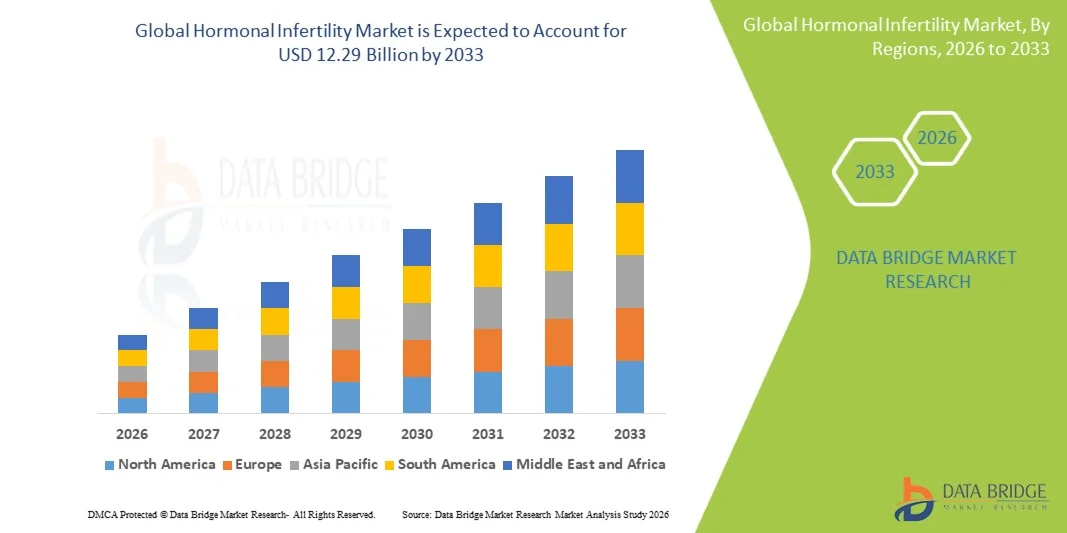
- The global hormonal infertility market size was valued at USD 8.32 billion in 2025 and is expected to reach USD 12.29 billion by 2033, at a CAGR of 5.00% during the forecast period
- The market growth is largely fueled by the increasing prevalence of hormonal disorders affecting fertility, such as polycystic ovary syndrome (PCOS), thyroid dysfunction, and hyperprolactinemia, along with rising infertility rates worldwide, leading to increased demand for diagnostic and therapeutic solutions in reproductive healthcare
- Furthermore, growing awareness regarding fertility health, advancements in hormone-based therapies, and increasing adoption of assisted reproductive technologies (ART) are establishing hormonal infertility treatments as a critical component of fertility management. These converging factors are accelerating the uptake of Hormonal Infertility solutions, thereby significantly boosting the industry's growth
Hormonal Infertility Market Analysis
- Hormonal infertility treatment solutions, including hormone therapy, ovulation induction, and assisted reproductive support, are increasingly vital components of modern reproductive healthcare systems due to their effectiveness in regulating hormonal imbalances and improving conception outcomes in both clinical and fertility care settings
- The escalating demand for hormonal infertility solutions is primarily fueled by rising infertility prevalence, increasing hormonal disorders such as PCOS and thyroid dysfunction, delayed pregnancies, lifestyle changes, and growing awareness regarding reproductive health and fertility treatments
- North America dominated the hormonal infertility market with the largest revenue share of 39.0% in 2025, driven by advanced fertility treatment infrastructure, high awareness of reproductive health, strong presence of fertility clinics, and widespread adoption of assisted reproductive technologies in the U.S.
- Asia-Pacific is expected to be the fastest growing region in the hormonal infertility market during the forecast period due to rising infertility rates, increasing healthcare expenditure, improving access to fertility treatments, and growing awareness about reproductive health solutions
- The luteinizing hormone segment held the largest market revenue share of around 52.1% in 2025, driven by its critical role in ovulation and reproductive cycle regulation. LH testing is widely used in infertility diagnostics and ovulation tracking
Report Scope and Hormonal Infertility Market Segmentation
|
Attributes |
Hormonal Infertility Key Market Insights |
|
Segments Covered |
|
|
Countries Covered |
North America
Europe
Asia-Pacific
Middle East and Africa
South America
|
|
Key Market Players |
|
|
Market Opportunities |
|
|
Value Added Data Infosets |
In addition to the insights on market scenarios such as market value, growth rate, segmentation, geographical coverage, and major players, the market reports curated by the Data Bridge Market Research also include in-depth expert analysis, patient epidemiology, pipeline analysis, pricing analysis, and regulatory framework. |
Hormonal Infertility Market Trends
“Advancements in Personalized Hormonal and Fertility Treatments”
- A significant and accelerating trend in the global hormonal infertility market is the rapid shift toward personalized and precision-based fertility care, supported by advancements in reproductive endocrinology, hormonal diagnostics, and patient-specific treatment planning
- For instance, the increasing use of comprehensive hormone profiling panels such as AMH (Anti-Müllerian Hormone) testing and multi-hormone fertility screening in women undergoing infertility evaluation enables clinicians to better assess ovarian reserve and design individualized treatment protocols
- The integration of advanced reproductive technologies and data-driven fertility assessments is improving the accuracy of diagnosis and enhancing treatment success rates across hormonal infertility cases
- Growing patient awareness regarding conditions such as polycystic ovary syndrome (PCOS), thyroid imbalance, and luteal phase disorders is further encouraging early diagnosis and timely medical intervention
- This ongoing shift toward customized treatment strategies is significantly improving clinical outcomes and reshaping modern fertility care practices
Hormonal Infertility Market Dynamics
Driver
“Rising Prevalence of Hormonal Disorders and Delayed Parenthood Trends”
- The increasing incidence of hormonal disorders such as PCOS, thyroid dysfunction, and elevated prolactin levels is a major driver fueling demand in the Hormonal Infertility market across both developed and emerging regions
- For instance, a growing number of women in urban populations are being diagnosed with PCOS at an earlier age due to improved screening programs and routine gynecological checkups, leading to higher adoption of hormonal infertility treatments such as ovulation induction therapy
- In addition, lifestyle changes including increased stress levels, sedentary behavior, obesity, and delayed family planning decisions are significantly contributing to rising infertility cases globally
- Improved access to fertility clinics and increasing awareness about reproductive health are further supporting early diagnosis and treatment adoption
- The expansion of specialized reproductive healthcare services is also playing a key role in driving market growth
Restraint/Challenge
“High Cost Burden and Limited Success Rates of Fertility Treatments”
- The increasing incidence of hormonal disorders such as PCOS, thyroid dysfunction, and elevated prolactin levels is a major driver fueling demand in the Hormonal Infertility market across both developed and emerging regions
- For instance, a growing number of women in urban populations are being diagnosed with PCOS at an earlier age due to improved screening programs and routine gynecological checkups, leading to higher adoption of hormonal infertility treatments such as ovulation induction therapy
- In addition, lifestyle changes including increased stress levels, sedentary behavior, obesity, and delayed family planning decisions are significantly contributing to rising infertility cases globally
- Improved access to fertility clinics and increasing awareness about reproductive health are further supporting early diagnosis and treatment adoption
- The expansion of specialized reproductive healthcare services is also playing a key role in driving market growth
Hormonal Infertility Market Scope
The market is segmented on the basis of gland, hormones, diseases, diagnosis, treatment, route of administration, end-users, and distribution channel.
• By Gland
On the basis of gland, the Hormonal Infertility market is segmented into hypothalamus, ovaries, pituitary gland, and others. The ovaries segment dominated the largest market revenue share of around 46.8% in 2025, driven by the high prevalence of ovulatory dysfunction and disorders such as PCOS affecting female fertility. Ovarian-related hormonal imbalance is one of the most common causes of infertility globally. Increasing awareness regarding early diagnosis of ovarian dysfunction is supporting demand. Rising adoption of hormone-based fertility treatments is further strengthening market growth. Advancements in reproductive endocrinology are improving treatment outcomes. Expanding fertility clinics and diagnostic centers are enhancing accessibility. Growing focus on women’s reproductive health is boosting market dominance. Continuous R&D in ovarian function assessment is improving clinical accuracy. Supportive healthcare policies for infertility treatment are increasing patient reach. Increasing lifestyle-related hormonal disorders are further accelerating demand. Expanding use of assisted reproductive technologies is supporting ovarian disorder management. Rising prevalence of endocrine imbalance is further strengthening segment dominance.
The hypothalamus segment is expected to witness the fastest CAGR of around 8.4% from 2026 to 2033, driven by rising cases of functional hypothalamic amenorrhea linked to stress and lifestyle changes. Improved diagnostic capabilities for central hormonal disorders are supporting early detection. Expanding research into neuroendocrine regulation is enhancing treatment development. Increasing awareness of brain–hormone reproductive interaction is supporting clinical adoption. Growing focus on stress-induced infertility is further driving segment growth. Expanding endocrinology research funding is strengthening innovation pipeline. Rising adoption of personalized hormonal therapy is improving treatment precision. Increasing mental health–fertility linkage awareness is boosting diagnosis rates. Growing availability of advanced hormonal assays is supporting market expansion. Rising lifestyle disorders among young population are further accelerating demand. Increasing physician awareness of hypothalamic dysfunction is improving treatment pathways.
• By Hormones
On the basis of hormones, the Hormonal Infertility market is segmented into luteinizing hormone, kisspeptin, and others. The luteinizing hormone segment held the largest market revenue share of around 52.1% in 2025, driven by its critical role in ovulation and reproductive cycle regulation. LH testing is widely used in infertility diagnostics and ovulation tracking. Increasing use of hormonal assays in fertility evaluation is supporting demand. Growing prevalence of ovulatory disorders is further driving adoption. Rising use of assisted reproductive technologies is increasing reliance on LH monitoring. Expanding clinical awareness of endocrine imbalance is strengthening market growth. Improved diagnostic kits are enhancing accuracy and accessibility. Growing integration of hormone panels in fertility clinics is further boosting demand. Increasing preventive fertility screening is supporting early diagnosis. Expanding awareness campaigns about reproductive health are improving testing rates. Rising demand for fertility monitoring kits is supporting adoption. Increasing healthcare expenditure on reproductive health is strengthening market expansion.
The kisspeptin segment is expected to witness the fastest CAGR of around 9.3% from 2026 to 2033, driven by emerging research on its role in initiating reproductive hormone release. Growing clinical trials targeting kisspeptin-based therapies are supporting innovation. Increasing focus on novel infertility biomarkers is accelerating adoption. Expanding reproductive endocrinology research is improving therapeutic potential. Rising investment in next-generation hormone therapies is further strengthening growth. Increasing collaboration between biotech firms and research institutes is boosting development. Growing focus on neuroendocrine signaling pathways is enhancing clinical interest. Rising demand for advanced fertility solutions is supporting innovation. Expanding pipeline of experimental fertility drugs is strengthening future prospects. Increasing academic research funding is boosting discovery.
• By Diseases
On the basis of diseases, the Hormonal Infertility market is segmented into polycystic ovary syndrome, pituitary tumors, diabetes, menopause, Cushing’s syndrome, STDs, polyps & fibroids, and others. The polycystic ovary syndrome segment dominated the largest market revenue share of around 38.6% in 2025, driven by its high global prevalence and strong association with hormonal imbalance and infertility. PCOS is one of the leading causes of anovulation in women of reproductive age. Increasing sedentary lifestyles and obesity rates are contributing to rising cases. Growing awareness and early screening programs are improving diagnosis rates. Expanding availability of hormonal therapies is supporting treatment adoption. Rising fertility clinic visits are strengthening market demand. Continuous advancements in endocrine disorder management are improving outcomes. Increasing public health focus on women’s fertility issues is boosting screening. Expanding use of ultrasound and hormonal testing is supporting early detection. Rising metabolic disorders are further fueling prevalence. Improved clinical guidelines for PCOS management are enhancing treatment adoption. Increasing reproductive health awareness campaigns are strengthening diagnosis rates.
The Cushing’s syndrome segment is expected to witness the fastest CAGR of around 8.9% from 2026 to 2033, driven by improved diagnostic imaging and hormonal testing capabilities. Increasing recognition of adrenal-related infertility factors is supporting growth. Expanding clinical research into cortisol-related reproductive dysfunction is enhancing treatment options. Rising awareness among physicians about endocrine infertility links is improving diagnosis rates. Growing availability of targeted therapies is supporting management. Increasing hospital-based endocrine disorder screening is further accelerating growth. Advancements in endocrine diagnostics are improving early detection. Rising adoption of specialized hormone tests is strengthening accuracy. Expanding awareness of rare infertility causes is supporting identification. Increasing research funding for adrenal disorders is boosting innovation.
• By Diagnosis
On the basis of diagnosis, the Hormonal Infertility market is segmented into ultrasound, blood & urine tests, hysterosalpingography, ovarian reserve testing, and others. The blood & urine tests segment held the largest market revenue share of around 44.7% in 2025, driven by their widespread use in hormonal level assessment and fertility screening. These tests are cost-effective and highly accessible across healthcare settings. Increasing routine fertility evaluations are boosting demand. Growing adoption of hormone panels in diagnostic labs is supporting market growth. Rising awareness about early infertility detection is further strengthening usage. Expanding clinical infrastructure is improving test availability. Increasing use of preventive reproductive health checkups is supporting adoption. Rising demand for quick diagnostic methods is boosting utilization. Expanding laboratory networks in emerging economies are enhancing access. Growing physician preference for non-invasive testing is strengthening adoption. Increasing insurance coverage for diagnostic tests is supporting uptake. Rising awareness campaigns on fertility health are improving screening rates.
The ovarian reserve testing segment is expected to witness the fastest CAGR of around 9.1% from 2026 to 2033, driven by rising demand for advanced fertility assessment tools. Increasing maternal age trends are boosting need for fertility prediction. Growing use of AMH testing and antral follicle count evaluation is supporting adoption. Expanding IVF treatments are further driving demand. Rising preference for personalized fertility planning is strengthening segment growth. Increasing awareness of reproductive aging is supporting early testing. Expanding fertility preservation trends are boosting adoption. Growing focus on egg quality assessment is enhancing clinical usage. Rising demand from IVF centers is strengthening market penetration. Increasing technological advancements in fertility diagnostics are improving accuracy.
• By Treatment
On the basis of treatment, the Hormonal Infertility market is segmented into medication, surgery, assisted reproductive technology, and others. The assisted reproductive technology segment dominated the largest market revenue share of around 49.3% in 2025, driven by rising success rates of IVF and ICSI procedures. Increasing infertility prevalence is boosting demand for ART services. Growing advancements in embryo culture and genetic screening are improving outcomes. Expanding fertility clinic infrastructure is supporting accessibility. Rising delayed pregnancies are increasing reliance on ART. Supportive reimbursement policies in some regions are further driving adoption. Increasing awareness of IVF success rates is encouraging patients. Expanding fertility tourism is boosting global demand. Growing use of embryo freezing techniques is improving treatment flexibility. Rising clinical innovation in reproductive technologies is strengthening success rates. Increasing number of fertility centers is enhancing accessibility. Growing adoption of minimally invasive procedures is supporting patient preference.
The medication segment is expected to witness the fastest CAGR of around 8.6% from 2026 to 2033, driven by increasing use of hormonal therapies and ovulation-inducing drugs. Rising preference for non-invasive treatment options is supporting growth. Expanding availability of generic fertility drugs is improving affordability. Increasing early-stage infertility treatment adoption is boosting demand. Growing prescription rates in primary care settings are further strengthening usage. Rising awareness of hormone regulation therapies is supporting uptake. Expanding access to outpatient treatment is enhancing convenience. Increasing R&D in fertility drugs is improving effectiveness. Growing use of combination hormonal therapies is boosting outcomes. Rising focus on personalized medication is strengthening adoption.
• By Route of Administration
On the basis of route of administration, the Hormonal Infertility market is segmented into oral, parenteral, implants, and others. The oral route segment held the largest market revenue share of around 41.9% in 2025, driven by convenience and high patient compliance. Oral hormonal medications are widely prescribed for ovulation induction and endocrine regulation. Increasing outpatient fertility treatments are supporting demand. Expanding availability through retail and online pharmacies is improving access. Growing preference for self-administered therapies is boosting adoption. Rising awareness of fertility drug accessibility is supporting uptake. Increasing affordability of oral formulations is strengthening usage. Expanding primary care prescriptions are enhancing reach. Growing patient preference for painless administration is supporting growth. Rising use in early infertility treatment is boosting demand. Increasing generic drug availability is improving affordability.
The parenteral segment is expected to witness the fastest CAGR of around 7.8% from 2026 to 2033, driven by high effectiveness of injectable hormonal therapies in controlled fertility treatments. Increasing use in IVF protocols is supporting growth. Rising clinical preference for precise hormone dosing is boosting adoption. Expanding fertility clinic procedures is strengthening demand. Growing use in advanced reproductive treatments is further accelerating segment growth. Increasing hospital-based administration is supporting usage. Rising demand for controlled release hormone therapy is boosting effectiveness. Expanding use in assisted reproduction cycles is improving outcomes. Growing physician preference for injectable hormones is strengthening adoption. Increasing success rates in IVF cycles are supporting demand.
• By End-Users
On the basis of end-users, the Hormonal Infertility market is segmented into hospitals, homecare, specialty clinics, and others. The hospitals segment dominated the largest market revenue share of around 51.6% in 2025, driven by high patient inflow for diagnosis, surgical treatment, and infertility care. Hospitals offer advanced diagnostic imaging and reproductive endocrinology facilities. Rising cases of hormonal disorders affecting fertility are increasing admissions. Availability of skilled reproductive specialists enhances treatment outcomes. Increasing healthcare infrastructure investments support market dominance. Expanding government healthcare initiatives are improving access. Growing referral cases from primary care are boosting hospital visits. Rising awareness of infertility treatments is increasing hospital dependency. Advanced laboratory integration is strengthening diagnostic efficiency. Expanding fertility treatment infrastructure is enhancing service capacity. Increasing insurance coverage for infertility care is supporting hospital usage.
The specialty clinics segment is expected to witness the fastest CAGR of around 8.1% from 2026 to 2033, driven by rising preference for focused fertility care and outpatient procedures. Expanding IVF and infertility centers is supporting growth. Increasing demand for personalized reproductive treatment is boosting adoption. Growing awareness of minimally invasive procedures is supporting outpatient care. Rising convenience of specialized clinics is improving patient preference. Expanding urban fertility infrastructure is strengthening access. Increasing success rates in specialty clinics are boosting trust. Growing medical tourism for fertility treatment is supporting expansion. Rising affordability compared to hospitals is driving demand. Expanding availability of advanced reproductive technologies is enhancing outcomes.
• By Distribution Channel
On the basis of distribution channel, the Hormonal Infertility market is segmented into hospital pharmacy, online pharmacy, and retail pharmacy. The retail pharmacy segment held the largest market revenue share of around 46.2% in 2025, driven by easy access to prescription fertility and hormonal medications. Strong pharmacy networks ensure widespread availability. Increasing demand for fertility supplements and hormone regulators is supporting sales. Growing availability of generic drugs enhances affordability. Rising outpatient prescriptions are boosting retail distribution. Expanding healthcare retail chains are strengthening accessibility. Increasing awareness of hormonal treatments is improving drug uptake. Growing physician prescribing patterns are supporting pharmacy sales. Expanding rural pharmacy penetration is improving access. Rising demand for over-the-counter fertility support products is boosting growth. Increasing chronic infertility management is strengthening demand.
The online pharmacy segment is expected to witness the fastest CAGR of around 9.0% from 2026 to 2033, driven by digital healthcare adoption and rising e-commerce penetration. Patients prefer online platforms for convenience and discreet purchases. Rising telemedicine integration is further boosting prescriptions. Expanding internet access is supporting digital pharmacy growth. Competitive pricing and home delivery benefits are attracting consumers. Increasing smartphone penetration is strengthening adoption. Growing trust in e-pharmacy platforms is boosting usage. Rising digital payment systems are supporting transactions. Expanding healthcare digitization is improving accessibility. Increasing awareness of online medicine availability is driving growth.
Hormonal Infertility Market Regional Analysis
- North America dominated the hormonal infertility market with the largest revenue share of 39.0% in 2025, driven by advanced fertility treatment infrastructure, high awareness of reproductive health, strong presence of fertility clinics, and widespread adoption of assisted reproductive technologies in the U.S.
- Patients in the region benefit from early diagnosis of hormonal disorders, easy access to specialized endocrinologists and fertility experts, and high adoption of advanced treatment options such as IVF and hormone therapy
- This widespread adoption is further supported by favorable reimbursement policies, high healthcare expenditure, and strong availability of advanced reproductive healthcare facilities, establishing North America as a leading region in infertility treatment adoption
U.S. Hormonal Infertility Market Insight
The U.S. hormonal infertility market captured the largest revenue share within North America in 2025, driven by high prevalence of hormonal imbalance-related infertility cases and strong access to advanced reproductive healthcare services. Patients are increasingly opting for assisted reproductive technologies such as IVF, IUI, and hormonal therapy due to improved success rates and technological advancements. The growing presence of specialized fertility clinics, along with increasing awareness of reproductive health, is further supporting market growth. In addition, continuous innovations in embryo transfer techniques and fertility preservation methods are enhancing treatment outcomes.
Europe Hormonal Infertility Market Insight
The Europe hormonal infertility market is projected to expand at a substantial CAGR throughout the forecast period, driven by rising cases of infertility linked to hormonal disorders and delayed pregnancies. Increasing awareness of reproductive health and strong public healthcare systems are supporting early diagnosis and treatment adoption. Countries across the region are witnessing growing demand for fertility treatments such as IVF and hormonal regulation therapies. In addition, supportive government healthcare frameworks and improved access to fertility clinics are strengthening market expansion.
U.K. Hormonal Infertility Market Insight
The U.K. hormonal infertility market is anticipated to grow at a steady CAGR during the forecast period, supported by rising infertility rates and increasing demand for assisted reproductive treatments. Patients are increasingly seeking early medical intervention for hormonal disorders affecting fertility outcomes. The presence of well-established fertility centers and public healthcare support systems is improving treatment accessibility. In addition, growing awareness regarding reproductive health is encouraging more individuals to opt for clinical fertility evaluations.
Germany Hormonal Infertility Market Insight
The Germany hormonal infertility market is expected to expand at a considerable CAGR during the forecast period, driven by advanced healthcare infrastructure and strong focus on reproductive medicine. Increasing awareness about hormonal disorders such as PCOS and thyroid-related infertility is contributing to higher diagnosis rates. Germany’s emphasis on precision medicine and advanced fertility treatments is further improving patient outcomes. In addition, availability of skilled fertility specialists and well-developed clinical facilities is supporting market growth.
Asia Pacific Hormonal Infertility Market Insight
Asia-Pacific hormonal infertility market is expected to be the fastest growing region in the Hormonal Infertility market during the forecast period due to rising infertility rates, increasing healthcare expenditure, improving access to fertility treatments, and growing awareness about reproductive health solutions. Rapid urbanization, changing lifestyle patterns, and delayed pregnancy trends in countries such as China, India, and Japan are further contributing to rising demand for infertility treatments. Government initiatives to improve maternal health and expand fertility care infrastructure are also supporting market expansion across the region
Japan Hormonal Infertility Market Insight
The Japan hormonal infertility market is gaining steady momentum due to increasing awareness of reproductive health and a growing aging population. Rising cases of hormonal imbalance-related infertility are driving demand for advanced fertility treatments. The country’s strong healthcare infrastructure and early adoption of assisted reproductive technologies are supporting market growth. In addition, improved access to specialized fertility clinics is enhancing treatment outcomes.
China Hormonal Infertility Market Insight
The China hormonal infertility market accounted for the largest revenue share in Asia-Pacific in 2025, supported by a large patient population, rising infertility rates, and expanding healthcare infrastructure. Increasing awareness of reproductive health and growing availability of fertility treatment centers are driving higher adoption of hormonal infertility therapies. In addition, rapid urbanization, lifestyle changes, and government support for healthcare development are further strengthening market growth.
Hormonal Infertility Market Share
The Hormonal Infertility industry is primarily led by well-established companies, including:
- Merck & Co., Inc. (U.S.)
- Ferring Pharmaceuticals (Switzerland)
- Bayer AG (Germany)
- Novartis AG (Switzerland)
- Pfizer Inc. (U.S.)
- Sanofi S.A. (France)
- AbbVie Inc. (U.S.)
- Teva Pharmaceutical Industries Ltd (Israel)
- Sun Pharmaceutical Industries Ltd. (India)
- Cipla Ltd. (India)
- Dr. Reddy’s Laboratories Ltd. (India)
- Lupin Limited (India)
- Organon & Co. (U.S.)
- Vitrolife AB (Sweden)
- CooperSurgical Inc. (U.S.)
- Bayer Zydus Pharma (India)
- Endo International plc (Ireland)
- Merck KGaA (Germany)
Latest Developments in Global Hormonal Infertility Market
- In June 2021, the U.S. FDA approved Follistim AQ Cartridge expanded indications updates and continued use in controlled ovarian stimulation protocols, strengthening its role in hormone-based infertility treatment for assisted reproductive technology (ART). This supported improved ovarian response management in IVF cycles
- In August 2022, Organon announced continued global rollout of its fertility portfolio, including hormonal infertility therapies such as Puregon (follitropin beta), strengthening access to gonadotropin-based treatments used in IVF and ovulation induction. This expansion reinforced Organon’s position in women’s health and reproductive endocrinology
- In November 2022, Ferring Pharmaceuticals presented updated clinical data on Rekovelle (follitropin delta) at major reproductive medicine conferences, demonstrating improved individualized dosing outcomes in controlled ovarian stimulation for IVF patients. This highlighted advancements in precision hormone therapy
- In March 2023, Merck (MSD outside U.S. and Canada) expanded availability of Gonal-f (follitropin alfa) in several regions, supporting wider access to recombinant follicle-stimulating hormone used in hormonal infertility treatment protocols. This helped improve global access to fertility treatments
- In September 2024, CooperSurgical announced expansion of its fertility and reproductive health portfolio, including hormonal infertility support products and IVF-related endocrine solutions, strengthening its global assisted reproduction ecosystem. This reflects growing integration of hormone therapies with advanced reproductive technologies
SKU-
Get online access to the report on the World's First Market Intelligence Cloud

- Interactive Data Analysis Dashboard
- Company Analysis Dashboard for high growth potential opportunities
- Research Analyst Access for customization & queries
- Competitor Analysis with Interactive dashboard
- Latest News, Updates & Trend analysis
- Harness the Power of Benchmark Analysis for Comprehensive Competitor Tracking
Research Methodology
Data collection and base year analysis are done using data collection modules with large sample sizes. The stage includes obtaining market information or related data through various sources and strategies. It includes examining and planning all the data acquired from the past in advance. It likewise envelops the examination of information inconsistencies seen across different information sources. The market data is analysed and estimated using market statistical and coherent models. Also, market share analysis and key trend analysis are the major success factors in the market report. To know more, please request an analyst call or drop down your inquiry.
The key research methodology used by DBMR research team is data triangulation which involves data mining, analysis of the impact of data variables on the market and primary (industry expert) validation. Data models include Vendor Positioning Grid, Market Time Line Analysis, Market Overview and Guide, Company Positioning Grid, Patent Analysis, Pricing Analysis, Company Market Share Analysis, Standards of Measurement, Global versus Regional and Vendor Share Analysis. To know more about the research methodology, drop in an inquiry to speak to our industry experts.
Customization Available
Data Bridge Market Research is a leader in advanced formative research. We take pride in servicing our existing and new customers with data and analysis that match and suits their goal. The report can be customized to include price trend analysis of target brands understanding the market for additional countries (ask for the list of countries), clinical trial results data, literature review, refurbished market and product base analysis. Market analysis of target competitors can be analyzed from technology-based analysis to market portfolio strategies. We can add as many competitors that you require data about in the format and data style you are looking for. Our team of analysts can also provide you data in crude raw excel files pivot tables (Fact book) or can assist you in creating presentations from the data sets available in the report.