


Global Hydatidiform Mole Market
Market Size in USD Billion
CAGR :
% 
 USD
1.86 Billion
USD
2.85 Billion
2025
2033
USD
1.86 Billion
USD
2.85 Billion
2025
2033
 Forecast Period Forecast Period |
2026 –2033 |
 Market Size (Base Year) Market Size (Base Year) |
USD 1.86 Billion |
 Market Size (Forecast Year) Market Size (Forecast Year) |
USD 2.85 Billion |
 CAGR CAGR |
% |
| Major Markets Players |
|
Hydatidiform Mole Market Size
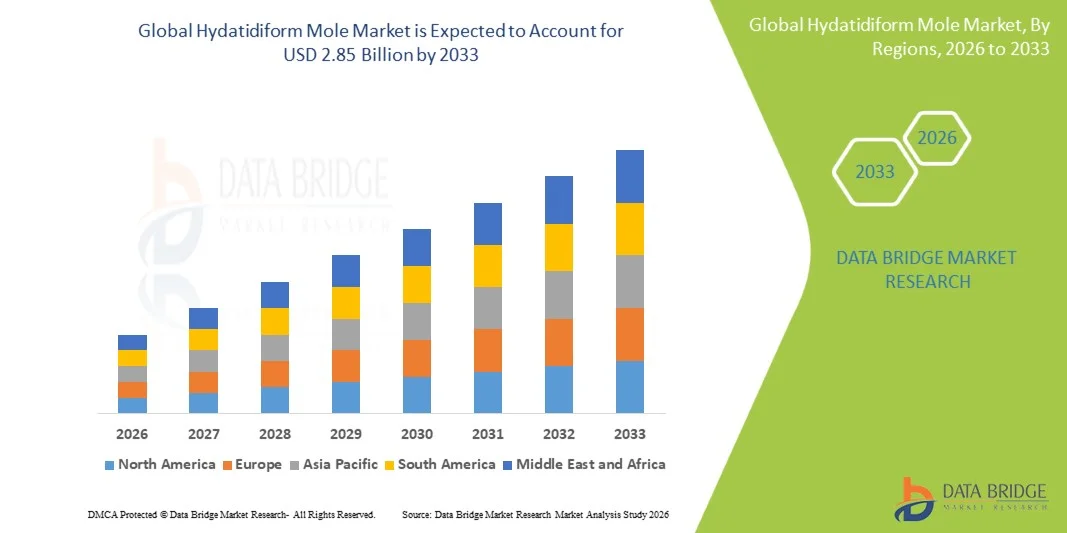
- The global hydatidiform mole market size was valued at USD 1.86 billion in 2025and is expected to reach USD 2.85 billion by 2033, at a CAGR of 5.48% during the forecast period
- The market growth is largely fueled by increasing awareness of pregnancy-related complications and advancements in obstetric imaging and laboratory diagnostics, leading to earlier detection and improved clinical management of Hydatidiform Mole in hospitals and gynecology care settings. Growing emphasis on maternal health screening programs and access to advanced prenatal care is further supporting market expansion
- Furthermore, rising demand for minimally invasive treatment approaches such as suction curettage, along with improved access to follow-up monitoring and beta-hCG testing for disease tracking, is strengthening the adoption of Hydatidiform Mole diagnostic and therapeutic solutions. These converging factors are accelerating the uptake of Hydatidiform Mole management solutions, thereby significantly boosting the industry's growth
Hydatidiform Mole Market Analysis
- Hydatidiform Mole, a gestational trophoblastic disease characterized by abnormal placental growth, is increasingly recognized as an important area within gynecological oncology and maternal healthcare due to rising emphasis on early pregnancy screening, improved ultrasound imaging, and advanced histopathological diagnostics for accurate detection and management
- The escalating demand for Hydatidiform Mole diagnostic and treatment solutions is primarily fueled by increasing awareness of early pregnancy complications, wider adoption of prenatal ultrasound screening, improved access to beta-hCG monitoring, and advancements in minimally invasive uterine evacuation procedures, all of which contribute to better patient outcomes and reduced complication risks
- North America dominated the Hydatidiform Mole market with the largest revenue share of 38.60% in 2025, supported by advanced maternal healthcare infrastructure, strong diagnostic capabilities, high awareness of early pregnancy disorders, and widespread availability of specialized gynecology services, with the U.S. witnessing significant adoption of early screening and follow-up care protocols
- Asia-Pacific is expected to be the fastest growing region in the Hydatidiform Mole market during the forecast period due to improving access to prenatal care, increasing healthcare investments, rising awareness of pregnancy-related disorders, and expanding diagnostic infrastructure across countries such as India, China, and Southeast Asia
- The Surgery segment held the largest market revenue share of 71.5% in 2025, driven by suction evacuation and dilation & curettage (D&C) procedures being the primary and most effective treatment for removing molar tissue
Report Scope and Hydatidiform Mole Market Segmentation
|
Attributes |
Hydatidiform Mole Key Market Insights |
|
Segments Covered |
|
|
Countries Covered |
North America · U.S. · Canada · Mexico Europe · Germany · France · U.K. · Netherlands · Switzerland · Belgium · Russia · Italy · Spain · Turkey · Rest of Europe Asia-Pacific · China · Japan · India · South Korea · Singapore · Malaysia · Australia · Thailand · Indonesia · Philippines · Rest of Asia-Pacific Middle East and Africa · Saudi Arabia · U.A.E. · South Africa · Egypt · Israel · Rest of Middle East and Africa South America · Brazil · Argentina · Rest of South America |
|
Key Market Players |
· F. Hoffmann-La Roche Ltd. (Switzerland) · Novartis AG (Switzerland) · Pfizer Inc. (U.S.) · Merck & Co., Inc. (U.S.) · Sanofi S.A. (France) · Takeda Pharmaceutical Company Limited (Japan) · Johnson & Johnson (U.S.) · AstraZeneca plc (U.K.) · Bristol Myers Squibb (U.S.) · Amgen Inc. (U.S.) · Bayer AG (Germany) · Ipsen S.A. (France) · Teva Pharmaceutical Industries Ltd. (Israel) · Sun Pharmaceutical Industries Ltd. (India) · Dr. Reddy’s Laboratories Ltd. (India) · Viatris Inc. (U.S.) · Eli Lilly and Company (U.S.) · AbbVie Inc. (U.S.) · Novo Nordisk A/S (Denmark) · CSL Behring (Australia) |
|
Market Opportunities |
· Expansion of early pregnancy screening and diagnostic technologies · Rising Demand in Emerging Markets |
|
Value Added Data Infosets |
In addition to the insights on market scenarios such as market value, growth rate, segmentation, geographical coverage, and major players, the market reports curated by the Data Bridge Market Research also include in-depth expert analysis, patient epidemiology, pipeline analysis, pricing analysis, and regulatory framework. |
Hydatidiform Mole Market Trends
“Advancements in Early Detection and Precision Management of Gestational Trophoblastic Diseases”
- A significant and accelerating trend in the global Hydatidiform Mole market is the increasing focus on early diagnosis, improved imaging techniques, and biomarker-based monitoring for gestational trophoblastic diseases. These advancements are improving clinical outcomes by enabling timely detection and reducing the risk of complications such as persistent trophoblastic disease
- For instance, hospitals and diagnostic laboratories are increasingly using high-resolution transvaginal ultrasound along with quantitative beta-hCG testing to detect abnormal placental growth patterns earlier and differentiate Hydatidiform Mole from normal pregnancy conditions
- Advancements in pathology techniques, including improved histopathological examination and molecular genetic testing, are enhancing diagnostic accuracy and classification of complete and partial moles
- Rising adoption of standardized follow-up protocols using serial hCG monitoring is helping clinicians detect recurrence or malignant transformation at an earlier stage, improving patient safety
- Growing research into the molecular mechanisms of trophoblastic proliferation is supporting the development of more targeted therapeutic approaches in gestational trophoblastic disease management
- This trend toward precision diagnosis and structured clinical monitoring is reshaping expectations for maternal healthcare in rare pregnancy-related conditions
Hydatidiform Mole Market Dynamics
Driver
“Rising Incidence of Gestational Complications and Improved Prenatal Screening Awareness”
- Increasing awareness of pregnancy-related complications and expanding access to prenatal screening services are major drivers supporting the growth of the Hydatidiform Mole market. Early detection plays a critical role in preventing severe maternal complications
- For instance, obstetric care centers and maternity hospitals are increasingly incorporating routine ultrasound screening in early pregnancy stages, which helps identify abnormal gestational development patterns associated with Hydatidiform Mole
- Growing maternal age at conception and higher prevalence of risk factors such as prior molar pregnancy and nutritional deficiencies are contributing to increased clinical attention toward early pregnancy abnormalities
- Expansion of maternal healthcare infrastructure and government-led initiatives to reduce maternal morbidity are also improving access to diagnostic and treatment services
- In addition, improved awareness among healthcare providers regarding early pregnancy bleeding and abnormal hCG levels is supporting faster referral and diagnosis rates
Restraint/Challenge
“Diagnostic Complexity, Limited Awareness in Early Pregnancy Care, and Risk of Delayed Intervention”
- Hydatidiform Mole can often present with symptoms similar to normal pregnancy or miscarriage, making early clinical identification challenging without specialized diagnostic tools
- For instance, in primary healthcare or rural settings, early pregnancy bleeding and abdominal discomfort may initially be misinterpreted as spontaneous abortion, delaying referral to specialist obstetric care
- Limited awareness among general practitioners and primary care providers about gestational trophoblastic diseases can contribute to delayed diagnosis and treatment initiation
- Inadequate access to advanced imaging and laboratory testing facilities in low-resource regions further complicates timely and accurate detection
- Addressing these challenges through improved prenatal education, expanded access to diagnostic infrastructure, and strengthened referral pathways will be essential for better disease management and improved patient outcomes
Hydatidiform Mole Market Scope
The market is segmented on the basis of drug type, treatment type, end user, and distribution channel.
- By Drug Type
On the basis of drug type, the Hydatidiform Mole market is segmented into Branded and Generics. The Generics segment dominated the largest market revenue share of 62.3% in 2025, driven by high affordability, wide availability, and strong usage in standard treatment protocols following evacuation procedures and post-molar monitoring care. Generic drugs are widely prescribed for managing post-treatment complications such as infection prevention, hormonal regulation, and supportive therapy. Healthcare systems in emerging economies particularly rely on generics due to cost constraints. Increasing government support for affordable maternal healthcare is further strengthening adoption. Hospitals and clinics prefer generics for routine treatment cycles due to procurement efficiency. Expanding pharmaceutical manufacturing capacity is also supporting supply availability. Rising awareness of early diagnosis and follow-up care increases prescription volumes. Generic formulations ensure accessibility across low- and middle-income regions. Overall, Generics remain the dominant drug type segment in 2025.
The Branded segment is expected to witness the fastest growth rate of 7.9% CAGR from 2026 to 2033, driven by increasing preference for high-quality, clinically validated, and specialized formulations used in complex or high-risk cases. Branded drugs are often associated with better efficacy assurance and stronger regulatory compliance. Rising adoption in private hospitals and specialty gynecology centers is supporting demand. Growing awareness of post-molar malignant transformation risk is encouraging use of premium therapies. Pharmaceutical companies are investing in innovative branded formulations for improved outcomes. Increased healthcare spending in developed regions is further boosting adoption. Physicians often prefer branded drugs for complicated or recurrent cases. Expanding insurance coverage for branded medications also supports growth. Enhanced clinical trust and safety profiles are key drivers. These factors position Branded drugs as the fastest-growing segment.
- By Treatment Type
On the basis of treatment type, the Hydatidiform Mole market is segmented into Surgery, Chemotherapy, and Radiation Therapy. The Surgery segment held the largest market revenue share of 71.5% in 2025, driven by suction evacuation and dilation & curettage (D&C) procedures being the primary and most effective treatment for removing molar tissue. Surgical intervention is the first-line treatment for both complete and partial hydatidiform mole cases. Increasing access to skilled gynecologic surgeons is supporting procedure volumes globally. Hospitals prefer surgical management due to its immediate effectiveness in preventing complications. Rising institutional deliveries and improved maternal healthcare infrastructure are further boosting demand. Early diagnosis through ultrasound screening contributes to timely surgical intervention. Technological advancements in minimally invasive gynecological procedures enhance safety and recovery. Strong clinical guidelines recommending surgery as first-line therapy reinforce dominance. Overall, surgery remains the cornerstone of treatment in this market.
The Chemotherapy segment is expected to witness the fastest growth rate of 9.4% CAGR from 2026 to 2033, driven by increasing cases of persistent gestational trophoblastic disease and malignant transformation of hydatidiform mole. Chemotherapy is widely used in high-risk or metastatic cases requiring systemic treatment. Advancements in targeted chemotherapeutic agents are improving survival outcomes. Rising awareness of follow-up monitoring after molar pregnancy is increasing early detection of complications. Expansion of oncology and gynecologic oncology centers is supporting adoption. Improved treatment protocols and combination therapies are enhancing effectiveness. Growing availability of outpatient chemotherapy services is improving accessibility. Government support for rare gynecologic cancers is also contributing to growth. Increasing clinical research in trophoblastic diseases strengthens treatment innovation. These factors collectively make Chemotherapy the fastest-growing treatment segment.
- By End User
On the basis of end user, the Hydatidiform Mole market is segmented into Hospitals, Specialty Clinics, Diagnostic Centers, and Others. The Hospitals segment accounted for the largest market revenue share of 56.8% in 2025, driven by the need for surgical evacuation procedures, emergency care, and post-treatment monitoring under specialized medical supervision. Hospitals are the primary treatment centers for molar pregnancies due to availability of gynecologists, surgical infrastructure, and diagnostic support. Increasing maternal healthcare admissions are further strengthening demand. Hospitals also manage complications such as bleeding and trophoblastic disease progression. Integrated diagnostic and treatment facilities enhance patient outcomes. Government healthcare programs and insurance coverage support hospital-based care. Expansion of maternity wards and gynecology departments is also boosting growth. Hospitals remain the preferred setting for high-risk pregnancy management. Overall, they continue to dominate the end-user segment.
The Specialty Clinics segment is expected to witness the fastest growth rate of 10.6% CAGR from 2026 to 2033, driven by rising preference for focused gynecological and reproductive health services. Specialty clinics offer advanced diagnostic evaluation, early detection, and personalized follow-up care for hydatidiform mole patients. Increasing awareness of reproductive health disorders is driving outpatient visits. Clinics provide faster access to consultations compared to hospitals. Growth in private healthcare infrastructure is supporting expansion. Improved ultrasound and laboratory facilities in clinics are enhancing diagnostic accuracy. Rising patient preference for outpatient management is boosting demand. Availability of specialist gynecologists in urban areas further supports growth. Teleconsultation services are also increasing accessibility. These factors collectively make Specialty Clinics the fastest-growing end user segment.
- By Distribution Channel
On the basis of distribution channel, the Hydatidiform Mole market is segmented into Hospital Pharmacy, Retail Pharmacy, Online Pharmacies, and Others. The Hospital Pharmacy segment dominated the largest market revenue share of 49.1% in 2025, driven by centralized treatment within hospitals where surgery and post-operative care are conducted. Hospital pharmacies provide essential medications such as chemotherapy drugs, supportive care medicines, and post-surgical antibiotics. Physicians prefer in-house dispensing to ensure proper dosage and monitoring. Increasing hospitalization rates for molar pregnancy management are supporting demand. Integrated treatment pathways strengthen hospital pharmacy utilization. Government healthcare systems also favor institutional drug distribution. Rising maternal healthcare infrastructure expansion is further boosting segment dominance. Strong inventory control and availability of critical drugs enhance efficiency. Overall, hospital pharmacies remain the primary distribution channel.
The Online Pharmacies segment is expected to witness the fastest growth rate of 11.8% CAGR from 2026 to 2033, driven by increasing digital healthcare adoption and demand for convenient access to post-treatment medications and follow-up therapies. Patients are increasingly using e-pharmacy platforms for hormone regulation drugs and recovery-related prescriptions. Growth of telemedicine consultations is boosting e-prescription adoption. Expanding internet penetration and smartphone usage are improving accessibility. Competitive pricing and home delivery services are attracting consumers. Online platforms are especially beneficial for long-term follow-up care. Rising trust in regulated digital pharmacies supports adoption. Improved logistics and cold-chain delivery systems enhance reliability. Increasing awareness of post-molar monitoring further drives usage. These factors make Online Pharmacies the fastest-growing distribution channel segment.
Hydatidiform Mole Market Regional Analysis
- North America dominated the Hydatidiform Mole market with the largest revenue share of 38.60% in 2025, supported by advanced maternal healthcare infrastructure, strong diagnostic capabilities, high awareness of early pregnancy disorders, and widespread availability of specialized gynecology services. The region benefits from well-established prenatal screening programs, rapid access to ultrasound diagnostics, and structured clinical pathways for early detection and management of gestational trophoblastic diseases
- Healthcare providers in the region highly emphasize early diagnosis, timely intervention, and systematic follow-up care to prevent complications associated with Hydatidiform Mole. Increasing use of advanced imaging techniques, serum hCG monitoring, and standardized post-treatment surveillance protocols is further strengthening market growth across hospitals and gynecology clinics
- This widespread adoption is further supported by strong healthcare spending, favorable insurance coverage, and high patient awareness regarding abnormal pregnancy outcomes, establishing North America as a leading region for Hydatidiform Mole diagnosis and management
U.S. Hydatidiform Mole Market Insight
The U.S. Hydatidiform Mole market captured the largest revenue share within North America in 2025, driven by significant adoption of early screening and follow-up care protocols. The country is witnessing increased use of ultrasound imaging, hormonal testing (hCG monitoring), and pathology services for early detection and accurate diagnosis of abnormal pregnancies. Hospitals, fertility centers, and specialized gynecology clinics are increasingly implementing structured management pathways that include early evacuation procedures, post-treatment monitoring, and long-term follow-up to reduce recurrence risk. Growing awareness among clinicians and patients regarding early pregnancy complications is further supporting market expansion in the U.S.
Europe Hydatidiform Mole Market Insight
The Europe Hydatidiform Mole market is projected to expand at a substantial CAGR throughout the forecast period, primarily driven by strong public healthcare systems, increasing access to prenatal diagnostics, and growing awareness of early pregnancy complications. The region is witnessing rising adoption of standardized obstetric screening protocols and improved access to ultrasound-based prenatal monitoring. Expanding focus on maternal health and early intervention strategies is contributing to better detection and management of gestational trophoblastic diseases across Europe.
U.K. Hydatidiform Mole Market Insight
The U.K. Hydatidiform Mole market is anticipated to grow at a noteworthy CAGR during the forecast period, supported by improved access to maternity care through the National Health Service (NHS) and increasing awareness of early pregnancy disorders. Routine prenatal screening programs and rapid referral systems are enhancing early diagnosis rates. Growing use of ultrasound diagnostics and serum hCG testing in obstetric care settings is further supporting timely management and follow-up care in the U.K.
Germany Hydatidiform Mole Market Insight
The Germany Hydatidiform Mole market is expected to expand at a considerable CAGR during the forecast period, fueled by advanced healthcare infrastructure, strong diagnostic capabilities, and well-established gynecological care services. Germany’s focus on precision diagnostics and structured prenatal monitoring supports early detection and effective management of abnormal pregnancies. Integration of imaging technologies with laboratory diagnostics is increasingly improving clinical outcomes in obstetric care.
Asia-Pacific Hydatidiform Mole Market Insight
The Asia-Pacific Hydatidiform Mole market is poised to grow at the fastest CAGR during the forecast period, driven by improving access to prenatal care, increasing healthcare investments, rising awareness of pregnancy-related disorders, and expanding diagnostic infrastructure across countries such as India, China, and Southeast Asia. The region is witnessing rapid growth in maternal healthcare services, ultrasound imaging facilities, and gynecology clinics. Government initiatives aimed at improving maternal health outcomes and expanding rural healthcare access are significantly contributing to market expansion.
Japan Hydatidiform Mole Market Insight
The Japan Hydatidiform Mole market is gaining momentum due to the country’s advanced healthcare system, high adoption of prenatal screening programs, and strong emphasis on maternal health monitoring. Japanese healthcare providers prioritize early ultrasound-based diagnosis and systematic follow-up care for abnormal pregnancies. The use of advanced imaging technologies and structured obstetric care pathways is supporting improved detection and management outcomes.
China Hydatidiform Mole Market Insight
The China Hydatidiform Mole market accounted for the largest market revenue share in Asia Pacific in 2025, attributed to expanding healthcare infrastructure, increasing access to prenatal diagnostics, and rising awareness of pregnancy complications. China is witnessing strong growth in hospital-based prenatal screening programs, ultrasound diagnostics, and gynecology services. Improved healthcare accessibility, along with government focus on maternal health and early diagnosis initiatives, is expected to significantly propel the market in the country.
Hydatidiform Mole Market Share
The Hydatidiform Mole industry is primarily led by well-established companies, including:
- Hoffmann-La Roche Ltd. (Switzerland)
- Novartis AG (Switzerland)
- Pfizer Inc. (U.S.)
- Merck & Co., Inc. (U.S.)
- Sanofi S.A. (France)
- Takeda Pharmaceutical Company Limited (Japan)
- Johnson & Johnson (U.S.)
- AstraZeneca plc (U.K.)
- Bristol Myers Squibb (U.S.)
- Amgen Inc. (U.S.)
- Bayer AG (Germany)
- Ipsen S.A. (France)
- Teva Pharmaceutical Industries Ltd. (Israel)
- Sun Pharmaceutical Industries Ltd. (India)
- Reddy’s Laboratories Ltd. (India)
- Viatris Inc. (U.S.)
- Eli Lilly and Company (U.S.)
- AbbVie Inc. (U.S.)
- Novo Nordisk A/S (Denmark)
- CSL Behring (Australia)
Latest Developments in Global Hydatidiform Mole Market
- In March 2021, the Society of Gynecologic Oncology (SGO) reaffirmed updated clinical guidance on gestational trophoblastic disease, emphasizing standardized use of ultrasound diagnosis followed by suction curettage as the primary treatment for hydatidiform mole, along with structured hCG monitoring protocols to prevent progression to gestational trophoblastic neoplasia
- In October 2021, updated treatment protocols published in major oncology references reinforced the use of methotrexate- and actinomycin-D–based chemotherapy regimens for patients who develop persistent post-molar gestational trophoblastic neoplasia, improving long-term survival rates to nearly 100% in low-risk cases
- In April 2022, the American College of Obstetricians and Gynecologists (ACOG) reinforced clinical practice recommendations for molar pregnancy management, highlighting early ultrasound diagnosis, immediate uterine evacuation, and strict post-evacuation hCG surveillance as standard global care practices
- In November 2022, tertiary care centers specializing in trophoblastic disease (including New England Trophoblastic Disease Center) reported expanded adoption of centralized registry-based monitoring systems for hydatidiform mole patients, improving long-term follow-up compliance and early detection of malignant transformation
- In February 2023, clinical oncology literature reported increasing use of refined ultrasound imaging and serum hCG trend algorithms to differentiate complete and partial hydatidiform mole earlier in pregnancy, allowing faster intervention and reduced complication rates
- In September 2023, global rare disease and gynecologic oncology networks strengthened multidisciplinary management models for hydatidiform mole cases, integrating gynecologic oncologists, pathologists, and reproductive specialists to improve fertility preservation outcomes after treatment
- In May 2024, updated GeneReviews and clinical reference materials on gestational trophoblastic disease emphasized improved molecular pathology techniques and immunohistochemistry use in confirming hydatidiform mole subtypes, enhancing diagnostic accuracy in complex cases
- In July 2024, published surgical reviews highlighted advancements in vacuum aspiration techniques combined with ultrasound guidance for safer and more complete uterine evacuation in hydatidiform mole patients, reducing hemorrhage risk and need for repeat procedures
- In January 2025, global oncology studies reported continued improvement in survival and fertility outcomes for patients treated for hydatidiform mole, driven by standardized hCG monitoring programs and early detection of post-molar gestational trophoblastic neoplasia
- In June 2025, international gynecologic oncology updates emphasized ongoing research into biomarkers beyond hCG for earlier prediction of malignant transformation in hydatidiform mole, supporting future development of more precise diagnostic and follow-up tools
SKU-
Get online access to the report on the World's First Market Intelligence Cloud

- Interactive Data Analysis Dashboard
- Company Analysis Dashboard for high growth potential opportunities
- Research Analyst Access for customization & queries
- Competitor Analysis with Interactive dashboard
- Latest News, Updates & Trend analysis
- Harness the Power of Benchmark Analysis for Comprehensive Competitor Tracking
Research Methodology
Data collection and base year analysis are done using data collection modules with large sample sizes. The stage includes obtaining market information or related data through various sources and strategies. It includes examining and planning all the data acquired from the past in advance. It likewise envelops the examination of information inconsistencies seen across different information sources. The market data is analysed and estimated using market statistical and coherent models. Also, market share analysis and key trend analysis are the major success factors in the market report. To know more, please request an analyst call or drop down your inquiry.
The key research methodology used by DBMR research team is data triangulation which involves data mining, analysis of the impact of data variables on the market and primary (industry expert) validation. Data models include Vendor Positioning Grid, Market Time Line Analysis, Market Overview and Guide, Company Positioning Grid, Patent Analysis, Pricing Analysis, Company Market Share Analysis, Standards of Measurement, Global versus Regional and Vendor Share Analysis. To know more about the research methodology, drop in an inquiry to speak to our industry experts.
Customization Available
Data Bridge Market Research is a leader in advanced formative research. We take pride in servicing our existing and new customers with data and analysis that match and suits their goal. The report can be customized to include price trend analysis of target brands understanding the market for additional countries (ask for the list of countries), clinical trial results data, literature review, refurbished market and product base analysis. Market analysis of target competitors can be analyzed from technology-based analysis to market portfolio strategies. We can add as many competitors that you require data about in the format and data style you are looking for. Our team of analysts can also provide you data in crude raw excel files pivot tables (Fact book) or can assist you in creating presentations from the data sets available in the report.












