


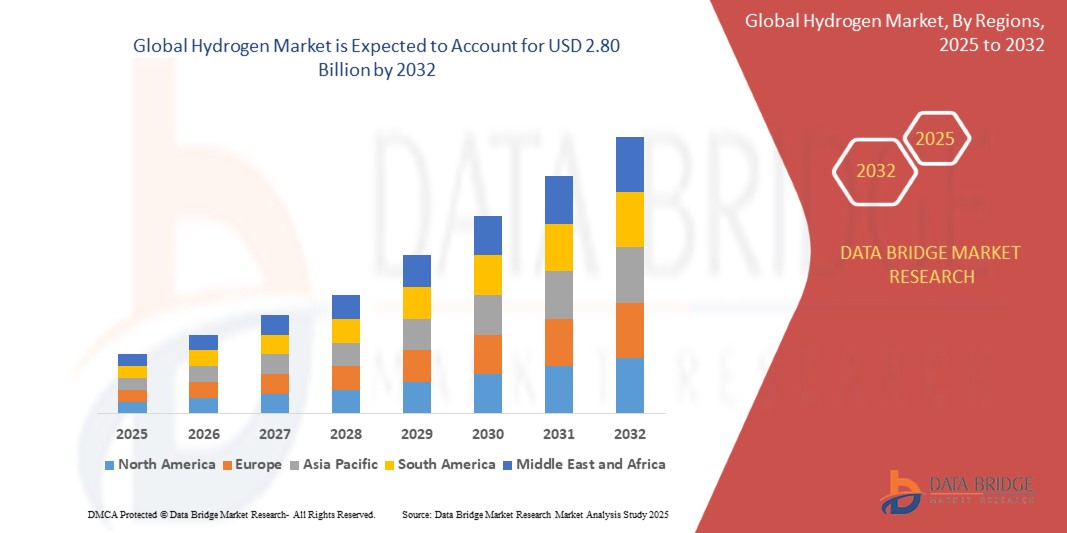
Hydrogen Market Size
- The global ophthalmic operational microscope market was valued at USD 1.44 billion in 2024 and is expected to reach USD 2.80 billion by 2032
- During the forecast period of 2025 to 2032 the market is likely to grow at a CAGR of 8.7%, primarily driven by the increasing demand for clean energy solutions, decarbonization efforts, and technological advancements in hydrogen production
- This growth is driven by factors such as government policies supporting renewable energy, the rise in hydrogen-based applications in industries such as transportation, chemicals, and power generation, and the shift toward sustainable energy solutions
Hydrogen Market Analysis
- Hydrogen is a versatile energy carrier with applications across various sectors, including transportation, industrial processes, power generation, and chemical production. It plays a critical role in decarbonization efforts and the transition to clean energy. Hydrogen is increasingly being used as a fuel for fuel cell vehicles, a feedstock in the production of ammonia and methanol, and a clean energy solution for heavy industries
- The demand for hydrogen is significantly driven by the global push towards reducing carbon emissions, energy transition goals, and advancements in hydrogen production technologies like electrolysis and green hydrogen. The transportation sector, particularly the shift towards hydrogen fuel cell vehicles, is a key growth driver
- Europe and Asia-Pacific stand out as dominant regions for hydrogen production and utilization, with significant investments in infrastructure and technology development. In particular, countries like Germany, Japan, and South Korea are leading the way in hydrogen adoption, supported by government policies and sustainability initiatives
- For instance, Germany's National Hydrogen Strategy, launched in 2020, is a major initiative aimed at making the country a global leader in green hydrogen production, with plans for a large-scale hydrogen infrastructure. Similarly, Japan has been investing heavily in hydrogen-powered vehicles and fuel cell technology, aiming to reduce its reliance on fossil fuels
- Globally, hydrogen is emerging as one of the key pillars in the energy transition, with its potential to decarbonize various sectors. It is expected to play a vital role in achieving net-zero emissions goals, particularly in industries that are hard to electrify, such as steel, chemicals, and heavy-duty transportation
Report Scope and Hydrogen Market Segmentation
|
Attributes |
Hydrogen Key Market Insights |
|
Segments Covered |
|
|
Countries Covered |
North America
Europe
Asia-Pacific
Middle East and Africa
South America
|
|
Key Market Players |
|
|
Market Opportunities |
|
|
Value Added Data Infosets |
In addition to the insights on market scenarios such as market value, growth rate, segmentation, geographical coverage, and major players, the market reports curated by the Data Bridge Market Research also include import export analysis, production capacity overview, production consumption analysis, price trend analysis, climate change scenario, supply chain analysis, value chain analysis, raw material/consumables overview, vendor selection criteria, PESTLE Analysis, Porter Analysis, and regulatory framework. |
Hydrogen Market Trends
“Increased Focus on Green Hydrogen and Infrastructure Development”
- One prominent trend in the global hydrogen market is the growing focus on green hydrogen production and the expansion of hydrogen infrastructure
- Green hydrogen, produced through the electrolysis of water using renewable energy sources, is gaining significant traction as it offers a sustainable and carbon-free solution for industries aiming to decarbonize
- For instance, Europe and Asia-Pacific are investing heavily in large-scale green hydrogen projects, with countries like Germany and Japan leading the way with ambitious targets for hydrogen adoption
- Simultaneously, there is a surge in infrastructure development, such as hydrogen refueling stations and pipelines, to support the growing demand for hydrogen across transportation, industrial, and power generation sectors
- This trend is accelerating the transition to clean energy, driving global efforts to reduce greenhouse gas emissions and diversify energy sources
Hydrogen Market Dynamics
Driver
“Growing Need Due to Increasing Demand for Clean Energy”
- The rising global demand for clean energy solutions and the urgency to reduce carbon emissions is significantly driving the growth of the hydrogen market.
- As governments and industries strive to meet climate targets, hydrogen is gaining traction as a clean energy carrier, particularly in sectors where electrification is challenging, such as heavy-duty transportation, industrial processes, and energy storage
- Hydrogen fuel cells are emerging as a key technology for decarbonizing industries like transportation (e.g., hydrogen-powered trucks, trains, and ships), as they offer a zero-emission alternative to traditional fossil fuels
- The growing shift towards sustainable energy, coupled with technological advancements in hydrogen production methods, is fueling the demand for green hydrogen as a viable, carbon-free energy source
For instance,
- In July 2024, Air Products and Teledyne announced the successful launch of a new hydrogen fueling station in California designed to increase the accessibility of hydrogen-powered vehicles. This development is expected to boost demand for hydrogen infrastructure and fuel cell vehicles
- In March 2023, Shell and ITM Power entered a joint venture to create one of the world's largest green hydrogen hubs in the UK, further advancing the role of green hydrogen in the energy transition
- This increasing focus on decarbonization and green hydrogen is creating significant growth opportunities for the global hydrogen market
Opportunity
“Expanding Hydrogen Adoption Through Green Hydrogen Production”
- The global hydrogen market is presented with a significant opportunity through the growing adoption of green hydrogen production, which is seen as a key solution for decarbonizing hard-to-electrify industries such as steel, chemicals, and heavy-duty transportation
- Green hydrogen, produced using renewable energy sources like wind and solar power, offers an environmentally friendly alternative to conventional hydrogen production methods (such as grey hydrogen from natural gas) and is central to achieving global net-zero emissions goals
- The development of green hydrogen technologies can reduce the cost of production, making hydrogen a more competitive energy source. Governments and industries are increasingly investing in infrastructure and partnerships to scale up green hydrogen production
For instance,
- In March 2024, Hydrogen Energy Supply Chain (HESC), a joint venture between JERA, Shell, and Mitsui announced the successful launch of the world’s first large-scale green hydrogen project in Australia, with plans to export hydrogen to Japan. This project aims to significantly lower hydrogen production costs and provide a reliable, sustainable supply of green hydrogen
- In September 2023, Siemens Energy and Ørsted revealed a strategic partnership to develop the world’s largest offshore wind-powered green hydrogen production plant in the North Sea, which will contribute significantly to Europe’s renewable energy and hydrogen goals
- The continued development of green hydrogen infrastructure and technologies offers a major growth opportunity for the global hydrogen market, positioning it as a key enabler of the energy transition
Restraint/Challenge
“High Production Costs and Infrastructure Investment Hindering Market Growth”
- One of the significant challenges in the global hydrogen market is the high production costs of green hydrogen and the need for substantial infrastructure investments
- Green hydrogen production, which relies on renewable energy sources such as wind and solar, involves high capital expenditures in electrolysis technologies and energy infrastructure, making it more expensive than traditional hydrogen production methods
- The lack of widespread hydrogen infrastructure, such as refueling stations and transportation pipelines, also hinders the ability to scale hydrogen adoption and makes it challenging for industries to transition to hydrogen-based solutions
For instance,
- In August 2023, BloombergNEF reported that the cost of producing green hydrogen is currently three to five times higher than conventional hydrogen, primarily due to the expensive electrolyzers required for water electrolysis. This price gap is a significant barrier to the widespread use of green hydrogen in industries like transportation and power generation
- In February 2024, Air Liquide and Linde discussed the high upfront costs and long payback periods associated with building hydrogen production plants and infrastructure, which pose a challenge for scaling hydrogen as a mainstream energy source
- As a result, the high costs of green hydrogen production and the required infrastructure investments are creating barriers for broader market penetration, particularly in developing regions where budget constraints and access to financing can be limiting factors
Hydrogen Market Scope
The market is segmented on the basis of systems, technology, and application.
|
Segmentation |
Sub-Segmentation |
|
By Systems |
|
|
By Technology |
|
|
By Application |
|
|
By Sector |
|
Hydrogen Market Regional Analysis
“Europe is the Dominant Region in the Hydrogen Market”
- Europe is the dominant region in the global hydrogen market, driven by strong government support, ambitious decarbonization targets, and significant investments in green hydrogen production and infrastructure
- Germany and the Netherlands are leading the charge in Europe due to their advanced hydrogen strategies, significant infrastructure projects, and commitment to achieving net-zero emissions by 2050
- The availability of strong policy frameworks, such as the European Green Deal, and incentives for clean energy projects further bolster the hydrogen market in the region
- Moreover, Europe’s increasing focus on green hydrogen, with plans for large-scale hydrogen hubs and cross-border hydrogen transport pipelines, is enhancing its position as a global leader in hydrogen technology adoption
“Asia-Pacific is Projected to Register the Highest Growth Rate”
- The Asia-Pacific region is projected to register the highest growth rate in the global hydrogen market, driven by rapid industrialization, increasing investments in clean energy, and strong government support for hydrogen adoption
- Countries such as China, India, and Japan are emerging as key markets for hydrogen, due to their significant efforts to reduce carbon emissions and invest in hydrogen infrastructure as part of their energy transition strategies
- Japan is at the forefront of hydrogen adoption, with its Hydrogen Roadmap aiming to become a global leader in hydrogen technology by 2030. The country’s advancements in hydrogen fuel cells for transportation and industry are a key driver for market growth
- China and India, with their rapidly growing industrial sectors and strong focus on sustainable energy solutions, are seeing increased investments in hydrogen production technologies, particularly green hydrogen, as they work to meet their carbon neutrality targets
Hydrogen Market Share
The market competitive landscape provides details by competitor. Details included are company overview, company financials, revenue generated, market potential, investment in research and development, new market initiatives, global presence, production sites and facilities, production capacities, company strengths and weaknesses, product launch, product width and breadth, application dominance. The above data points provided are only related to the companies' focus related to market.
The Major Market Leaders Operating in the Market Are:
- Air Liquide (France)
- Air Products Inc. (U.S.)
- FuelCell Energy (U.S.)
- Cummins Inc. (U.S.)
- Iwatani Corporation (Japan)
- Linde plc (Germany)
- Messer Group (Germany)
- Praxair (U.S.)
- SHOWA DENKO K.K. (Japan)
- TAIYO NIPPON SANSO CORPORATION (Japan)
- Xebec Communications (Canada)
- ALLY HI-TECH CO., LTD. (China)
- Ballard Power Systems (Canada)
- CALORIC (Germany)
- CLAIND srl (Italy)
- Erre Due s.p.a. (Italy)
- HyGear (Netherlands)
- NUVERA FUEL CELLS, LLC (U.S.)
- ProtonOnsite (U.S.)
- Teledyne Technologies Incorporated (U.S.)
Latest Developments in Global Hydrogen Market
- In April 2025, Infinite Green, a green hydrogen company based in Western Australia, collapsed due to financial conflicts and project setbacks, highlighting the challenges of scaling up green hydrogen production
- In April 2025, Rio Tinto joined forces with Voestalpine and Primetals Technologies to develop a hydrogen-based steelmaking plant in Austria, with the goal of eliminating carbon emissions by replacing coal with hydrogen
- In March 2025, German gas company VNG revealed plans to begin test operations of a 30 MW electrolysis plant in Q3 2025. The plant will produce green hydrogen using renewable energy sourced from local wind turbines, contributing to the growing shift toward sustainable hydrogen production in Germany
- In January 2023, Fortescue Metals Group's partner, Plug Power, withdrew from their joint venture to build a hydrogen electrolyser manufacturing plant in Gladstone, Australia, citing economic concerns. Consequently, Fortescue plans to proceed independently, utilizing its own electrolyser technology
- In 2023, Iberdrola initiated over 60 green hydrogen projects across eight countries, including Spain, the USA, Mexico, Brazil, the UK, Portugal, Italy, and Australia. These initiatives aim to promote electrification and decarbonization in sectors such as industry and heavy transport

- Interactive Data Analysis Dashboard
- Company Analysis Dashboard for high growth potential opportunities
- Research Analyst Access for customization & queries
- Competitor Analysis with Interactive dashboard
- Latest News, Updates & Trend analysis
- Harness the Power of Benchmark Analysis for Comprehensive Competitor Tracking
Global Hydrogen Market, Supply Chain Analysis and Ecosystem Framework
To support market growth and help clients navigate the impact of geopolitical shifts, DBMR has integrated in-depth supply chain analysis into its Global Hydrogen Market research reports. This addition empowers clients to respond effectively to global changes affecting their industries. The supply chain analysis section includes detailed insights such as Global Hydrogen Market consumption and production by country, price trend analysis, the impact of tariffs and geopolitical developments, and import and export trends by country and HSN code. It also highlights major suppliers with data on production capacity and company profiles, as well as key importers and exporters. In addition to research, DBMR offers specialized supply chain consulting services backed by over a decade of experience, providing solutions like supplier discovery, supplier risk assessment, price trend analysis, impact evaluation of inflation and trade route changes, and comprehensive market trend analysis.
Data collection and base year analysis are done using data collection modules with large sample sizes. The stage includes obtaining market information or related data through various sources and strategies. It includes examining and planning all the data acquired from the past in advance. It likewise envelops the examination of information inconsistencies seen across different information sources. The market data is analysed and estimated using market statistical and coherent models. Also, market share analysis and key trend analysis are the major success factors in the market report. To know more, please request an analyst call or drop down your inquiry.
The key research methodology used by DBMR research team is data triangulation which involves data mining, analysis of the impact of data variables on the market and primary (industry expert) validation. Data models include Vendor Positioning Grid, Market Time Line Analysis, Market Overview and Guide, Company Positioning Grid, Patent Analysis, Pricing Analysis, Company Market Share Analysis, Standards of Measurement, Global versus Regional and Vendor Share Analysis. To know more about the research methodology, drop in an inquiry to speak to our industry experts.
Data Bridge Market Research is a leader in advanced formative research. We take pride in servicing our existing and new customers with data and analysis that match and suits their goal. The report can be customized to include price trend analysis of target brands understanding the market for additional countries (ask for the list of countries), clinical trial results data, literature review, refurbished market and product base analysis. Market analysis of target competitors can be analyzed from technology-based analysis to market portfolio strategies. We can add as many competitors that you require data about in the format and data style you are looking for. Our team of analysts can also provide you data in crude raw excel files pivot tables (Fact book) or can assist you in creating presentations from the data sets available in the report.













