


Global Hyperlocal Services Market
Market Size in USD Billion
CAGR :
% 
 USD
3,570.98 Billion
USD
13,377.40 Billion
2025
2033
USD
3,570.98 Billion
USD
13,377.40 Billion
2025
2033
 Forecast Period Forecast Period |
2026 –2033 |
 Market Size (Base Year) Market Size (Base Year) |
USD 3,570.98 Billion |
 Market Size (Forecast Year) Market Size (Forecast Year) |
USD 13,377.40 Billion |
 CAGR CAGR |
% |
| Major Markets Players |
|
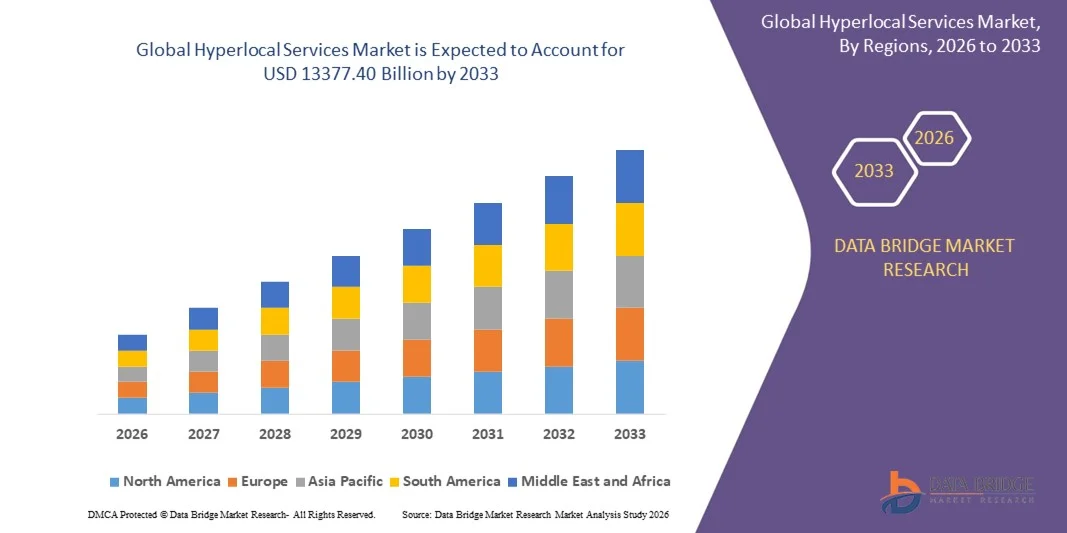
What is the Global Hyperlocal Services Market Size and Growth Rate?
- The global hyperlocal services market size was valued at USD 3570.98 billion in 2025 and is expected to reach USD 13377.40 billion by 2033, at a CAGR of17.95% during the forecast period
- The rise in the penetration of the Internet of Things among the population across the globe acts as one of the major factors driving the growth of the hyperlocal services market
- The increase in smartphone adoption across the emerging regions, in conjunction with enhanced payment gateways and better search options application support, and surge in the investment and funds for the e-commerce business accelerate the market growth
What are the Major Takeaways of Hyperlocal Services Market?
- The rise in the adoption of hyperlocal business by giants who deal in e-commerce for reducing the transportation cost and minimizing the significant delivery time and raise in demand for these services especially due to the pandemic, further influence the market
- In addition, urbanization and digitization, increased disposable income, and change in consumer preference positively affect the hyperlocal services market. Furthermore, technological advancements in the services extend profitable opportunities to the market players
- North America dominated the hyperlocal services market with a 41.58% revenue share in 2025, driven by high penetration of app-based food delivery, grocery ordering, and on-demand home services across the U.S. and Canada
- Asia-Pacific is projected to register the fastest CAGR of 8.9% from 2026 to 2033, driven by rapid urbanization, rising smartphone penetration, expanding middle-class population, and growing reliance on app-based services across China, India, Japan, South Korea, and Southeast Asia
- The Food Ordering segment dominated the market with an estimated 41.6% share in 2025, driven by high-frequency consumer usage, widespread smartphone penetration, and strong urban demand for on-demand meal
Report Scope and Hyperlocal Services Market Segmentation
|
Attributes |
Hyperlocal Services Key Market Insights |
|
Segments Covered |
|
|
Countries Covered |
North America
Europe
Asia-Pacific
Middle East and Africa
South America
|
|
Key Market Players |
|
|
Market Opportunities |
|
|
Value Added Data Infosets |
In addition to the insights on market scenarios such as market value, growth rate, segmentation, geographical coverage, and major players, the market reports curated by the Data Bridge Market Research also include in-depth expert analysis, pricing analysis, brand share analysis, consumer survey, demography analysis, supply chain analysis, value chain analysis, raw material/consumables overview, vendor selection criteria, PESTLE Analysis, Porter Analysis, and regulatory framework. |
What is the Key Trend in the Hyperlocal Services Market?
Increasing Shift Toward App-Based, On-Demand, and Rapid Fulfillment Hyperlocal Services
- The hyperlocal services market is witnessing strong adoption of mobile app–based platforms that enable real-time service discovery, instant booking, and location-based fulfillment for food delivery, grocery, home services, and local logistics
- Service providers are increasingly leveraging AI-driven dispatch systems, GPS tracking, and dynamic pricing models to improve delivery speed, operational efficiency, and customer experience
- Growing demand for quick turnaround times, contactless delivery, and last-mile convenience is accelerating adoption across urban households, working professionals, and small businesses
- For instance, companies such as Swiggy, Instacart, DoorDash, foodpanda, and Urban Company have expanded hyperlocal capabilities through dark stores, micro-fulfillment centers, and real-time order tracking
- Rising consumer preference for same-day and under-30-minute deliveries is pushing platforms to optimize local vendor networks and hyperlocal supply chains
- As urbanization and smartphone penetration increase, Hyperlocal Services will remain critical for fast, flexible, and personalized service delivery
What are the Key Drivers of Hyperlocal Services Market?
- Rising demand for convenient, time-saving, and location-specific services across food delivery, grocery, pharmacy, and home services
- For instance, in 2025, leading platforms such as Instacart, Swiggy, and Delivery Hero expanded hyperlocal fulfillment through AI-based demand forecasting and local partner integration
- Rapid growth of urban populations, dual-income households, and digital payment adoption is fueling demand across the U.S., Europe, and Asia-Pacific
- Advancements in mobile apps, cloud platforms, real-time analytics, and route optimization technologies are enhancing service scalability and profitability
- Increasing penetration of 5G, smartphones, and IoT-enabled logistics is improving delivery accuracy and speed
- Supported by strong investments in digital infrastructure, local commerce digitization, and platform-based ecosystems, the Hyperlocal Services market is expected to witness sustained long-term growth
Which Factor is Challenging the Growth of the Hyperlocal Services Market?
- High operational costs related to last-mile delivery, rider incentives, and logistics infrastructure limit profitability for service providers
- For instance, during 2024–2025, rising fuel costs, labor shortages, and regulatory pressures increased operating expenses for several global hyperlocal platforms
- Managing service quality, delivery consistency, and vendor reliability across dense urban markets remains challenging
- Limited digital literacy and low platform penetration in semi-urban and rural regions restrict market expansion
- Intense competition among platforms leads to pricing pressure, high customer acquisition costs, and low margins
- To overcome these challenges, companies are focusing on automation, subscription models, hyperlocal warehousing, and AI-driven logistics optimization to strengthen long-term growth of Hyperlocal Services
How is the Hyperlocal Services Market Segmented?
The market is segmented on the basis of type and nature.
- By Type
On the basis of type, the hyperlocal services market is segmented into Food Ordering, Grocery Ordering, Home Utility Services Marketplaces, and Logistics Service Providers. The Food Ordering segment dominated the market with an estimated 41.6% share in 2025, driven by high-frequency consumer usage, widespread smartphone penetration, and strong urban demand for on-demand meals. Rapid expansion of restaurant partnerships, cloud kitchens, and quick commerce models has strengthened platform scalability and customer retention. Food ordering platforms benefit from shorter delivery cycles, repeat purchases, and advanced AI-based recommendation systems.
The Grocery Ordering segment is expected to grow at the fastest CAGR from 2026 to 2033, supported by rising adoption of instant grocery delivery, dark stores, and micro-fulfillment centers. Increasing demand for fresh produce, daily essentials, and same-day delivery—especially among working professionals and urban households—is accelerating growth. Investments in cold-chain logistics, predictive demand analytics, and subscription-based grocery models are further enhancing long-term expansion across global hyperlocal ecosystems.
- By Nature
On the basis of nature, the hyperlocal services market is segmented into Goods Delivery and Utility Services. The Goods Delivery segment dominated the market with a 62.3% share in 2025, owing to strong demand for food, groceries, pharmaceuticals, and retail products delivered within short timeframes. Growth is supported by increasing reliance on app-based platforms, digital payments, and optimized last-mile logistics networks. High order volumes, repeat consumption patterns, and scalability across dense urban regions continue to reinforce the dominance of goods delivery services.
The Utility Services segment is projected to grow at the fastest CAGR from 2026 to 2033, driven by rising demand for on-demand home services such as plumbing, electrical repair, appliance servicing, beauty, and wellness. Urbanization, busy lifestyles, and growing preference for verified, app-based professionals are accelerating adoption. Platforms offering standardized pricing, skilled workforce onboarding, and real-time service tracking are expected to drive sustained growth in utility-focused hyperlocal services globally.
Which Region Holds the Largest Share of the Hyperlocal Services Market?
- North America dominated the hyperlocal services market with a 41.58% revenue share in 2025, driven by high penetration of app-based food delivery, grocery ordering, and on-demand home services across the U.S. and Canada. Strong consumer preference for convenience, high disposable incomes, and widespread adoption of digital payments continue to fuel demand for hyperlocal platforms across urban and suburban regions
- Leading players in North America are investing in AI-driven logistics, real-time order tracking, dark stores, and micro-fulfillment centers, strengthening service speed, reliability, and customer experience. Continuous innovation in last-mile delivery and platform optimization supports long-term regional growth
- High smartphone usage, mature e-commerce ecosystems, strong logistics infrastructure, and availability of skilled gig workers further reinforce North America’s leadership in the Hyperlocal Services market
U.S. Hyperlocal Services Market Insight
The U.S. is the largest contributor in North America, supported by strong adoption of food delivery, instant grocery, pharmacy delivery, and on-demand home services. High consumer spending, busy lifestyles, and preference for same-day or under-30-minute deliveries intensify platform usage. Presence of major hyperlocal players, advanced logistics networks, and widespread subscription models drives sustained market expansion.
Canada Hyperlocal Services Market Insight
Canada contributes significantly to regional growth, driven by rising urbanization, increasing digital adoption, and growing demand for grocery delivery and home utility services. Expansion of local vendor partnerships, contactless delivery, and government support for digital commerce strengthens hyperlocal service adoption across major cities.
Asia-Pacific Hyperlocal Services Market
Asia-Pacific is projected to register the fastest CAGR of 8.9% from 2026 to 2033, driven by rapid urbanization, rising smartphone penetration, expanding middle-class population, and growing reliance on app-based services across China, India, Japan, South Korea, and Southeast Asia. Increasing demand for quick commerce, local logistics, and on-demand services is accelerating platform expansion across densely populated cities.
China Hyperlocal Services Market Insight
China leads Asia-Pacific due to massive urban populations, advanced digital payment ecosystems, and strong logistics infrastructure. High demand for food delivery, grocery ordering, and instant commerce supports large-scale adoption of hyperlocal platforms nationwide.
Japan Hyperlocal Services Market Insight
Japan shows steady growth supported by high service quality expectations, advanced urban logistics, and strong demand for grocery delivery and home utility services. Aging population and preference for convenience-driven services reinforce market expansion.
India Hyperlocal Services Market Insight
India is emerging as a high-growth market, driven by rapid urbanization, rising disposable incomes, expanding startup ecosystems, and increasing smartphone penetration. Strong demand for food delivery, grocery, and home services fuels hyperlocal platform adoption.
South Korea Hyperlocal Services Market Insight
South Korea contributes significantly due to tech-savvy consumers, dense urban centers, and advanced digital infrastructure. High demand for fast delivery, subscription services, and AI-driven platforms supports continued market growth.
Which are the Top Companies in Hyperlocal Services Market?
The hyperlocal services industry is primarily led by well-established companies, including:
- foodpanda (Germany)
- Delivery Hero SE (Germany)
- Grubhub (U.S.)
- Grofers India Pvt. Ltd. (India)
- Swiggy (India)
- TinyOwl (India)
- Delivery Club (Russia)
- Instacart (U.S.)
- Olo (U.S.)
- HelloFresh (Germany)
- Porch.com, Inc. (U.S.)
- Zimmber (India)
- Taskbob (India)
- Localoye (India)
- UrbanClap Technologies India Pvt. Ltd. (India)
- DoorMint (India)
What are the Recent Developments in Global Hyperlocal Services Market?
- In May 2024, Uber India intensified its focus on hyperlocal delivery by expanding neighborhood store–based order fulfillment across nine Indian cities, using two-wheelers to collect and deliver items from nearby shops, strengthening last-mile efficiency and faster local commerce access
- In May 2024, Reliance Retail, a subsidiary of Reliance Industries Limited, launched a pilot for instant grocery and FMCG delivery in select areas of Mumbai, leveraging its own stores, warehouses, and JioMart Partner–affiliated local retailers, enhancing rapid fulfillment capabilities within dense urban markets
- In November 2023, UPS, a global shipping and logistics provider, introduced a hyperlocal delivery service offering select customers a rapid next-day delivery option within metropolitan areas, enabling the company to capture higher-margin B2B and B2C volumes through expedited local logistics
- In November 2022, Celcius Logistics, an Indian logistics service provider, launched hyperlocal temperature-controlled delivery services for food and pharmaceutical orders, partnering with Zomato as a preferred cold-chain delivery partner, improving reliability and quality assurance for sensitive deliveries
- In September 2021, Flipkart launched its hyperlocal initiative Flipkart Quick to deliver electronics and groceries within 90 minutes, with plans to scale same-day delivery across 20 Indian cities, accelerating quick-commerce adoption and competitive differentiation
SKU-
Get online access to the report on the World's First Market Intelligence Cloud

- Interactive Data Analysis Dashboard
- Company Analysis Dashboard for high growth potential opportunities
- Research Analyst Access for customization & queries
- Competitor Analysis with Interactive dashboard
- Latest News, Updates & Trend analysis
- Harness the Power of Benchmark Analysis for Comprehensive Competitor Tracking
Research Methodology
Data collection and base year analysis are done using data collection modules with large sample sizes. The stage includes obtaining market information or related data through various sources and strategies. It includes examining and planning all the data acquired from the past in advance. It likewise envelops the examination of information inconsistencies seen across different information sources. The market data is analysed and estimated using market statistical and coherent models. Also, market share analysis and key trend analysis are the major success factors in the market report. To know more, please request an analyst call or drop down your inquiry.
The key research methodology used by DBMR research team is data triangulation which involves data mining, analysis of the impact of data variables on the market and primary (industry expert) validation. Data models include Vendor Positioning Grid, Market Time Line Analysis, Market Overview and Guide, Company Positioning Grid, Patent Analysis, Pricing Analysis, Company Market Share Analysis, Standards of Measurement, Global versus Regional and Vendor Share Analysis. To know more about the research methodology, drop in an inquiry to speak to our industry experts.
Customization Available
Data Bridge Market Research is a leader in advanced formative research. We take pride in servicing our existing and new customers with data and analysis that match and suits their goal. The report can be customized to include price trend analysis of target brands understanding the market for additional countries (ask for the list of countries), clinical trial results data, literature review, refurbished market and product base analysis. Market analysis of target competitors can be analyzed from technology-based analysis to market portfolio strategies. We can add as many competitors that you require data about in the format and data style you are looking for. Our team of analysts can also provide you data in crude raw excel files pivot tables (Fact book) or can assist you in creating presentations from the data sets available in the report.












